Showing posts with label Fairy Tale. Show all posts

Wednesday, 5 October 2022

Ivey, Eowyn "The Snow Child"


Ivey, Eowyn "The Snow Child" - 2012

I'm not a fantasy fan but I like magic realism and I like fairy tales. Some people will claim that is the same but I know real fantasy fans will agree. Now, this was a mixture between magic realism and fairy tale, it is based on an old Russian fairy tale but takes place in Alaska in the 1920s.

It is difficult to explain without giving too much away but the book description already says a lot. I liked the old couple and I loved the young girl. I liked the interaction between them and I also enjoyed the descriptions of the nature and the hard work people had to endure in order to make a living.

A great story about what could have been.

Book Description:

"Alaska, 1920: a brutal place to homestead, and especially tough for recent arrivals Jack and Mabel. Childless, they are drifting apart - he breaking under the weight of the work of the farm; she crumbling from loneliness and despair. In a moment of levity during the season's first snowfall, they build a child out of snow. The next morning the snow child is gone - but they glimpse a young, blonde-haired girl running through the trees."

Eowyn Ivey was a finalist for the Pulitzer Prize for "The Snow Child" in 2013.

Wednesday, 24 November 2021

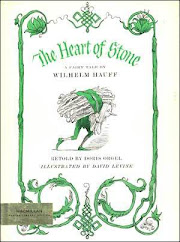
Hauff, Wilhelm "The Heart of Stone"

Hauff, Wilhelm "The Heart of Stone" aka The Cold Heart or the Marble Heart) (German: Das kalte Herz) - 1837

I was reminiscing about books from my youth and school years and noticed that I never reviewed one of my favourite novels we read in school.

This story is from the first half of the 19th century and even though we live in different times now, the message of the book still applies. We need empathy and feelings in our lives, otherwise it is completely meaningless.

Wilhelm Hauff's fairy tales cannot be compared to those by the Brothers Grimm, they have a very dark streak.

Peter Munk is a woodsman in the Black Forest. He lives with his mother and produces and charcoal. He falls in love with a village girl but since he is poor, he can't marry her. Because he was born on a Sunday, he can ask the forest spirits to help him. First, he turns the small "Glasmännlein" (little glass man). He first wishes for wealth but he loses all his money. Then he asks the dark forest spirit, "Holländer-Michel" (Dutch Michel). He also grants him wealth but wants his heart which he replaces with a stone as he has done with all the rich villagers before him.

From the back cover (translated):

"'The Cold Heart' is a Black Forest fairy tale in which the poet describes the fate of the Sunday child Peter Munk. After serious mistakes, Peter Munk's fate is finally brought to a happy end by the friendly elemental spirit of the little glass man. "

Remark by Goodreads:

"This work has been selected by scholars as being culturally important and is part of the knowledge base of civilization as we know it.

Scholars believe, and we concur, that this work is important enough to be preserved, reproduced, and made generally available to the public.
"

Thursday, 13 April 2017

Pinkola Estés, Clarissa "Women Who Run With the Wolves"

Pinkola Estés, Clarissa "Women Who Run With the Wolves: Myths and Stories of the Wild Woman Archetype" - 1992

The latest book that was suggested by Emma Watson from the Goodreads group "Our Shared Shelf". There have been good and bad books, in my opinion, in this group. This is one of the better ones. Dr. Pinkola Estés talks about myths about the Wild Woman, she tells us fairy tales, folk sagas, anything that has to do with women standing on their own feet, defending themselves and their offspring and explains the symbolism behind it. Highly interesting.

The author explains so much about the human being so that this book should not just be read by women, also a great selection for men who would like to understand women better. You can tell this is written by a professional who knows everything about the human psyche, has studied it for a long time and always tries to look at every aspect of every story. Dr. Pinkola Estés is a Jungian analyst and even if you have never heard of Jung, she explains everything very detailed so that anyone can follow her stories and her analysis.

I have read a lot of fairy tales and there were quite a few stories that I heard in a similar version but every story the author retold was like new to me the way she explained them.

I borrowed this book from the library but might want to buy it for myself to read it again some other time. That's how good it was. And encouraging book that teaches us a lot about ourselves.

From the back cover:

"Within every woman there is a wild and natural creature, a powerful force, filled with good instincts, passionate creativity, and ageless knowing. Her name is Wild Woman, but she is an endangered species. Though the gifts of wildish nature come to us at birth, society's attempt to 'civilize' us into rigid roles has plundered this treasure, and muffled the deep, life-giving messages of our own souls. Without Wild Woman, we become over-domesticated, fearful, uncreative, trapped. Clarissa Pinkola Estes, Ph.D., Jungian analyst and cantadora storyteller, shows how woman's vitality can be restored through what she calls 'psychic archeological digs' into the bins of the female unconscious. In Women Who Run with the Wolves, Dr. Estes uses multicultural myths, fairy tales, folk tales, and stories chosen from over twenty years of research that help women reconnect with the healthy, instinctual, visionary attributes of the Wild Woman archetype. Dr. Estes collects the bones of many stories, looking for the archetypal motifs that set a woman's inner life into motion. 'La Loba' teaches about the transformative function of the psyche. In 'Bluebeard,' we learn what to do with wounds that will not heal; in 'Skeleton Woman,' we glimpse the mystical power of relationship and how dead feelings can be revived; 'Vasalisa the Wise' brings our lost womanly instincts to the surface again; 'The Handless Maiden' recovers the Wild Woman initiation rites; and 'The Little Match Girl' warns against the insidious dangers of a life spent in fantasy. In these and other stories, we focus on the many qualities of Wild Woman. We retrieve, examine, love, and understand her, and hold her against our deep psyches as one whois both magic and medicine. In Women Who Run with the Wolves, Dr. Estes has created a new lexicon for describing the female psyche. Fertile and lifegiving, it is a psychology of women in the truest sense, a knowing of the soul."

Monday, 25 July 2016

Sendak, Maurice "Where The Wild Things Are"

Sendak, Maurice "Where The Wild Things Are" - 1963

I think everyone born after the year 1960 must have had this book read to them when they were little. At least those in the English speaking world. Even though it has been translated into several languages in the meantime, I don't think it was around when I was little.

Anyway, the story reminds me a lot of the fairy tales we used to listen to and read when we were little. I loved them all but never became a fantasy fan. But this story is different, it IS a fairy tale, even though it wasn't written at the times of the Brothers Grimm.

Definitely a classic that is still worth picking up.

According to Wikipedia, "in a 2012 survey of School Library Journal readers, it was voted the number one picture book - and not for the first time."

From the back cover:

"One night Max puts on his wolf suit and makes mischief of one kind and another, so his mother calls him 'Wild Thing' and sends him to bed without his supper. That night a forest begins to grow in Max's room and an ocean rushes by with a boat to take Max to the place where the wild things are. Max tames the wild things and crowns himself as their king, and then the wild rumpus begins. But when Max has sent the monsters to bed, and everything is quiet, he starts to feel lonely and realises it is time to sail home to the place where someone loves him best of all."

See more comments on my ThrowbackThursday post in 2026.

Wednesday, 4 May 2016

Grimm, Jacob und Wilhelm "Jorinda and Joringel"

Grimm, Jacob und Wilhelm "Jorinda and Joringel. Eight Fairy Tales" (German: Jorinde und Joringel. Acht Märchen der Brüder Grimm) - 1812

I used to love fairy tales when I was a child. We didn't have many books in the house, especially not children's books but we did have some fairy tale books.

A while ago, I found this little gem of a book with a few fairy tales in there, eight altogether. The title story "Jorinda and Joringel" used to be one of my favourite ones, a girl - Jorinda - is turned into a bird by a wicked witch and her lover - Joringel - has to find a way to get her back. You can find the whole story here.

The other fairy tales included in this booklet are:

The Tailor in Heaven (Der Schneider im Himmel)

The Pack of Scoundrels (Das Lumpengesindel)

The Six Swans (Die sechs Schwäne)

The Goose-Girl (Die Gänsemagd)

The Story of a Clever Tailor (Vom klugen Schneiderlein)

The Star Talers (Die Sterntaler)

The Gifts of the Little People (Die Geschenke des kleinen Volkes)

I especially like "The Six Swans" and "The Goose-Girl" from this selection.

Find more translations of Grimm's Fairy Tales here.

Funnily, my love for fairy tales in my early years has not translated into a love for fantasy novels. Don't know why but that's just what it is.

Tuesday, 11 February 2014

Trivizas, Eugene "The Three Little Wolves and The Big Bad Pig"

Trivizas, Eugene "The Three Little Wolves and The Big Bad Pig" - 1997

If you have read and enjoyed "The True Story of the Three Little Pigs" by Jon Scieszka with your kids, you definitely should try this book, as well.

As the title already suggests, the wolves are little and the pig is bad, so the whole story is just the opposite from the usual fairy tale. It shows kids how every story can have two sides and how you can understand every story differently.

The start is the same, the wolves want to buy a good house and the pig destroys them. Only, the wolves are clever and build their houses from bricks and concrete but the pig comes with a sledgehammer and dynamite. Only when they build a house form flowers and the pig smells the lovely smell, does he stop pursuing them.

We could also say, this is a "Make Love Not War" story for children, showing them that being nice to each other is better than fighting.

See more comments on my ThrowbackThursday post in 2025.

From the back cover:

"When it comes time for the three little wolves to go out into the world and build themselves a house, their mother warns them to beware the big bad pig. But the little wolves' increasingly sturdy dwellings are no match for the persistent porker, who has more up his sleeve than huffing and puffing. It takes a chance encounter with a flamingo pushing a wheelbarrow full of flowers to provide a surprising and satisfying solution to the little wolves' housing crisis. 

Eugene Trivizas's hilarious text and Helen Oxenbury's enchanting watercolors have made this delightfully skewed version of the traditional tale a contemporary classic.
"

Wednesday, 20 November 2013

Scieszka, Jon; Smith, Lane "The True Story of the Three Little Pigs"

Scieszka, Jon; Smith, Lane "The True Story of the Three Little Pigs" - 1989

This is the true story of the "Three Little Pigs and the Big Bad Wolf" as retold by Alexander T. Wolf. Or is it "The Three Bad Pigs and the Nice Little Wolf"?

In any case, the story is hilarious, for children and adults alike. It is not just that the well known story has been turned around and the wolf is the innocent one in this scenario, there are so many aspects to the story that can be discussed with children of all ages whether they are still too little to read it themselves or are older than the kids who usually read fairy tales and picture books.

The wolf insists he only wanted to borrow sugar to make a cake for his grandmother's birthday. Poor wolf. It's not his fault he likes to eat pork.

The illustrations are also wonderful. A great book all around.

See more comments on my ThrowbackThursday post in 2025.

From the back cover:

"A spoof on the three little pigs story, this time told from the wolf's point of view. Lane Smith also illustrated Hallowe'en ABC which was one of The New York Times Best Illustrated Books of the Year."

Wednesday, 23 January 2013

Wilde, Oscar "The Nightingale and the Rose

Wilde, Oscar "The Nightingale and the Rose. Short Stories" - 1891

I'm not a big fan of short stories. I'm also not a big fan of reading plays. But - I am a big fan of Oscar Wilde, so I couldn't resist reading this.

"She said that she would dance with me if I brought her red roses," cried the young Student; "but in all my garden there is no red rose."

That's how this little story begins. A Nightingale hears this and helps the student to find the rose. The story does not end how we might like but short stories seldom do. They have a message they want to send in just a few pages. And Oscar Wilde, being the perfect writer he was, manages this perfectly.

I read this in a collection of short stories by Oscar Wilde and the other ones were also quite good.

From the back cover:

"An allegorical fable of love, sacrifice and selfishness. As with all of Wilde's short stories it embodies strong moral values and is told with an effervescence akin to that of the 1001 nights.

It is the tale of a lovestruck student who must provide his lover with a red rose in order to win her heart. A nightingale overhearing his lament from a solitary oak tree is filled with sorrow and admiration all at once, and decides to help the poor young man.

She journeys through the night seeking the perfect red rose and finally comes across a rambling rose bush but alas, the bush has no roses to offer her. However, there is a way to MAKE a red rose, but with grave consequences.
"

Other works by Oscar Wilde here.

Wednesday, 7 November 2012

Brumbeau, Jeff/de Marcken, Gail "The Quiltmaker’s Gift"

Brumbeau, Jeff/de Marcken, Gail "The Quiltmaker’s Gift" - 2001

Beautiful book with great illustrations about the most beautiful quilts ever. I bought this book for my children who were not as interested in it than I was, after all, they are boys. However, they did like the story of the king who ahd everything but the one thing he really wanted. A quilt from the quiltmaker who would only donate one of the most beautiful quilts you have ever seen to people who have nothing. This puts the king in quite a dilemma and we can follow him as he changes his heart by admiring all the beautiful quilts the quiltmaker makes.

There is also a book with quilts that were made after the illustrations in this book "Quilts From The Quiltmaker's Gift" by Joanne Larsen Line and Nancy Loving Tubesing.

Whether you have children or not, you might want to have a look at either of these books if you love quilts.

See more comments on my ThrowbackThursday post in 2025.

From the back cover:

"When a generous quiltmaker finally agrees to make a quilt for a greedy king, but only under certain conditions, she causes him to undergo a change of heart. Each page highlights a different quilt block pattern whose name relates to the unfolding story."