Showing posts with label TBR Pile. Show all posts

Wednesday, 30 September 2026

Ghosh, Amitav "The Hungry Tide"


Ghosh, Amitav "The Hungry Tide" - 2004

I have read a few books by Amitav Ghosh (see here) and loved them all. So, I was looking forward to this one. It is also great, just not as great as the others.

Maybe there was too much biology in the book to my liking. 

I did like the history of the settlers in the Bay of Bengals and all the problems they encountered. And of the hospital that was started by an immigrant. I could have done without the whole dolpin story.

But that won't keep me from reading another book by Amitav Ghosh. If you have a favourite, please, let me know.

I also loved that they had a map in the book. However, it only shows the real life places, I would have loved an indication as to where the fictitious ones were.

From the back cover:

"From the author of the international bestseller The Glass Palace, The Hungry Tide is a novel of adventure and romance set in the exotic Sundarbans -- treacherous islands in the Bay of Bengal where isolated inhabitants live in fear of drowning tides and man-eating tigers. A headstrong young American arrives in this lush landscape to study a rare species of river dolphin. She enlists the aid of a local fisherman and a translator, and soon their fates on the waterways will be determined by the forces of nature and human folly."

Tuesday, 4 August 2026

Weir, Andy "Project Hail Mary"

Weir, Andy "Project Hail Mary" - 2021

I learned with this book that there is such a thing as hard science fiction. *) I am not a sci-fi fan but I do like this kind of description. And it is true, this one definitely falls under that category. All his descriptions are logical. The author even manages to describe physical explanations in a way that I understand it. Physics was not my favourite subject at school and I have not expanded the knowledge I gained there, so I learned a lot from this book.

But even if you're not into those explanations at all, you can just enjoy the story as it is.

And enjoy I did it. 

I had loved The Martian and therefore bought this novel a while ago. But with my large TBR pile, it took me a while to tackle this. I had talked to my son about The Martian and given my copy to him. He liked it and then mentioned that he would like this one for his upcoming birthday. Since I already had it, I told him not to worry, I'd read this one and then he would get my copy.

I am glad I did. I thoroughly enjoyed the excursion, the attempt to save the Earth. But this book is also full of humour and compassion. 

I can't tell too much about the content because it would involve too many spoilers but ask me, if you have any questions.

*) Hard science fiction is a category of science fiction characterized by concern for scientific accuracy and logic. (Wikipedia)

Book Description:

"Ryland Grace is the sole survivor on a desperate, last-chance mission—and if he fails, humanity and the earth itself will perish.

Except that right now, he doesn’t know that. He can’t even remember his own name, let alone the nature of his assignment or how to complete it.

All he knows is that he’s been asleep for a very, very long time. And he’s just been awakened to find himself millions of miles from home, with nothing but two corpses for company.

His crewmates dead, his memories fuzzily returning, Ryland realizes that an impossible task now confronts him. Hurtling through space on this tiny ship, it’s up to him to puzzle out an impossible scientific mystery—and conquer an extinction-level threat to our species.

And with the clock ticking down and the nearest human being light-years away, he’s got to do it all alone.

Or does he?"

Monday, 22 June 2026

Cela, Camilo José "The Hive"

Cela, Camilo José "The Hive" (Spanish: La colmena) - 1951
The Classicics Spin chose #9 from our list this month. Great, I thought, a Nobel Prize winner. Two birds with one stone.

Often, I find a new favourite author when I read a Nobel Prize winner. Was that the same this time? I don't think so. The book was alright but nothing too special. Apparently, this was his best, his most important novel.

It was a bit too much of a jumble for me. In German, we have a good word for that, "Kuddelmuddel". There were too many short stories that somehow had a connection but the break between one and the next was so large that you often didn't even remember who he was talking about. Yes, he wanted to show how much life in Spain during the Franco regime resembled a beehive. Unfortunately, he succeeded all too well in that.

Funnily enough, he mentions a book that has been published by F. Sempere & Co. in Valencia. I don't think he has any relation to the one in Carlos Ruiz Zafon's "Cemetery of Forgotten Books" series but I've been speculating whether it is or is not a coincidence. Now, Ruiz Zafón was a great Spanish author, one of my favourites.

Anyway, the story was distorted, the characters not very amiable, the whole book didn't give us a way to see into the lives. What a pity.

This appears on the cover of my book (translated):

"The morning rises ever so gradually. It crawls like a caterpillar across the hearts of the city’s men and women. Almost coaxingly, it taps against half-awakened gazes—gazes that never discover new horizons, new landscapes, or new settings. The morning—this eternally recurring morning—plays a little, seeking to alter the face of the city. It is a grave, a climbing pole, a beehive."

And this is the book description I found on the internet:

"The Hive presents a panoramic view of the degradation and sufferings of the lower-middle class in post-civil war Spain. Readers are introduced to over a hundred characters through a series of starkly rendered interlocking vignettes. Filled with violence, hunger, and compassion, The Hive captures the buzzing ambitions and set-backs of Spanish society under the rule of Franco."

Camilo José Cela received the Nobel Prize for Literature in 1989 "for a rich and intensive prose, which with restrained compassion forms a challenging vision of man's vulnerability."

I contribute to this page: Read the Nobels and you can find all my blogs about Nobel Prize winning authors and their books here.

Here are all the books on my original Classics Club list.
And here is a list of all the books I read with the Classics Spin.

Thursday, 18 June 2026

Frazier, Charles "The Trackers" - 2023

Frazier, Charles "The Trackers" - 2023

I love Charles Frazier. I have read four of his books, "Cold Mountain" is still one of my favourite books ever, I've read it several times. But if I had to list his stories, this one would come last. It was an alright read because he is a good writer but the story is nothing compared to his other books. You can always imagine being right there with the characters. Only, I didn't really like any of them. That makes it harder to connect to them, harder to like the book. And it didn't really grab my attention, the story was too slow.

Just one quote that I really liked and by which I live (my friends will certainly back me up there): "First rule of hosting, excess is always preferable to shortage."

From the back cover:

"Hurtling past the downtrodden communities of Depression-era America, painter Val Welch travels westward to the rural town of Dawes, Wyoming. Through a stroke of luck, he's landed a New Deal assignment to create a mural representing the region for their new Post Office.

A wealthy art lover named John Long and his wife Eve have agreed to host Val at their sprawling ranch. Rumors and intrigue surround the couple: Eve left behind an itinerant life riding the rails and singing in a western swing band. Long holds shady political aspirations, but was once a WWI sniper--and his right hand is a mysterious elder cowboy, a vestige of the violent old west. Val quickly finds himself entranced by their lives.

One day, Eve flees home with a valuable painting in tow, and Long recruits Val to hit the road with a mission of tracking her down. Journeying from ramshackle Hoovervilles to San Francisco nightclubs to the swamps of Florida, Val's search for Eve narrows, and he soon turns up secrets that could spark formidable changes for all of them.

In The Trackers, singular American writer Charles Frazier conjures up the lives of everyday people during an extraordinary period of history that bears uncanny resemblance to our own. With the keen perceptions of humanity and transcendent storytelling that have made him beloved for decades, Frazier has created a powerful and timeless new classic."

Monday, 15 June 2026

Jeffers, Honorée Fanonne "The Love Songs of W.E.B. Du Bois"

Jeffers, Honorée Fanonne "The Love Songs of W.E.B. Du Bois" - 2021

This is such a beautiful book. Don't let yourself get scared by the 800+ pages, they are totally worth it. Barack Obama has it on his reading list. It's an Oprah book and it has been chosen by various other reading lists/awards. Definitely a good recommendation on all accounts.

W.E.B. Du Bois, the guy in the tile, was an American sociologist, writer, historian, and Pan-Africanist civil rights activist who lived from 1868 to 1963 and was the first African American to earn a doctorate at Harvard University. This book mentions him a lot. I have read his book "The Souls of Black Folk" which is a very thorough study of black culture in the United States. This novel adds to that subject.

The story circles around Ailey Pearl Garfield, a black girl born in 1973, and all her ancestors, going back to the first known ones in the 1740s. She has both black and Native American ancestors and there is a lot about their history. She has to struggle through all the problems many women but especially black women have to overcome. She is a strong woman but many obstacles are thrown in her way. And we learn how her ancestors, especially the women managed.

The only criticism I have has nothing to do with the story or the book. There is a family tree at the beginning but it is sometimes quite confusing. Either a diagram or some numbers as to who belongs to whom would have been helpful. The way it is presented, there is too much searching involved if you want to know more. If you are still reading it, there is a diagram on Wikipedia.

But other than that, book was just fantastic, epic.

From the back cover:

"A magisterial epic—an intimate yet sweeping novel with all the luminescence and force of Homegoing; Sing, Unburied, Sing; and The Water Dancer—that chronicles the journey of one American family, from the centuries of the colonial slave trade through the Civil War to our own tumultuous era.

The great scholar, W. E. B. Du Bois, once wrote about the Problem of race in America, and what he called 'Double Consciousness,' a sensitivity that every African American possesses in order to survive. Since childhood, Ailey Pearl Garfield has understood Du Bois’s words all too well. Bearing the names of two formidable Black Americans—the revered choreographer Alvin Ailey and her great grandmother Pearl, the descendant of enslaved Georgians and tenant farmers—Ailey carries Du Bois’s Problem on her shoulders.

Ailey is reared in the north in the City but spends summers in the small Georgia town of Chicasetta, where her mother’s family has lived since their ancestors arrived from Africa in bondage. From an early age, Ailey fights a battle for belonging that’s made all the more difficult by a hovering trauma, as well as the whispers of women—her mother, Belle, her sister, Lydia, and a maternal line reaching back two centuries—that urge Ailey to succeed in their stead.

To come to terms with her own identity, Ailey embarks on a journey through her family’s past, uncovering the shocking tales of generations of ancestors—Indigenous, Black, and white—in the deep South. In doing so Ailey must learn to embrace her full heritage, a legacy of oppression and resistance, bondage and independence, cruelty and resilience that is the story—and the song—of America itself."

Monday, 22 December 2025

O'Farrell, Maggie "Hamnet"

O'Farrell, Maggie "Hamnet" - 2020

Somebody talked to me about this book. Someone who likes Maggie O'Farrell. I have a vague recollection of who it was but I can't find it again. So, maybe it was someone else. Sorry, whoever you are.

Anyway, it was nice to read about a part of Shakespeare's life that is not so well known. We know that his son died young. That his name was Hamnet and that his father wrote a play called Hamlet. As to the book, the spelling of the name is interchangeable, so it is more or less the same. I mean, Shakespeare himself had about 27 varieties of is last name. Or something like that.

The author mentions that this is a piece of fiction based on only the few facts I mentioned above. So, she lets us know her imagination and we can add to that.

But I still learned about Shakespeare and especially his wife, Anne Hathaway, who is called Agnes in the novel. Because I like to search for more information elsewhere whenever I read a book. Sometimes, you need a starter for that.

And what was also excellent is the description of the grief parents go through when losing a child. That was heartbreaking.

Maggie O'Farrell received several prizes for this book, i.a. the Women's Prize for Fiction 2020.

We discussed this book in our local book club in April 2026.

A few comments from our book club members:

  • Shakespeare's life in London wasn't given enough attention.
  • How is it that such a strong woman suffers so much from the death of her child?
  • We liked the way the transmission of the plague was described.

From the back cover:

"On a summer's day in 1596, a young girl in Stratford-upon-Avon takes to her bed with a fever. Her twin brother, Hamnet, searches everywhere for help. Why is nobody at home?

Their mother, Agnes, is over a mile away, in the garden where she grows medicinal herbs. Their father is working in London.

Neither parent knows that one of the children will not survive the week.

Hamnet is a novel inspired by the son of a famous playwright. It is a story of the bond between twins, and of a marriage pushed to the brink by grief. It is also the story of a kestrel and its mistress; flea that boards a ship in Alexandria; and a glovemaker's son who flouts convention in pursuit of the woman he loves. Above all, it is a tender and unforgettable reimagining of a boy whose life has been all but forgotten, but whose name was given to one of the most celebrated plays ever written."

Monday, 8 December 2025

Goethe, Johann Wolfgang von "Faust"

Goethe, Johann Wolfgang von "Urfaust. Faust: Erster und zweiter Teil" (German: Faust I + II) - 1772-1808

After reading "The Sound and the Fury" for our classics spin challenge, I thought I will never get through Faust in time if that gets chosen, so I started it right away.

The story is said to be the greatest work of German literature and I can well believe that. 250 years have passed in the meantime but I don't believe that there has been a single book that is as well-known around the world than this.

Even though my edition had more than a thousand pages, I got through it faster than I thought. I mentioned it a lot of times, I am no fan of reading plays, it's not so easy to follow through. However, I didn't find this too bad. Maybe because, growing up in Germany, I've come across descriptions and fragments of the story before. And I found a lot of aphorisms, metaphors, symbols and sayings that we use in German often, quite often. Goethe is our Shakespeare, he has moulded the language more than anyone.

The story itself, well, what can I say? It shows the view of women at the time, of the religion and beliefs of people. The morale of the time is depicted just as well as the internal struggles of the protagonist. And even for non-Germans, the play shows so much of people that would be valid anywhere.

My edition didn't just have the Faust that we know today but also the Urfaust, his early work. It shows all versions in parallel which helps in seeing what he changed and what he added. Totally interesting.

I can well believe that Goethe needed about sixty years to write the whole tale, starting with the Gretchen story and then passing on to Helena. Part I was first published as "Faust. A Tragedy".

All in all, I am really happy I finally read this.

Book Description:

"Goethe's Faust is a classic of European literature. Based on the fable of the man who traded his soul for superhuman powers and knowledge, it became the life's work of Germany's greatest poet. Beginning with an intriguing wager between God and Satan, it charts the life of a deeply flawed individual, his struggle against the nihilism of his diabolical companion Mephistopheles.

Part One presents Faust's pact with the Devil and the harrowing tragedy of his love affair with the young Gretchen. Part Two shows Faust's experience in the world of public affairs, including his encounter with Helen of Troy, the emblem of classical beauty and culture. The whole is a symbolic and panoramic commentary on the human condition and on modern European history and civilisation.

This new translation of both parts of Faust preserves the poetic character of the original, its tragic pathos and hilarious comedy. In addition, John Williams has translated the Urfaust, a fascinating glimpse into the young Goethe's imagination, and a selection from the draft scenarios for the Walpurgis Night witches' sabbath - material so ribald and blasphemous that Goethe did not dare publish it."

Monday, 17 November 2025

Faulkner, William "The Sound and the Fury"

Faulkner, William "The Sound and the Fury" - 1929

For the Classics Spin #42, we received #17 and this was my novel. When I revealed this to the other bloggers, I got a lot of comments that people did not like the book at all. But I was determined to like it. After all, I loved "Light in August" by the same author.

However, this is not comparable to the first of his books that I read. I think I agree with most of the other readers.

But let's get to the book.

In one of the reviews (see here), I read "I appreciated the writer's skill a lot more than I enjoyed reading the novel." I think that hits the nail on its head. Another one compared it with "Look Homeward, Angel" which I could also agree on. Another Southern US writer whom you might only want to follow, if you are a Southerner yourself.

I'm sure you guessed it, this wasn't my favourite book of the year. But I appreciated having read it.

They mention "Ulysses" in the description. As you can see, I read that and said at the time "this is the most difficult book I have ever read". It still belongs on that list but I understood that better than this one. I also said "the longer I distance myself from this novel, the more it makes sense and the bigger an impact does it have on me." I doubt this will ever happen here but one can always hope.

I did understand the actions in the book but really didn't like a single character and couldn't follow any of their decisions.

It is also says in the description that "... in the next two sections ... the novel begins to reveal itself."

Nope, not really, it was still as confusing as before. If you're not a huge fan of stream of consciousness books, I wouldn't recommend it.

From the back cover:

"Ever since the first furore was created on its publication in 1929, The Sound and the Fury has been considered one of the key novels of this century. Although it is difficult, in the same way that Ulysses is difficult, it is rewarding. Few readers can fail to become absorbed in this imaginative creation of the degenerate und disintegrating Compson family.

Faulkner does not use characters as pawns in a plot: he is interested in minds and emotions, in the interaction of characters and the way incidents and events affect individuals and their relationships. This is done by dividing the novel into four sections: the first is 'told by an idiot' - Benjy, for whom time does not exist. It is in the next two sections, when the reader hears the tale told by Benjy's two brothers, that the novel begins to reveal itself.

In essence this is a novel about lovelessness - 'only an idiot has no grief; only a fool would forget it. What else is there in this world sharp enough to stick to your guts?' It is a novel about intense and passionate family relationships wherein there is no love, only self-centredness.

The cover shows a detail from 'The Scarecrow' by Andrew Wyeth in the National Collection of Fine Arts, Washington."

William Faulkner received the Nobel Prize for Literature in 1949 "for his powerful and artistically unique contribution to the modern American novel."

I contribute to this page: Read the Nobels and you can find all my blogs about Nobel Prize winning authors and their books here.

Here are all the books on my original Classics Club list.
And here is a list of all the books I read with the Classics Spin.

Monday, 20 October 2025

Hammond, Richard "As You Do"

Hammond, Richard "As You Do: Adventures With Evil, Oliver And The Vice President Of Botswana" - 2008

I have always loved Top Gear and especially Richard Hammond, "The Hamster" (see his book On the Edge). The adventures the guys had in their show, they were always hilarious albeit very scary.

Here, Richard Hammond has written about his race to the North Pole with a dog-driven sled against his friends in a car - with a lot of preparation beforehand (Polar Special, also known as the Polar Challenge). And about his trip through Africa in a car that he bought right there and kept later on because he had named it (Ollie) and you cannot sell a car with a name. LOL.

And there are other stories in the book, how he rescued some friends who were stuck in their house in the flood in Gloucestershire. And how he met Eviel Knievel, a guy I never was interested in and am even less after reading about him, even though he was one of the author's heroes.

In any case, this was a very interesting book with lots of funny scenes, almost like watching Top Gear. And it was an easy yet still worthy book to read.

From the back cover:

"The wry, honest and often hilarious chronicles of a very brave and clever TV presenter, Arctic Explorer and general drawer of the Short Straw. 

As one third of the BBC's Top Gear team, Richard Hammond's year since his near-fatal accident has been full of stunts and drama. From a race to the North Pole (with skis and dog-sled) to a journey through Botswana in a car named Oliver, and a seventeen-mile run through floods to his Gloucestershire home, in order to get to his daughter's birthday party, the year has been eventful, to say the least . . .

With his boundless optimism in the face of certain failure, Richard Hammond has become one of our funniest writers about a life (and a job) which constantly present a challenge."

Monday, 14 July 2025

Aristophanes "Lysistrata and Other Plays"

Aristophanes "Lysistrata and Other Plays" (Greek: Lysistrátē/Λυσιστράτη) - 411 BC

For the Classics Spin #41, we received #11 and this was my novel.

I had found this book a while ago in a used book sale. I am grateful for that because that way, I only paid €1 for it.

My edition included not just "Lysistrata" but also "The Acharnians" (Acharnes) and "The Clouds" (Nephelai).

As you can see in the description, they praise the author's "ribald humour". Ribald it was indeed but I couldn't find humour in that, it was far too rough, coarse and crude. Probably the times. I wouldn't be surprised if this book was on the banned book list in the States.

But the stories itself also weren't too interesting. I think one must see this and not read it. Someone told me that the play is indeed hilarious and that the costumes added a lot to that. Well, Aristophanes didn't explain that. LOL

Book Description:

"Writing at the time of political and social crisis in Athens, Aristophanes was an eloquent yet bawdy challenger to the demagogue and the sophist. The Achanians is a plea for peace set against the background of the long war with Sparta. In Lysistrata a band of women tap into the awesome power of sex in order to end a war. The darker comedy of The Clouds satirizes Athenian philosophers, Socrates in particular, and reflects the uncertainties of a generation in which all traditional religious and ethical beliefs were being challenged.

For this edition Alan Sommerstein has completely revised his translation of these three plays, bringing out the full nuances of Aristophanes’ ribald humour and intricate word play, with a new introduction explaining the historical and cultural background to the plays."

Here are all the books on my original Classics Club list.
And here is a list of all the books I read with the Classics Spin.

Monday, 28 April 2025

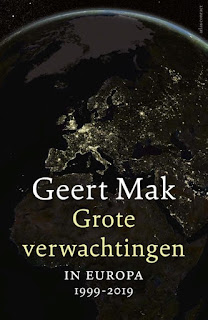
Mak, Geert "The Dream of Europe"

Mak, Geert "The Dream of Europe. Travels in a Troubled Continent" (Dutch: Grote verwachtingen. In Europa 1999-2019) - 2019

This book was a present by my son for Christmas. While I usually try to read Dutch books in Dutch, this was an English edition. In the end, I was not unhappy about that because now I can pass it on to my sons. They both speak Dutch but wouldn't read such a large book in that language.

I have read a few book by this fantastic journalist and author. All of them having to do with the changes of our continent in modern times. Totally interesting and very well examined and described.

He wrote this book six years ago and he predicted many events that are true today. That shows how well he observes. This can be seen as a follow-up to "In Europe. Travels through the Twentieth Century". A very-well deserved and very well executed follow-up. His observations about the first twenty years of our century are shocking and frightening. We should listen what he has to say about the future.

And here are some important quotes (from many):

"I wrote Enraged Citizens to show how it ought to be. The Capital (Die Hauptstadt)  is what it actually is." Robert Menasse

"But let all those idiots gather together in politics without sufficient resistance of any kind and you get a dictatorship of idiocy". Jacques de Kadt, Dutch essayist, in 1936

"He [one of the Republican candidates in 2015] lacked even the most basic respect for facts, institutions and democratic principles. To him, political opponents were enemies, a compromise was not a dignified agreement but a capitulation …" Doesn’t that apply to all of them???

From the back cover:

'Mak is the history teacher everyone should have had' Financial Times

How did the great European dream turn sour? And where do we go from here? From the author of the internationally acclaimed In Europe, a stunning history of our present,examining the first two decades of this most fragile and fraught new millennium. The great European project was built out of a common desire for peace, prosperity and freedom; a wish for a united Europe striving towards a common goal. The EU was to set an an arena for close cooperation, tackling crucial shared concerns from climate change to organized crime, promoting open borders and social security. But the first two turbulent decades of this century have been times of rapid and profound change. From the shores of Lampedusa to Putin's Moscow, the continent threatens to tear itself apart. What's happened to Europe's optimism and euphoria? How has it given way to nostalgia, frustration and fear, the fragile European dream in danger of turning into a nightmare?

In The Dream of Europe, Geert Mak, one of Europe's best-loved commentators, charts the seismic events that have shaped people's lives over the past twenty years. Mak's monumental book In Europe defined the continent on the verge of a new millennium. The Dream of Europe brings us up to the present day, through the rocky expansion of the EU, the aftermath of 9/11 and terrorist attacks across Europe, the 2008 financial crash and the euro crisis, the tragedy of the migrant crisis in the Mediterranean, the rise of right-wing populism and Brexit.

Like no other, Mak blends history, politics and culture with the stories and experiences of the many Europeans he meets on his travels. He brings this continent to life, and asks what role does Europe play now, and how might we face our challenges together, in the spirit of solidarity and connection.

'A powerful, humane and serious mind' Guardian

'Mak is a truly cosmopolitan chronicler' Independent"

Monday, 21 April 2025

Brooks, Geraldine "Year of Wonders"

Brooks, Geraldine "Year of Wonders" - 2001

My goodness, what a story! I have read several books about the plague before or novels that had the plague in their book. But this one was one just about the plague. Well, up until the last couple of pages where another book was more or less forced into just one chapter.

Still, I loved this book about a village that struggled during the plague, that had the idea to shut themselves off from the rest of the world in order not to bring this horrible disease to others. The village existed, the people in the book were based on real people from that time. But it was still a novel.

Apparently, this was Geraldine Brooks' first book. I think she learned not to add such a quick end but I still loved it very much. The author is such a great writer. And I think the Covid-19 pandemic brought the story even closer to us.

From the back cover:

"Spring 1666: when the Great Plague reaches the quiet Derbyshire village of Eyam, the villagers make an extraordinary decision. They elect to isolate themselves in a fateful quarantine. So begins the Year of Wonders, seen through eighteen-year-old Anna Frith’s eyes as she confronts the loss of her family, the disintegration of her community, and the lure of a dangerous and illicit love. Based on a true story, this novel explores love and learning, fear and fanaticism, and the struggles of seventeenth-century science and religion to interpret the world at the cusp of the modern era."

Monday, 17 March 2025

Clarke, Stephen "Talk to the Snail"

Clarke, Stephen "Talk to the Snail. Ten Commandments for Understanding the French" - 2006

I have read two books by Stephen Clarke, so far. This was my third. While the others were fiction about an English guy living in Paris (well, the story is based on the author's life), this is a non-fiction book about the French people and the French language. Quite funny at times. Unless you're a very serious French person who doesn't have a sense of humour. I've lived abroad half of my life (though not in France) and I can see where some of his frustration comes from. 

There are so many parts in this book where I just nodded - or where I had to shake my head. There were a lot of things that I remarked in England, e.g. when he complains that the French don't use French words for illnesses or medication. I had that same experience in England. Unless it's a common cold, the use mainly Latin or Greek words, even for the doctors they go to. 

Then there are the international problems, like not getting on with your neighbours, that's not just a problem an Englishman in France has. And not getting served in a restaurant. How often do you have to dislocate your arm or should in order to get the attention of a waiter? Not just in France, I am sorry to say.

Still, there are a lot of helpful hints in the book, language- and otherwise. And the author hasn't lost his humour, either. Lovely book.

From the back cover:

"The only book you'll need to understand what the French really think, how to get on with them and, and most importantly, how to get the best out of them. With useful sections on:

  • Making sure you get served in a café
  • Harassing French estate agents
  • Living with bacteria
  • Pronouncing French swear-words
  • Surviving the French driving experience
  • Falling in amour, Paris-style
  • And beaucoup beaucoup more!

Don't go to France without reading this book!"

Friday, 28 February 2025

Worsley, Lucy "Jane Austen at Home"

Worsley, Lucy "Jane Austen at Home" - 2017

My favourite book of the month. As part of the commemoration of Jane Austen's 250th birthday, the Classics Club has started a #Reading Austen project. We are reading a book by her every other month, last month it was "Pride & Prejudice", next month will be "Sense & Sensibility". When it fits in with my other reading "duties" (book clubs and challenges), I want to do read something Austen-related by her in between.

This was a fabulous biography. Lucy Worsley really "visited" Jane Austen at home and accompanied her on all her visits to friends and family. It was so nice to read what she and her family, especially her sister Cassandra had been up to. You hear about the relationship between them and also any other person of their lifetime. Also, the way they lived. We all know that they had money problems but it is different today, at least in our countries. Also, the things Jane did for female authors and women in general are not to be underestimated.

After reading this book, I feel I got to know Jane Austen better, almost personally. I would love to have all biographies written like this. I think I love the author even more than I did before.

There are so many quotes I could mention but I leave it at this one  about my favourite novel: "Persuasion was … set precisely in the period of peace between the months June 1814 and February 1815, when Britian's naval officers were on shore leave." It shows how her novels relate to the time she lived in.

From the back cover:

"Historian Lucy Worsley visits Jane Austen at home, exploring the author's life through the places which meant the most to her.

On the 200th anniversary of Jane Austen's death, historian Lucy Worsley leads us into the rooms from which our best-loved novelist quietly changed the world.

This new telling of the story of Jane's life shows us how and why she lived as she did, examining the places and spaces that mattered to her. It wasn't all country houses and ballrooms, but a life that was often a painful struggle. Jane famously lived a 'life without incident', but with new research and insights Lucy Worsley reveals a passionate woman who fought for her freedom. A woman who far from being a lonely spinster in fact had at least five marriage prospects, but who in the end refused to settle for anything less than Mr Darcy."

The book also contains some interesting pictures that relate to Jane Austen's life.

Monday, 9 September 2024

Stedman, M L "The Light Between Oceans"

Stedman, M L "The Light Between Oceans" - 2012

I must say, I expected more from this novel. But I don't want to spoil it for anyone who still wants to read this. I really would welcome comments from those who have.

Spoiler:
As you can see from the book description, a couple who cannot have a child "finds" one and decides to keep it. Even when they know where it belongs, they don't tell the truth. An interesting topic. Is it correct to keep a baby if you think it might have been abandoned? Is it correct to keep it even if you know it isn't? I would say no in both cases. Someone who is not able to have children but would love to have them, might think different but I think about the mother whose baby is stolen. Yes, stolen. I would have killed anyone who would have done that to me.

An interesting subject but the writing has not enticed me to read anything else by this author. It was a little to "chick-litty" for me.

From the back cover:

"Tom Sherbourne, released from the horrors of the First World War, is now a lighthouse keeper, cocooned on a remote island with his young wife Izzy, who is content in everything but her failure to have a child.

One April morning, a boat washes ashore carrying a dead man - and a crying baby. Safe from the real world, Tom and Izzy break the rules and follow their hearts.

It is a decision with devastating consequences."

Wednesday, 28 August 2024

Garfield, Simon "To the Letter: A Curious History of Correspondence - A Celebration of the Lost Art of Letter Writing"

Garfield, Simon "To the Letter: A Curious History of Correspondence - A Celebration of the Lost Art of Letter Writing" - 2013

I read a book by Simon Garfield a couple of years ago: "On the Map. Why the World Looks the Way it Does".

I really loved it. And since I love letters just as much as I love maps, I just had to get this one.

It is an interesting book about the development of letters, how they came into existence in the first place, how they changed over the centuries, what they mean today in a world of e-mails and phone messages.

I used to be a keen letter writer and was really looking forward to this book. And though it is a good survey into the habit of letter writing and contained some nice anecdotes, I found it a little boring at times. I don't mind jumping around in a story but this was all a little too haphazardly.

That might have been one of the reasons why I didn't read this in one go, I just couldn't get my head around his structure.

Also, he mentions a lot of authors and books in his work, a table of contents would have been nice.

I still like writing letters.

A nice quote:

"Today is the tomorrow we worried about yesterday."

He also mentions a letter subscripion where you receive an actual letter by one of your favourite authors twice a month. It still exists and you can find all about it here at "The Rumpus". I couldn't find out whether they also send something abroad but there are quite a few US readers here, so maybe something for them.

From the back cover:

"To the Letter tells the story of our remarkable journey through the mail. From Roman wood chips discovered near Hadrian's Wall to the wonders and terrors of email, Simon Garfield explores how we have written to each other over the centuries and what our letters reveal about our lives.

Along the way he delves into the great correspondences of our time, from Cicero and Petrarch to Jane Austen and Ted Hughes (and John Keats, Virginia Woolf, Jack Kerouac, Anaïs Nin and Charles Schulz), and traces the very particular advice offered by bestselling letter-writing manuals. He uncovers a host of engaging stories, including the tricky history of the opening greeting, the ideal ingredients for invisible ink, and the sad saga of the dead letter office. As the book unfolds, so does the story of a moving wartime correspondence that shows how letters can change the course of life.

To the Letter is a wonderful celebration of letters in every form, and a passionate rallying cry to keep writing."

Monday, 12 August 2024

Pamuk, Orhan "To Look Out the Window"

Pamuk, Orhan "To Look Out the Window" aka "Pieces from the View: Life, Streets, Literature" (Turkish: Manzaradan Parçalar: Hayat, Sokaklar, Edebiyat) - Der Blick aus meinem Fenster. Betrachtungen - 2008

An interesting book by Orhan Pamuk in which he discusses many topics. Whether it's his childhood in Istanbul, his family, politics or his job as a writer, literature, art, he simply has something interesting and worth knowing to say about everything.

That is certainly the main reason why this author is one of my favorites. I hope he writes a new novel soon.

Book description (translated from the German copy):

"Whether it's the crumbling plaster of Istanbul houses or the Turkish flag, whether it's his father or the terrifying nature of Dostoyevsky's demons - with Orhan Pamuk everything becomes a complex universe. Pamuk observes coolly and tells moving stories. Autobiographical, narrative, politics, art and literature: his essays are the sum of different and contradictory experiences - an incredible stroke of luck."

As you can see from my Wikipedia link, there is an English title, though I could not find the book. Still, I hope it has been translated into English.

Orhan Pamuk "who in the quest for the melancholic soul of his native city has discovered new symbols for the clash and interlacing of cultures" received the Nobel Prize for Literature in 2006.

Orhan Pamuk received the Peace Prize of the German Book Trade (Friedenspreis) in 2005.

I contribute to this page: Read the Nobels and you can find all my blogs about Nobel Prize winning authors and their books here.

Read my original review here. 

Monday, 5 August 2024

Allende, Isabel "City of the Beasts"

Allende, Isabel "City of the Beasts" (Memories of the Eagle and the Jaguar #1) (Spanish: La ciudad de las bestias) (Las memorias del Águila y del Jaguar #1) - 2002

I found this book ages ago but my TBR pile is so large that it took me half a decade until I tackled this book. Not for want of interest. I love Isabel Allende.

I wasn't aware that this is supposed to be a young adult book but it definitely is also suitable for "old" adults like me. I love this story about a teenager who is taken out of his usual habitat and has to get on in a totally different world. First, he has to find an address in New York without any help but with many obstacles. But the real adventure starts when he leaves for the rainforest with his grandmother. Together with the daughter of their local guide, he explores the area. They rely on each other for their different knowledge and he grows up.

That is the beauty of this story. It's magical, they meet not just the natives but also their spirits, something totally alien to them as well as to us as readers.

There are two more books about Alex and Nadia, "Kingdom of the Golden Dragon" (El Reino del Dragón de Oro), and "Forest of the Pygmies" (El Bosque de los Pigmeos). I totally intend to read them.

From the back cover:

"An ecologial romance with a pulsing heart, equal parts Rider Haggard and Chico Buarque -- one of the world's greatest and most beloved storytellers broadens her style and reach with a Amazonian adventure story which will appeal to all ages Fifteen-year-old Alexander Cold has the chance to take the trip of a lifetime. With his mother in hospital, too ill to look after him, Alex is sent out to his grandmother Kate -- a fearless reporter with blue eyes 'as sharp as daggers' points'. Kate is about to embark on an expedition to the dangerous, remote world of the Amazon rainforest, but rather than change her plans, she simply takes Alex along with her. They set off with their team -- including a local guide and his daughter Nadia, with her wild, curly hair and skin the colour of honey -- in search of a fabled headhunting tribe and a legendary, marauding creature known to locals only as 'the Beast', only to find out much, much more about the mysteries of the jungle and its inhabitants. In a novel rich in adventure, magic and spirit, internationally-celebrated novelist Isabel Allende takes readers of all ages on a voyage of discovery and wonder, deep into the heart of the Amazon."

Monday, 8 April 2024

Tomalin, Claire "Jane Austen - A Life"

Tomalin, Claire "Jane Austen - A Life" - 1997

Jane Austen is one of my favourite authors. I have read all her novels, even the ones she didn't finish, some letters and short stories, so: a lot about her.

Claire Tomalin is a British journalist and biographer. She has a good reputation, especially for her biographies.

After reading this book, I understand why. I think she put together whatever is known about Jane Austen and her life, her family, her works, her illness, her death, anything. And she also tells us a lot about the era the author lived in, how female authors were regarded, how women were regarded, how people lived. You just have the feeling you lived with them.

We also get to see many of her writings, not all the letters as a whole but many excerpts that give us a glimpse of the author's life.

It's a shame Jane Austen was not able to write more books but this is a good supplement to her literature.

From the back cover:

"At her death in 1817, Jane Austen left the world six of the most beloved novels written in English - but her shortsighted family destroyed the bulk of her letters; and if she kept any diaries, they did not survive her.  Now acclaimed biographer Claire Tomalin has filled the gaps in the record, creating a remarkably fresh and convincing portrait of the woman and the writer.

While most Austen biographers have accepted the assertion of Jane's brother Henry that '
My dear Sister's life was not a life of events,' Tomalin shows that, on the contrary, Austen's brief life was fraught with upheaval.  Tomalin provides detailed and absorbing accounts of Austen's ill-fated love for a young Irishman, her frequent travels and extended visits to London, her close friendship with a worldly cousin whose French husband met his death on the guillotine, her brothers' naval service in the Napoleonic wars and in the colonies, and thus shatters the myth of Jane Austen as a sheltered and homebound spinster whose knowledge of the world was limited to the view from a Hampshire village."

Monday, 18 March 2024

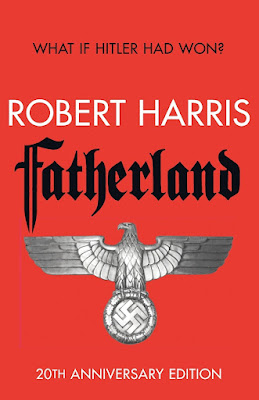
Harris, Robert "Fatherland"

Harris, Robert "Fatherland" - 1992

What an awful thought. Hitler resp. the Nazis had won the war. I always say, the Germans didn't lose the war, that were the Nazis. The Germans effectively won the war. In this book (and in various others, like my favourite "The Children's War") we can all see why.

The story itself concentrates on one particular case. A policemen who is not a fan of the Nazis but still has to wear their uniform for his job, tries to find the secret behind a murder. And with that, he could transform the whole world.

We need people like that everywhere, people who don't just blindly follow some dicatators, even if it is an advantage for them.

I think, right now is the right time to read this book again. Right now, where the Right is on the rise in many, many countries. Too many, if you ask me. How can people forget what it was? Even if you haven't lived during the war, most of us haven't, lets be honest. My parents would have been ninety had they still lived. And they were five when the Nazis were elected, so anyone responsible for the regime must be about a hundred. Not many of them alive anymore. But we have to remember what our parents or grandparents told us and see where we are heading if we elect those idiots that tell us the foreigners are our enemies. Nope, those who want to abolish our hard-earned democracy are.

We should all be happy that the war ended the way it did, this book shows us what could have been had it been different.

From the back cover:

"April 1964.

The naked body of an old man floats in a lake on the outskirts of Berlin. In one week it will be Adolf Hitler’s 75th birthday. A terrible conspiracy is starting to unravel…

What if Hitler had won?
"