Showing posts with label Russia. Show all posts

Wednesday, 11 March 2026

Turgenev, Ivan "Fathers and Sons"

Turgenev, Ivan "Fathers and Sons" (Russian: Отцы и дети/Otzy i deti) - 1862
I love Russian authors, as all my friends know. But I had never read a book by Turgenjew. So, I was happy that #2 was chosen for our classic spin this term.

Was it as good as most of the other Russian authors I read? Yes, it was. I loved reading about life in Russia in the middle of the nineteenth century, when times started to change, farmers got more freedom, serfdom started to be abolished and the whole order of society was questioned.

Almost any kind of character was described in this book, diffferent ages, different social status, different education, different housholds, town and countryside, students and farmers, parents and children, women and men (which doesn't happen often in those books).

According to Wikipedia, this is considered the first modern Russian novel. I can well believe that. Changes were coming and the author managed to put that situation to paper.

In any case, I can highly recommend this book. And not just to those who love classics and/or Russian literature.

From the back cover:

"Bazarov—a gifted, impatient, and caustic young man—has journeyed from school to the home of his friend Arkady Kirsanov. But soon Bazarov’s outspoken rejection of authority and social conventions touches off quarrels, misunderstandings, and romantic entanglements that will utterly transform the Kirsanov household and reflect the changes taking place across all of nineteenth-century Russia.

Fathers and Sons enraged the old and the young, reactionaries, romantics, and radicals alike when it was first published. At the same time, Turgenev won the acclaim of Flaubert, Maupassant, and Henry James for his craftsmanship as a writer and his psychological insight. Fathers and Sons is now considered one of the greatest novels of the nineteenth century.

A timeless depiction of generational conflict during social upheaval, it vividly portrays the clash between the older Russian aristocracy and the youthful radicalism that foreshadowed the revolution to come—and offers modern-day readers much to reflect upon as they look around at their own tumultuous, ever changing world."

Here are all the books on my original Classics Club list.
And here is a list of all the books I read with the Classics Spin.

Monday, 15 September 2025

Dostoevsky, Fyodor "A Little Hero"

Dostoevsky, Fyodor "A Little Hero" (Russian: Маленький герой/Malen'kiy geroy) - 1857

Novel in Nine Letters - 1847
A Gentle Creature - 1876
A Little Hero - 1849

This booklet consists of three short stories, but I liked the "Novel in Nine Letters" the best. It's the correspondence between two men who somehow always manage to miss each other. 

Dostoevsky said of this: "When I was penniless the other day, I visited Nekrasov. While I was sitting with him, the idea came to me to write a novel in nine letters. When I returned home, I finished the novel in one night. In the morning, I brought the manuscript to Nekrasov and received 125 rubles for it."

In this story, you can tell that Pyotr Ivanych wants something from Ivan Petrovich and vice versa. One excuse for why the meeting doesn't take place follows another. Very funny.

I had already read "The Gentle One" in another collection. (see here) Also an interesting story about the beginning and end of a relationship and how it all came about.

I found the actual story, or rather the one that adorns the title, rather boring. An eleven-year-old falls in love with his cousin, and the "gentlewomen" of society make this the subject of their amusement, making fun of him, and embarrassing him. Nevertheless, it's a Dostoyevsky story and therefore worth reading in its own right.

From the back cover:

"At that time I was nearly eleven, I had been sent in July to spend the holiday in a village near Moscow with a relation of mine called T., whose house was full of guests, fifty, or perhaps more.... I don't remember, I didn't count. The house was full of noise and gaiety. It seemed as though it were a continual holiday, which would never end. It seemed as though our host had taken a vow to squander all his vast fortune as rapidly as possible, and he did indeed succeed, not long ago, in justifying this surmise, that is, in making a clean sweep of it all to the last stick."

Wednesday, 3 July 2024

Erpenbeck, Jenny "Kairos"

Erpenbeck, Jenny "Kairos" (German: Kairos.) - 2021

This was the starter book for this month's Six Degrees of Separation. I haven't read the starter book very often but this was a new acclaimed book by an author I'd read and liked before, so I gave it a go.

I quite liked "The End of Days" (Aller Tage Abend) and hope this one would be just as good.

Jenny Erpenbeck was the first German author to receive the 2024 International Booker Prize.

This was an okay read but I was a little disappointed. The writing was not as fluent as expected. I think the love story should reflect the relationship between the two countries. And that was not a bad attempt. But, I didn't care for either of the protagonists, I couldn't feel sorry for them.

For those who don't know much about the former GDR or how the fall of the fall came about it probably isn't a bad book, though there are better ones that will tell you about this (The Tower/Der Turm, for instance)

All in all, I found the book, boring, tedious and tiresome. Yet another Booker prize award that I didn't like.

The title comes from an ancient Greek term for the right time.

From the back cover:

"Jenny Erpenbeck’s much anticipated new novel Kairos is a complicated love story set amidst swirling, cataclysmic events as the GDR collapses and an old world evaporates Jenny Erpenbeck (the author of Go, Went, Gone and Visitation ) is an epic storyteller and arguably the most powerful voice in contemporary German literature. Erpenbeck’s new novel Kairos - an unforgettably compelling masterpiece - tells the story of the romance begun in East Berlin at the end of the 1980s when nineteen-year-old Katharina meets by chance a married writer in his fifties named Hans. Their passionate yet difficult long-running affair takes place against the background of the declining GDR, through the upheavals wrought by its dissolution in 1989 and then what comes after. In her unmistakable style and with enormous sweep, Erpenbeck describes the path of two lovers, as Katharina grows up and tries to come to terms with a not always ideal romance, even as a whole world with its own ideology disappears."

Friday, 7 July 2023

Theroux, Paul "Riding the Iron Rooster"

Theroux, Paul "Riding the Iron Rooster" - 1988

The name Theroux is well known in the United Kingdom. Though not with the first name Paul but with that of his son, Louis. So, I had never read anything by the elder Theroux until I was given this book by one of our book club members.

I love travel books and this one doesn't make an exception. The author travelled through China in the 1980s, first with a travel group, then on his own. The members or the travel group are described the way that I would probably see them, as well. I have always preferred to travel with family or some good friends rather than some strangers that might turn out to be real bores or terribly annoying. But also when he carries on on his own, he is hardly ever alone as the Chinese like to give him a babysitter.

In any case, the descriptions of the voyage is interesting, the people he meets on the train, one is more weird than the other, the landscape is depicted to well that you can imagine seeing it yourself, the food seems to stand just in front of you.

I liked the interaction with the Chinese people and the exploring of areas where they hardly let any foreigner travel. A good book about a country still very unknown to us. I wonder what Paul Theroux would see today?

Some books, Paul Theroux was reading while "Riding the Iron Rooster":
Avedon, John "In Exile from the Land of Snows" - 1984 (Goodreads)
Balzac "Old Goriot" (FR: Le Père Goriot) - 1834 (Goodreads)
Lewis, Sinclair "Elmer Gantry" - 1927 (Nobel Prize in Literature 1930) (Goodreads)
Lewis, Sinclair "Main Street" - 1920 (Goodreads)
Morrison, Arthur "The Hole in the Wall" - 1902 (Goodreads)
Stevenson, Robert Louis "Kidnapped" - 1886 (Goodreads)

From the back cover:

"An eye-opening and entertaining account of travels in old and new China, by the author of The Great Railway Bazaar

Paul Theroux left Victoria Station on a rainy Saturday in April thinking that taking eight trains across Europe, Eastern Europe, the USSR and Mongolia would be the easy way to get to the Chinese border - the relaxing way, even. He would read a little, take notes, eat regular meals and gaze contentedly out of windows. The reality, of course, was very different. In fact, Theroux experienced a decidedly odd and unexpected trip to China that set the challenging tone for his epic year-long rail journey around that vast, inscrutable land - a journey which involved riding nearly every train in the country.
"

Wednesday, 15 February 2023

Wood, Levison "Eastern Horizons"

Wood, Levison "Eastern Horizons. Hitchhiking the Silk Road" - 2017

I love stories about travels, I loves stories about the Middle and Far East, so this book sounded just like the right one for me.

And it was. Levison Wood tells us, how he travelled at the age of 22, first through Russia, then through Georgia and Turkey into Iran, from there to Afghanistan, then Pakistan and finally into the country he wanted to reach all along: India.

This was  a wonderful book for anyone who would love to do such a trip themselves but can't for whatever reason. As a woman, I doubt it would have been the same as it was for the author and the other men he met along the road. So, I am glad I can see it through his eyes.

I see that he has written more books like this, I should probably go and read them, as well.

From the back cover:

"Levison Wood was only 22 when he decided to hitch-hike from England to India through Russia, Iran, Afghanistan and Pakistan, but he wasn't the conventional follower of the hippy trail. A fascination with the deeds of the early explorers, a history degree in the bag, an army career already planned and a shoestring budget of £750 - including for the flight home - he was determined to find out more about the countries of the Caucasus and beyond - and meet the people who lived and worked there. Eastern Horizons is a true traveller's tale in the tradition of the best of the genre, populated by a cast of eccentric characters; from mujahideen fighters to the Russian mafia. Along the way he meets some people who showed great hospitality, while others would rather have murdered him... 

This book confirms that Levison Wood, Winner of the 2016 Edward Stanford Adventure Travel Book Of The Year Award, has indeed 'breathed new life into adventure travel ' (Michael Palin)"

Wednesday, 8 February 2023

Petrowskaja, Katja "Maybe Esther"

Petrowskaja, Katja "Maybe Esther" (German: Vielleicht Esther) - 2014

A great tale of a Jewish family's history. One critic wrote that Katja Petrowskaja could have written a great novel, but only reproduced fragments. I think it is precisely these fragments that show more of what this family - representative of all other Jewish families - went through, all the little details that you don't often hear about.

A wonderful book.

From the back cover:

"An inventive, unique, and extraordinarily moving literary debut that pieces together the fascinating story of one woman’s family across twentieth-century Russia, Ukraine, Poland, and Germany.

Katja Petrowskaja wanted to create a kind of family tree, charting relatives who had scattered across multiple countries and continents. Her idea blossomed into this striking and highly original work of narrative nonfiction, an account of her search for meaning within the stories of her ancestors.

In a series of short meditations, Petrowskaja delves into family legends, introducing a remarkable cast of characters: Judas Stern, her great-uncle, who shot a German diplomatic attaché in 1932 and was sentenced to death; her grandfather Semyon, who went underground with a new name during the Bolshevik Revolution in Russia, forever splitting their branch of the family from the rest; her grandmother Rosa, who ran an orphanage in the Urals for deaf-mute Jewish children; her Ukrainian grandfather Vasily, who disappeared during World War II and reappeared without explanation forty-one years later - and settled back into the family as if he’d never been gone; and her great-grandmother, whose name may have been Esther, who alone remained in Kiev and was killed by the Nazis.

How do you talk about what you can’t know, how do you bring the past to life? To answer this complex question, Petrowskaja visits the scenes of these events, reflecting on a fragmented and traumatized century and bringing to light family figures who threaten to drift into obscurity. A true search for the past reminiscent of Jonathan Safran Foer’s
Everything Is Illuminated, Daniel Mendelsohn’s The Lost, and Michael Chabon’s Moonglow, Maybe Esther is a poignant, haunting investigation of the effects of history on one family."

In 2013, Katja Petrowskaja received the Ingeborg Bachmann Prize, one of the most important awards for literature in the German language.

Friday, 27 January 2023

Ulitzkaja, Ljudmila "Medea and Her Children"

Ulitzkaja, Ljudmila "Medea and Her Children" (Russian: Медея и её дети/ Medeja i eë deti) - 1996

This book was suggested to us by a book club member. It was said that Ukrainian history would be presented here through a family from Crimea. Well, after the description I had imagined something else and was glad to have read "Ukraine verstehen" [Understanding Ukraine: History, Politics and Struggle for Freedom] by Steffen Dobbert beforehand. I had heard a lot about the Ukraine, including the problems with Russia, long before they first annexed Crimea and then invaded the country, but it was good to hear more details that also helped to understand this book.

Medea is the good soul of the Sinopli family. She lives in Crimea, where her ancestors came from, and every summer the family comes to visit. Not only are they now scattered all over the Ukraine and other former Soviet Union countries, they also all have different problems and motives, as is usual in large families, which lead them to Aunt Medea. The family also has many different origins. While she would probably describe herself primarily as Greek, her ancestors come from many other places as well.

At the beginning of the book we are shown a family tree, which I think could have been a bit more detailed, especially since surnames, patronyms, nicknames, etc. are used again and again, which can lead to confusion. Also, the author mentions in the foreword that she is talking about her family, but I think this is more of a novel based on her family.

The various characters are described very well, you feel somehow in the middle of the family. In that respect it is an excellent book. I had already read "The Green Tent" by Ljudmila Ulitzkaja and found it simply remarkable. I probably also put too much expectation into this book, or was misprepared, but I didn't have the same feeling as I did with the first book. And most book club members had the same opinion. But that won't stop me from reading more books by this author.


From the back cover:

"Medea Georgievna Sinoply Mendez is an iconic figure in her Crimean village, the last remaining pure-blooded Greek in a family that has lived on that coast for centuries. Childless Medea is the touchstone of a large family, which gathers each spring and summer at her home. There are her nieces (sexy Nike and shy Masha), her nephew Georgii (who shares Medea’s devotion to the Crimea), and their friends. In this single summer, the languor of love will permeate the Crimean air, hearts will be broken, and old memories will float to consciousness, allowing us to experience not only the shifting currents of erotic attraction and competition, but also the dramatic saga of this family amid the forces of dislocation, war, and upheaval of twentieth-century Russian life."

Friday, 18 November 2022

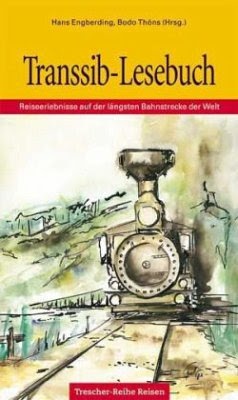
Engberding, Hans; Thöns, Bodo "Transsib Reader"

Engberding, Hans; Thöns, Bodo (Ed.) "Transsib-Lesebuch: Reiseerlebnisse auf der längsten Bahnstrecke der Welt" [Transsib Reader: Travel Experiences On The Longest Railway Line In The World] - 2002

Usually, I don't review books that have not been translated into English. But I promised to do so in this case. And some of the articles have been written in English. Whenever I found the original title (or the translation into English), I added it in bold.

I found this collection at an antiquarian bookstore. It contains articles, excerpts from books, short stories by well-known writers who have all at some point traveled the Trans-Siberian Railway and recorded their experiences in writing. The first description is from 1901, the last from 2001, i.e. a report that goes back over a hundred years in which a lot has happened.

The authors all have an interesting point of view, everyone experiences the trip differently, even if they travel around the same time. While some accept any inconvenience as if it were the most natural thing in the world and are happy to be able to gain this insight into a culture that is foreign to them, others get upset about small things that would probably have happened to them on other routes, as well. And then there are those who support communism (or rather Stalinism) a hundred percent that everything is glorified.

In any case, it is fascinating to see how the railway was built, how it has changed over time, especially when the political situation has changed.


John Foster Fraser, Sir, UK, 1868-1936
Das wahre Sibirien (1901)
The Real Siberia

Eugen Zabel, D, 1851-1925
Auf der sibirischen Bahn nach China (1903)

Karl Tanera, D, 1849-1904
Zur Kriegszeit auf der sibirischen Bahn und durch Rußland (1904)

O.T. Tuck, UK, 1876-?
Tagebuch (1909)

Marcus Lorenzo Taft, US,
Fremdes Sibirien (1909)

Fridtjof Nansen, N, 1861-1930 - Nobel Prize for Peace 1922
Sibirien ein Zukunftsland (1913)
Through Siberia the Land of the Future/Gjennem Sibirien

Otto Goebel, D, 1872-1955
Über Sibirien nach Ostasien (1914)

Sven Hedin, S, 1865-1952
Von Peking nach Moskau (1923)

Richard Tröger, D, 1879-1965
Tagebuch über eine Rußland-Japan-Reise (1929)

Kurt Faber, D, 1883-1929
Weltwanderers letzte Fahrten und Abenteuer (1930)

Peter Fleming, UK, 1907-74 (Ian Fleming's brother)
Mit mir allein. Eine Reise nach China (1933)
One's Company: A Journey to China in 1933

Erik Bergengren, S, 1900-1977
Gelbe Gesichter. Sibirische Nächte und japanische Tage (1936)

Mildred Widmer Marshall, US
Zwei Schullehrerinnen aus Oregon reisen um die Welt (1937)

Sławomir Rawicz, PL/BY, 1915-2004
Flucht durch Steppe und Wüste (1939)
The Long Walk?

Sigrid Undset, DK, 1882-1949 - Nobel Prize for Literature 1928
Wieder in die Zukunft (1940)
Back to the future/Tilbake til fremtiden

Ryszard Kapuscinski, PL/BY, 1932-2007
Imperium. Sowjetische Streifzüge (1958)
Imperium

Siegfried Meissgeier, D, 1924-1988 and Günter Linde, D, 1925-1992
Sibirien ohne Geheimnisse (1959)

Paul Theroux, USA, 1922-
Abenteuer Eisenbahn. Auf Schienen um die halbe Welt (1965)
The Great Railway Bazaar

Hugo Portisch, SLK, 1927-2021
So sah ich Sibirien (1966)

Vittorio Lojacono, I
Die Straße der Gefahr (1969)

Eric Newby, UK, 1919-2006
Auf der großen roten Bahn (1977)
The Big Red Train Ride

Hans-Otto Meissner, D/F, 1909-1992
Sibirien-Expreß (1979)

Wolfgang Seidl, D, 1933-
Ins rote Reich des gelben Drachens (1984)

Hardy Krüger, D, 1928-2022
Sibirienfahrt (1984)

Johanna Hornef-Blau
Unterwegs mit der Transsibirischen Eisenbahn (1994)

Colin Thubron, UK, 1939-
Sibirien. Schlafende Erde - Erwachendes Land (1998)
In Siberia

Kurt Drawert, D, 1956-
Nach Osten ans Ende der Welt (1999)

Mark Bauch, D 1971-
Transsibirisch Reisen (2001)
Das wahre Sibirien (1901)

Pictures by Claudia Mathea (D, 1969-) complement the stories.

Book Description (translation):

"The Trans-Siberian Railway has fascinated travelers from all over the world for a century now. This beautifully designed reader brings together prominent and less prominent Trans-Siberian travelers from all decades of the 20th century, who report on their journey on what is probably the world's most famous railway line.

Lively descriptions of the day-to-day organization of life on the Trans-Siberian Railway, the events on the train and the experiences with fellow travelers stand alongside historical observations from the checkered history of Russia, Mongolia and China. This creates a diverse picture of the countries traveled through.

Sven Hedin, Fridtjof Nansen, Hardy Krüger, Paul Theroux, Sigrid Undset, Peter Fleming and many others take the reader on an adventurous journey through the Siberian expanse.
The Transsib Reader is the ideal complement to the Transsib Handbook.
"

Wednesday, 9 November 2022

Mandelstam, Ossip "The Noise of Time"

Mandelstam, Ossip "The Noise of Time" aka "The Din of Time (RUS: Шум времени/Shum vremeni) - 1925

A story of a childhood at the turn of the last century, the author was born in 1891. His memories of his father and mother, leather smell on the bookshelf, memories of poetry, memories of Jewish customs and festivities. The author gives us a good survey of life at the beginning of the 20th century, that of his contemporaries and of his own, the reflections of his sense of alienation in the Soviet system.

While this book is only a compilation of short stories, it still gives us insights into the life of a Jewish boy in a country that didn't want any criticism, and who gave his life for his beliefs: "Only in Russia is poetry respected, it gets people killed. Is there anywhere else where poetry is so common a motive for murder?"

He mentions the "propertyless intellectual who needs no memories. It should be enough for him to tell of the books he has read."

And then he mentions in the "Mensheviks in Georgia" (written 1922-1927): "Everyone, Georgians, Armenians, Greeks, Persians, Englishmen and Italians spoke Russian. A wild Volapük, a Russian Black Sea Esperanto buzzed in the air." Esperanto was created in 1887 and it seemed normal to Ossip Mandelstam that everyone should know what he was talking about.

"The Noise of Time" is an interesting collection of stories that will surely please not only fans of Russian literature.

From the back cover:

"Collected prose works by one of Russia's towering literary figures. Osip Mandelstam has in recent years come to be seen as a central figure in European modernism. Though known primarily as a poet, Mandelstam worked in many styles: autobiography, short story, travel writing, and polemic. Mandelstam's biographer, Clarence Brown, presents a collection of the poet's prose works that illuminates his far-ranging talent and places him within the canon of European modernism.

This volume includes Mandelstam's
'The Noise of Time,' a series of autobiographical sketches; 'The Egyptian Stamp,' a novella echoing Gogol and Dostoevsky; 'Fourth Prose,' and the famous travel memoirs 'Theodosia' and 'Journey to Armenia.'"

Monday, 17 October 2022

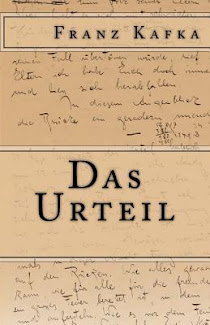
Kafka, Franz "The Judgment"

Kafka, Franz "The Judgment" (German: Das Urteil) - 1912

A son's relationship with his father. The bad relationship between son and father. The terrible relationship between son and father. Supposedly the closest thing to Kafka's autobiography. If so, I no longer wonder at this writer's insane thoughts. How can a father wish his son dead?

Well, Kafka really isn't my thing at all.


Book Description:

"'The judgment' is considered the most autobiographical of Kafka's stories. First, there are Kafka's own commentaries and entries in his diary. When he re-read the story, for instance, he noted that only he could penetrate to the core of the story which, much like a newborn child, 'was covered with dirt and mucus as it came out of him'; he also commented in his diary that he wanted to write down all possible relationships within the story that were not clear to him when he originally wrote it. This is not surprising for a highly introverted writer like Kafka, but it does illustrate the enormous inner pressure under which he must have written 'The judgment.'"

Wednesday, 5 October 2022

Ivey, Eowyn "The Snow Child"


Ivey, Eowyn "The Snow Child" - 2012

I'm not a fantasy fan but I like magic realism and I like fairy tales. Some people will claim that is the same but I know real fantasy fans will agree. Now, this was a mixture between magic realism and fairy tale, it is based on an old Russian fairy tale but takes place in Alaska in the 1920s.

It is difficult to explain without giving too much away but the book description already says a lot. I liked the old couple and I loved the young girl. I liked the interaction between them and I also enjoyed the descriptions of the nature and the hard work people had to endure in order to make a living.

A great story about what could have been.

Book Description:

"Alaska, 1920: a brutal place to homestead, and especially tough for recent arrivals Jack and Mabel. Childless, they are drifting apart - he breaking under the weight of the work of the farm; she crumbling from loneliness and despair. In a moment of levity during the season's first snowfall, they build a child out of snow. The next morning the snow child is gone - but they glimpse a young, blonde-haired girl running through the trees."

Eowyn Ivey was a finalist for the Pulitzer Prize for "The Snow Child" in 2013.

Monday, 2 May 2022

Ilf, Ilya; Petrov, Yevgeny "The Twelve Chairs"

Ilf, Ilya; Petrov, Yevgeny "The Twelve Chairs" (Russian: Двенадцать стульев/Dvenadtsat stulyev) - 1928

This was our international online book club novel for March 2022.

I love Russian literature. So, I was quite happy when my book club chose this novel. Funnily enough, I remembered a German TV show from the seventies where they were looking for thirteen chairs and I found out that it was based on this novel. I remember that being quite funny.

And yes, this is a satirical novel with quite some funny bits but it didn't really excite me very much. The plot is nice and the writing is interesting but somehow it didn't do much for me.

So, yes, unfortunately not my favourite Russian story.

However, here is a very positive remark by one of the other book club members.

"Amazing that all these decades later the characters, situations and humour still hold charm. This book took me right out of my usual reading paths onto an enjoyable side trail. Authors Ilf and Petrov seem like a couple of fun guys."

From the back cover:

"Ostap Bender is an unemployed con artist living by his wits in postrevolutionary Soviet Russia. He joins forces with Ippolit Matveyevich Vorobyaninov, a former nobleman who has returned to his hometown to find a cache of missing jewels which were hidden in some chairs that have been appropriated by the Soviet authorities. The search for the bejeweled chairs takes these unlikely heroes from the provinces to Moscow to the wilds of Soviet Georgia and the Trans-caucasus mountains; on their quest they encounter a wide variety of characters: from opportunistic Soviet bureaucrats to aging survivors of the prerevolutionary propertied classes, each one more selfish, venal, and ineffective than the one before."

Monday, 4 April 2022

Shaw, Karl "Royal Babylon"

Shaw, Karl "Royal Babylon: The Alarming History of European Royalty" - 1999

I love to read about history. I love non-fiction, I love historical novels, anything to do with what happened before us. In order to know what happened, in order to help that it doesn't get repeated, in order to quench my thirst for knowledge.

This book is a little different. It's non-fiction and gives you lots of information, including some great family trees of all the different royal houses in Europe. Mind you, it is more or less just the one house that spreads out everywhere.

But there is more. We don't just hear who lived when, who married whom and why, no, we get to know what went on behind the scenes, who had an affair with whom (and how many), who was insane (almost all of them because of the terrible in-breading - not that that was any news), why did they change names, what did they do to keep their status.

I have heard several comments about this book, whilst some were pretty negative, some I didn't agree with, others I did (no footnotes), others were pretty funny and accurate: The Onion version of European royalty (Mary Overton), it has entirely changed the concept of "someday my prince will come"(Liana from California), trashy historical non-fiction (Jennifer from Colorado)

A witty book about madness, snobbery, infidelity, a gossip column about royalty. And if we look at what their ancestors did, nobody should complain about the royal house of Windsor today because here are a few divorces, as they are in most common families nowadays.

From the back cover:

"An uproarious, eye-opening history of Europe's notorious royal houses that leaves no throne unturned and will make you glad you live in a democracy.

Do you want to know which queen has the unique distinction of being the only known royal kleptomaniac? Or which empress kept her dirty underwear under lock and key? Or which czar, upon discovering his wife's infidelity, had her lover decapitated and the head, pickled in a jar, placed at her bedside?

Royally dishing on hundreds of years of dubious behavior,
Royal Babylon chronicles the manifold appalling antics of Europe's famous families, behavior that rivals the characters in an Aaron Spelling television series. Here, then, are the insane kings of Spain, one of whom liked to wear sixteen pairs of gloves at one time; the psychopathic Prussian soverigns who included Frederick William and his 102-inch waist; sex-fixated French rulers such as Philip Duke D'Oreleans cavorting with more than a hundred mistresses; and, of course, the delightfully drunken and debauched Russian czars - Czar Paul, for example, who to make his soldiers goose-step without bending their legs had steel plates strapped to their knees. But whether Romanov or Windsor, Habsburg or Hanover, these extravagant lifestyles, financed as they were by the royals' badgered subjects, bred the most wonderfully offbeat and disturbingly unbelievable tales - and Karl Shaw has collected them all in this hysterically funny and compulsively readable book.

Royal Babylon is history, but not as they teach it in school, and it underlines in side-splitting fashion Queen Victoria's famous warning that it is unwise to look too deeply into the royal houses of Europe."

Monday, 6 December 2021

Towles, Amor "A Gentleman in Moscow"

Towles, Amor "A Gentleman in Moscow" - 2016

I love Russian authors and stories about Russia. And I've heard a lot about this novel by American author Amor Towles. Both praise and not so much praise. So, when I came across this copy, I knew I'd have to give it a try.

And I'm glad I did. This novel is not just a great story which vivid characters and an unusual plot, it is a mystery and history, a love story and a political report, a story of friendship and kindness, a fairy tale and a psychological essay. I know I read a review about the book and I was told to better read it in one go otherwise I'd lose the connections but I didn't find it as challenging. I kept the link to that post in order to go there again and see what the blogger had written but it looks like it has been removed because I get referred to the main page of it and the post about the "Gentleman in Moscow" isn't there.

The characters in this book are all beautifully described and very much "alive". A completely different take on Stalinism, Russia and communism in general. I loved how all the people, especially the women he met, enabled the Count to have a halfway normal life and not despair. For those of you who have read it, I found the ending not too surprising, yet, wonderful.

There are so many layers in this novel. We can also see the way people react to the old hierarchy and the new way of life after Stalin. Whilst some embrace it, others just live in the past and can't let go of whatever happened during that era. I have seen this everywhere in real life. Guess who are the happier of the people?

One of my favourite quotes from this book: "If a man does not master his circumstances then he is bound to be mastered by them." If only I could follow that advice all the time.

I think this is also a great introduction to Russian reading. Other than the Russian authors I love so much, this one doesn't jump from one name of a person to the next. They always ae mentioned by the one name they are given from the beginning. Something not too unimportant because I have heard a lot of people complain about that when reading or attempting to read Russian authors. There are also footnotes to explain the background of Russian history, where necessary. And a great explanation why Russians have three different kind of names (on page 100 in my paperback edition).

The story sounds so true, I had to check at the beginning whether the Count was real or not. Nope, he's not, totally fictional yet so alive that you would love to meet him.

I was told that Kenneth Branagh has bought the film rights for the story and will play Count Rostov himself. While I don't often like films made from books I loved, I am really looking forward to it because I think Kenneth Branagh is one of the best actor-directors of all time and totally love his work.

And I'd love to read his first book, "Rules of Civility" and the next one he has written, "The Lincoln Highway".

From the back cover:

"On 21 June 1922 Count Alexander Rostov - recipient of the Order of Saint Andrew, member of the Jockey Club, Master of the Hunt - is escorted out of the Kremlin, across Red Square and through the elegant revolving doors of the Hotel Metropol.

Deemed an unrepentant aristocrat by a Bolshevik tribunal, the Count has been sentenced to house arrest indefinitely. But instead of his usual suite, he must now live in an attic room while Russia undergoes decades of tumultuous upheaval.

Can a life without luxury be the richest of all?
"

Wednesday, 10 March 2021

Gogol, Nikolai "The Overcoat. Stories from Russia"


Gogol, Nikolai (Никола́й Васи́льевич Го́голь, Nikolay Vasilyevich Gogol) "The Overcoat. Stories from Russia" (Russian: Шинел/Shinyeliь) (German collection: Gogols Mantel. Erzählungen aus Russland - 1842 et al.

This is a collection of Russian short stories, starting with "The Overcoat" by Nikolai Gogol. As with many of these anthologies, there isn't one with exactly the same stories. But, you can find all these in different other editions which I have tried to find for you.

I always love reading Russian novels. Even these short stories were fantastic. Funnily enough, my favourite was literally the most "fantastic" of them all, "Pkhenz" by Andrei Sinyavsky who wrote under the pseudonym Abram Tertz. Not that it helped him much, the KGB found out who was behind that name and sent him to a labour camp.

When I found the book, I thought it was a book with more than one story by Gogol. It wasn't, there's just "The Overcoat". But the others are all fantastic stories, as well. There was even a Nobel Prize winner among them, Ivan Bunin, who was the first Russian to received that prestigious award.

"The Overcoat" was discussed in our international online book club in October 2018. 

Gogol, Nikolai (Никола́й Васи́льевич Го́голь, Nikolay Vasilyevich Gogol) "The Overcoat" (RUS: Шинель/Shinel) - 1842
If you're not sure whether you like Russian literature, this is a perfect example. A simple story of a man who buys an overcoat yet there is so much in it about Russia and its soul. Unbelievable. A story I will probably read again and again.
Famous quote by Dostoevsky "We all come out of Gogol's 'Overcoat". Well said.
Blurb: "A sincere young clerk makes great sacrifices to attain an overcoat of untold value and power."

Dostoevsky, Fyodor "A Gentle Creature" (aka The Gentle Spirit) (RUS: Кроткая/Krotkaja) - 1876
Dostoevsky is one of my favourite Russian authors and this short story is just as great as some of his big novels. In this tale he explains the beginning and end of a relationship and how it all happened. Incredible how much you can put on so few pages.
Blurb: "In this compelling study of despair, based on a real-life incident, a pawnbroker mourns the loss of his wife, a quiet, gentle young girl. Why has she killed herself? Could he have prevented it? These are the questions the pawnbroker asks himself as he pieces together past events and minor incidents, changes of mood and passing glances, in his search for an answer that will relieve his torment.
In this short story, Dostoyevsky masterfully depicts desperation, greed, manipulation and suicide.
"

Tolstoy, Lew Nikolajewitsch (Толстой, Лев Николаевич) "The Death of Ivan Ilyich" (RUS: Смерть Ивана Ильича/Smert' Ivána Ilyichá) - 1886
I've read this before since it was in Tolstoy's "Collected Works". Again, a very Russian work. An observation about death and its impact not only on the person dying but also on those near to him. There are people who try to enjoy life as much as they can, live it to their fullest, others who give up and have nothing.
If you want to experience Russian literature at its best but don't like long stories, try this one. It's a great one by this brilliant author.
Blurb: "Tolstoy’s most famous novella is an intense and moving examination of death and the possibilities of redemption
Ivan Ilyich is a middle-aged man who has spent his life focused on his career as a bureaucrat and emotionally detached from his wife and children. After an accident he finds himself on the brink of an untimely death, which he sees as a terrible injustice. Face to face with his mortality, Ivan begins to question everything he has believed about the meaning of life.
The Death of Ivan Ilyich is a masterpiece of psychological realism and philosophical profundity that has inspired generations of readers."

Chekhov, Anton Pavlovich (Антон Павлович Чехов) "The Lady with the Dog" (RUS: Дма с собачкой/Dama s sobachkoy) - 1899
Oh, the problems of the upper class (today we would say first world problems, I guess) who know nothing about the problems of the little man who has to work tremendously in order for his family not to starve. Often we read about the latter but this is a tale about the former. Great writing.
Again, I have read this story before in another collection "Summer Holidays".
Blurb: "This short story describes an adulterous affair between an unhappily married Moscow banker and a young married woman which begins while both are vacationing alone in Yalta. It is one of Chekhov's most famous pieces of short fiction, and Vladimir Nabokov considered it to be one of the greatest short stories ever written."

Babel, Isaac Emmanuilovich (Исаак Эммануилович Бабель) "Red Cavalry" (RUS: Конармия/Konarmiya) - 1926
"Nine prisoners of war are no longer alive."
A witness oft he civil war when Cossack cavalry invaded Poland after WWI, Isaac Babel describes the attack on a train and the subsequent killing of nine prisoners. This is only on of the stories from this collection which must all be great.
Blurb: "Based on Babel's own diaries that he wrote during the Russo-Polish war of 1920, Red Cavalry is a lyrical, unflinching and often startlingly ironic depiction of the violence and horrors of war. A classic of modern fiction, the short stories are as powerful today as they were when they burst onto the Russian literary landscape nearly a century ago. The narrator, a Russian-Jewish intellectual, struggles with the tensions of his dual identity: fact blends with fiction; the coarse language of soldiers combines with an elevated literary style; cultures, religions and different social classes collide. Shocking, moving and innovative, Red Cavalry is one of the masterpieces of Russian literature."

Kharms, Daniil (Дании́л Ива́нович Хармс) "Interruption" (RUS: помеха/Pomeha)
collection: Russian Absurd and Даниил Хармс. В двух томах. Том 1/Daniil Kharms. V dvukh tomakh. Tom 1
article: Three New Decrees (Авиация превращений/Aviacija prevrashhenij) (original: Собрание сочинений в 3 томах/Sobraniye sochineniy v 3 tomakh)
Another short story from a collection of stories. Very futuristic.
This is only a very small story, three pages long. I have found a few collections of short stories by Daniil Kharms and hope it is in one of them.
To my liking, this was far too short, I would have liked to read more.
Blurb: "A writer who defies categorization, Daniil Kharms has come to be regarded as an essential artist of the modernist avant-garde. His writing, which partakes of performance, narrative, poetry, and visual elements, was largely suppressed during his lifetime, which ended in a psychiatric ward where he starved to death during the siege of Leningrad. His work, which survived mostly in notebooks, can now be seen as one of the pillars of absurdist literature, most explicitly manifested in the 1920s and ’30s Soviet Union by the OBERIU group, which inherited the mantle of Russian futurism from such poets as Vladimir Mayakovsky and Velimir Khlebnikov. This selection of prose and poetry provides the most comprehensive portrait of the writer in English translation to date, revealing the arc of his career and including a particularly generous selection of his later work."

Bunin, Ivan Alekseyevich (Иван Алексеевич Бунин) "In Paris" (RUS: в Париже/v Parizhe) - 1943
collection: Dark Avenues (or Dark Alleys) (RUS: Тёмные аллеи/Tyomnyie alleyi)
Ivan Bunin was an emigrant, he saw a lot of Russian culture from the outside. "In Paris" is a story of Russian emigrants - exactly - in Paris, where he lived for a long time.
As someone who lived abroad myself for a long time, I could relate to many of his allusions. This short story is very interesting and I wouldn't mind reading more by this author.
You will find this story in his collection "Dark Avenues".
Blurb: "One of the great achievements of twentieth-century Russian émigré literature, Dark Avenues took Bunin's poetic mastery of language to new heights.
Written between 1938 and 1944 and set in the context of the Russian cultural and historical crises of the preceding decades, this collection of short fiction centres around dark, erotic liaisons. Love - in its many varied forms - is the unifying motif in a rich range of narratives, characterized by the evocative, elegiac, elegant prose for which Bunin is renowned.
"
Ivan Alekseyevich Bunin received the Nobel Prize for Literature in 1933 "for following through and developing with chastity and artfulness the traditions of Russian classic prose." He was the first Russian author to be awarded this prize.

Tertz, Abram (Абрам Терц), Abram/Sinyavsky, Andrei Donatovich (Андрей Донатович Синявский) "Pkhenz" (RUS: Пхенц/Pkhenz) - 1959
collection: Fantastic Stories 
A science fiction story. Not normally my thing though I have read a few that I really liked. As I did this one. Probably the story that will stay with anyone longest who reads this collection.
I can see the comparison with Kafka though I really prefer this one.
Blurb: "Abram Tertz is the pseudonym of Andrei Sinyavsky, the exile Soviet dissident writer whose works have been compared to fabulists like Kafka and Borges. Tertz's settings are exotic but familiar and as compelling as those of lunatics and mystics. This edition contains the nightmarish 'Pkhentz', a story missing from the first English edition."

I contribute to this page: Read the Nobels and you can find all my blogs about Nobel Prize winning authors and their books here.


Monday, 28 December 2020

Camus, Albert "The Just Assassins"

Camus, Albert "The Just Assassins" (aka The Just) (French: Les Justes) - 1949

I'm not the biggest fan of reading plays but I love Albert Camus. And what should I say, this almost read like a novel. It probably helped that it was about a subject I am very interested in. Apparently, this is based on real social revolutionaries.

The big philosophical question of the play is: Can you kill for the sake of revolution? Is it just or is it still murder? Do you kill a few in order to save thousands or even more? It's for you to decide.

Not just with the location, also with the subject and the way he asks the questions, does he remind me of my favourite Russian authors, Dostoevsky and Tolstoy.

In any case, this book leaves us with a lot to ponder about. Perfect.

From the back cover:

"Camus’s The Just (Les Justes) is a five-act play based on the true story of a group of Russian revolutionaries who assassinated Grand Duke Sergei Alexandrovich in 1905. First produced in 1949, The Just is a significant, eerily resonant, moving, and highly theatrical work. With a humanist perspective, Camus delves into the hearts and minds of five idealists who each grapple with a heinous choice and ultimately commit murder, in the name of justice. Now, more than ever, the play provokes and reverberates with a troubling yet necessary line of inquiry. Do the ends justify the means? Is terrorism ever a viable choice? What is the true cost of resistance? What is the difference between a freedom fighter and a murderer?

What
The Just makes so compelling and haunting is the way Camus uses clearly drawn characters to tell such an intimate yet horrific story. He completely understands and sympathizes with his characters but never apologizes for their actions. And although it was written more than fifty years ago and set in another era, The Just feels entirely contemporary and vital. In this play, Camus attempts to understand what it would require to take violent action and assassinate someone in power yet somehow maintain a sense of justice and morality. Is this even possible?"


Albert Camus received the Nobel Prize for Literature in 1957 "for his important literary production, which with clear-sighted earnestness illuminates the problems of the human conscience in our times".

I contribute to this page: Read the Nobels and you can find all my blogs about Nobel Prize winning authors and their books here.

Monday, 14 September 2020

Kaminer, Wladimir "Travel to Trulala"

Kaminer, Wladimir "Travel to Trulala" (German: Die Reise nach Trulala) - 2002

Honestly, I have no idea whether this book has been published in English or not. I have found the title "Travel to Trulala" which is an exact translation of the German original but I haven't found a cover picture.

Still, Wladimir Kaminer is on his way to become one of my absolute favourite "German" authors. He is originally Russian but has lived in Germany for ages and writes in German. And he is absolutely fabulous. He has been described as "part Bill Bryson" and I think that is a great description. His books are not generally travel books or even always non-fiction but this one is.

Wladimir Kaminer describes how he first comes to Germany and what his dreams are, where he wants to travel. While he doesn't really get very far (except for a trip to Denmark), he has plenty of friends who do that for him and who give him enough material for probably three more books.

Usually, the author tells us about life in Germany as a foreigner. Not this time. And, while this is technically a collection of short stories, it doesn't feel like it. The author has a great talent of going from one event to the next and linking it in a way that it belongs together.

If you can't get this book in English, there's always "Russian Disco" (German: Russendisko) which I read and reviewed a couple of years ago.

From the back cover (translated):

"Whether in the most remote corners of the world or in the streets of the metropolises, the unexpected lurks everywhere. And who can tell about it in a more rousing way than Wladimir Kaminer, who takes the reader on adventurous journeys to Siberia and Denmark, Moscow and Paris. And much of what he reports should be completely new even to experts ..."

Thursday, 20 August 2020

Orth, Stephan "Couchsurfing in Russia"

Orth, Stephan "Couchsurfing in Russia: Friendships and Misadventures Behind Putin’s Curtain" (German: Couchsurfing in Russland. Wie ich fast zum Putin-Versteher wurde) - 2017

I have read two books by Stephan Orth (so far) and this was the first one of those that has been translated.
Initially, for my list, I had translated the title from German into English: "Couchsurfing in Russia. How I almost started to understand Putin".
But, the publishers have decided to give it another title: "Behind Putin's Curtain: Friendships and Misadventures Inside Russia". In the meantime, the author regrets having chosen that original German subtitle because he fears it might lead to misunderstandings.

The author did what thousands of young people do every year (or used to before Covid put a stop to almost anything), he traveled the world through CouchSurfing. It gives people the opportunity to stay at other private homes and get to know the people in the country a lot better than if they went to a hotel. And, of course, it's a lot cheaper. The host also gets his reward, he can learn about other countries without having to travel. I have known this concept since the 1970s when I started to learn Esperanto. We call it Pasporta Servo (Passport Service). I've been hosting many people from different countries that way. It's always a lot of fun.

Anyway, Stephan Orth travels through countries where it isn't easy to travel alone and/or privately, usually both. In this book, he went through Russia, but he's also been to China and Iran.
"Couchsurfing im Iran: Meine Reise hinter verschlossenen Türen" (Couchsurfing in Iran: Revealing a Hidden World/Couchsurfing in Iran: My journey behind closed doors) - 2015
"Couchsurfing in China. Durch die Wohnzimmer der neuen Supermacht" (Couchsurfing in China. Through the living rooms of the new super power) - 2019

This is a brilliant book. It's not the usual travel book where someone lists all the attractions a country can offer. No, it does a lot more, it shows us how ordinary people live in these countries, how they study, earn their money, live. We get to know their lives and their customs. He doesn't just visit the big cities that everyone talks about, he goes to the "outbacks", he visits unusual sites that are still very interesting, even if (or maybe because) they don't attract millions of people.

He has a great writing style. Humorous, witty, informative. It's lovely to follow him around the country in his investigative and unprejudiced way and thereby learning more about this big country than in many history or political books.

From the back cover:

"'In the late summer of 2016,’ writes award-winning travel writer Stephan Orth, ‘a journey to Russia feels like visiting enemy territory. In this humorous and thought-provoking book, Orth ventures through that vast and mysterious territory to uncover the real, unfiltered Russia not seen in today’s headlines: authentic, bizarre, dangerous, and beautiful. Sidestepping the well-trod tourist path, he travels the country from Moscow to Vladivostok - across seven time zones and almost 9,500 kilometres i making stops in Chechnya, Saint Petersburg, Siberia, and beyond. Staying with an eclectic array of hosts, he bumps into gun nuts, internet conspiracy theorists, faux shamans, and Putin fans; learns to drive in death-defying Russian style; and discovers how to cure hangovers by sniffing rye bread. But he also sees a darker side of the country, witnessing firsthand the effects of Putin’s influence in the run-up to the 2016 American election and the power of propaganda in this ‘post-fact’ era. Weaving everything together with thoughtfulness and warmth, Orth follows the acclaimed Couchsurfing in Iran with another complex, funny, and personal travelogue - a colourful portrait of a fascinating and misunderstood country."

Wednesday, 19 August 2020

Gorky, Maxim "Mother"


Gorky, Maxim (Максима Горького) "Mother" (Russian: Мать/Matj) - 1906/07

I love Russian literature. Their style is quite unique. This book makes no difference. The author was not only active in the emerging Marxist communist movement, he founded this style, the socialist realism literary method. We meet Pelageya who is abused by her husband. After his death, her son Pavel starts fighting the Tsarist regime. His mother is at first hesitant and fearful, but then she supports the young people because she realizes that things cannot go on like this. She "adopts" all her son's friend and is a second mother to them, sometimes more a mother than their own one.

We learn how hard life is in a village in Russia at the turn into the 20th century and how difficult it is for the ordinary man to feed his family. They had nothing, not even hope that under this government anything would ever get better for them. I don't know what many of us would do in those circumstances nowadays.

The book is mainly about the revolutionists, the underground résistance and why they fought their tsars. We can all imagine but this puts it on paper for all to follow. It's also about the love of her mother to her son and how far she would go in supporting and defending him.

A great book.

Apparently, he was nominated five times for the Nobel Prize for Literature. What a shame he never received it. Would have been well deserved it.

From the back cover:

"Maksim Gorky was a Soviet author and founder of the socialist realism literary method. He was also a political activist who spent several lengthy stays in Capri and Italy. Gorky traveled throughout his native land and at one point became friends with Lenin. His travels overwhelmed him with the vastness and beauty of his country and they also made him sharply aware of the ignorance and poverty of its people. This novel tells the story of the common proletariat who protested against the czar and the capitalists which eventually led to the October Revolution. Pelageya is the wife of a factory worker who ignores the political upheaval in her country in favor of caring for her personal life. She represents hundreds of workers who are concerned with living their lives. Her son Pavel takes a different path and joins the revolution inspiring many Russians who were living under a capitalistic society in Russia. Gorky saw the 'mother country' as supporting her children as they fought for their rights.

Every day the factory whistle bellowed forth its shrill, roaring, trembling noises into the smoke-begrimed and greasy atmosphere of the workingmen's suburb; and obedient to the summons of the power of steam, people poured out of little gray houses into the street. With somber faces they hastened forward like frightened roaches, their muscles stiff from insufficient sleep. In the chill morning twilight they walked through the narrow, unpaved street to the tall stone cage that waited for them with cold assurance, illumining their muddy road with scores of greasy, yellow, square eyes."

Thursday, 2 July 2020

Shelley, Mary Wollstonecraft "Frankenstein"

Shelley, Mary Wollstonecraft "Frankenstein: or, The Modern Prometheus" - 1818

I always wanted to read this book, it's one of the classics that doesn't really fit into my usual genre but it is definitely a classic. Apparently, one of the very first science fiction novels. Mary Wollstonecraft spent some time in Switzerland with her later husband Percy B. Shelley and Lord Byron when they decided to have a competition. Who would write the best horror story? I haven't read any of the two other authors but I'm sure Mary won this one.

Like I said, not my usual genre but our book club chose it as a solution to the lockdown procedures which prevented many of us to use our usual library and therefore, we needed something we could find online. Luckily, my son still has part of his books in our house so that I even had the book.

Frankenstein is not the monster, as people often believe. He's the creator. Although, maybe he has the touch of a monster in himself as he doesn't really care what will become of his creation. He is so ugly that he can't socialize and therefore becomes a monster.

This book is not just a horror story, there's a lot of psychology behind the scenes. We can look inside human beings, their dreams and their ambitions.

What I liked about the science fiction part, there are no strange explanations about how the being is created. You see this so often in films that they make something that is absolutely impossible in a way that you know wouldn't work. This way, there is nothing we can say was done incorrectly. We just have to imagine that it happened.

And before I forget, this is great writing. Not just the plot, also the style and technique are wonderful. Beautiful classic.

This was our international online book club novel in June 2020.

From the back cover:

"Mary Shelley began writing Frankenstein when she was only eighteen. At once a Gothic thriller, a passionate romance, and a cautionary tale about the dangers of science, Frankenstein tells the story of committed science student Victor Frankenstein. Obsessed with discovering the cause of generation and life and bestowing animation upon lifeless matter, Frankenstein assembles a human being from stolen body parts but; upon bringing it to life, he recoils in horror at the creature's hideousness. Tormented by isolation and loneliness, the once-innocent creature turns to evil and unleashes a campaign of murderous revenge against his creator, Frankenstein.

Frankenstein, an instant bestseller and an important ancestor of both the horror and science fiction genres, not only tells a terrifying story, but also raises profound, disturbing questions about the very nature of life and the place of humankind within the cosmos: What does it mean to be human? What responsibilities do we have to each other? How far can we go in tampering with Nature? In our age, filled with news of organ donation genetic engineering, and bio-terrorism, these questions are more relevant than ever."