Showing posts with label Death. Show all posts

Monday, 8 June 2026

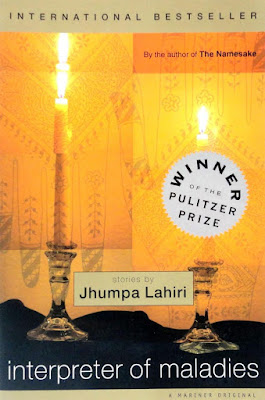
Lahiri, Jhumpa "Interpreter of Maladies"

Lahiri, Jhumpa "Interpreter of Maladies" - 1999

I have read this book in 2015. This was my review back then:

"As most of my friends know, I am not a big fan of short stories. However, I read 'The Namesake' by the same author and really loved it. And several of my friends had recommended 'Interpreter of Maladies' to me, one had even left a copy to me when she was moving, I just had to read it.

I was pleasantly surprised. What a lovely collection of short stories, some of them even interlink, so it doesn't seem like there are a hundred small stories that you forget right away. On the contrary, Jhumpa Lahiri has created some wonderful characters that you won't forget that easily. She incorporates all sorts of problems anyone might face who lives in a culture different from the one they or their parents grew up with. She describes some lovely people (and some not so lovely ones) who are all confronted with a life in two different parts of this world. Since the author is Indian herself and grew up in the United States, this is the background to almost all her stories. Having lived abroad (though not in such a different culture as the characters in the book) almost half of my life myself, I can certainly relate to a few of them.

Jhumpa Lahiri has a good, elegant style, her stories just flow, I will certainly read more of her writings."

A while ago, I joined an online group called Literary Wives/Marriage Plot and this was the next book on our list. So, I re-read the book because it was a while ago that I read it and we read it with a different topic in mind. What does the author say about the wives in his book?

Most of these stories take place in India and/or around Indian couples.

A Temporary Matter

We look at the end of a marriage. A couple suffers from the loss of a baby that was stillborn. They have nothing to say to each other even though they try hard.

When Mr. Pirzada Came to Dine

In this story, a woman remembes a man from East Pakistan/Bangladesh coming to visit her Indian family in the States while his family is back home. It is more a story about the man than about this particular wife but it still gives us an insight into the life of the Indian wives in the US.

Interpreter of Maladies

This is about an Indian American family visiting the country of their heritage. We learn even more about the life of such a wife, she is so lonely. I can relate because as a non-working wife abroad, you don't have the sort of social life your husband and children have and it is hard work to try and find your place.

A Real Durwan (doorkeeper)

This story is about an elderly woman who is a stairsweeper and lives on the roof ot the building she works in.

While this is less about the situation of a wife, it tells us about poverty and how you can be even poorer than all the others around you.

Sexy

We're back in the US. Again, not the story of a wife but of a mistress. And of a husband who is leaving his wife. A good reflection about this kind of situation from every point of view, the wife and the mistress. 

Mrs. Sen's

Her we have the story of an Indian woman living in the States who doesn't drive and doesn't have any contact outside the house. She looks after an eleven year old boy after school and teaches him about their food. Probably one of my favourite stories. I really felt for the lady.

This Blessed House

A yound married Indian couple in Connecticut who moves into their new house and find many Christian relics. The wife puts them on the mantel of the fireplace. A good story about how different people can have different opinions about what to keep and what not and what to embrace. And how they have to work on your marriage.

The Treatment of Bibi Haldar

A woman suffers from seizures and a doctor recommends to marry her off. But it costs money to get married and you have to find a suitor. So, her relatives rather let her live on the roof. This story focuses on the treatment of illness and of prejudices.

The Third and Final Continent

This guy has moved from India to London and then to the States where he rents a room from a 103-year-old lady. They develop a good connection until he gets married and moves out. We follow his and his wife's life and how they get to know each other.

As I mentioned in the stories, they are not all about the wives, some of them don't relate to their status at all, they are just there. But where they are mentioned, we learn a lot about the differences between Indian and (mainly) American wives, their rights and their duties.

I think it also helps to understand why immigrants so often stay among themselves. It is not just about the language, though that doesn't help if nobody teaches them the host language, it is more about the culture and understanding each other. Especially the wives are invisible, they disappear in the crowd. Especially if it has been an arranged marriage, the husband often doesn't understand his wife.

From the back cover:

"Navigating between the Indian traditions they've inherited and the baffling new world, the characters in Jhumpa Lahiri's elegant, touching stories seek love beyond the barriers of culture and generations. In 'A Temporary Matter,' published in The New Yorker, a young Indian-American couple faces the heartbreak of a stillborn birth while their Boston neighborhood copes with a nightly blackout. In the title story, an interpreter guides an American family through the India of their ancestors and hears an astonishing confession. Lahiri writes with deft cultural insight reminiscent of Anita Desai and a nuanced depth that recalls Mavis Gallant."

Jhumpa Lahiri received the Pulitzer Prize for "Interpreter of Maladies" in 2000.

And here are the reviews of the other literary wives:

Becky from Sydney of Aidanvale

Kate from Melbourne of booksaremyfavoriteandbest

Rebecca from Maryland, USA of Bookish Beck

Kay from Washington State, USA of What? Me Read?

Monday, 30 March 2026

Dickey, James "Deliverance"

Dickey, James "Deliverance" - 1970

Apparently, this is one of the most important books of the last century. I read that somewhere but can't find that remark anymore. Still, it seems to have had a great success.

When I read the description, I was afraid this wasn't a book for me and I might not like it. But the description is a little different from the book itself. The story is not as much about the natives but about some criminals in the woods.

Still, the book is totally mesmerizing. And tense. There is so much going on, the trip the four men take is about one of the most horrifying stories I ever read.

Thanks to Karin for the minutes which I will include in the spoiler:

"The book club had a very positive discussion about Deliverance. Almost everyone rated the novel 4/5 or higher, and several readers felt it was close to a five-star book. One of the most praised aspects was the translation, which many felt captured the tone, tension, and atmosphere exceptionally well.

A big part of the conversation focused on how efficiently the novel is built. Compared to many large contemporary literary novels — where hundreds of pages may be spent on background — Deliverance manages to establish its characters, themes, and emotional stakes in about fifty pages. Readers appreciated how tightly the story is framed: first the buildup before the trip, then the intense three days on the river, and finally the aftermath. This clear structure made the story feel focused and impactful.

The characters were widely seen as believable and vividly drawn. We talked a lot about how people react differently in crisis situations: one person freezes while another unexpectedly finds strength, and even serious injury doesn’t necessarily stop someone from acting. The novel felt realistic because the characters make flawed and sometimes foolish decisions in recognizably human ways. Their journey begins partly out of boredom and a desire to escape everyday life, which makes what follows feel even more unsettling.

The discussion also touched on trauma and its aftermath. Rather than being neatly explained, the characters’ experiences linger in ambiguous ways — in memory, in the body, and even in sleep. This subtle psychological impact was something many readers found especially powerful. Several participants noted how the trauma seems disorganized and difficult to articulate, reflecting how real experiences often remain unresolved rather than clearly understood.

Moral questions sparked lively debate. Was it necessary for the characters to hide what happened? Would they have survived if they had trusted the authorities? Would justice have treated them fairly? The novel’s ambiguity — what exactly happened, who was responsible, and how events should be interpreted — kept the discussion open-ended and engaging.

Several readers noticed the careful use of foreshadowing and 'Chekhov’s gun,' where details introduced early gain importance later. The tight pacing and chapter structure were seen as key strengths: nothing feels unnecessary, yet the characters and world feel fully developed.

We also discussed broader themes, including human behavior under pressure, the thin boundary between civilization and survival, encounters with wilderness, and the portrayal of rural stereotypes. Many agreed that the book 'gets under your skin' — even for readers who wouldn’t normally choose this genre.

Notes on the Film Adaptation
Some members had seen the film adaptation and recommended it alongside the book. The movie was described as very effective in showing the physical danger and tension of the river journey. While the novel focuses more on the characters’ inner thoughts and moral uncertainty, the film emphasizes action and atmosphere with the actors even doing their own dangerous stunt work. The group felt the two versions work well together: the book offers psychological depth, and the film adds a strong visual and emotional experience".

Overall Takeaway
"Overall, the group agreed that Deliverance is a balanced, well-crafted novel that combines suspense with psychological depth. Even when it wasn’t stylistically everyone’s personal favorite, it left a strong and lasting impression and proved to be an excellent choice for discussion — a book that continues to provoke thought long after finishing it." 

This was our read in our international online book club in March 2026.

Book Description:

"The heart-stopping classic 1970 novel--an unforgettable tale of violent adventure and profound inner discovery.

Four middle-class men from suburban Altana decide to embark on a three-day canoe trip down a particularly wild section of a river in Georgia. For them the trip represents a break in the domestic routine, a chance for adventure with few real risks, and the last occasion to see a beautiful valley before the river is dammed up. Their leader, an enthusiastic outdoorsman and champion archer, is obsessed by the desire to pit himself against nature.

When two of the group are attacked viciously by sinister mountain men, a mildly adventurous canoe trip explodes into a nightmare of horror and murder. Men stalk and are stalked by other men, the treacherous river becomes a graveyard for those without the strength or the luck to survive, and one man, forced to assume the leadership of the group, must call up his resources to try to achieve deliverance."

Wednesday, 11 March 2026

Turgenev, Ivan "Fathers and Sons"

Turgenev, Ivan "Fathers and Sons" (Russian: Отцы и дети/Otzy i deti) - 1862
I love Russian authors, as all my friends know. But I had never read a book by Turgenjew. So, I was happy that #2 was chosen for our classic spin this term.

Was it as good as most of the other Russian authors I read? Yes, it was. I loved reading about life in Russia in the middle of the nineteenth century, when times started to change, farmers got more freedom, serfdom started to be abolished and the whole order of society was questioned.

Almost any kind of character was described in this book, diffferent ages, different social status, different education, different housholds, town and countryside, students and farmers, parents and children, women and men (which doesn't happen often in those books).

According to Wikipedia, this is considered the first modern Russian novel. I can well believe that. Changes were coming and the author managed to put that situation to paper.

In any case, I can highly recommend this book. And not just to those who love classics and/or Russian literature.

From the back cover:

"Bazarov—a gifted, impatient, and caustic young man—has journeyed from school to the home of his friend Arkady Kirsanov. But soon Bazarov’s outspoken rejection of authority and social conventions touches off quarrels, misunderstandings, and romantic entanglements that will utterly transform the Kirsanov household and reflect the changes taking place across all of nineteenth-century Russia.

Fathers and Sons enraged the old and the young, reactionaries, romantics, and radicals alike when it was first published. At the same time, Turgenev won the acclaim of Flaubert, Maupassant, and Henry James for his craftsmanship as a writer and his psychological insight. Fathers and Sons is now considered one of the greatest novels of the nineteenth century.

A timeless depiction of generational conflict during social upheaval, it vividly portrays the clash between the older Russian aristocracy and the youthful radicalism that foreshadowed the revolution to come—and offers modern-day readers much to reflect upon as they look around at their own tumultuous, ever changing world."

Here are all the books on my original Classics Club list.
And here is a list of all the books I read with the Classics Spin.

Thursday, 26 February 2026

Chevalier, Tracy "The Glassmaker"

Chevalier, Tracy "The Glassmaker" - 2024

I have read quite a few novels by Tracy Chevalier and they were all highly interesting, always about different people in different areas at different times.

But this was special. From the descriptions, I first thought this was a little like the stories by Edward Rutherfurd who guides us through centuries by introducing several people from several families. Well, this was a little different. The story starts in 1494 Orsola Rossa, the protagonist, lives in Murano with her family of glassmakers. After 500 years, she is in her sixties and has lived through a plague, several wars, many changes in the lives of people, especially women.

While I was first a little dismayed by this way of telling the story, I really loved the people in Murano and Venice. Not all, but most of them. And the story of the family and how they got through all the upheavals, was also fantastic. 

You can tell, that Tracy Chevalier put a lot of time and effort into the research. I especially loved to learn about all the details of glassmaking. Well done.

I doubt I will ever get to see Venice but this is a good substitute.

From the back cover:

"Across the lagoon lies Murano. Time flows differently here – like the glass the island’s maestros spend their lives perfecting.

In secret, Orsola Rosso learns to craft glass. As a woman, she must flout convention to save her family from ruin. We follow her through hundreds of years of war and plague, tragedy and triumph, love and loss.

Skipping like a stone across the centuries, The Glassmaker is a virtuoso portrait of a woman, a family and a city that are as everlasting as glass."

Wednesday, 18 February 2026

Garmus, Bonnie "Lessons in Chemistry"

Garmus, Bonnie "Lessons in Chemistry" - 2022

A member of my German book club had suggested this book  but despite everyone agreeing to it at first, it wasn't chosen in the end. But I had already ordered the book, so I wanted to read it.

It certainly would have been a good choice to discuss. I doubt I would have chosen it, had I only seen the cover. On the other hand, I suppose those people who are looking for a romantic chick lit, might be disappointed.

It's hard to describe this book. I would probably declare it as chick-lit though it has some deeper meanings. However, I did like the protagonist a lot, I wish I would have had an Elizabeth Zott in my life when growing up. Even though I am certainly about a decade younger than her, all those obstacles that were placed in the way of women were still around. And there was nobody, absolutely nobody who supported me in my education, not my parents and definitely not my teachers (except for the one in elementary school but he wasn't there anymore later). On the contrary, all I heard was "you will get married and don't need a job". And my boss got a guy in from outside instead of promoting me. For the same reason.

Same as Elizabeth, I had the feeling my whole life that I worked for men less intelligent than me.

The books is described as humorous and there are certain aspects of humour in it, but overal, the sadness is more important and stays more in our memories.

Maybe this story speaks more to a younger audience, it just brought too many bad memories for me. (Although that speaks in favour of the book.) I wouldn't say I disliked the book completly, but it brought me back to a time I'd rather forget. I would have loved to discuss it with my book club and hear what the other women have to say about it.

And last, but not least, some things have changed but not enough. What do you think???

From the back cover:

"Chemist Elizabeth Zott is not your average woman. In fact, Elizabeth Zott would be the first to point out that there is no such thing.

But it's the early 1960s and her all-male team at Hastings Research Institute take a very unscientific view of equality. Forced to resign, she reluctantly signs on as the host of a cooking show, Supper at Six. But her revolutionary approach to cooking, fuelled by scientific and rational commentary, grabs the attention of a nation. Soon, a legion of overlooked housewives find themselves daring to change the status quo. One molecule at a time."

"Lessons in Chemistry" has been chosen favourite book of the year 2022 by the German Indepent Book Shops.

Monday, 22 December 2025

O'Farrell, Maggie "Hamnet"

O'Farrell, Maggie "Hamnet" - 2020

Somebody talked to me about this book. Someone who likes Maggie O'Farrell. I have a vague recollection of who it was but I can't find it again. So, maybe it was someone else. Sorry, whoever you are.

Anyway, it was nice to read about a part of Shakespeare's life that is not so well known. We know that his son died young. That his name was Hamnet and that his father wrote a play called Hamlet. As to the book, the spelling of the name is interchangeable, so it is more or less the same. I mean, Shakespeare himself had about 27 varieties of is last name. Or something like that.

The author mentions that this is a piece of fiction based on only the few facts I mentioned above. So, she lets us know her imagination and we can add to that.

But I still learned about Shakespeare and especially his wife, Anne Hathaway, who is called Agnes in the novel. Because I like to search for more information elsewhere whenever I read a book. Sometimes, you need a starter for that.

And what was also excellent is the description of the grief parents go through when losing a child. That was heartbreaking.

Maggie O'Farrell received several prizes for this book, i.a. the Women's Prize for Fiction 2020.

We discussed this book in our local book club in April 2026.

A few comments from our book club members:

  • Shakespeare's life in London wasn't given enough attention.
  • How is it that such a strong woman suffers so much from the death of her child?
  • We liked the way the transmission of the plague was described.

From the back cover:

"On a summer's day in 1596, a young girl in Stratford-upon-Avon takes to her bed with a fever. Her twin brother, Hamnet, searches everywhere for help. Why is nobody at home?

Their mother, Agnes, is over a mile away, in the garden where she grows medicinal herbs. Their father is working in London.

Neither parent knows that one of the children will not survive the week.

Hamnet is a novel inspired by the son of a famous playwright. It is a story of the bond between twins, and of a marriage pushed to the brink by grief. It is also the story of a kestrel and its mistress; flea that boards a ship in Alexandria; and a glovemaker's son who flouts convention in pursuit of the woman he loves. Above all, it is a tender and unforgettable reimagining of a boy whose life has been all but forgotten, but whose name was given to one of the most celebrated plays ever written."

Monday, 10 November 2025

Murrin, Alan "The Coast Road"

Murrin, Alan "The Coast Road" - 2024

A friend had read this book and lent it to me. It sounded quite interesting, stories about Ireland often are. But, this story really could have taken place almost everywhere. There are people like that in every village. I grew up in a Catholic village in the sixties and seventies, and life there was almost like that. Actually, there are still people around who act similar. However, these characters didn't come across very likely and likeable.

So, an easy read for anyone who is looking for that. Since I usually don't, I didn't enjoy this book that much. Not my thing.

From the back cover:

"It's 1994 in County Donegal, Ireland, and everyone is talking about Colette Crowley - the writer, the bohemian, the woman who left her husband and sons to pursue a relationship with a married man in Dublin. But now Colette is back, and nobody knows why.

Returning to the community to try and reclaim her old life, Colette quickly learns that they are unwilling to give it back to her. The man to whom she is still married is denying her access to her children, and while the legalisation of divorce might be just around the corner, Colette finds herself caught between her old life and the freedom for which she risked everything. Desperate to see her children, she enlists the help of Izzy, a housewife and mother of two, and the women forge a friendship that will send them on a spiralling journey - one toward a path of self-discovery, and the other toward tragedy."

Monday, 6 October 2025

Vreeland, Susan "The Passion of Artemisia"

Vreeland, Susan "The Passion of Artemisia" - 2002

I read "Girl in Hyacinth Blue" by this author a couple of years ago and really loved it. I always wanted to read something else by her. Now, I came across this book and it's about a female paper from the Baroque period. I had never heard of Artemisia Gentileschi even though I love art. Typical, women are never acknowledged much.

To start, I really like the note by the author. She mentioned that any work of fiction about history or a historical character ist still a work of imagination, not of reality. Based on known evidence, she spins her story. She used actual works of the artist and actual occurrences. I loved that.

Her style or writing is very vivid. Her descriptions are very detailed. We could see how people at the time lived, what were their hopes and fears. How did the church impact their lives?

Through this novel, I got to know a wonderful woman, a keen and gifted painter who struggled with the constrictions of the time but who nonetheless created some beautiful art.

I will look for more books by Susan Vreeland. Let me know if you've read one.

From the back cover:

"From extraordinary highs - patronage by the Medicis, friendship with Galileo and, most importantly of all, beautiful and outstandingly original paintings - to rape by her father's colleague, torture by the Inquisition, life-long struggles for acceptance by the artistic Establishment, and betrayal by the men she loved, Artemisia was a bold and brilliant woman who lived as she wanted, and paid a high price."

Monday, 22 September 2025

Benedetti, Mario "The Truce"

Benedetti, Mario "The Truce" (Spanish: La Tregua) - 1960

Diana from Thoughts on Papyrus recommended this book to me. It's not very long, so I read it in between other things. Despite its brevity, it contains a lot, practically everything you need for a long life.

It's about a man nearing retirement. Well, much earlier than most people retire, but the situation is still realistic. He's wondering what he's going to do with the rest of his life. Then he falls in love with a co-worker, and she falls in love with him. After raising his three children alone after the untimely death of his wife, this is a new beginning for him.

In his diary, we can follow his thoughts. It also deals with religion; among other things, he says: "Frankly, I don't know if I believe in God. Sometimes I think that if God really existed, such doubts shouldn't upset him." I think this quote alone says a lot about the book, which I really enjoyed. It's a calm narrative that nevertheless has a lot to say.

From the back cover:

"'Perhaps that moment had been exceptional, but still, I felt alive. That pressure on my chest means being alive.' Forty-nine, with a kind face, no serious ailments (apart from varicose veins on his ankles), a good salary, and three moody children, widowed accountant Martín Santomé is about to retire. He assumes he'll take up gardening, or the guitar, or whatever retired people generally do. What he least expects is to fall passionately in love with his shy young employee Laura Avellaneda. As they embark upon an affair, happy and irresponsible, Martín begins to feel the weight of his quiet existence lift - until, out of nowhere, their joy is cut short. The intimate, heartbreaking diary of an ordinary man who is reborn when he falls in love one final time, this beloved Latin American novel has been translated into twenty languages and sold millions of copies worldwide."

Monday, 15 September 2025

Dostoevsky, Fyodor "A Little Hero"

Dostoevsky, Fyodor "A Little Hero" (Russian: Маленький герой/Malen'kiy geroy) - 1857

Novel in Nine Letters - 1847
A Gentle Creature - 1876
A Little Hero - 1849

This booklet consists of three short stories, but I liked the "Novel in Nine Letters" the best. It's the correspondence between two men who somehow always manage to miss each other. 

Dostoevsky said of this: "When I was penniless the other day, I visited Nekrasov. While I was sitting with him, the idea came to me to write a novel in nine letters. When I returned home, I finished the novel in one night. In the morning, I brought the manuscript to Nekrasov and received 125 rubles for it."

In this story, you can tell that Pyotr Ivanych wants something from Ivan Petrovich and vice versa. One excuse for why the meeting doesn't take place follows another. Very funny.

I had already read "The Gentle One" in another collection. (see here) Also an interesting story about the beginning and end of a relationship and how it all came about.

I found the actual story, or rather the one that adorns the title, rather boring. An eleven-year-old falls in love with his cousin, and the "gentlewomen" of society make this the subject of their amusement, making fun of him, and embarrassing him. Nevertheless, it's a Dostoyevsky story and therefore worth reading in its own right.

From the back cover:

"At that time I was nearly eleven, I had been sent in July to spend the holiday in a village near Moscow with a relation of mine called T., whose house was full of guests, fifty, or perhaps more.... I don't remember, I didn't count. The house was full of noise and gaiety. It seemed as though it were a continual holiday, which would never end. It seemed as though our host had taken a vow to squander all his vast fortune as rapidly as possible, and he did indeed succeed, not long ago, in justifying this surmise, that is, in making a clean sweep of it all to the last stick."

Wednesday, 10 September 2025

Dickens, Charles "Martin Chuzzlewit"

Dickens, Charles "Martin Chuzzlewit. The Life and Adventures of Martin Chuzzlewit" - 1843-44 

I'm a huge fan of Charles Dickens and am glad I read this novel. But I wouldn't recommend it if you haven't read anything else by him. For me, this was one of his worst novels.

Too many characters, even though he was able to include many interesting names. This also meant that some things got lost, such as the main love story, which is what everything supposedly revolves around. But it's barely portrayed. We hardly see the couple together. Otherwise, too much confusion, chaos, one catastrophe after another.

I read somewhere that this is Dickens' most underrated book. I wouldn't say that; I think it landed exactly where it belongs, somewhere at the very bottom of all his fantastic books.

I recommend "David Copperfield" for starters.

From the back cover:

"Old Martin Chuzzlewit believes that greed is so endemic in his family that he disinherits his grandson and hinders his courtship of Mary Graham. As the intricacies of he plot develop the story passes from sunny comedy to the grimmest depths of criminal psychology. Domestic tyranny is tellingly depicted through the household of Mr Pecksniff and public villainy - leading to blackmail and  murder - revealed in the activities of the Anglo-Bengalee Disinterested Loan and Life Assurance Company...

A brilliant satire on selfishness and hypocrisy revolving around a stubborn young protagonist. Martin Chuzzlewit is also one of Dickens's comic masterpieces. Peopled with a cast of characters - including Mrs. Gamp, Poll Sweedlepipe, Montague Tigg and Chevy Slyme - unequalled elsewhere in his novels."

Wednesday, 6 August 2025

Barbery, Muriel "Une Rose Seule"

Barbery, Muriel "A Single Rose" (French: Une Rose Seule) - 2020

I read Muriel Barbery's "The Elegance of the Hedgehog" and found it truly beautiful.

This book was recommended to me as a lovely, light French book. Well, it was light, but perhaps a bit too long-winded for me. Asian thinking is foreign to me, I'm not a yoga or Zen fan, and I can't empathize with myself as much as is often desired.

The author and her protagonist certainly succeeded in doing this, but it wasn't really comprehensible to me. The first few chapters are all about landscapes, flowers, food and drink, temples, etc. I also couldn't warm to Rose, who only thawed out a bit towards the end.

And although I normally enjoy reading philosophical books, this was a bit too much of a good thing for me, too forced.

A Japanese story, a fairy tale, or a fable, was interspersed between the chapters. I found some of them interesting, while others made me wonder what they had to do with the book.

Well, it was nice to read a French book again, and also a good read for our "Paris in July" challenge, but that was about it.

From the back cover:

"From the bestselling author of The Elegance of the Hedgehog comes a story about a woman’s journey, in which she discovers the father she never knew and a love she never thought possible.

Rose has turned forty, but has barely begun to live. When her Japanese father dies and she finds herself an orphan, she leaves France for Kyoto to hear the reading of his will. Paul, her father’s assistant, takes Rose on a mysterious pilgrimage designed by her deceased father. Her bitterness is soothed by the temples, Zen gardens and teahouses, and by her encounters with her father’s friends. As she recognises what she has lost, and as secrets are divulged, Rose learns to accept a part of herself that she has never before acknowledged.

Through her father’s itinerary, he opens his heart posthumously to his daughter, and Rose finds love where she least expects it. This stunning fifth novel from international bestseller Muriel Barbery is a mesmerising story of second chances, of beauty born out of grief."

Monday, 28 July 2025

Gappah, Petina "Out of Darkness, Shining Light"

Gappah, Petina "Out of Darkness, Shining Light" - 2019

Of course, we all know about David Livingstone's search for the source of the river Nile. It is also widely known that his heart was buried in Africa and his body in Europe. This is the story, told by two slaves, how the body got from the middle of Africa to the sea so that he could be transferred to Great Britain.

Two different people tell the story, a women who is employed as a cook. Her story is pretty African, she uses far too many words that the average Europen will not understand. Granted, there is a small annex with explanations but you have to use that far too often and it destroys the enjoyment of any story. Then there is a guy who wants to become a priest. He is preaching already. All the time. Almost every second sentence starts or ends with "dear Lord" or something similar. He comes across as a religious fanatic. Reading the Bible is more wordly.

Have you guessed it already? I didn't like the book.

There was only about one sentence that made me smile. When someone told the other slaves about the meeting between Henry Morton Stanley and David Livingstone, he translated the first sentence (Dr. Livingstone, I presume?) into: "It can only be that you are Bwana Daudi."

We discussed this in our international online book club in July 2025.

Comments from the members:

The start of the book felt slow, and didn't feel pulled into it for the story so much until the murder plot unwound. It was a really nice read though in terms or history and culture. The discussion we had resulted into talking and thinking about African history, slavery, imperialist influences, death rites... The characters in the story were also really distinct. I feel a bit smarter about African history for having read it.

Many in the book club agreed that the language, particularly the religious tone and African dialects, made the beginning difficult to follow. However, as the story progresses, the plot becomes more engaging, especially with the focus on the African slaves who carried Livingstone’s body. Their journey is central to the book, and the contrast between their lives and Livingstone’s European legacy opens up important discussions about colonialism and the erasure of African voices in history. Some felt the religious elements were repetitive, but they were seen as integral to understanding the mindset of the time. Despite the slow start and challenging style, many found the novel’s exploration of historical and cultural themes thought-provoking.

Overall it was a really good discussion book, because we have read some books about African history and by African authors before, it always becomes an interesting part, looking at the books we have read, and how the new books align in with those. In that sense this felt like quite a good book to add to the list.

From the back cover:

"This is the story of the body of Bwana Daudi, the Doctor, the explorer David Livingstone - and the sixty-nine men and women who carried his remains for 1,500 miles so that he could be borne across the sea and buried in his own country.

This is the story of those in the shadows of history: the  dark companions who saved a white man's bones on an epic funeral march - little knowing his corps carried the maps that sowed the seeds of their continent's colonisation and enslavement.

This is the story of how human bravery, loyalty and love can triumph over darkness - and the result is Petina Gappah's radical masterpiece."

Monday, 21 April 2025

Brooks, Geraldine "Year of Wonders"

Brooks, Geraldine "Year of Wonders" - 2001

My goodness, what a story! I have read several books about the plague before or novels that had the plague in their book. But this one was one just about the plague. Well, up until the last couple of pages where another book was more or less forced into just one chapter.

Still, I loved this book about a village that struggled during the plague, that had the idea to shut themselves off from the rest of the world in order not to bring this horrible disease to others. The village existed, the people in the book were based on real people from that time. But it was still a novel.

Apparently, this was Geraldine Brooks' first book. I think she learned not to add such a quick end but I still loved it very much. The author is such a great writer. And I think the Covid-19 pandemic brought the story even closer to us.

From the back cover:

"Spring 1666: when the Great Plague reaches the quiet Derbyshire village of Eyam, the villagers make an extraordinary decision. They elect to isolate themselves in a fateful quarantine. So begins the Year of Wonders, seen through eighteen-year-old Anna Frith’s eyes as she confronts the loss of her family, the disintegration of her community, and the lure of a dangerous and illicit love. Based on a true story, this novel explores love and learning, fear and fanaticism, and the struggles of seventeenth-century science and religion to interpret the world at the cusp of the modern era."

Friday, 18 April 2025

Hislop, Victoria "The Figurine"

Hislop, Victoria "The Figurine" - 2023

I have been a fan of Victoria Hislop since I read her first book "The Island". I have only been to Greece once, and not even to the mainland but to Crete. But through this author, I have come to love the country and this one is one of her best.

The heroine of the book, Helena, has a Scottish father and a Greek mother. And her family does the best thing one can do to a bi-cultural child, they send her to her grandparents for the holidays so that she becomes a fully bilingual child.

The story is so exciting, not just from the language or the Greek point of view, there is so much going on and we can follow Greek history recent and ancient in this one novel. Fantastic.

I don't know which one is my favourite, "The Island" or this one but it certainly is one of the two. Such a beautiful story.

From the back cover:

"'Her love for Greece shines through and transports readers to a brilliantly drawn world' Independent

'Family turmoil, unanswered questions, romance and betrayal, all served up against the backdrop of Greece and its enchanting history' Daily Express

An unputdownable read with a family's dark history giving a unique glimpse into Greece's troubled past. Athens sparkles in Victoria Hislop's imagination. Concealed beneath the dust sheets in the Athens apartment she has inherited from her grandparents, Helena McCloud discovers a hidden hoard of rare antiquities, amassed during a dark period in Greek history when the city and its people were gripped by a brutal military dictatorship. Helena's fascination for archaeology, ignited by a summer spent on a dig on an Aegean island, tells her that she must return these precious artefacts to their rightful place. Only then will she be able to allay the darkness of the past and find the true meaning of home - for cultural treasures and for herself."

Monday, 7 April 2025

Flaubert, Gustave "Madame Bovary"

Flaubert, Gustave "Madame Bovary" (French: Madame Bovary) - 1857

For the Classics Spin #40, we received #4 and this was my novel.

I have a love-hate relationship with French books. I love the French language. I absolutely love the books by Albert Camus, there are a few others I don't exactly dislike but, in general, they are not for me.

I had hoped that this one would be for me like my beloved English classics by Jane Austen, Charles Dickens, the Brontës, etc. etc. But it was not to be.

What did I dislike about the novel? Not the story itself, it was quite interesting to follow the story of Emma, a young girl who marries a doctor but finds her life beside him completely boring so looks for excitement in other men. Or maybe it was the story. It was as boring as the life of the protagonist. So, maybe that's exactly what he was trying to show. Then he succeded. But not with me.

From the back cover:

"Madame Bovary is the debut novel of French writer Gustave Flaubert, published in 1856. The character lives beyond her means in order to escape the banalities and emptiness of provincial life. When the novel was first serialized in La Revue de Paris between 1 October 1856 and 15 December 1856, public prosecutors attacked the novel for obscenity. The resulting trial in January 1857 made the story notorious. After Flaubert's acquittal on 7 February 1857, Madame Bovary became a bestseller in April 1857 when it was published in two volumes. A seminal work of literary realism, the novel is now considered Flaubert's masterpiece, and one of the most influential literary works in history."

Here are all the books on my original Classics Club list.
And here is a list of all the books I read with the Classics Spin.

Monday, 31 March 2025

Weir, Alison "Katharine Parr. The Sixth Wife"

Weir, Alison "Katharine Parr. The Sixth Wife" (Six Tudor Queens #6) - 2021

The sixth wife of Henry VIII. And the sixth book in the Tudor Queens series by Alison Weir.

I think I knew far too little about Katharine Parr. She was Henry's last wife. She survived him. She had two husbands before him. She married again when he died only to die herself in childbed. That's about all I knew.

Of course, this is a novel based on the life of the queens. However, there is a lot in it that is history and where we can learn about that time in England.

We see through the eyes of Katharine Parr that women were just a commodity, and not worth a lot for that. At her first marriage, she doesn't even know the husband. Then she has to look for another one because otherwise a woman has no means to live. When she falls in love with Thomas Seymour, she has to marry the king who also wants her. What a life!

In any case, Alison Weir has brought the Tudor queens to life in a way no history book could ever have done. For that, I thank her profoundly.

From the back cover:

"Two husbands dead; a life marred by sadness. And now Katharine is in love for the first time in her life.

The eye of an ageing and dangerous king falls upon her. She cannot refuse him. She must stifle her feelings and never betray that she wanted another.

And now she is the sixth wife. Her queenship is a holy mission yet, fearfully, she dreams of the tragic parade of women who went before her. She cherishes the secret beliefs that could send her to the fire. And still the King loves and trusts her.

Now her enemies are closing in. She must fight for her very life.

KATHARINE PARR – the last of Henry’s queens.

Alison Weir recounts the extraordinary story of a woman forced into a perilous situation and rising heroically to the challenge. Katharine is a delightful woman, a warm and kindly heroine – and yet she will be betrayed by those she loves and trusts most.

Too late, the truth will dawn on her."

Friday, 7 March 2025

Backman, Fredrik "Britt-Marie was here"

Backman, Fredrik "Britt-Marie was here" (Swedish: Britt-Marie var här) - 2014

This was my second book by Fredrik Backman. And my last. The first one was quite nice, funny, but I couldn't care for this one. I didn't like the protagonist, Britt-Marie because I'm not OCD even though I like order, I don't like football, so that didn't allure me, either. The story is described as "funny and moving", I couldn't find either.

This was a book club book, otherwise I might not have finished it.

We read this in our international online book club in February 2025.

Some comments from the other members:

"It scored pretty low by most others in the discussion.

Some commented that it felt more like a movie script than a real novel. Which makes sense as Backman's books have many of them been filmed both in Sweden and internationally. For me it was a nice light humorous read, maybe more like a fun summer read than real thought raising literature. This despite me hating the main character from the very start. I guess much of Backman's stories are like that, with quite stereotypical characters, and predictable plot and then an uplifting twist at the end. The timeline of the book felt familiar in terms of what was happening in small towns here in the Nordics in maybe 90-s or early 00s. Services being closed down and some neighbourhoods being quite poor. Not really something I believe can be saved by one determined lady and the community. But a nice thought."

From the back cover:

"Britt-Marie can’t stand mess. A disorganized cutlery drawer ranks high on her list of unforgivable sins. She is not one to judge others—no matter how ill-mannered, unkempt, or morally suspect they might be. It’s just that sometimes people interpret her helpful suggestions as criticisms, which is certainly not her intention.

But hidden inside the socially awkward, fussy busybody is a woman who has more imagination, bigger dreams, and a warmer heart that anyone around her realizes.

When Britt-Marie walks out on her cheating husband and has to fend for herself in the miserable backwater town of Borg—of which the kindest thing one can say is that it has a road going through it—she finds work as the caretaker of a soon-to-be demolished recreation center. The fastidious Britt-Marie soon finds herself being drawn into the daily doings of her fellow citizens, an odd assortment of miscreants, drunkards, layabouts. Most alarming of all, she’s given the impossible task of leading the supremely untalented children’s soccer team to victory. In this small town of misfits, can Britt-Marie find a place where she truly belongs?

Funny and moving, sweet and inspiring, Britt-Marie Was Here celebrates the importance of community and connection in a world that can feel isolating."

Monday, 17 February 2025

Takahashi, Yuta "The Chibineko Kitchen"

Takahashi, Yuta "The Chibineko Kitchen" (Japanese: ちびねこ亭の思い出ごはん 黒猫と初恋サンドイッチ/Chibinekoteino omoidegohan kuronekoto hatsukoisandoitchi) (Meals to Remember at the Chibineko Kitchen #1) - 2020

This is an interesting story. I am sure we all have wanted to have one last conversation with a deceased loved one. Now, the Chibineko Kitchen makes this possible. You go there and order a Remembrance Meal. Then, when it is served, the person in question appears and you can have one very last talk with them until the food gets cold.

Sounds desirable, right? The story is heartwarming, it might even help some of us to get over the loss of a loved one.

And there are quite a few nice Japanese recipies in the book.

From the back cover:

"Follow the bank of the Koitogawa river until you reach the beach. From there a path of white seashells will lead you to the Chibineko Kitchen. Step inside, they'll be expecting you.

These are the directions Kotoko has been given. She arrives at the tiny restaurant, perched right by the water, early in the morning. Still reeling from the sudden death of her brother, she's been promised that the food served there will bring him back to her, for one last time.

Taking a seat in the small, wood-panelled room, she waits as Kai, the restaurant's young chef, brings out steaming bowls of simmered fish, rice and miso soup. Though she hadn't ordered anything, Kai had somehow known the exact dish her brother always used to cook for her. And as she takes her first delicious bite, the gulls outside fall silent and the air grows hazy . . .

Soul-nourishing and comforting, The Chibineko Kitchen will help you remember what matters most in life."

Monday, 13 January 2025

Tartt, Donna "The Secret History"

Tartt, Donna "The Secret History" - 1992

"The Secret History" has been on my wishlist ever since I read "The Goldfinch". And this year, I finally got to it. 

And a very impressive story it is. But it's difficult to get into details without giving out spoilers. Just this much. A group of students does something really bad and can only get out of it by doing something even worse. The characters are not really likeable but they get under your skin. You can't follow their actions but somehow you can.

A challenging book that will probably stay with me forever.

Quotes

on migraines:
"Henry, flat on his back in a dark room, ice packs on his head and a handkerchief tied over his eyes.

'I don't get them so often as I once did. When I was thirteen or fourteen I had them all the time. But not it seems that when tey do come - sometimes only once a year - they're much worse. ...'"

on death:
"Is death really so terrible a thing? It seems terrible to you, because you are young, ... It does not do to be frightened of things you know nothing ..."

From the back cover:

"Under the influence of their charismatic classics professor, a group of clever, eccentric misfits at an elite New England college discover a way of thinking and living that is a world away from the humdrum existence of their contemporaries. But when they go beyond the boundaries of normal morality their lives are changed profoundly and for ever."