Showing posts with label Author: Geraldine Brooks. Show all posts

Monday, 21 April 2025

Brooks, Geraldine "Year of Wonders"

Brooks, Geraldine "Year of Wonders" - 2001

My goodness, what a story! I have read several books about the plague before or novels that had the plague in their book. But this one was one just about the plague. Well, up until the last couple of pages where another book was more or less forced into just one chapter.

Still, I loved this book about a village that struggled during the plague, that had the idea to shut themselves off from the rest of the world in order not to bring this horrible disease to others. The village existed, the people in the book were based on real people from that time. But it was still a novel.

Apparently, this was Geraldine Brooks' first book. I think she learned not to add such a quick end but I still loved it very much. The author is such a great writer. And I think the Covid-19 pandemic brought the story even closer to us.

From the back cover:

"Spring 1666: when the Great Plague reaches the quiet Derbyshire village of Eyam, the villagers make an extraordinary decision. They elect to isolate themselves in a fateful quarantine. So begins the Year of Wonders, seen through eighteen-year-old Anna Frith’s eyes as she confronts the loss of her family, the disintegration of her community, and the lure of a dangerous and illicit love. Based on a true story, this novel explores love and learning, fear and fanaticism, and the struggles of seventeenth-century science and religion to interpret the world at the cusp of the modern era."

Tuesday, 7 November 2023

Brooks, Geraldine "Caleb's Crossing" - 2011

Brooks, Geraldine "Caleb's Crossing" - 2011

In our local book club, we always bring a book we just read and loved and then decide which one the group will read. This time, I had brought "People of the Book" because it is my favourite book of the year. But someone else had brought this one and we thought it funny that we both had chosen the same author.

So, we decided to read "Caleb's Crossing". The story takes place at Martha's Vinyard and Harvard College. It tells about the life of the first Native American to graduate from Harvard College. Caleb Cheeshahteaumauk was born around 1646 and he learned English and Latin and all the other subject he needed to graduate.

The author explains that her book is based on the life of Caleb and that the stories about the Wampanoag and the island are true but that the rest is fiction. Still, we can very well believe how life must have been for a young English girl at the time. And there is also a lot of documentation about the life of the Native Americans to make the story plausible.

I love historical fiction and this is a wonderful example of how you can describe life in a past century through both real and fictional characters. This was only my fourth book by Geraldine Brooks, I need to read more.

The other readers also really liked the book and the author. We would like to read "Year of Wonders", her first book.

From the back cover:

"Bethia Mayfield is a restless and curious young woman growing up in Martha's vineyard in the 1660s amid a small band of pioneering English Puritans. At age twelve, she meets Caleb, the young son of a chieftain, and the two forge a secret bond that draws each into the alien world of the other. Bethia's father is a Calvinist minister who seeks to convert the native Wampanoag, and Caleb becomes a prize in the contest between old ways and new, eventually becoming the first Native American graduate of Harvard College. Inspired by a true story and narrated by the irresistible Bethia, Caleb’s Crossing brilliantly captures the triumphs and turmoil of two brave, openhearted spirits who risk everything in a search for knowledge at a time of superstition and ignorance."

Wednesday, 28 June 2023

Brooks, Geraldine "People of the Book"

Brooks, Geraldine "People of the Book" - 2008

This is going to be one of my favourite books this year. Such a wonderful story about a book and its history. I have once read a similar story, well, not a similar story, just a book that tries to follow a piece of art, a painting from today into past until it was created. That was by Susan Vreeland and it was called "Girl in Hyacinth Blue". I loved that one and this was just as interesting.

The main "character" is the Sarajevo Haggada, a Jewish religious book that really exists (see here on Wikipedia or here on The National Museum of Bosnia and Herzegovina website) The word "haggada" is Hebrew for telling, story or account, the book "Haggadah" is a text that describes the order of the Passover Seder.

There are books, even ancient ones, where you know exactly where they come from and who made them. This is not one. The author has put down some ideas and made a wonderful story about it that travels around the whole world. From the Australian conservationist who tries to find some clues that sound just like a crime story we travel back from Bosnia-Herzegovina to Italy, Austria, Spain and to the shores of Ifriqiya (modern day Tunisia, parts of Algeria and Libya). In between, we visit the Untied States and the United Kingdom where the protagonist does not only find out more about the book but also about her family.

I absolutely loved the whole story, how we get to know the different kinds of people who contributed first to the creation of the book and then to the saving of it. Some of the ideas might even be true. Well, we can always dream.

Remarks from the book club:
I partly felt the book was really interesting and wanted to know more about the old stories from history.
The parts about WWII always feel a little too close for comfort anyway.
The author's experience as a journalist shone through the story. But the present day frame-story felt slightly "puff-piece" kind of full with story gaps.
Overall still give it 4/5 or maybe even 4,5/5.

We read this in our international online book club in October 2023.

From the back cover:

"During World War II a Bosnian Muslim risks his life to save the book from the Nazis; it gets caught up in the intrigues of hedonistic 19th-century Vienna; a Catholic priest saves it from burning in the fires of Inquisition. These stories and more make up the secret history of the priceless Sarajevo Haggadah - a medieval Jewish prayer book recovered from the smouldering ruins of the war-torn city.
Now it is in the skilled hands of rare-book restorer Hanna Heath. And while the content of the book interests her, it is the hidden history which captures her imagination. Because to her the tiny clues - salt crystals, a hair, wine stains - that she discovers in the pages and bindings are keys to unlock its mysteries.
"

Wednesday, 19 January 2022

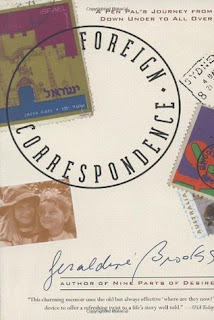
Brooks, Geraldine "Foreign Correspondence"

Brooks, Geraldine "Foreign Correspondence: A Pen Pal's Journey from Down Under to All Over" - 1997

Geraldine Brooks describes how she started writing to many different people from all over the world because she felt so far away from everything. That was the same for me, even though I lived in the middle of Europe. But at the time, the little village in Northern Germany might as well have been on the moon.

Other than that, there wasn't a huge difference in her upbringing and mine. We are about the same age and grew up in similar circumstances, though my parents were purely working class, no former singer or anything, and they were from the same area where they lived and died.

So, I really liked this story because it was also mine. When I was fourteen, I had my first penfriend. She was from Romania, and I met her once even though we are not in touch anymore. But I have two very good penfriends who started writing to me shortly afterwards, from France and the USA, and we are still in touch. The French friend has visited me several times (first alone, then with husband and family) and I have visited her, as well, same thing, first alone, later with husband, then with children.

I have lived abroad for more than half of my life. I think wanting to meet people from other countries stems from my first friendships by letters. I started to learn Esperanto when I got the opportunity and went abroad as soon as I was able to. Having penfriends certainly encouraged me to explore the world further.

But even if you don't belong to the keen letter writers, Geraldine Brooks has a fantastic way of describing her life as well as that of others, totally interesting.

So far, I have only read this book and "March" by Geraldine Brooks. Must change that.

From the back cover:

"As a young girl in a working-class neighborhood of Sydney, Australia, Geraldine Brooks longed to discover the places where history happens and culture comes from, so she enlisted pen pals who offered her a window on adolescence in the Middle East, Europe, and America. Twenty years later Brooks, an award-winning foreign correspondent, embarked on a human treasure hunt to find her pen friends. She found men and women whose lives had been shaped by war and hatred, by fame and notoriety, and by the ravages of mental illness. Intimate, moving, and often humorous, Foreign Correspondence speaks to the unquiet heart of every girl who has ever yearned to become a woman of the world."

Monday, 13 February 2012

Brooks, Geraldine "March"

Brooks, Geraldine "March. A Love Story in a Time of War" - 2006

Who hasn't read "Little Women" and wouldn't mind reading more about the March family. Well, here's your chance.

I am not a big fan of any "sequels" written by other people than the author him/herself, especially not decades or even centuries later. However, Geraldine Brooks is an exception, she writes her novels more like biographies. As in this case. The protagonist of her story is John March, the father of Meg, Jo, Beth, and Amy, Marmee's beloved husband. A lot of his work is told in the background in "Little Women", here we can see the man himself, his ideals, his politics, he was an abolitionist as well as an advocate for women's rights, a dreamer of a better world. As Louisa May Alcott has really told the story of her family, this is the story of her father, Amos Bronson Alcott. He was quite a remarkable man, way ahead of his time and his story is worth reading.

See more comments on my ThrowbackThursday post in 2025.

From the back cover:

"As the North reels under a series of unexpected defeats during the dark first year of the war, one man leaves behind his family to aid the Union cause. His experiences will utterly change his marriage and challenge his most ardently held beliefs. Riveting and elegant as it is meticulously researched, March is an extraordinary novel woven out of the lore of American history.

From Louisa May Alcott’s beloved classic
Little Women, Geraldine Brooks has taken the character of the absent father, March, who has gone off to war, leaving his wife and daughters to make do in mean times. To evoke him, Brooks turned to the journals and letters of Bronson Alcott, Louisa May’s father - a friend and confidant of Ralph Waldo Emerson and Henry David Thoreau. In her telling, March emerges as an idealistic chaplain in the little known backwaters of a war that will test his faith in himself and in the Union cause as he learns that his side, too, is capable of acts of barbarism and racism. As he recovers from a near mortal illness, he must reassemble his shattered mind and body and find a way to reconnect with a wife and daughters who have no idea of the ordeals he has been through.

Spanning the vibrant intellectual world of Concord and the sensuous antebellum South, March adds adult resonance to Alcott’s optimistic children’s tale to portray the moral complexity of war, and a marriage tested by the demands of extreme idealism - and by a dangerous and illicit attraction. A lushly written, wholly original tale steeped in the details of another time, March secures Geraldine Brooks’s place as an internationally renowned author of historical fiction."

Geraldine Brooks received the Pulitzer Prize for "March" in 2006.