Showing posts with label Italy. Show all posts

Thursday, 26 February 2026

Chevalier, Tracy "The Glassmaker"

Chevalier, Tracy "The Glassmaker" - 2024

I have read quite a few novels by Tracy Chevalier and they were all highly interesting, always about different people in different areas at different times.

But this was special. From the descriptions, I first thought this was a little like the stories by Edward Rutherfurd who guides us through centuries by introducing several people from several families. Well, this was a little different. The story starts in 1494 Orsola Rossa, the protagonist, lives in Murano with her family of glassmakers. After 500 years, she is in her sixties and has lived through a plague, several wars, many changes in the lives of people, especially women.

While I was first a little dismayed by this way of telling the story, I really loved the people in Murano and Venice. Not all, but most of them. And the story of the family and how they got through all the upheavals, was also fantastic. 

You can tell, that Tracy Chevalier put a lot of time and effort into the research. I especially loved to learn about all the details of glassmaking. Well done.

I doubt I will ever get to see Venice but this is a good substitute.

From the back cover:

"Across the lagoon lies Murano. Time flows differently here – like the glass the island’s maestros spend their lives perfecting.

In secret, Orsola Rosso learns to craft glass. As a woman, she must flout convention to save her family from ruin. We follow her through hundreds of years of war and plague, tragedy and triumph, love and loss.

Skipping like a stone across the centuries, The Glassmaker is a virtuoso portrait of a woman, a family and a city that are as everlasting as glass."

Thursday, 23 October 2025

Hemingway, Ernest "In Our Time"

Hemingway, Ernest "In Our Time" - 1925

I chose this book because the year 1925 was given for our Read the Year challenge. A whole century ago. I had read a few books from that year already, so the choice was not exactly limited but there wasn't a single book on my wishlist that would fit the challenge. So, I went for an author that I like and that I wanted to read more from.

Had I chosen it if I'd been aware that this is a collection of short stories? Probably not. Granted, they were linked with each other, somehow. But it still wasn't enough to really grip me.

However, this was his first publication and we can see a lot of topics that will come up in his later work. Having read some of those helped.

So, not my favourite of his books.

Book Description:

"A strikingly original collection of short stories and accompanying vignettes that marked Ernest Hemingway’s American debut.

When In Our Time was first published in 1925, it was widely praised for its simple and precise use of language to convey a wide range of complex emotions, and earned Hemingway a place among the most promising American writers of that period. In Our Time contains several early Hemingway classics, including the famous Nick Adams stories 'Indian Camp' and 'The Three Day Blow', and introduces readers to the hallmarks of the Hemingway a lean, tough prose, enlivened by an ear for the colloquial and an eye for the realistic. His writing suggests, through the simplest of statements, a sense of moral value and a clarity of vision.

Now recognized as one of the most important short story collections of twentieth-century literature, In Our Time provides key insights into Hemingway’s later works."

Ernest Hemingway received the Nobel Prize for Literature in 1954 "for his mastery of the art of narrative, most recently demonstrated in 'The Old Man and the Sea' and for the influence that he has exerted on contemporary style".

I contribute to this page: Read the Nobels and you can find all my blogs about Nobel Prize winning authors and their books here.

Find all my Read The Year books here.

Monday, 6 October 2025

Vreeland, Susan "The Passion of Artemisia"

Vreeland, Susan "The Passion of Artemisia" - 2002

I read "Girl in Hyacinth Blue" by this author a couple of years ago and really loved it. I always wanted to read something else by her. Now, I came across this book and it's about a female paper from the Baroque period. I had never heard of Artemisia Gentileschi even though I love art. Typical, women are never acknowledged much.

To start, I really like the note by the author. She mentioned that any work of fiction about history or a historical character ist still a work of imagination, not of reality. Based on known evidence, she spins her story. She used actual works of the artist and actual occurrences. I loved that.

Her style or writing is very vivid. Her descriptions are very detailed. We could see how people at the time lived, what were their hopes and fears. How did the church impact their lives?

Through this novel, I got to know a wonderful woman, a keen and gifted painter who struggled with the constrictions of the time but who nonetheless created some beautiful art.

I will look for more books by Susan Vreeland. Let me know if you've read one.

From the back cover:

"From extraordinary highs - patronage by the Medicis, friendship with Galileo and, most importantly of all, beautiful and outstandingly original paintings - to rape by her father's colleague, torture by the Inquisition, life-long struggles for acceptance by the artistic Establishment, and betrayal by the men she loved, Artemisia was a bold and brilliant woman who lived as she wanted, and paid a high price."

Tuesday, 10 December 2024

Oates, Joyce Carol "Blonde"

Oates, Joyce Carol "Blonde" - 2000

I find it hard to write this review. I love books by Joyce Carol Oates, I think she deserves the Nobel Prize. I am intrigued by the figure of Marilyn Monroe, I read the book "Marilyn" (Goodreads) by Norman Mailer ages ago. I think I was expecting something along that line.

What I got was a description of a child who didn't stand a chance in the world. How she became one of the greatest icons in the film industry? That was a long and arduous way and it didn't bring her any joy.

I had to remind myself often that this was just a book based on the real life story of the film star, even though most of the facts were true.

It was a long and heavy read. Did I enjoy it as much as the other JCO books? I'm not sure but I'm glad I read it.

From the back cover:

"In 'Blonde' we are given an intimate, unsparing vision of the woman who became Marilyn Monroe like no other: the child who visits the cinema with her mother; the orphan whose mother is declared mad; the woman who changes her name to become an actress; the fated celebrity, lover, comedienne, muse and icon. Joyce Carol Oates tells an epic American story of how a fragile, gifted young woman makes and remakes her identity, surviving against crushing odds, perpetually in conflict and intensely driven. Here is the very essence of the individual hungry and needy for love: from an elusive mother; from a mysterious, distant father and from a succession of lovers and husbands. Joyce Carol Oates sympathetically explores the inner life of the woman destined to become Hollywood’s most compelling legend. 'Blonde' is a brilliant and deeply moving portrait of a culture hypnotised by its own myths and the shattering reality of the personal effects it had on the woman who became Marilyn Monroe."

Monday, 30 October 2023

Voltaire "Candide"

Voltaire "Candide, or Optimism" (French: Candide, ou l'Optimisme) - 1759

For the Classics Spin #35, we received #2 and this was my novel.

An interesting take on the Age of Enlightenment.

Candide is a young guy who lives in Germany. He falls in love with a girl but is prevented from marrying her because of her parents. He learns the philosophy "All is for the Best" and travels around the world with this belief.

He probably encounters as many troubles as Homer's Odysseus in the "Odyssey" and solves them almost with the same vigour.

The novel promises to be funny and indeed it is. I have laughed quite a few times during the reading. How can a book be funny and philosophical at the same time? I'm not surprised Voltaire is still such a renowned author even more than two centuries later. I am really happy #2 was pulled for this challenge because I really enjoyed the story.

This novel reminded me a little of Eichendorff's "Life of a Good For Nothing", although it should be the other way around since this one was written earlier. Other than the German novel, I could see more philosophy in this book.

From the back cover:

"Candide tells of the hilarious adventures of the naïve Candide, who doggedly believes that 'all is for the best' even when faced with injustice, suffering, and despair. Controversial and entertaining, Candide is a book that is vitally relevant today in our world pervaded by - as Candide would say - 'the mania for insisting that all is well when all is by no means well.'"

Monday, 28 August 2023

Arnim, Elizabeth von "The Enchanted April"

Arnim, Elizabeth von "The Enchanted April" - 1922

A book club book. My very first novel by Elizabeth von Arnim. I might have chosen another one, I don't know.

The book seems a bit dated in parts, but we had a really nice conversation about it. It's funny, the readers really liked it, and we may read another book by her soon.

The author has led an interesting life, first married to a Prussian nobleman, then had an affair with H.G.
Wells, followed by a second marriage to an English aristocrat. Her story reads like a novel.

As for the book, I didn't really identify with the characters, but then again, they lived a full century ago.

Four English women who hardly know each other go on vacation together. They rent a house and, of course, don't get along at all, because everyone has different ideas.

Well, times have changed - fortunately - and women don't see themselves as complete until they have a man in their life.


From the back cover:

"Four women, with very different backgrounds and characters - the artless Lottie Wilkins, the pious Rose Arbuthnot, the cantankerous Mrs Fisher and the haughty Lady Caroline Dester - respond to an advertisement in The Times offering a medieval castle to rent in Italy that April. As their joint holiday begins, tensions flare up between them, but they soon bond over their past misfortunes and rediscover hope and the pleasures of life in their tranquil surroundings."

Tuesday, 30 May 2023

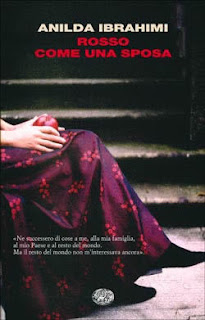
Ibrahimi, Anilda "Red Like a Bride"


Ibrahimi, Anilda "Red Like a Bride" (Italian: Rosso come una sposa) - 2008

This Italian book has not been translated into English but because it is available in other languages (Finnish, French, German, Serbian), some of us read it in our international online book club. I read the German translation: Rot wie eine Braut.

For a long time, we hardly heard anything about Albania. You knew the country was secluded, no one came in, even fewer less came out.

In this book we are told about life behind the curtain. We get to know four generations of women, starting with Saba, who was married to her sister's widower at the age of 15 and had nine children by him, five girls and four boys.

The war changes the position of women, they get an education and become more independent, also in the countryside. We live through the different generations up to Dora who is telling the story.

The title alludes to the tradition that in Albania a bride would be dressed all in red.

An interesting story about life in a country we still don't know much about. Well written, easy to read. I liked it very much.

This was discussed in our international online book club in May 2023.

The group had a really good discussion about it, it was very well liked among everyone, both from the interesting perspective of Albanian history and culture, and the different stories moving along the book along the lives of the women the story told about towards modern times, how life goes on and is connected. The group thought it was a high quality read, and warmly would recommend it and gave it 5 out of 5 points.

Book description (translated):

"Four generations of women, a chest full of memories, the start of a new life Young Dora left her native Albania to start a better life in Italy. In the distance, the memories of her family, who have lived a simple life in the small mountain village of Kaltra for generations, determined by archaic traditions, suddenly seem like they are from another time. But whenever she opens the chest that was left to her by Saba, the grandmother, takes Saba's red wedding veil in her hands and smells the familiar smell of quince, the past comes to life before her eyes..."

Tuesday, 11 April 2023

Lagerkvist, Pär "Barabbas"

Lagerkvist, Pär "Barabbas" (Swedish: Barabbas) - 1950

For the The Classics Spin #33, we were given #18, and this was my novel.

Almost a novella, but this novel needs no more pages. We all know Barabbas, the one in whose place Jesus was crucified. But what do we know about him other than his name? Here Pär Lagerkvist thought about what might have happened to Barabbas afterwards.

The story is believable, many early Christians went the way Barabbas goes in the book. There is the wish to believe, the doubt, the inability to come to terms with what happens. Something that still is in every Christian today, I think.

And even if this is not at all what happened to the protagonist, it's an interesting thought to see what could have been.

They even made a film out of the story, Barabbas was portrayed by Anthony Quinn.

From the back cover:

"Barabbas is the acquitted; the man whose life was exchanged for that of Jesus of Nazareth, crucified upon the hill of Golgotha. Barabbas is a man condemned to have no god. 'Christos Iesus' is carved on the disk suspended from his neck, but he cannot affirm his faith. He cannot pray. He can only say, 'I want to believe.'"

Pär Lagerkvist received the Nobel Prize for Literature in 1951 "for the artistic vigour and true independence of mind with which he endeavours in his poetry to find answers to the eternal questions confronting mankind".

I contribute to this page: Read the Nobels and you can find all my blogs about Nobel Prize winning authors and their books here.

By the way, this is where I heard about the book in the first place: The Content Reader.

Wednesday, 25 January 2023

Ondaatje, Michael "The English Patient"

Ondaatje, Michael "The English Patient" - 1992

I have read "Anil's Ghost" and "Warlight" by Michael Ondaatje both of which I really liked. I had been looking forward to reading this one for ages, so when I came across the book lately, I decided it was finally time to read it.

There might have been a reason why I didn't tackle it before. I was not as happy with it as I had been with the others. Maybe I should have stayed away from it because it received the Booker Prize, I rarely like those, and I have no idea why.

It was quite confusing at times. Who is the author talking about? At what time is he talking? Before the war? During the war? After the war? Are they in Italy or in Egypt, in Canada or India? And why is that English couple in the story? I know, I know, they met the English patient before but it still is weird, somehow it doesn't fit.

I saw a review where someone said the people in the book were not speaking like people in the 1940s. That might be one of the reasons, as well.

But what really bothered me was that you didn't really get to know the people very well, they remain shallow, trivial, superficial.

I might have enjoyed this more, had I not read and loved his other books and therefore expected a brilliant novel. This is an okay novel but that's all. So, I might wait a while until I read the next book by this author.

From the back cover:

"With unsettling beauty and intelligence, Michael Ondaatje's Booker Prize-winning novel traces the intersection of four damaged lives in an abandoned Italian villa at the end of World War II. The nurse Hana, exhausted by death, obsessively tends to her last surviving patient. Caravaggio, the thief, tries to reimagine who he is, now that his hands are hopelessly maimed. The Indian sapper Kip searches for hidden bombs in a landscape where nothing is safe but himself. And at the center of his labyrinth lies the English patient, nameless and hideously burned, a man who is both a riddle and a provocation to his companions - and whose memories of suffering, rescue, and betrayal illuminate this book like flashes of heat lightning."

Wednesday, 7 September 2022

Saviano, Roberto "Gomorrha"

Saviano, Roberto "Gomorrah: A Personal Journey Into the Violent International Empire of Naples' Organized Crime System" (Italian: Gomorra: Viaggio Nell’impero Economico E Nel Sogno Di Dominio Della Camorra) - 2006

For most of us it's just "the" mafia, but there are so many sub-groups and they go by many other names. The Camorra is an organization made up of different families from Naples and Campania.

The author received death threats after the book's publication. A quote from Winston Churchill goes well with this: "You have enemies? Good. That means that you have stood up for something, sometime in your life." It's good that we have people like that.

We learn so much about the machinations of these people, it's hard to believe. I read this book ages ago, but it still has an impact. The author describes how the fashion and clothing industry is infiltrated, how the drug trade arises from this, how banks are also influenced, arms trade, they don't even stop at construction and disposal. There is hardly an area in which there is no criminal involvement. If it's lucrative, the Camorra is involved.

Quote from the author from an interview:

"Whatever I would like my life to be, the fact is, I wrote Gomorrah, and I pay the price every day. (…)
I’m attacked not just by the Camorra, but also by parts of civil society and even by journalists who are ashamed that they’ve never spoken out against the mafia, and that their silence makes them complicit
."

Also: "You only do good if you can also do bad things. A failed existence on the other hand, a joke, a do-nothing person can only do good things, but that's a gift, it's worth nothing. Something is good when you consciously decides to do so, because one could also do the bad." That applies to many areas, or actually to all.

From the back cover:

"A groundbreaking major bestseller in Italy, Gomorrah is Roberto Saviano's gripping nonfiction account of the decline of Naples under the rule of the Camorra, an organized crime network with a large international reach and stakes in construction, high fashion, illicit drugs, and toxic-waste disposal. Known by insiders as "the System," the Camorra affects cities and villages along the Neapolitan coast, and is the deciding factor in why Campania, for instance, has the highest murder rate in all of Europe and whycancer levels there have skyrocketed in recent years.

Saviano tells of huge cargoes of Chinese goods that are shipped to Naples and then quickly distributed unchecked across Europe. He investigates the Camorra's control of thousands of Chinese factories contracted to manufacture fashion goods, legally and illegally, for distribution around the world, and relates the chilling details of how the abusive handling of toxic waste is causing devastating pollution not only for Naples but also China and Somalia. In pursuit of his subject, Saviano worked as an assistant at a Chinese textile manufacturer, a waiter at a Camorra wedding, and on a construction site. A native of the region, he recalls seeing his first murder at the age of fourteen, and how his own father, a doctor, suffered a brutal beating for trying to aid an eighteen-year-old victim who had been left for dead in the street.

Gomorrah is a bold and important work of investigative writing that holds global significance, one heroic young man's impassioned story of a place under the rule of a murderous organization.
"

Monday, 25 July 2022

Bellow, Saul "Humboldt's Gift"

Bellow, Saul "Humboldt's Gift" - 1975

I try to read the latest Nobel Prize winner for Literature and at least one former one every year. This was my fourth one since the last laureate was announced. I still need to get a copy of one of Abdulrazak Gurnah's books before the next announcements in October.

Apparently, this book didn't just get the Pulitzer Prize, it is also said that it won Saul Bellow the Nobel Prize. In his acceptance speech, he called on writers to be beacons for civilization and awaken it from intellectual torpor.

An intense book, there is so much to talk about. The relationship between Charlie Citrine, our protagonist, and his friend Von Humboldt Fleisher, a renowned author who takes Charlie under his wings. Whilst he is only at the beginning of this career, he tells us this story from the point of view when it has more or less ended.

When I was reading the book, I'd been wondering whether this might have been a biography, or at least partly a biography. I then found out, that this is a "roman à clef" (French for novel with a key), a novel about real-life events that is overlaid with a façade of fiction. The fictitious names in the novel represent real people, and the "key" is the relationship between the nonfiction and the fiction. Aha! In this case, it's about the author's friendship with the poet Delmore Schwartz with Bellow being Citrine. Well, I'd never heard of Delmore Schwartz and now I have learned a lot about him (not just form the book, I also looked him up on Google and Wikipedia.) Very interesting, read the information in the links.

While this is probably a good account of Bellow's and Schwartz' relationship, the book also tries to come to terms with the constant changes in the world, especially in culture. The difference between the ideal world and the real one is a big topic in this book that was only supposed to be a short story but then ended up with almost 500 pages.

Brilliant storytelling with lots of fields covered: literature, culture, divorce, relationships, parenting, alcoholism, madness … and also all types of characters from all levels social classes, including a Mafia boss. Oh, and there's quite a bit of humour in the story, as well.

The Times mentions that "Bellows is one of the most gifted chroniclers of the Western World alive today." Apart from the fact that he has passed away in the meantime, I totally agree. So, if you're in for a great read, this is worth picking up.

From the back cover:

"For many years, the great poet Von Humboldt Fleisher and Charlie Citrine, a young man inflamed with a love for literature, were the best of friends. At the time of his death, however, Humboldt is a failure, and Charlie's life has reached a low point: his career is at a standstill, and he's enmeshed in an acrimonious divorce, infatuated with a highly unsuitable young woman and involved with a neurotic mafioso. And then Humboldt acts from beyond the grave, bestowing upon Charlie an unexpected legacy that may just help him turn his life around."

Saul Bellow received the Nobel Prize for Literature in 1976 "for the human understanding and subtle analysis of contemporary culture that are combined in his work" and the Pulitzer Prize for "Humboldt's Gift" also in 1976.

I contribute to this page: Read the Nobels and you can find all my blogs about Nobel Prize winning authors and their books here.

Wednesday, 11 May 2022

Sampedro, José Luis "The Etruscan Smile"

Sampedro, José Luis "The Etruscan Smile" (Spanisch: La sonrisa etrusca) - 1985

The Etruscan Smile is set in Italy but written in Spanish by a Spaniard. It is about an old farmer in Calabria who was a resistance fighter in his youth. Now he is ill and has to go to his son in Milan. From the South to the North. The transition is pretty tough.

But this way he also gets to know and love his grandson.
Through him he finds the meaning of life. He mixes the little boy's problems with his experiences from the war. He learns many new emotions, especially to forgive his enemies, but also to see the good in people.

An excellent book, very touching and heartwarming.

Book Description:

"A tough old farmer from southern Italy takes pride in his time served as a partisan during World War II. Due to a serious medical condition, he must move in with his son and daughter-in-law in Milan. While disliking life in the northern city, the relations between the old man and his tender grandson evolve, transforming his life during his final days."

I took the picture from the movie they made where they have changed the location but you can find the English text of the book here.

Wednesday, 4 May 2022

Agus, Milena "From the Land of the Moon"

Agus, Milena "From the Land of the Moon" or: The House in Via Manno (Italian: Mal di pietre) - 2006

An interesting tale about the life of a woman who cannot break out of the prescribed path. One would like to leave immediately for Sardinia. Or at least to Milan. Definitely to Italy. 

This is a short but very powerful story about family history, told by the granddaughter of the woman in question.

The original title is "Kidney Stones". The unnamed married woman is sent away to treat her kidney stones and then she meets the love of her life. They even turned it into a film in the meantime, see here.

From the back cover:

"But what do we really know about other people? In this international bestselling novel, a young unnamed Sardinian woman explores the life of her grandmother, a romantic, bewitching, eccentric figure, and a memorable literary creation. Her life has been characterized by honor and fierce passion, and above all by an abiding search for perfect love that has spanned much of the twentieth century. Ever in the background of this remarkable woman's story is the stunning Sardinian landscape, the deep blues of the Mediterranean, the rugged mountains of the Sardinian back-country dotted with charming villages lost in time.

With warmth, great humor, and deep insight Milena Agus writes about the customs and the beauty of her native Sardinia, about love, family, immigration, war, and peace.
From the Land of the Moon is the moving English debut of one of Italy s most important new literary talents."

Wednesday, 23 March 2022

Eichendorff, Joseph von "Life of a Good-For-Nothing"

Eichendorff, Joseph von "Life of a Good-For-Nothing" aka "Memoirs of a Good-For-Nathing" (German: Aus dem Leben eines Taugenichts und andere Novellen) - 1826

German is a good language for romanticism. We can wallow in words, we can praise nature and anything we like to praise with overwhelming expressions. And that is just what Joseph von Eichendorff does.

As in any book by this genre, don't expect too much deep thinking or philosophy, even though it is in there, just on a low level. Nowadays, I would certainly classify this as chick lit, a novel about someone who doesn't fit in and finds a happy end.

From the back cover:

"Following a row with his father, a young man leaves home, and - following a series of picturesque wanderings - eventually finds love with the girl of his dreams. Deeply imbued with the style of German Romanticism, this classic story is at once an exhilarating romp and an exemplary distillation of 19th-century thought."

Monday, 20 December 2021

Shakespeare, William "Much Ado About Nothing"

Shakespeare, William "Much Ado About Nothing" - 1598/99

As many of you might know, I am not the biggest fan of reading plays. I love seeing them in the theatre or even on TV and I always say that's what they were written for. However, from time to time, I really want to read a Shakespeare play, especially since it has been almost impossible for me to watch anything in the theatre since the beginning of Covid.

One of my favourite shows on TV is "Much Ado About Nothing" by and with the great Kenneth Brannagh as Benedick with his then-wife Emma Thompson (of whom I am also a huge fan) as Beatrice.

Some time ago, I found the "No Fear" reading version of the play and thought, that sounds interesting. The lovely thing with this is, you don't just get a modern version of the play, you get the original wording right next to it, on the left-hand side with the new one on the right. Plus explanations of old expressions etc. Brilliant. Especially for people who are not used to reading classics.

Of course, having seen the play helped a lot in understanding what was going on. But I might try to read some more of the Bard of Stratford-upon-Avon from this publisher.

Description:

"In Much Ado About Nothing, Shakespeare includes two quite different stories of romantic love. Hero and Claudio fall in love almost at first sight, but an outsider, Don John, strikes out at their happiness. Beatrice and Benedick are kept apart by pride and mutual antagonism until others decide to play Cupid."

From the back cover:

"No Fear Shakespeare gives you the complete text of Much Ado About Nothing on the left-hand page, side-by-side with an easy-to-understand translation on the right.
Each No Fear Shakespeare contains:
The complete text of the original play
A line-by-line translation that puts Shakespeare into everyday language
A complete list of characters with descriptions
Plenty of helpful commentary
"

Wednesday, 17 November 2021

Highsmith, Patricia "The Talented Mr. Ripley"

Highsmith, Patricia "The Talented Mr. Ripley" - 1955


This is my seventh Classic Spin and we were given #12.

I found this book on a swap shelf, otherwise I probably wouldn't have even looked at it, I'm not much into crime stories. I had heard of Mr. Ripley through the film of the same name with Matt Damon and Jude Law but never watched it, for the same reason as I normally wouldn't have read this book.

However, Patricia Highsmith is an author with a high reputation and I thought I ought to read at least one of her books. And I'm glad I did. Not because I really enjoyed the story all that much but because she was a talented author.

The characters reminded me a little of "The Great Gatsby", those young people living without any aim or task, only thinking about themselves.

I know there are a lot more books about Tom Ripley but I doubt I'll read any of them, even though the story was well written, this is not my kind of thing.

From the back cover:

"Tom Ripley is struggling to stay one step ahead of his creditors and the law, when an unexpected acquaintance offers him a free trip to Europe and a chance to start over. Ripley wants money, success and the good life and he's willing to kill for it. When his new-found happiness is threatened, his response is as swift as it is shocking."

Thursday, 5 August 2021

Twain, Mark "A Tramp Abroad"

Twain, Mark "A Tramp Abroad" - 1880

I have often remarked how much I love Bill Bryson, specifically his travel books. I was told by a few people that I ought to read those of Mark Twain about his travels to Europe. So I did. Five years ago, I read "The Innocents Abroad" and found that it wasn't just the most boring book ever but also a very racist one. I was then told that "A Tramp Abroad" was a lot better. Okay, I gave him another chance.

Maybe I didn't like his judgment about Europe but even more, I think, I didn't like the way he portrayed the American tourist. And, again,  I couldn't find any humour in his writing.

I didn't find this book as racist as his first one (though that is still no excuse for some of the diatribes) but he was still rambling on and on, mostly about nothing at all. Boring, boring, boring. I guess this will be my last book by Mark Twain, unless I'll reread "Tom Sawyer" and "Huckleberry Finn" again one day with my grandchildren, if ever I should have any.

From the back cover:

"Twain's account of traveling in Europe, A Tramp Abroad sparkles with the author's shrewd observations and highly opinionated comments on Old World culture, and showcases his unparalleled ability to integrate humorous sketches, autobiographical tidbits, and historical anecdotes in a consistently entertaining narrative. Cast in the form of a burlesque walking tour through Germany, Switzerland, France, and Italy, A Tramp Abroad includes among its adventures a voyage by raft down the Neckar and an ascent of Mont Blanc by telescope, as well as the author's attempts to study art - a wholly imagined activity Twain 'authenticated' with his own wonderfully primitive pictures in this volume."

Monday, 3 May 2021

Andersson, Per J. "From the Swede who took the train and saw the world with different eyes"

Andersson, Per J. "From the Swede who took the train and saw the world with different eyes" (aka: Take the train: on the track through history, present and future) (Swedish: Ta tåget: på spåret genom historien, samtiden och framtiden) - 2019

This is one of the books where I found an English title (even two English titles in this case) but no picture of the cover. So, I hope it has been translated. If not, sorry, let's hope it will get a translation. Because it is a good book. It's not what I expected. It thought this was a description of his travels. And it is, in a way. But it was more a description of his time in the train in order to get to the places rather than about the places itself.

It starts by the author travelling by train with his parents as a little child. It includes a description of his grandparents who worked for the train company in Sweden. Then he goes on how he travelled as a teenager by interrail and later with his children when they reached that age. He visits Italy and Germany, India and Nepal, the USA, takes the Orient Express. And mainly, he advocates travels by train in order to save the world.

I used to take the train a lot when I was younger. From fifth grade onwards, I took the train to get to my secondary school, at the beginning it was even a steam train which always amazes most of my American friends. Then, I used it to get to work. I also participated in the Interrail community, I went to Scandinavia (Denmark, Sweden, Finland) with it, Great memories. And all in all, a very well written book.

The author also mentioned quite a few films that include train rides:
The Arrival of a Train (French: L'arrivée d'un train en gare de La Ciotat), 1896
The General, 1926
The Lady Vanishes, 1938
Tåg 56, 1943
Brief Encounter, 1945
Strangers on a Train, 1951 (Hitchcock)
North by Northwest, 1959 (Hitchcock)
From Russia with Love, 1963 (James Bond)
The Train, 1964
Closely watched trains (Czech: Ostře sledované vlaky), 1966
The Taking of Pelham One Two Three, 1974
Runaway Train, 1985
The Darjeeling Limited, 2007

Then there are books that mention train rides:
Greene, Graham "Stamboul Train" - 1932
Christie, Agatha "Murder on the Orient Express" - 1934 (the story was also turned into several wonderful films, my favourite Hercule Poirot is, of course, David Suchet, but the greatest landscapes can be seen in the recent one by Sir Kenneth Branagh)
Guthrie, Woody "This Land is My Land" - 1943
Theroux, Paul "The Great Railway Bazaar" - 1975
MacLean, Alistair "Death Train" - 1989
Diski, Jenny "Stranger on a Train - Daydreaming and Smoking Around America" - 2002
Nair, Anita "Ladies Coupé" - 2001
Liksom, Rosa "Compartment No. 6" (Finnish: Hytti nro 6) - 2012

I am sure we can all find other books where trains play an important role. I can think of a few, some of them I've read, others are on my wishlist, others I just came across.

Christie, Agatha "4:50 from Paddington" - 1957
- "The Mystery of the Blue Train" - 1928
Dickens, Charles "Dombey and Son" - 1848
Fowler, Christopher "Hell Train" - 2011
Hawkins, Paula "The Girl on the Train" - 2015
Hay, Ashley "The Railwayman's Wife" - 2013
Highsmith, Patricia "Strangers on a Train" - 1950
MacNeill, Alastair "Alistair MacLean's Death Train" - 1989
Mercier, Pascal "Night Train to Lisbon" (German: Nachtzug nach Lissabon) - 2004
Nesbit, E "The Railway Children" - 1906
Pasternak, Boris "Doctor Zhivago" (Russian: Доктор Живаго = Doktor Živago) - 1957
Rowling, J.K. "Harry Potter and the Philosopher’s Stone" (US: "Harry Potter and the Sorcerer’s Stone) - 1997
Stoker, Bram "Dracula" - 1897
Tolstoy, Leo (Толстой, Лев Николаевич) "Anna Karenina" (Russian: Анна Каренина = Anna Karenina) - 1877
Verne, Jules "Around the World in Eighty Days" (French: Le tour du monde en quatre-vingts jours) - 1873

He also has a good website (in Swedish): Bloggarvagabond

And this is the German cover:

From the back cover: (Description here.)

"All Aboard! How You Learn to Stop Worrying About Climate Change and Love to Travel by Train
Per J. Andersson

A powerful reflection on the importance of train travel and a mesmerizing love letter to trains

In times of climate change and shifting global powers, traveling by train can offer not only a green alternative but also fascinating way of exploring the distance between two places and the people you meet on the way…

In this book Per J Andersson makes us his travel companions on enthralling train rides throughout the world. We embark on classic train journeys through the gruff North of England and on Indian railroads, on exhausting long-haul train rides through America and even on a trip on the infamous Orient Express from Paris to Istanbul.

While we watch the world roll past us through the windows, Andersson tells us all about what we see and about everything else hidden from our view: from stories and meanings behind train stations to the multi-layered history of train travel itself, its value in different times and places, how humans experience and use trains and what impact the railway will have in the future. As trains represent participation, social responsibility and environmental awareness, everyone who believes in a future for the railway also believes in the value of caring for future generations.

Per J. Andersson has written an exciting and informative book that will make every train ride an astonishing experience.
"

Monday, 29 March 2021

Rhoides, Emmanuel "The Curious History of Pope Joan"

Rhoides, Emmanuel (Emmanuel Roidis) "The Curious History of Pope Joan" (Greek: Πάπισσα Ιωάννα/Papissa Ioanna) - 1866

With my book club, I read "Pope Joan" by Donna Woolfolk Cross twenty years ago (my, how time flies!) At some point, I bought this older book about the same subject because it was on a reduced shelf in my bookshop.

Same as the first book I read, this didn't really impress me that much. Granted, there might have been a female pope, I can well believe that but the story itself wasn't too exciting. Also, I couldn't detect the humour that some people loved so much.

However, there is some information about life in the 9th century. That's always nice.

Since this was a Greek book, I read it in German. "Die Päpstin Johanna von Ingelheim"

From the back cover:

"'Pope Joan' or 'Papissa Joanna' was originally published in 1886 by the Greek author Emmanuel Royidis. It tells the story of Pope John VIII, the purported ruler of Xendom for a period of two years, five months & four days in the middle of the 9th century. 'Pope Joan' is a comic masterpiece of irreverence towards the medieval Church & the accepted pieties of its revisionist historians. Indeed, insofar as Royidis continued to propagate the legend of Pope Joan, to claim that the work contained only 'facts & events proved beyond discussion', the text itself ingeniously combines history, legend & wit to subvert claims of authority. As Durrell notes in his Preface to his English translation & adaptation, 'the authorities of the Orthodox Church were horrified by what seemed to them to be the impious irony of its author - & no less by the gallery of maggot-ridden church fathers which he described so lovingly.' Not suprisingly, Royidis was excommunicated from the Orthodox Church, his book banned in Greece.

The first three parts of 'Pope Joan' tell of Joanna prior to her arrival in Rome, before she became an historical personage. Set in the 9th century, the narrative captures Europe after the death of Charlemagne, a time when civilization was tenuous & the Church provided one of the few viable social structures. This part is the imagined story of Joanna's life in Germany & then in Greece. After her parents die, Joanna clandestinely enters a monastery where she meets the monk Frumentius & develops a romantic relationship with him. When her gender is surmised, Joanna & Frumentius flee one monastery & then another, eventually ending up in Greece. Joanna soon becomes tired of romance & her intellectual brilliance attracts the attention of Church leaders thruout Greece. She leaves Frumentius & departs alone for Rome, where the legend, some say the history, of Pope Joan begins. She becomes a papal secretary renowned for her intellect &, when Pope Leo IV dies, she ascends to the papacy. Pope Joan becomes pregnant & dies after giving birth during a procession thru Rome.

While the general outline of the narrative may seem only mildly interesting, the translation of Lawrence Durrell, together with the biting, irreverent wit of Royidis, make 'Pope Joan' a work of comic genius. A flavor for this wit & style can be found in a passage describing what ensued after Joan gave birth: 'Great was the consternation when a premature infant was produced from among the voluminous folds of the papal vestments...Some hierarchs who were profoundly devoted to the Holy See sought to save the situation & change horror & disgust to amazement by crying out A miracle! A miracle! They bellowed loudly calling the faithful to kneel & worship. But in vain. Such a miracle was unheard of; & indeed would have been a singular contribution to the annals of Xian thaumaturgy which, while it borrowed many a prodigy from the pagans, had not yet reached the point where it could represent any male saint as pregnant & bringing forth a child.'

While the apologist position has denied the historicity of Pope Joan, there is some suggestion that the legend is factual. As Durrell suggests in his Preface, one telling point is that Platina includes a biography of Pope John VIII in his 'Lives of the Popes'. The Catholic Encyclopedia states: 'Platina's Lives of the Popes is a work of no small merit, for it is the first systematic handbook of papal history. ' Historical disputation aside, however, 'Pope Joan' stands as a brilliant work of comic writing & translation."

Monday, 8 February 2021

Goethe, Johann Wolfgang von "Italian Journey"

Goethe, Johann Wolfgang von "Italian Journey" (aka Letters from Italy) (German: Italienische Reise) - 1817

Goethe is considered one of the greatest thinkers in the world. He was not just a writer of novels, poetry and play, he was also a scientist and an artist. One of his most famous non-fictional publications is the "Theory on Colours", published in 1810, including his colour wheel and a very early study on the physiological effects of colour.

In his late thirties, he embarked on a trip to Italy, not a two week holiday like we are used to nowadays, no, he stayed for more than a year, travelled through the country and observed their culture and art.

In this book, he tells us all about his visits to the various parts of Italy, the museums and operas, his meeting the local population. Since not many people could travel at the time, it was something like a travel documentary you might watch on television today of a place you know you will never get to visit.

But he didn't just do a sightseeing tour, he also made botanical, mineralogical, geological and geographical researches and made quite a few discoveries, e.g. on the propagation of plants.

So, if any of this interests you, I can heartily recommend the book. After all, he was a perfect author and could tell stories in a way not many can. However, if you think the topic is too dry, I recommend other works by Goethe, e.g. "The Sorrows of Young Werther" (German: Die Leiden des jungen Werther).

But it is certainly worth reading Goethe. I hope he is as great in the translations as he is in German. In the "Country of Poets and Thinkers", he truly is one of the greatest. His thoughts are still as up to date as they were 200 years ago.

From the back cover:

"In 1786, when he was already the acknowledged leader of the Sturm und Drang literary movement, Goethe set out on a journey to Italy to fulfil a personal and artistic quest and to find relief from his responsibilities and the agonies of unrequited love. As he travelled to Venice, Rome, Naples and Sicily he wrote many letters, which he later used as the basis for the Italian Journey. A journal full of fascinating observations on art and history, and the plants, landscape and the character of the local people he encountered, this is also a moving account of the psychological crisis from which Goethe emerged newly inspired to write the great works of his mature years."
 
The picture on the cover of the English book (Goethe in the Roman Campagna) was painted by his friend Johann Heinrich Wilhelm Tischbein whom Goethe visited in Rome during his travels. The picture is both the most famous one by Tischbein as well as the most famous one of Goethe.