Showing posts with label Language. Show all posts

Tuesday, 20 January 2026

Brandreth, Gyles "Have You Eaten Grandma?"

Brandreth, Gyles "Have You Eaten Grandma?" - 2017

I know Gyles Brandreth from TV, mainly from panel shows. And he is always really, really funny. When I saw the title of this book, I just had to get it. I already enjoyed writings like "Eats, Shoots and Leaves" by Lynne Truss (not to be confused with the "minor royal" or "local dignity" Liz Truss) and this one was just as great.

Just as in his shows, the author is simply hilarious. He can teach us about the English language and make a great joke at the same time. 

As a non-native speaker, I am always surprised at mistakes like mixing up their, there and they're. What's the problem? Are people really so dumb or do the just not care. I suppose the latter because 90% of internet users cannot be dyslexic.

If only everyone would read this book, we could pass on a great legacy to our descendants.

And if you ever have someone correct your English, don't call them Grammar Nazis. They want to improve your English, not kill you. Call us nerds, if you like.

From the back cover:

"Don't know if it's, like, okay to say 'like'?
Are your apostrophe's in the wrong place?
Should it be 'past' or 'passed'?
Want to make fewer not less grammatical mistakes?

Then do not despair, Gyles Brandreth's Have You Eaten Grandma? is the definitive (and hilarious) guide to punctuation, spelling, and good English for the twenty-first century.

Sunday Times best-selling author and grammar guru, Gyles pokes fun at the linguistic foibles of our time, tells us where we've been going wrong (and how to put it right), and reveals his tips and tricks to make every one of us better, more confident users (not abusers) of the English language."

Monday, 17 March 2025

Clarke, Stephen "Talk to the Snail"

Clarke, Stephen "Talk to the Snail. Ten Commandments for Understanding the French" - 2006

I have read two books by Stephen Clarke, so far. This was my third. While the others were fiction about an English guy living in Paris (well, the story is based on the author's life), this is a non-fiction book about the French people and the French language. Quite funny at times. Unless you're a very serious French person who doesn't have a sense of humour. I've lived abroad half of my life (though not in France) and I can see where some of his frustration comes from. 

There are so many parts in this book where I just nodded - or where I had to shake my head. There were a lot of things that I remarked in England, e.g. when he complains that the French don't use French words for illnesses or medication. I had that same experience in England. Unless it's a common cold, the use mainly Latin or Greek words, even for the doctors they go to. 

Then there are the international problems, like not getting on with your neighbours, that's not just a problem an Englishman in France has. And not getting served in a restaurant. How often do you have to dislocate your arm or should in order to get the attention of a waiter? Not just in France, I am sorry to say.

Still, there are a lot of helpful hints in the book, language- and otherwise. And the author hasn't lost his humour, either. Lovely book.

From the back cover:

"The only book you'll need to understand what the French really think, how to get on with them and, and most importantly, how to get the best out of them. With useful sections on:

  • Making sure you get served in a café
  • Harassing French estate agents
  • Living with bacteria
  • Pronouncing French swear-words
  • Surviving the French driving experience
  • Falling in amour, Paris-style
  • And beaucoup beaucoup more!

Don't go to France without reading this book!"

Wednesday, 28 August 2024

Garfield, Simon "To the Letter: A Curious History of Correspondence - A Celebration of the Lost Art of Letter Writing"

Garfield, Simon "To the Letter: A Curious History of Correspondence - A Celebration of the Lost Art of Letter Writing" - 2013

I read a book by Simon Garfield a couple of years ago: "On the Map. Why the World Looks the Way it Does".

I really loved it. And since I love letters just as much as I love maps, I just had to get this one.

It is an interesting book about the development of letters, how they came into existence in the first place, how they changed over the centuries, what they mean today in a world of e-mails and phone messages.

I used to be a keen letter writer and was really looking forward to this book. And though it is a good survey into the habit of letter writing and contained some nice anecdotes, I found it a little boring at times. I don't mind jumping around in a story but this was all a little too haphazardly.

That might have been one of the reasons why I didn't read this in one go, I just couldn't get my head around his structure.

Also, he mentions a lot of authors and books in his work, a table of contents would have been nice.

I still like writing letters.

A nice quote:

"Today is the tomorrow we worried about yesterday."

He also mentions a letter subscripion where you receive an actual letter by one of your favourite authors twice a month. It still exists and you can find all about it here at "The Rumpus". I couldn't find out whether they also send something abroad but there are quite a few US readers here, so maybe something for them.

From the back cover:

"To the Letter tells the story of our remarkable journey through the mail. From Roman wood chips discovered near Hadrian's Wall to the wonders and terrors of email, Simon Garfield explores how we have written to each other over the centuries and what our letters reveal about our lives.

Along the way he delves into the great correspondences of our time, from Cicero and Petrarch to Jane Austen and Ted Hughes (and John Keats, Virginia Woolf, Jack Kerouac, Anaïs Nin and Charles Schulz), and traces the very particular advice offered by bestselling letter-writing manuals. He uncovers a host of engaging stories, including the tricky history of the opening greeting, the ideal ingredients for invisible ink, and the sad saga of the dead letter office. As the book unfolds, so does the story of a moving wartime correspondence that shows how letters can change the course of life.

To the Letter is a wonderful celebration of letters in every form, and a passionate rallying cry to keep writing."

Monday, 30 January 2023

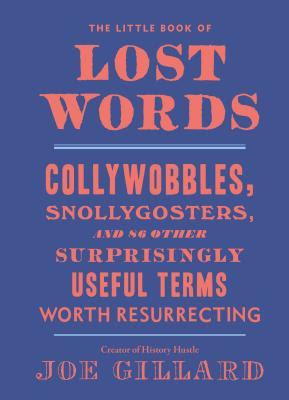
Gillard, Joe "The Little Book of Lost Words"

Gillard, Joe "The Little Book of Lost Words. Collywobbles, Snollygosters, and 86 Other Surprisingly Useful Terms Worth Resurrecting" - 2019

I found this book through Lisa's blog Captivated Reader (here). The title was so amusing, I just had to have a look.

And the title keeps what it promises. There are lots of forgotten words, or words you never knew. Some of my favourites are "betweenity" (being in the middle, or between two things), "namelings" (people who possess the same name), "slugabed" (a person who sleeps in later than is appropriate) and "ultracrepidarian" (a person with opinions on subjects beyond their knowledge). Arnet' they all fantastic?

I wasn't too keen on the pictures, even though they stem from some famous classic artists. But I didn't buy the book for the pictures.

A great book for any lover of words. Thank you, Lisa.

From the back cover:

"The founder of History Hustle presents a handy guide for expressing yourself with history's best words.

This collection features scores of unique words from history that deal with surprisingly modern issues like sleeping in and procrastination - proving that some things never change!
The Little Book of Lost Words presents each term that's ready to be brought back into modern-day use, complete with definition, hilarious sample sentence, and cheeky historical art. You'll learn new words for the cozy room where you like to Netflix and chill (snuggery), for a dishonest politician (snollygoster), and for a young person who sleeps through the day and doesn't work (dewdropper). If you like Lost in Translation, Shakespeare Insult Generator, Drunk History, and Roald Dahl - and you delight in the way words like blatteroon and flapdoodle roll off the tongue - then you're the word lover this book was written for. Want to know what a fizgig or groke is? Read this book!"

Monday, 10 May 2021

See, Lisa "Snow Flower and the Secret Fan"

See, Lisa "Snow Flower and the Secret Fan" - 2005

Lily and her friend Snow Flower were both born on "the fifth day of the sixth month of the third year of the Daoguang Emperor's reign" which translated into June 5, 1824 in our calendar. Because of that and some other traits they have in common, they are destined to be "laotong", we would probably say BFFs (best friends forever) today. Yet, same as their husbands, they don't choose the laotong themselves, it's the stars that predict it.

I have already read another book by Lisa See, "Peony in Love", where she mainly writes about the Chinese culture about death and how to take care of your dead ancestors. This one is more about the living, especially the women, the way women in the 19th century in China lived. Not only were they more or less confined to the women's chambers (and the kitchen) of the house, they also had to endure foot binding. This horrible custom gets described very well in this book and while I have read many books about China (my first ones were by Pearl S. Buck when I was a teenager), I don't recall it ever being described so vividly. It's also interesting to see how important it was to have small feet, the smaller, the more marriageable a young girl would be, the better her station in life later on.

It is hard for us today to even understand how parents could do that to their children. And how women were treated in general. How could a mother do that to her daughter? Well, first of all, they all get told all their life that women aren't worth anything and that they raise their daughters for another family. But they want them to have a comfortable or at least half-way decent life. And culture dictated that women had to have small feet. The smaller the feet, the better the marriage. I doubt I could have done that today but it's easy to make that judgment from our point of view. We can decide not to get married or choose our own husbands without big problems. But back then it was essential for survival.

But we also read about Nü Shu, a secret phonetic form of 'women's writing which is something that fascinated me from the moment I heard about it. And the custom that a woman only started living with her husband (and his family) once she had given birth to her first child. Until then, she stayed with her parents and then she would only return to them on certain days of the year when everyone else did the same.

In the book, Lily starts looking back at her life from the view of an 80-year-old woman. She tells us all about her life in her native family, her married family, her friendship and breakup with Snow Flower, her life during the Taiping Rebellion (Wikipedia), her roles as daughter, wife, mother, friend. She doesn't leave anything out.

I also thought it was interesting how important horoscopes were. Lily and Snow Flower were horses which meant they were free-spirited and independent, but also hardworking.

But the language in the book is also beautiful, makes you want to read on and on.

A very interesting novel if you are interested in history, China, or the life or women in general.

From the back cover:

"In nineteenth-century China, in a remote Hunan county, a girl named Lily, at the tender age of seven, is paired with a laotong, 'old same', in an emotional match that will last a lifetime. The laotong, Snow Flower, introduces herself by sending Lily a silk fan on which she’s painted a poem in nu shu, a unique language that Chinese women created in order to communicate in secret, away from the influence of men.

As the years pass, Lily and Snow Flower send messages on fans, compose stories on handkerchiefs, reaching out of isolation to share their hopes, dreams, and accomplishments. Together, they endure the agony of foot-binding, and reflect upon their arranged marriages, shared loneliness, and the joys and tragedies of motherhood. The two find solace, developing a bond that keeps their spirits alive. But when a misunderstanding arises, their deep friendship suddenly threatens to tear apart.
"

Thursday, 21 January 2021

Snider, Grant "I Will Judge You by Your Bookshelf"

Snider, Grant "I Will Judge You by Your Bookshelf" - 2020

Every once in a while, we all need a picture book. I often find cute little comics on the internet, more often than not, if they are about reading, Grant Snider is the originator. So, I was happy to find this book.

A couple of years ago, I already talked about this in my blogpost "Judge a reader by his books". So, I was happy to find a like-minded person here.

There are some wonderful pages here, like the "book fair" that gives us all the little booths you will find, just with a different title (fresh-squeezed romance, deep-fried memoir, ice-cold true crime or self-help on a stick for the food stalls, for example). Just cute. Or "The Portrait of Parent Reading". Or "Behind every great novelist is a …" And then there is a guide to the "National Department of Poetry". It's tough to find the best bits, these are just some short examples I found while flipping through the book.

But the best part of the book is: you can get it out again and again and have a wonderful time, it always makes you smile. It's funny, creative, a great way of showing us how we are. Readers of the world, unite. And read Grant Snider!

From the back cover:

"A look at the culture and fanaticism of book lovers, from beloved New York Times illustrator Grant Snider
 
It’s no secret, but we are judged by our bookshelves. We learn to read at an early age, and as we grow older we shed our beloved books for new ones. But some of us surround ourselves with books. We collect them, decorate with them, are inspired by them, and treat our books as sacred objects. In this lighthearted collection of one- and two-page comics, writer-artist Grant Snider explores bookishness in all its forms, and the love of writing and reading, building on the beloved literary comics featured on his website, Incidental Comics. With a striking package including a die-cut cover,
I Will Judge You By Your Bookshelf is the perfect gift for bookworms of all ages."

Monday, 18 January 2021

Pamuk, Orhan "The Naïve and the Sentimental Novelist"

Pamuk, Orhan "The Naïve and the Sentimental Novelist" (Turkish: Saf ve Düşünceli Romancı) - 2011

One of my favourite authors talks about one of my favourite subjects: books. What could go wrong?

Nothing. Orhan Pamuk talks about his view of writing, his approach to literature in just the same enchanting way as he describes the characters in his novels. He goes through various forms of writing for all of which he gives good examples from well-known literature (see list below). He uses a lot of Russian literature, especially comes back to "Anna Karenina" a lot.

This is an introduction to literature, how to understand it and what to make of it. It would probably be a great book for students of any language but certainly those who study literature. I have yet to find a book by this fabulous author where I don't learn at least a little. Here, I have learned a lot.

If he hadn't received it already, I would have suggested him for the Nobel Prize many times, but certainly after this book.

From the back cover:

"From the Nobel Prize-winning novelist, an inspired, thoughtful, and deeply personal book about reading and writing novels. 

In this fascinating set of essays, based on the talks he delivered at Harvard University as part of the distinguished Norton Lecture series, Pamuk presents a comprehensive and provocative theory of the novel and the experience of reading. Drawing on Friedrich Schiller’s famous distinction between 'naïve' writers - those who write spontaneously - and 'sentimental' writers - those who are reflective and aware - Pamuk reveals two unique ways of processing and composing the written word. He takes us through his own literary journey and the beloved novels of his youth to describe the singular experience of reading. Unique, nuanced, and passionate, this book will be beloved by readers and writers alike."

Orhan Pamuk "who in the quest for the melancholic soul of his native city has discovered new symbols for the clash and interlacing of cultures" received the Nobel Prize for Literature in 2006.

Orhan Pamuk received the Peace Prize of the German Book Trade (Friedenspreis) in 2005.

You can read more about the books I read by one of my favourite authors here.

I contribute to this page: Read the Nobels and you can find all my blogs about Nobel Prize winning authors and their books here. Read my other reviews of the Nobel Prize winners for Literature.

List of books and/or authors mentioned:
Abū Nuwās (al-Ḥasan ibn Hānī al-Ḥakamī) (~756-814)
Albrecht, Michael von (1933-)
Alighieri, Dante (1265-1321)
Allston, Washington (1779-1843)
Aristoteles "Physics" (Φυσικὴ ἀκρόασις/Phusike akroasis) ~4th century
Auden, W.H. "The Shield of Achilles" - 1952
Austen, Jane (1775-1817)
Bakhtin, Michail (1895-1975)
Balzac, Honorée de "Father Goriot" (Le Père Goriot) - 1835
- "The Human Comedy" (La Comédie humaine) - 1829–48
Barnes, Julian "A History of the World in 10½ Chapters" - 1989
Beaudelaire, Charles (1821-67)
Beauvoir, Simone de (1908-86)
Benjamin, Walter (1892-1940)
Bhabha, Homi K. (1949-)
Borges, Jorge Luis (1899-1986)
Bourdieu, Pierre (1930-2002)
Broch, Hermann (1886-1951)
Brod, Max (1884-1968)
Bulgakov, Michail "The Master and Margarita" (Мастер и Маргарита/Master I Margarita) - 1866-67
Butor, Michel (1926-2016)
Cabrera Infante, Guillermo "Three Sad Tigers" (Tres tristes tigres) - 1967
Calvino, Italo "Invisible Cities" (Le città invisibili) - 1972
- "If on a Winter's Night a Traveller" (Se una notte d’inverno un viaggiatore) - 1979
Çelebi, Evliya (1611-83)
Cervantes, Miguel de "Don Quixote, vols. 1 and 2" (El Ingenioso Hidalgo Don Quijote de la Mancha) - 1605-1615
Christie, Agatha "Murder on the Orient Express" - 1934
Coetze, J.M. (1940-)
Coleridge, Samuel Taylor "Biographia Literaria or Biographical Sketches of My Literary Life and Opinions" - 1817
- "The Rhyme of the Anicent Mariner" - 1798
Conrad, Joseph (1857-1924)
Cortázar, Julio "Hopscoth" (Rayuela) - 1963
Defoe, Daniel "Robinson Crusoe" - 1719
Desai, Kiran (1971-)
Dick, Philip K. (1928-82)
Dickens, Charles "David Copperfield" - 1850
- "Oliver Twist" - 1838
Diderot, Denis (1713-84)
Dikbaş, Nazim (1973-)
Dostoevsky, Fyodor "The Brothers Karamazov" (Братья Карамазовы/Brat'ya Karamazovy) - 1879-80
- "Demons" aka "The Possessed" (Бесы/Bésy) - 1871´-72
Eco, Umberto (1932-2016)
Ekrem, Recaizade Mahmut "Araba Sevdazi" - 1896
Eliot, George (1819-80)
Eliot, T.S. "Hamlet and his Problems" - 1919
Faulkner, William "As I lay dying" - 1930
- "The Sound and the Fury" - 1929
- "The Wild Palms/The Old Man or If I Forget Thee Jerusalem" - 1939
Fielding, Henry "The History of Tom Jones, a Foundling" - 1749
Firdausi, Abu l-Qasem-e (940-1020)
Flaubert, Gustave "Madame Bovary" (Madame Bovary) - 1857
- "Sentimental Education" (L’Éducation sentimentale) - 1869
Forster, E.M. "Aspects of the Novel" - 1927
Foucault, Michel "What Is an Author?" (Qu’est-ce qu’un auteur?) - 1969
Frank, Joseph "Dostoevsky: The Miraculous Years" - 1995
García Márquez, Gabriel (1927-2014)
Gautier, Théophile (1811-72)
Goethe, Johann Wolfgang von (1749-1832)
Greenblatt, Stephen (1943-)
Habermas, Jürgen (1929-)
Hakmen, Roza (1956-)
Handke, Peter (1942-)
Hedayat, Sadegh "The Blind Owl" (بوف کور/Boof-e koor) - 1936
Heidegger, Martin (1889-1976)
Highsmith, Patricia (1921-95)
Homer "Iliad" (Ἰλιάς, Iliás)
- "Odyssey" (Ομήρου Οδύσσεια, Odýsseia) - 800-600 BC
Horace "The Art of Poetry" (Ars Poetica) ~19 BC
Huyssen, Andreas (1942-)
Iser, Wolfgang (1926-2007)
James, Henry "The Golden Bowl" - 1904
Joyce, James "Finnegans Wake" - 1939
- "Ulysses" - 1922
Kafka, Franz "The Metamorphosis" (Die Verwandlung) - 1912
Kundera, Milan "The Unbearable Lightness of Being" (Nesnesitelná lehkost bytí) - 1984
Le Carré (1931-2020)
Lem, Stanisław (1921-2006)
Leskov, Nikolai "Lady Macbeth of the Mtsensk District" (Леди Макбет Мценского уезда Ledi Makbet Mtsenskovo uyezda) - 1865
Lessing, Gotthold Ephraim "Laocoon: or, The limits of Poetry and Painting" (Lakoon oder Über die Grenzen der Malerei und Poesie) - 1766
Lukács, György "The Theory of the Novel" (Theorie des Romans) -1974
Mann, Thomas "Buddenbrooks: The Decline of a Family" (Buddenbrooks) - 1901
- "The Magic Mountain" (Der Zauberberg) - 1924
Manzoni, Alessandro "The Betrothed" (I Promessi Sposi) - 1827
Melville, Herman "Bartleby, the Scrivener" - 1853
- "Moby Dick or The Whale" - 1851
Molière "The Miser" (L'avare) - 1668
Montaigne, Michel de (1533-1592)
Murasaki, Lady Shikibu "The Tale of Genji" (源氏物語/Genji Monogatari) - early 11th century
Nabokov, Vladimir Vladimirovich "Lolita" - 1955
- "Pale Fire" - 1962
Naipaul, V.S. "Finding the Centre" - 1984
- "In a Free State" - 1971
Nerval, Gérard de "Sylvie" (Sylvie) - 1853
Nietzsche, Friedrich (1844-1900)
Ortega y Gasset, José - 1883-1955
Pamuk, Orhan "The Black Book" (Kara Kitap) - 1990
- "Cevdet Bey and His Sons" (Cevdet Bey ve Oğulları) - 1982
- "Istanbul - Memories of a City" (İstanbul: Hatıralar ve Şehir) - 2003
- "The Museum of Innocence" (Masumiyet Müzesi) - 2008
- "My Name is Red" (Benim Adim Kirmizi) - 1998
- "The Silent House" (Sessiz Ev) - 1983
- "Snow" (Kar) - 2002
- "The White Castle" (Beyaz Kale) - 1985
Perec, Georges "Life; A User's Manual" (La vie mode d'emploi) - 1978
Poe, Edgar Allen "The Philosophy of Composition" - 1846
 - "The Raven" - 1845
Proust, Marcel "In Search of Lost Time" (À la recherche du temps perdu) - 1913-27
- "Swann's Way" (Du côté de chez Swann) - 1913
Rabelais, François (~1483-94-1553)
Robbe-Grillet, Alain (1922-2008)
Rousseau, Jean-Jacques "Confessions of Jean-Jacques Rousseau" (Les Confessions) - 1782
- "Julie; or, The New Heloise" (Julie ou la Nouvelle Héloïse) - 1761
Rumi "Masnavi" (Masnavi-ye-Ma'navi/مثنوی معنوی‎) ~1273
Sartre, Jean-Paul "The Words" (Les Mots) - 1964
Schiller, Friedrich "Über naive und sentimentalische Dichtung" (On Naïve and Sentimental Poetry) - 1795
Shakespeare, William "Macbeth" - 1606
Shklovsky, Viktor (1893-1984)
Şoray, Türkan (1945-)
Stendhal "The Charterhouse of Parma" (La Chartreuse de Parme) - 1839
- "The Red and the Black" (Le Rouge et le Noir) - 1830
Sterne, Laurence "The Life and Opinions of Tristram Shandy, Gentleman" - 1759-67
- "Sentimental Journey through France and Italy" - 1768
Strindberg, August "The Son of a Servant" (Tjänstekvinnans son) - 1886
Sue, Eugène (1804-57)
Tanizaki, Jun'ichirō "Naomi" (痴人の愛/Chijin no Ai) - 1925
Tanpınar, Ahmet Hamdi "The Time Regulation Institute" (Saatleri Ayarlama Enstitüsü) - 1961
Thomas, Bernard "Old Masters" (Alte Meister) - 1895
Tolstoy, Leo "Anna Karenina" (Анна Каренина/Anna Karenina) - 1877
- "War and Peace" (Война и мир/Woina I Mir) - 1868/69
Vargas Llosa, Mario "Aunt Julia and the Scriptwriter" (La tía Julia y el escribidor) - 1977
Woolf, Virginia "Mrs. Dalloway" - 1925
- "The Waves" - 1931
Wordsworth, William (1770-1850)
Yourcenar, Marguerite "The Abyss" (L'Œuvre au noir) - 1968
- "Memoirs of Hadrian" (Mémoires d'Hadrien) - 1951
- "That Mighty Sculptor, Time" (essay "Ton et langage dans le roman historique" from "Le Temps, ce grand sculpteur") - 1983
Zola, Émile "Nana" (Nana) - 1880

Monday, 28 September 2020

Sanders, Ella Frances "Lost in Translation


Sanders, Ella Frances "Lost in Translation. An Illustrated Compendium of Untranslatable Words from Around the World" - 2014

I recently read that a linguaphile is a person who loves language and words. They can be interested in many different things such as learning to speak several different languages or simply nerding out about words in general.

I think they definitely go together. You just want everyone to partake in your wisdom you acquired by learning those languages. LOL. I certainly nerd out everyone in my environment and thoroughly enjoy it.

So, a book like "Lost in Translation" is just the right one for me. I saw words I know well like "gezellig" from the Dutch = The feeling of butterflies in your stomach, usually when something romantic or cute takes place. Mind you, the Dutch also use it in the same form as the Danes use "hygge". Or "Kummerspeck" from German, literally meaning "grief-bacon". It's excess weight we gain from emotional overeating. And "Ubuntu", meaning "I find my worth in you, and you find your worth in me." More or less human kindness. While this is a Bantu word and I don't speak that language, I've learned this word through my Esperanto life, just another reason to learn the international language. And "Tsundoku", from the Japanese, which means you leave a book unread after buying it. This, of course, I know because I tend to do that, as well. Another word from my native language you might like is "Kabelsalat", literally "cable salad", it describes a mess of very tangled cables, as one can imagine when one hears the word.

These are just a few of the many interesting words the author has put together and illustrated with her beautiful drawings. A great book for any language nerd.

From the back cover:

"Did you know that there's a Finnish word, PORONKUSEMA, meaning the distance a reindeer can travel before needing to rest?


Or that in Germany they have the very handy KUMMERSPECK: literally, grief-bacon, the weight we gain from emotional overeating?


Ever wished there was a word to convey the time it takes to eat a banana (approximately 2 minutes)? No sweat, in Malay it's PISANZAPRA?


This delightful compendium celebrates the words from across the globe that remains stubbornly - tantalizingly - not quite translatable.
"

P.S.: Don't confuse this with the following, though that is also brilliant:
Croker, Charlie "Løst in Tränšlatioπ. Misadventures in English Abroad" (Lost in Translation) - 2006

Monday, 18 May 2020

Yaourter, Mondegreen, Lorem Ipsum and Pangrams

While watching an episode of the fabulous Maigret series with Rowan Atkinson, I tried to decipher the text in the theme song. Even though I speak French and can usually understand French songs, I had trouble deciphering this one. I found out that the song is not French at all, just sounds like it, as if someone who doesn't speak French, thinks he understands the words and repeats them like that.

The French have a word for it "yaourter" (to yoghurt). There is also an English word for that, usually when someone misinterprets a word in their own language. The English word is "mondegreen" and comes from the misunderstanding of the line from "The Bonnie Earl o’ Moray":
"They ha’e slain the Earl o’ Moray / And laid him on the green." which is made into "They ha’e slain the Earl o’ Moray / And Lady Mondegreen."

There is also a Japanese word that is used for the homophonic translation of songs, Soramimi.

Anyway, I thought this was so interesting that I wanted to know more.

In the meantime, there is a hypothesis about what the text could mean.

La-bas le chat est sur le toit
Le chien chasse dans la rue
L'oiseau, il vole dans le ciel
Et moi vois tout la tout
Mais toujours
La-bas toujours
Quelqu'un regarde moi
Toujours
La-bas toujours
Quelqu'un regarde vous


Which means in English more or less:
There the cat is on the roof,
the dog chases in the street.
The bird, it flies in the sky
And I see it all
But always
Down there always
someone looks at me
always
down there always
someone looks at you.


Mind you, I listened to the song again after I found the "lyrics". I don't know what accent that person is supposed to be speaking. I have talked to French people from the South of France to the South of Belgium plus Candians and Swiss from the different French speaking regions, I never heard anyone like this. 😉

While researching, I found another interesting word that I hadn't heard about but it goes with this subject: greeking.

Lorem ipsum vim ut utroque mandamus intellegebat, ut eam omittam ancillae sadipscing, per et eius soluta veritus.

Looks Latin, right? But it doesn't mean anything. Well, my Latin isn't good enough to judge whether there are roots in it that can be interpreted, as some people claim.

Publishers and graphic designers use it when they design text blocks, so they don't have to put any specific text there but can see what it looks like with a text. Also, you don't get tempted to actually read and understand the text and can concentrate on the layout.

I always thought they might use sentences like "The quick brown fox jumps over the lazy dog", a pangram, or sentence that contains all the letters of the alphabet. We used it when learning to type (on the typewriter) and later on when trying out whether a typewriter did actually function alright and no letter was "hanging". Nowadays, people use it to compare fonts.

Monday, 4 May 2020

Adjective Order in the English Language

I haven't read the book "The Elements of Eloquence: How to Turn the Perfect English Phrase" by Mark Forsyth but maybe I should.

I happened upon this quote from his book that is interesting to any non-native speaker of English but probably also to any native speaker who wants to know more about their language.

Anyway, the quote is:

"Adjectives, absolutely have to be in this order: opinion-size-age-shape-colour-origin-material-purpose Noun. So, you can have a lovely little old rectangular green French silver whittling knife. But if you mess with that order in the slightest, you’ll sound like a maniac."

Of course, I've looked it up elsewhere and found some more information, so "Google is my best friend" … and they gave me the following list:

Generally, the adjective order in English is:
•    Quantity or number.
•    Quality or opinion.
•    Size.
•    Age.
•    Shape.
•    Colour.
•    Proper adjective (often nationality, other place of origin, or material)
•    Purpose or qualifier.

Beginnings
• Initially
• At first
• To start with
• First of all
• Firstly
• To begin with
• In the beginning

Middles
• Secondly
• thirdly
• later
• then
• afterwards
• at this point
• meanwhile
• next
• after that
• subsequently
• later on
• during this time

Endings
• Finally
• Eventually
• In time
• In the end
• Ultimately
• Lastly

You can never stop learning a language, even your own, and I know that most readers are also interested in language, so I thought more people might be interested in this.

Apparently, the British Council disagrees but I think we all need some sort of guidance when learning a foreign language, so I say, stick to one or the other, most native speakers won't notice anyway. 😉

Tuesday, 13 August 2019

Yu, Hua "China in Ten Words"

Yu, Hua (余華/Yú Huá) "China in Ten Words" (Chinese: 十個詞彙裡的中國/Shi ge cihui li de Zhongguo) - 2012

Our latest book club suggestion. I am happy somebody thought of it because it is a remarkable book. I love to read about different cultures but I also love to read about language and find out what kind of words are used in which connection. To read about "disparity" or "copycat" and what the meaning of that is in modern day China is pretty interesting. Whether it's about Great Leap Forward or the Cultural Revolution, the ever present Little Red Book or just the ordinary Chinese person, the author has experienced it all first-hand.

My favourite chapter must have been "Reading", there are some fantastic quotes that recap my feelings brilliantly:

"I did once sum up my experience in the following way:
'every time I read one of the great books, I feel myself transported to another place, and like a timid child I hug them close and mimic their steps, slowly tracing the long river of time in a journey where warmth and emotion fuse. They carry me off with them, then let me make my own way back, and it's only on my return that I realize they will always be part of me.'
"

and

"If literature truly possesses a mysterious power, I think perhaps it is precisely this: that one can read a book by a writer of a different time, a different country, a different race, a different language, and a different culture  and there encounter a sensation that is one's very own. Heine put into words the feeling I had as a child when I lay napping in the morgue. And that, I tell myself, is literature."


The book teaches us a lot about life in China during the lifetime of the author (born 1960) so far as well as about the author himself. I thought it fascinating to learn about a life that could have been mine since I am about the same age as Hua Yu. Intriguing.

From the back cover:

"From one of China’s most acclaimed writers, his first work of nonfiction to appear in English: a unique, intimate look at the Chinese experience over the last several decades, told through personal stories and astute analysis that sharply illuminate the country’s meteoric economic and social transformation.

Framed by ten phrases common in the Chinese vernacular - 'people,' 'leader,' 'reading,' 'writing,' 'Lu Xun' (one of the most influential Chinese writers of the twentieth century), 'disparity,' 'revolution,' 'grassroots,' 'copycat,' and 'bamboozle' - China in Ten Words reveals as never before the world’s most populous yet oft-misunderstood nation. In 'Disparity,' for example, Yu Hua illustrates the mind-boggling economic gaps that separate citizens of the country. In 'Copycat,' he depicts the escalating trend of piracy and imitation as a creative new form of revolutionary action. And in 'Bamboozle,' he describes the increasingly brazen practices of trickery, fraud, and chicanery that are, he suggests, becoming a way of life at every level of society.

Characterized by Yu Hua’s trademark wit, insight, and courage, China in Ten Words is a refreshingly candid vision of the 'Chinese miracle' and all its consequences, from the singularly invaluable perspective of a writer living in China today."

We discussed this book in our international online book club in July 2019.

Tuesday, 10 April 2018

Piercy, Joseph "The Story of English"

Piercy, Joseph "The Story of English: How an Obscure Dialect became the World's Most-Spoken Language" - 2012

I love languages. I love to know everything about them, so I can't really pass over a book that says "The Story of English: How an Obscure Dialect became the World's Most-Spoken Language". Obscure dialect. That sounds interesting.

I have read a lot about how the English language developed, I know about the Celts and the Romans, the Angles and the Saxons, the Vikings and the Normans and you can tell which words come from which language and why English has such a weird spelling. We know about Chaucer, Shakespeare and many other important writers and what they have done to shape the language.

This book reads like a novel about some people who inhabited a small island, were invaded and then started to invade others, as well. Totally interesting. There is a lot of history in this book but you can't understand the English language without getting into their history.

It's a quick story about the evolution of the language (less than 200 pages), not as funny as those by Bill Bryson ("Mother Tongue", "Troublesome Words" and "Made in America") but still not a bad read.

My favourite quotes:

"To write or even speak English is not a science but an art. There are no reliable words. Whoever writes English is involved in a struggle that never lets up even for a sentence. He is struggling against vagueness, against obscurity, against the lure of the decorative adjective, against the encroachment of Latin and Greek, and, above all, against the worn-out phrases and dead metaphors with which the language is cluttered up."
George Orwell, English Novelist (1903-59)

and

"If you describe things as better than they are, you are thought a romantic; if you describe things as worse than they are, you are thought a realist; if you describe things exactly as they are, you will be thought a satirist."
Quentin Crisp, English Writer and Raconteur (1908-99)

From the back cover:

"This is the compelling account of how the obscure dialects spoken by tribes from what are now Denmark, the Low Countries, and northern Germany became the most widely spoken language in the world.

English may have originated with just one country, but it is actually built upon influences from many different languages. From the Anglo-Saxons in the fifth century to the Normans in the eleventh, and on to present-day America, The Story of English shows how our language has evolved during the last two millenia.

Divided chronologically into sections ranging from pre-Roman and Latin influences to today's global language, this fascinating book also explores, among much else, the history of the printing press, the works of Chaucer, the evolution of The American Dictionary of the English Language - better known as Webster's - and the magisterial Oxford English Dictionary, to the use of slang in today's speech and the coming of electronic messaging: language for a postmodern world. 

The Story of English is the perfect gift for any lover not just of English, but of the history and development of language."

Wednesday, 8 November 2017

Guo, Xiaolu (郭小橹) "Language"


Guo, Xiaolu (郭小橹) "Language" - 2017

The story of a Chinese girl who moves to England.

I found this little book at the till when paying for another book (or two or three ...) and it sounded interesting. It really is only an extract from another book, "A Concise Chinese-English Dictionary for Lovers" which certainly must be interesting, as well. Anyway, our Chinese girl has learned some English but she really doesn't know much when she first comes to England. It must be quite daunting living in another country and not knowing the language, especially if you are from a completely different culture. I have lived in several countries in my life but always knew the language and the cultures between some Western European countries are not all that different.

The book is written like a diary of the young girl who comes to England and at first, her English is rather limited. But you can tell by the time you get to the end that she gets better all the time. I quite liked that.

Anyway, I have learned more about the Chinese customs in this book than about the English language and that is exactly what I like. Nice short read.

From the back cover:

"Have you ever tried to learn another language? When Zhuang first comes to London from China she feels like she is among an alien species. The city is disorientating, the people unfriendly, the language a muddle of dominant personal pronouns and moody verbs. But with increasing fluency in English surviving turns to living. And they say that the best way to learn a language is to fall in love with a native speaker…

Selected from the book A Concise Chinese-English Dictionary for Lovers by Xiaolu Guo"

Monday, 24 August 2015

Orsenna, Erik "Grammar Is a Sweet, Gentle Song"

Orsenna, Érik "Grammar Is a Sweet, Gentle Song" (French: La grammaire est une chanson douce) - 2001

An interesting book. A different book. A grammar book. A story.

An interesting story that explains grammar not only to children but also to learners of the French language. I have no idea how the translation compares because grammar is not the same in every language and especially English misses many of the different kind of tenses the French have, for example.

Still, a beautifully written story about two kids who relearn their own language. Lots of plays with words, lots of background information. I liked this book and would recommend it to anyone interested in languages. A very creative story, written with a lot of imagination. It also has some lovely illustrations.

I read this book in the original French.

See more comments on my ThrowbackThursday post in 2025.

From the back cover:

"At the heart of its message is an impassioned plea for the magic and power of words. Jeanne, the tough-minded ten-year-old narrator, and Thomas, fourteen, are traveling to America on an ocean liner to visit their mother when a violent storm sinks their ship and tosses them up on an island. They are unhurt, but the shock of the experience leaves them without the ability to speak. Taken into the care of Monsieur Henri, an elderly islander, Jeanne and Thomas discover that the island is unlike any place they've ever been. There is the Word Market, where Monsieur Henri visits the Poets' and Song-Writers' Corner to see if they have any rhymes for sweet and mom. At town hall, pairs of words are married by the mayor. And Jeanne sneaks off to the Vocabulary of Love Shop, where a woman whose husband has left her wants to buy "a word that will make him understand how hurt I am, a mighty word that will make him ashamed." A celebration of language in all its forms, Grammar Is a Sweet, Gentle Song will delight confirmed word-lovers and inspire the uninitiated with the pleasures of the spoken and written word."

Tuesday, 28 October 2014

Burgess, Anthony "A Clockwork Orange"

Burgess, Anthony "A Clockwork Orange" - 1962

My first thoughts about this book, I would have liked to read this in English. Alternatively, I would have liked to have the translation of Nadsat (the invented language the storyteller uses.) in the book rather than having to search for it online.

So, the beginning of the book was not very pleasurable at all. I found it very hard to follow Alex's thoughts. But, even when I did finally find the link online, I found it hard to follow his thoughts. This is not your usual dystopian literature where you see the world from the view of the oppressed, rather you see it from the oppressor's side, and that is not a nice view, either. Maybe it is because the protagonist is only fifteen, you don't want a teenager to have such negative thoughts, to live such a violent life. Maybe it is also because life changes even for Alex and his friends.

In any case, even though there were parts of the book I enjoyed, I don't think this is a novel I would pick up again soon.

From the back cover:

"Anthony Burgess's nightmare vision of a society overrun by nihilistic violence and governed by a menacing totalitarian state, 'A Clockwork Orange' includes an introduction by Blake Morrison in Penguin Modern Classics. Fifteen-year-old Alex doesn't just like ultra-violence - he also enjoys rape, drugs and Beethoven's ninth. He and his gang of droogs rampage through a dystopian future, hunting for terrible thrills. But when Alex finds himself at the mercy of the state and subject to the ministrations of Dr Brodsky, and the mind-altering treatment of the Ludovico Technique, he discovers that fun is no longer the order of the day.

The basis for Stanley Kubrick's notorious 1971 film, 'A Clockwork Orange' is both a virtuoso performance from an electrifying prose stylist and a serious exploration of the morality of free will."

Monday, 20 January 2014

Grjasnowa, Olga "All Russians Love Birch Trees"

Grjasnowa, Olga "All Russians Love Birch Trees" (German: Der Russe ist einer, der Birken liebt) - 2012 

I heard about this book on the German radio, a journalist (Christine Westermann) who talks about special books recommended it. I love her suggestions and I liked the title, so I wanted to read the book.

The protagonist is a young woman not unlike the author. She grew up in Azerbaijan and speaks several languages. So does Masha, our main character. She lives in Frankfurt with her boyfriend. After a tragedy, she goes to Israel where she tries to settle. Her home could be everywhere, yet, she finds it is nowhere. She has to come to terms with being from an immigrant family from the big Soviet Union, being Jewish and all that involves including her family's history both in Azerbaijan as well as in Germany, But she also describes the way she is treated in Germany, how her family lives there. Should be an interesting read for young people.

It is not the story as such that is so extraordinary, it's the sequence of events and the dreams of a woman, the search for happiness. A story well worth reading. That is probably the main reason why this has not just been translated into various other languages but that one of the languages is English.

A captivating story that I read in the original German.

See more comments on my ThrowbackThursday post in 2025.

From the back cover: (contains spoilers)

"Set in Frankfurt, All Russians Love Birch Trees follows a young immigrant named Masha. Fluent in five languages and able to get by in several others, Masha lives with her boyfriend, Elias. Her best friends are Muslims struggling to obtain residence permits, and her parents rarely leave the house except to compare gas prices. Masha has nearly completed her studies to become an interpreter, when suddenly Elias is hospitalized after a serious soccer injury and dies, forcing her to question a past that has haunted her for years. Olga Grjasnowa has a unique gift for seeing the funny side of even the most tragic situations. With cool irony, her debut novel tells the story of a headstrong young woman for whom the issue of origin and nationality is immaterial—her Jewish background has taught her she can survive anywhere. Yet Masha isn’t equipped to deal with grief, and this all-too-normal shortcoming gives a particularly bittersweet quality to her adventures."

Monday, 9 December 2013

Pool, Daniel "What Jane Austen Ate and Charles Dickens Knew"

Pool, Daniel "What Jane Austen Ate and Charles Dickens Knew: From Fox Hunting to Whist - the Facts of Daily Life in Nineteenth-Century England" - 1993

Even though this book is a non-fiction one, the first part reads like a novel. If, like me, you love your English classics, especially Jane Austen, the Brontës, Charles Dickens, George Eliot, Thomas Hardy, Anthony Trollope, Wilkie Collins and similar authors, this is the book for you. It's not just about food but, as the second part of the title already suggests, about every important or not so important fact about life in the 19th century in England. If you always wanted to know how they play whist, what a Rear Admiral of the White is, why the ladies need all sorts of clothing that we are not aware of today and why Mr. Collins in Pride & Prejudice has to inherit the Bennett estate rather than the daughters of the family, this book gives you all the explanations.

The authors of that era wrote, same as most authors of any era, for their contemporaries. After all, they were the ones who would pay for their work. They didn't want to hear explanations about the food they ate or the celebrations they had, they already knew the background. Now you can, too. I have read a lot of that literature and about the background, so I had learnt a lot before I picked up this book but I never found a piece that was as explicit as this one. It has so many details.

Daniel Pool has done a lot of research and came up with a great book about that time of life in England. Even though he wrote this for Americans in the first place (and it does come up quite frequently), it is also interesting for the rest of us. While the first part is divided into chapters where everything from politics and public life up to customs and rituals are explained in a narrative form, the second part is a dictionary, a reference book that you can always go back to and check out the exact job description of a scullery maid or what the difference was between a physician and an apothecary. And is a baron more than a marquis or less (he is lower) and what on earth is the difference between a curate and a perpetual curate? You will find all the answers to those questions you never asked yourself in this book.

Any work about everyday life in Regency or Victorian England couldn't be more fascinating. A great companion to your English classics.

See more comments on my ThrowbackThursday post in 2025.

From the back cover: 
 
"For every frustrated reader of the great nineteenth-century English novels of Austen, Trollope, Dickens, or the Brontës who has ever wondered whether a duke outranked an earl, when to yell "Tally Ho!" at a fox hunt, or how one landed in "debtor's prison," here is a "delightful reader's companion that lights up the literary dark" (The New York Times). 

This fascinating, lively guide clarifies the sometimes bizarre maze of rules, regulations, and customs that governed everyday life in Victorian England. Author Daniel Pool provides countless intriguing details (did you know that the "
plums" in Christmas plum pudding were actually raisins?) on the Church of England, sex, Parliament, dinner parties, country house visiting, and a host of other aspects of nineteenth-century English life -- both "upstairs" and "downstairs." 

An illuminating glossary gives at a glance the meaning and significance of terms ranging from "a
gue" to "wainscoting," the specifics of the currency system, and a lively host of other details and curiosities of the day."

Thursday, 4 July 2013

Abdolah, Kader "My Father’s Notebook"

Abdolah, Kader (Hossein Sadjadi Ghaemmaghami Farahani) "My Father’s Notebook" (Dutch: Spijkerschrift) - 2000

In 2010, we read "The House of the Mosque" in our book club. It was by the same author and I wanted to read this book ever since. Well, I finally did and I am not disappointed. Same as in his other book, the author manages to transport us to the country of his birth, not just in place but also in time. He tells us about the changes during the decades that he lived there.

This novel is even more personal, it is almost an autobiography. Ishmael, the protagonist in this story, has a deaf-mute father who works as a carpet restaurateur, same as Kader Abdolah, whose pseudonym is the pen name of Hossein Sadjadi Ghaemmaghami Farahani. The name is an homage to two friends who were executed in Iran, one during the regime of the shah, the other one under the ayatollahs.

Ishmael ends up in the Netherlands as a writer, his wife follows him later ... well, I think I leave it at that, there are more similarities between the author and his protagonist.

Coming back to the book, it does go a bit back and forth, from Ismail's father Aga Akbar's youth to today, then back to Aga Akbar's youth, then Ishmael's youth, his studies ... But it is in no way confusing. A good report about the history of the situation in Iran.

I also quite liked the subject of the original Dutch title: "Spijkerschrift" meaning cuneiform script, the very first known system of writing. His father writes this way, since he can't hear and talk, he develops his own spelling. Quite interesting if you are into this kind of topic.

This novel is political as well as historical. A fascinating read.

See more comments on my ThrowbackThursday post in 2025.

From the back cover:

"On a holy mountain in the depths of Persia there is a cave with a mysterious cuneiform carving deep inside it. Aga Akbar, a deaf-mute boy from the mountain, develops his own private script from these symbols and writes passionately of his life, his family and his efforts to make sense of the changes the twentieth century brings to his country. Exiled in Holland a generation later, Akbar's son Ishmael struggles to decipher the notebook, reflecting how his own political activities have forced him to flee his country and abandon his family. As he gets closer to the heart of his father's story, he unravels the intricate tale of how the silent world of a village carpet-mender was forced to give way to one where the increasingly hostile environment of modern Iran has brought the family both love and sacrifice."

I read this book in the original Dutch.

Monday, 3 June 2013

Arana, Marie "American Chica: Two Worlds, One Childhood"

Arana, Marie "American Chica: Two Worlds, One Childhood" - 2002

I bought this book mainly because of the bilingual and multi-cultural aspect since I am always interested in this topic. We threw our children into a bilingual situation, they had to grow up with two and a half languages even though the cultures didn't clash as much.

A Peruvian/US-American family, described by the youngest daughter of the family who grew up between her father's Peruvian family who was very much into their ancestors and into FAMILY and her mother's US-American, almost non-existent family. She only saw her maternal grandparents once in her life and none of the others whereas in Peru she was surrounded by grandparents, uncles and aunts, cousins, and a lot of other people that "belonged" to her family's estate.

Even though the story as such was interesting, I wasn't too excited about the style of writing. The story just didn't seem to flow, the author was just as much torn between two worlds in her book as she must be in real life, you have the feeling she is still trying to find her roots, who she really is and that she doesn't come to a conclusion and therefore the story goes a little higgledy-piggledy. She seems to wonder from one word to the next and never belong. So, in that respect, she has just written the right book. But it was not easy to read because if that.

From the back cover:

"In her father’s Peruvian family, Marie Arana was taught to be a proper lady, yet in her mother’s American family she learned to shoot a gun, break a horse, and snap a chicken’s neck for dinner. Arana shuttled easily between these deeply separate cultures for years. But only when she immigrated with her family to the United States did she come to understand that she was a hybrid American whose cultural identity was split in half. Coming to terms with this split is at the heart of this graceful, beautifully realized portrait of a child who “was a north-south collision, a New World fusion. An American Chica.

Here are two vastly different landscapes: Peru - earthquake-prone, charged with ghosts of history and mythology - and the sprawling prairie lands of Wyoming. In these rich terrains resides a colorful cast of family members who bring Arana’s historia to life...her proud grandfather who one day simply stopped coming down the stairs; her dazzling grandmother, 'clicking through the house as if she were making her way onstage.' But most important are Arana’s parents: he a brilliant engineer, she a gifted musician. For more than half a century these two passionate, strong-willed people struggled to overcome the bicultural tensions in their marriage and, finally, to prevail.
"

Monday, 18 February 2013

Barnes, Valerie "A Foreign Affair"

Barnes, Valerie "A Foreign Affair. A Passionate Life in Four Languages" - 2004

Often I read a book about a subject I know nothing about and it is always interesting to learn about new subjects. Very rarely do I read a book where so much sounds as familiar as in this one.

I have never lived in Switzerland and I am not a translator and/or interpreter but a large part of Valerie Barnes' story sounds like my own. The only difference, she is a couple of years older than me (actually, a whole generation, she is just a couple of years older than my mother) and at my time you wouldn't just get a telegram to show up in Geneva to start working for the United Nations a week later. At my time, you would have had to apply and certainly needed a university degree for any of the jobs she performed. The other difference, my husband is just wonderful, something the author unfortunately could not say of hers.

So, it was a pleasure to read the experience of someone else, someone who went abroad in her early twenties (the same as I did) to find her destiny.

Valerie Barnes tells us about her life as an ex-pat, the life of someone who juggles several languages at the same time, lets us look behind the scenes of an international organization, gives us a glimpse into an unhappy marriage to a philanderer, shows us all her international travels around the world, just a wonderful account of an interesting life.

If you are at all interested in any of these topics, you should read the book. It's wonderful.

Some of my favourite quotes:

When talking about her toddler son:
"His English was very polite, for he had heard no English swear-words from Mary-Ann or myself. Not so with French!"
I made that same experience with my children. In our case, the swear words would be the English ones.

Quotation from G.K. Chesterton: "A translation is like a woman: if she is beautiful she is not faithful, and if she is faithful she is not beautiful."
Such a true observation as anyone can testify who deals with several languages and/or translations.

"Sometimes English is so concise that in the other languages a whole sentence is needed to translate just two or three English words. This also means that English is an imprecise language; particularly when compared to French, Spanish and Russian ..."
Another phenomenon nobody ever thinks about unless they deal with translations. I also don't think you can compare languages, one language is always more imprecise in one field than another. It depends on the value people speaking that language have put on that specific field. Or at the culture that is associated with the language.

 See more comments on my ThrowbackThursday post in 2025.
 
From the back cover:

"Walking along the drab, grey streets past bomb craters and piles of rubble, I daydreamed about a more romantic world where people spoke exotic languages, played music, sang and danced with passion." 'Trapped in the austerity of post-war London, 20-year-old Valerie Barnes yearned for the good times promised by the wartime songs. Then two chance meetings catapulted her into a high-flying career at the newly-formed United Nations in Geneva and the arms of a glamorous Frenchman ... Joining an elite breed of independent women who travelled the world in the 1950s and 1960s, Valerie lived a jet-setting life as an interpreter, working in exotic locales and rubbing shoulders with prime ministers and presidents. At the same time she was juggling a Swiss chalet home, three children and a love rat of a husband back in Geneva. But whatever Valerie did, she threw herself into it with zest. From dancing flamenco to being kidnapped in Cairo, being wooed by an African president or falling for a passionate Pole, Valerie's gift for storytelling makes A FOREIGN AFFAIR a lively, funny, utterly delightful memoir."