Showing posts with label Magic Realism. Show all posts

Tuesday, 3 March 2026

Baldursdóttir, Kristín Marja "Karitas untitled"

Baldursdóttir, Kristín Marja "Karitas untitled" (Icelandic: Karitas án titils) - 2004

None of us had read many books from Iceland before, so we decided to choose this one for our book club.

Iceland 100 years ago. A widow with six children. That's certainly not easy even today, but a hundred years ago it was incredibly difficult everywhere. But Steinunn Olafsdóttir not only manages to raise her children during those hard times, she also provides them all with an education, even the girls, which was very unusual back then. Of course, everyone has to pitch in, otherwise it wouldn't be possible.

The youngest daughter, Karitas, even becomes a painter; she has great talent and is given the opportunity to study in Denmark. But even she can't escape the customs of the time.

A highly interesting novel about a life we ​​know very little about.

It was nice that there was a map of Iceland in the book. It wasn't so nice that the places mentioned in the book are hardly ever shown on the map.

We had a really nice discussion about this book, even though we all basically agreed. But everyone was able to take something different away from it or noticed something different, which greatly contributed to our understanding.

Personally, the scenes with elves and ghosts bothered me a little, but one member suggested that they were partly hallucinations of the protagonist. That's quite possible, and I'm glad someone saw it from a different perspective.

We also really liked that there was a matching drawing by the "ice painter" (German title) for each chapter.

We discussed this book in our local book club in February 2026.

Book Description:

"A portrait of an artist trapped by convention and expectations but longing for the chaos that can set her free. Growing up on a farm in early twentieth-century rural Iceland, Karitas Jónsdóttir, one of six siblings, yearns for a new life. An artist, Karitas has a powerful calling and is determined to never let go of her true being, one unsuited for the conventional. But she is powerless against the fateful turns of real life and all its expectations of women. Pulled back time and again by design and by chance to the Icelandic countryside―as dutiful daughter, loving mother, and fisherman’s wife―she struggles to thrive, to be what she was meant to be. Spanning decades and set against a breathtaking historical canvas, Karitas Untitled , an award-winning classic of Icelandic literature, is a complex and immersive portrait of an artist’s conflict with love, family, nature, and a country unaccustomed to an untraditional woman―but most of all, with herself and the creative instincts she has no choice but to follow."

Thursday, 26 February 2026

Chevalier, Tracy "The Glassmaker"

Chevalier, Tracy "The Glassmaker" - 2024

I have read quite a few novels by Tracy Chevalier and they were all highly interesting, always about different people in different areas at different times.

But this was special. From the descriptions, I first thought this was a little like the stories by Edward Rutherfurd who guides us through centuries by introducing several people from several families. Well, this was a little different. The story starts in 1494 Orsola Rossa, the protagonist, lives in Murano with her family of glassmakers. After 500 years, she is in her sixties and has lived through a plague, several wars, many changes in the lives of people, especially women.

While I was first a little dismayed by this way of telling the story, I really loved the people in Murano and Venice. Not all, but most of them. And the story of the family and how they got through all the upheavals, was also fantastic. 

You can tell, that Tracy Chevalier put a lot of time and effort into the research. I especially loved to learn about all the details of glassmaking. Well done.

I doubt I will ever get to see Venice but this is a good substitute.

From the back cover:

"Across the lagoon lies Murano. Time flows differently here – like the glass the island’s maestros spend their lives perfecting.

In secret, Orsola Rosso learns to craft glass. As a woman, she must flout convention to save her family from ruin. We follow her through hundreds of years of war and plague, tragedy and triumph, love and loss.

Skipping like a stone across the centuries, The Glassmaker is a virtuoso portrait of a woman, a family and a city that are as everlasting as glass."

Wednesday, 17 December 2025

Mason, Daniel "North Woods"

Mason, Daniel "North Woods" - 2023

A book found by a friend who was nice enough to lend it to me. She wasn't a hundred percent sure whether I would love it but she thought I might like it. And she was right, a great and interesting book.

What I didn't realize at first was that I read a book by the same author years ago and I really liked that one: "The Piano Tuner".

The description on the back of this book was useless as it was interspersed with critics' laudations. But here it is (better version from Goodreads at the end):

"Over four centuries,
A single house dep in the woods of New England
Is the Home to runaways and visionairies, inseparable twins, a lovelorn painer, a desperat mother and a ruthless con man.
Each of them has a story to tell.
Prepare to be changed."

The set-up reminded me of another book I really loved where the author describes the life or a painting:
Vreeland, Susan "Girl in Hyacinth Blue" - 1999

And that again had reminded me of a film about the life of a violin: "The Red Violin" - 1998

All these stories go over centuries and we get to know the owners or, in this case, inhabitants of the house. Here, we see all kinds of different people (or, in one case, even an animal) live in the house in the woods. For a long time, they grow the best apples that ever exist. How would I have loved to taste one of those Wonder apples. 

In any case, I can highly recommend this novel.

The book received the JCO Award in 2020. I had not heard about this prize even though I am a huge Joyce Carol Oates fan. They have given out awards since 2017. I might have to read more of the winners.

Book Description:

"When two young lovers abscond from a Puritan colony, little do they know that their humble cabin in the woods will become the home of an extraordinary succession of human and nonhuman characters alike. An English soldier, destined for glory, abandons the battlefields of the New World to devote himself to growing apples. A pair of spinster twins navigate war and famine, envy and desire. A crime reporter unearths an ancient mass grave—only to discover that the earth refuse to give up their secrets. A lovelorn painter, a sinister con man, a stalking panther, a lusty beetle: As the inhabitants confront the wonder and mystery around them, they begin to realize that the dark, raucous, beautiful past is very much alive.

This magisterial and highly inventive novel from Pulitzer Prize finalist Daniel Mason brims with love and madness, humor and hope. Following the cycles of history, nature, and even language, North Woods shows the myriad, magical ways in which we’re connected to our environment, to history, and to one another. It is not just an unforgettable novel about secrets and destinies, but a way of looking at the world that asks the timeless question: How do we live on, even after we’re gone?"

Monday, 29 September 2025

Ihimaera, Witi "The Whale Rider"

Ihimaera, Witi "The Whale Rider" - 1987

We discussed this in our international online book club in September 2025.

This was a weird book for me. I so wanted to like it because I love stories about ancient times and other cultures. And this is exactly it. But, in my opinion, this is more a book written for those who know the language of the Maori than for those who want to learn about it. Let's not forget, this is supposed to be a children's book. But it is just of foreign language sentences that aren't explained anywhere. No glossary in the end, no footnotes. I hated that and it made me dislike the whole book.

It also took me a long time to get into the book, to be able to follow the characters and the actions. That might have to do with the lack of explanations but if I didn't get it, how is a child supposed to?

Someone on the internet suggests "The Bone People" by Keri Hulme (Goodreads) instead. I shall try to get a look at that one.

However, this was not the opinion of all the members. The book got good remarks on writing, language and flow. Although the characters were not deeply introduced and the plot felt light, the book opened up a wide range of themes to talk about. So, here come their remarks: 

  •     The group found it interesting to read about Maori culture and the balance between preserving old traditions, adapting to modern influences, and acknowledging needed changes. This led to reflections on the rights of native peoples, gender equality, and even broader environmental topics like whale hunting, Greenpeace activity in 1980s New Zealand, and the causes of whale strandings (from human activity to natural phenomena) and overall Marine legends and migration patterns.

  •     The group also noted the characters’ travels to Australia and Papua New Guinea, which brought in questions of racial divides between whites, refugees (e.g. from Indonesia), and indigenous peoples.

  •     Stylistically, they felt the story was easy to read, almost poetic. The mix of Maori language, folklore, legend, and nature descriptions gave it a melodic, fairytale-like quality. What was especially enjoyed was the fairytale-like quality of the writing. Looks like the Finnish members had a glossary at the back of their copies — being used to foreign words in text, from living in a small-language country, however, they all chose to take the meaning from context rather than wanting to interrupt the flow of reading to check. I would have welcomed a list like that but my copy didn't have that. I like to look up words I don't know so I know them exactly.

  •     The group agreed the story would be suitable for all ages, despite it being shelved as a book for adults in Finland (not my British copy, the one without the explanations where I think it should include more information). Especially in the 1980s context when books for younger readers were less "polished" of sadness after all stories of a chosen child, who needs to overcome difficulties and prove their worth and right to lead is a common theme in stories for younger readers. If it were written today though, it might be much longer and more graphic in its depictions of whale deaths and cultural conflicts. Instead, the group appreciated Ihimaera's calm, restrained style, which told the story in a minimalistic yet powerful way. 

  • Overall, the group really enjoyed the fairytale style and poetic tone, and found it to be an easy but rewarding read that gave them much to reflect on. None of us had watched the movie based on the book, but thought it might be interesting to do. Usually we try to think of other books we have read that connect to the one we discuss, for this we thought of a few of the fairytales and fantasy we have read, and some of the stories about racial divide in Africa, but none of the club had read anything from the Maori culture before.

One of the descriptions says:

"A mystical story of Maori culture The birth of a daughter, Kahu, breaks the lineage of a Maori tribe. Rejected by her grandfather, Kahu develops the ability to communicate with whales, echoing those of the ancient Whale Rider after whom she was named.

This magical and mythical novel tells of the conflict between tradition and heritage, from the perspective of Kahu's grandfather, and Kahu's destiny to secure the tribe's future. Age 11+ Ideal for studying multi-cultural texts, gender and environmental issues."

From the back cover:

"Eight-year-old Kahu craves her great-grandfather's love and attention. But he is focused on his duties as chief ofa Maori tribe in Whangara, on the East Coast of New Zealand - a tribe that claims descent from the legendary 'whale rider'. In every generation since the whale rider, a male has inherited the title of chief. But now there is no male heir - there's only Kahu. She should be the next in line for the title, but her great-grandfather is blinded by tradition and sees no use for a girl. Kahu will not be ignored. And in her struggle she has a unique ally: the whale rider himself, from whom she has inherited the ability to communicate with whales. Once that sacred gift is revealed, Kahu may be able to re-establish her people's ancestral connections, earn her great-grandfather's attention - and lead her tribe to a bold new future."

Monday, 17 February 2025

Takahashi, Yuta "The Chibineko Kitchen"

Takahashi, Yuta "The Chibineko Kitchen" (Japanese: ちびねこ亭の思い出ごはん 黒猫と初恋サンドイッチ/Chibinekoteino omoidegohan kuronekoto hatsukoisandoitchi) (Meals to Remember at the Chibineko Kitchen #1) - 2020

This is an interesting story. I am sure we all have wanted to have one last conversation with a deceased loved one. Now, the Chibineko Kitchen makes this possible. You go there and order a Remembrance Meal. Then, when it is served, the person in question appears and you can have one very last talk with them until the food gets cold.

Sounds desirable, right? The story is heartwarming, it might even help some of us to get over the loss of a loved one.

And there are quite a few nice Japanese recipies in the book.

From the back cover:

"Follow the bank of the Koitogawa river until you reach the beach. From there a path of white seashells will lead you to the Chibineko Kitchen. Step inside, they'll be expecting you.

These are the directions Kotoko has been given. She arrives at the tiny restaurant, perched right by the water, early in the morning. Still reeling from the sudden death of her brother, she's been promised that the food served there will bring him back to her, for one last time.

Taking a seat in the small, wood-panelled room, she waits as Kai, the restaurant's young chef, brings out steaming bowls of simmered fish, rice and miso soup. Though she hadn't ordered anything, Kai had somehow known the exact dish her brother always used to cook for her. And as she takes her first delicious bite, the gulls outside fall silent and the air grows hazy . . .

Soul-nourishing and comforting, The Chibineko Kitchen will help you remember what matters most in life."

Monday, 30 December 2024

Haig, Matt "The Midnight Library"

Haig, Matt "The Midnight Library" - 2020

We read this in our international online book club in December 2024. And before I begin, let me tell you, this was my favourite of our selection this year, besides "Morning and Evening". And I did not think I would like it at all because this is so not my genre.

Have you ever wondered what your life might have been if something had or hadn't happened? If you hadn't visited that school you went to, if you had decided to get another profession, if you had met another partner in life? Well, here you can find how it might be if you could explore your life in different circumstances.

Imagine a library on the way between life and death. Nora, our protagonist, finds herself just there and tries quite a few different alternatives.

It's so wonderful to see what choices she could have made and where they would have led. Brilliant story.

From the back cover:

"Between life and death there is a library.

When Nora Seed finds herself in the Midnight Library, she has a chance to make things right. Up until now, her life has been full of misery and regret. She feels she has let everyone down, including herself. But things are about to change.

The books in the Midnight Library enable Nora to live as if she had done things differently. With the help of an old friend, she can now undo every one of her regrets as she tries to work out her perfect life. But things aren't always what she imagined they'd be, and soon her choices place the library and herself in extreme danger.

Before time runs out, she must answer the ultimate question: what is the best way to live?"

Monday, 28 October 2024

Rulfo, Juan "Pedro Páramo"

Rulfo, Juan "Pedro Páramo" (Spanish: Pedro Páramo) - 1955

This was our international online book club book for October 2024.

I really like South American and Central American authors, they are always interesting, they are different from our European or the North American ones,.

Juan Rulfo is not that different from the other authors of that genre. Gabriel García Márquez and Jorge Luis Borges had nothing but praise for him.

The book was interesting though quite confusing at times. You think you are at the beginning of November celebrating Dia de los Muertos (All Souls Day) because we accompany a young man into a village where his parents grew up but it is a ghost town.

It is an unusual kind of writing, so the story is hard to follow, you don't know whether you are in this world or the next, whether someone is dead or alive. The narrative is non-linear, so it jumps around all the time. But the novel is definitely worth reading.

Some comments from members at the meeting:

  • The book was strongly magical realism, we did not get a good grasp of the plot, but found it poetic.
  • It was quite eerily ghostly, at first it not being clear where the story is going, who is alive and who is dead and what is going on. Then the horrors started creeping up on what was going on in the town becoming just worse and worse. The lawlessness, the enabling of violence and murder and rich and powerful dominating the poorer people and women. It was a really interesting book to read, but not one I would pick up to read again.
  • As we had read 2 other Latin-American authors, Jorge Luis Borges and Gabriel García Márquez , who had been said to have been deeply influenced by Rulfo, I could definitely see the connection, but found Rulfo to be more subtle in his approach to describing evil. At moments the writing was beautifully poetic giving a lot of feeling and nuance to the story.

Book Description:

"The highly influential masterpiece of Latin American literature, now published in a new, authoritative translation, and featuring a foreword by Gabriel García Márquez

A masterpiece of the surreal that influenced a generation of writers in Latin America,
Pedro Páramo is the otherworldly tale of one man’s quest for his lost father. That man swears to his dying mother that he will find the father he has never met - Pedro Páramo - but when he reaches the town of Comala, he finds it haunted by memories and hallucinations. There emerges the tragic tale of Páramo himself, and the town whose every corner holds the taint of his rotten soul. Although initially published to a quiet reception, Pedro Páramo was soon recognized as a major novel that has served as a touchstone text for writers including Mario Vargas Llosa and José Donoso.

Now published in a new translation from the definitive Spanish edition by celebrated Rulfo scholar Douglas J. Weatherford, and featuring a foreword by Gabriel García Márquez, this new edition of the novel cements its place as one of the seminal literary texts of the twentieth century."

Monday, 5 August 2024

Allende, Isabel "City of the Beasts"

Allende, Isabel "City of the Beasts" (Memories of the Eagle and the Jaguar #1) (Spanish: La ciudad de las bestias) (Las memorias del Águila y del Jaguar #1) - 2002

I found this book ages ago but my TBR pile is so large that it took me half a decade until I tackled this book. Not for want of interest. I love Isabel Allende.

I wasn't aware that this is supposed to be a young adult book but it definitely is also suitable for "old" adults like me. I love this story about a teenager who is taken out of his usual habitat and has to get on in a totally different world. First, he has to find an address in New York without any help but with many obstacles. But the real adventure starts when he leaves for the rainforest with his grandmother. Together with the daughter of their local guide, he explores the area. They rely on each other for their different knowledge and he grows up.

That is the beauty of this story. It's magical, they meet not just the natives but also their spirits, something totally alien to them as well as to us as readers.

There are two more books about Alex and Nadia, "Kingdom of the Golden Dragon" (El Reino del Dragón de Oro), and "Forest of the Pygmies" (El Bosque de los Pigmeos). I totally intend to read them.

From the back cover:

"An ecologial romance with a pulsing heart, equal parts Rider Haggard and Chico Buarque -- one of the world's greatest and most beloved storytellers broadens her style and reach with a Amazonian adventure story which will appeal to all ages Fifteen-year-old Alexander Cold has the chance to take the trip of a lifetime. With his mother in hospital, too ill to look after him, Alex is sent out to his grandmother Kate -- a fearless reporter with blue eyes 'as sharp as daggers' points'. Kate is about to embark on an expedition to the dangerous, remote world of the Amazon rainforest, but rather than change her plans, she simply takes Alex along with her. They set off with their team -- including a local guide and his daughter Nadia, with her wild, curly hair and skin the colour of honey -- in search of a fabled headhunting tribe and a legendary, marauding creature known to locals only as 'the Beast', only to find out much, much more about the mysteries of the jungle and its inhabitants. In a novel rich in adventure, magic and spirit, internationally-celebrated novelist Isabel Allende takes readers of all ages on a voyage of discovery and wonder, deep into the heart of the Amazon."

Monday, 6 May 2024

Tsumura, Kikuko "There's No Such Thing as an Easy Job"

Tsumura, Kikuko "There's No Such Thing as an Easy Job" (Konoyoni tayasui shigoto wa na/この世にたやすい仕事はない) - 2015

This was our international online book club book for April 2024.

My first impression was, this is a weird book that talks about weird jobs. Some that I never heard about it. A young woman goes from one of them to the next. Jobs that don't seem to require any special experience or talents.

Or is that so? The more we get to know the protagonist, we get to recognize that she has a lot of talents and uses them well to go through her various tasks.

I doubt I would have picked up this novel if I had just come across it in a book shop. And even if I had, despite a pink cover, I don't think the description would have convinced me that this would be a book for me.

But, since it was a book club book, I started and finished it and I can honestly say, it was a nice read.

And - the title is correct, there is no such thing as an easy job.

Comments from members:
The focused on differences between Japanese and Western culture and attitudes to working life.
Only after listening to club members who are more familiar with Japanese culture did I understand the point of the book and why it became popular.
Participating in the discussion added a lot to the reading experience.

From the back cover:

"A young woman walks into an employment agency and requests a job that has the following traits: it is close to her home, and it requires no reading, no writing - and ideally, very little thinking.

She is sent to a nondescript office building where she is tasked with watching the hidden-camera feed of an author suspected of storing contraband goods. But observing someone for hours on end can be so inconvenient and tiresome. How will she stay awake? When can she take delivery of her favourite brand of tea? And, perhaps more importantly - how did she find herself in this situation in the first place?

As she moves from job to job, writing bus adverts for shops that mysteriously disappear, and composing advice for rice cracker wrappers that generate thousands of devoted followers, it becomes increasingly apparent that she's not searching for the easiest job at all, but something altogether more meaningful...
"

One of our members recommended this essay: "The Absurdity of Labor in There’s No Such Thing as an Easy Job"

Monday, 15 May 2023

Şafak, Elif "The Island of Missing Trees"

Şafak, Elif "The Island of Missing Trees" - 2021

I have read several books by Elif Şafak. They all seem to be different but they are all fantastic.

In this one, we learn about Cyprus, about the people on this divided island. As an example we have Greek Kostas and Turkish Defne. They fall in love but - as usual in such cases - their love is forbidden.

But we don't just learn about the people and the circumstances that they have to live in, we also get told by a tree, a fig tree, how trees work, how they grow, how they communicate. They have a lot to tell. Fascinating. This part of the story reminded me a little of Elif Şafak's compatriot and my favourite book by Orhan Pamuk who is one of my favourite authors: My Name is Red. He also lets non-humans tell part of the story.

In any case, this is a fantastic story, very original, beautiful and heartbreaking. In the end we know that the island is not only missing its trees.

From the back cover:

"In 1974 , two teenagers, from opposite sides of a divided Cyprus, meet at a tavern in the city they both call home, Nicosia. The tavern is the only place that Kostas, who is Greek, and Defne, who is Turkish, can meet in secret, hidden beneath the leaves of a fig-tree growing through the roof of the tavern. This tree will witness their hushed, happy meetings, and will be there when the war breaks out and the teenagers vanish.

Decades later in north London, sixteen-year-old Ada has never visited the island where her parents were born. She seeks to untangle years of her family’s silence, but the only connection she has to the land of her ancestors is a fig tree growing in the back garden of their home…
"

Tuesday, 21 March 2023

Ruiz Zafón, Carlos "The City of Mist"

Ruiz Zafón, Carlos "The City of Mist" (Spanish: La Ciudad de Vapor) - 2020
(El cementerio de los libros olvidados #5)

Yes, we return to Barcelona, one last journey with a wonderful author who left a big hole in the literary world with his death. His fans can look forward to a last greeting. All stories that fit somewhere in his Cemetery of Forgotten Books. How it came about and what it has contributed to. One or the other story has already been read beforehand, e.g. "Gaudí in Manhattan" or "The Prince of Parnassus" (El Príncipe de Parnaso), but that doesn't detract from the joy of this book.

And if you haven't read the wonderful series yet, you should do so as soon as possible. These short stories are also good for getting in the mood. You can read all of his books in any order, they complement each other well.

From the back cover:

"Return to the mythical Barcelona library known as the Cemetery of Forgotten Books in this posthumous collection of stories from the New York Times bestselling author of The Shadow of the Wind and The Labyrinth of the Spirits.

Bestselling author Carlos Ruiz Zafón conceived of this collection of stories as an appreciation to the countless readers who joined him on the extraordinary journey that began with
The Shadow of the Wind. Comprising eleven stories, most of them never before published in English, The City of Mist offers the reader compelling characters, unique situations, and a gothic atmosphere reminiscent of his beloved Cemetery of Forgotten Books quartet.

The stories are mysterious, imbued with a sense of menace, and told with the warmth, wit, and humor of Zafón's inimitable voice. A boy decides to become a writer when he discovers that his creative gifts capture the attentions of an aloof young beauty who has stolen his heart. A labyrinth maker flees Constantinople to a plague-ridden Barcelona, with plans for building a library impervious to the destruction of time. A strange gentleman tempts Cervantes to write a book like no other, each page of which could prolong the life of the woman he loves. And a brilliant Catalan architect named Antoni Gaudí reluctantly agrees to cross the ocean to New York, a voyage that will determine the fate of an unfinished masterpiece.

Imaginative and beguiling, these and other stories in
The City of Mist summon up the mesmerizing magic of their brilliant creator and invite us to come dream along with him.

Blanca and the Departure
Nameless
A Young Lady from Barcelona
Rose of Fire
The Prince of Parnassus
A Christmas Tale
Alicia, at Dawn
Men in Grey
Kiss
Gaudí in Manhattan
Two-Minute Apocalypse"

Friday, 2 December 2022

Shin, Kyung-sook "Please Look After Mom"

Shin, Kyung-sook "Please Look After Mom" (Korean: 엄마를 부탁해 Ch'angbi) - 2008

We read this in our international online book club in November 2022.

I wouldn't be able to say whether I liked this book or not. The first half was not too bad. We learn about the family who lost their mother. She just disappeared in a busy train station in a large city, Seoul, though that could have happened anywhere since the mother seems to suffer from Alzheimer's.

The story is told by the various family members and that's how we get to know them, though, at times, you are not a hundred percent sure who is talking. We get to know the life in a small village in South Korea as well as in the capital, the traditions and the changes in society. That was quite interesting.

However, I couldn't relate as much to the second part. It was too much magic realism for me, too "Asian" for my European thinking. And a little too muddled up. We get to like the father even less than in the first part, he's just like all the other machos in this world who believe they own everything just because they are male and the women are their slaves.

However, other members didn't agree with that:

"I absolutely loved this book. It spoke about an unknown culture, country and time in history for me, reminded me of my visit to the Vatican, and spoke about relationships in a family and the path through life to death.

The main character reminded me of my grandmother about the same age (minus the dementia) who grew up as a farm-wife, lived through WWII and never complained about having to do what needs to be done. The perspective of the story's narrator was in the second form which made it feel very personal, and it told the story from many of the characters' perspectives. It felt like real people, a real unperfect family with real thoughts and issues. And the main character got to observe all the other characters and think about her feelings towards them. Wonderful and really moving at the end.

And I would not be surprised at all if the author receives a Nobel Prize in Literature in about 20-30 years from now."

From the back cover:

"An international sensation and a bestseller that has sold over 1.5 million copies [...], Please Look After Mom is a stunning, deeply moving story of a family's search for their missing mother - and their discovery of the desires, heartaches and secrets they never realized she harbored within.

When sixty-nine year old So-nyo is separated from her husband among the crowds of the Seoul subway station, and vanishes, their children are consumed with loud recriminations, and are awash in sorrow and guilt. As they argue over the 'Missing' flyers they are posting throughout the city - how large of a reward to offer, the best way to phrase the text - they realize that none of them have a recent photograph of Mom. Soon a larger question emerges: do they really know the woman they called Mom?

Told by the alternating voices of Mom's daughter, son, her husband and, in the shattering conclusion, by Mom herself, the novel pieces together, Rashomon-style, a life that appears ordinary but is anything but.

This is a mystery of one mother that reveals itself to be the mystery of all our mothers: about her triumphs and disappointments and about who she is on her own terms, separate from who she is to her family. If you have ever been a daughter, a son, a husband or a mother,
Please Look After Mom is a revelation - one that will bring tears to your eyes."

Monday, 28 November 2022

Sendker, Jan-Philipp "A Well-Tempered Heart"

Sendker, Jan-Philipp "A Well-Tempered Heart" (Burma Trilogy #2) (German: Herzenstimmen) - 2012

After reading "The Art of Hearing Heartbeats" (Das Herzenhören), the first part of the Burma Trilogy, I naturally had to know how the story continues.

Julia Win, whom we already know from the first book, suddenly hears a voice inside her. She is advised to go back to Burma to find out what the voice is trying to tell her. I don't believe in such mystical experiences, but Julia's story on her return visit is very interesting. She learns the history of Burma, meets new people, finds a new love, sees her life with different eyes. And the reader learns a lot about the differences between East and West.

As always, Jan-Philipp Sendker has written a wonderful story about Asia. His language is captivating and this is a very good sequel to a wonderful book.

From the back cover:

"Almost ten years have passed since Julia Win came back from Burma, her father’s native country. Though she is a successful Manhattan lawyer, her private life is at a crossroads; her boyfriend recently left her, she has suffered a miscarriage, and she is, despite her wealth, unhappy with her professional life. Julia is lost and exhausted.

One day, in the middle of an important business meeting, she hears a stranger’s voice in her head that causes her to leave the office without explanation. In the following days, her crisis only deepens. Not only does the female voice refuse to disappear, but it starts to ask questions Julia has been trying to avoid. Why do you live alone? To whom do you feel close? What do you want in life?

Interwoven with Julia’s story is that of a Burmese woman named Nu Nu who finds her world turned upside down when Burma goes to war and calls on her two young sons to be child soldiers. This spirited sequel, like The Art of Hearing Heartbeats, explores the most inspiring and passionate terrain: the human heart."

Wednesday, 5 October 2022

Ivey, Eowyn "The Snow Child"


Ivey, Eowyn "The Snow Child" - 2012

I'm not a fantasy fan but I like magic realism and I like fairy tales. Some people will claim that is the same but I know real fantasy fans will agree. Now, this was a mixture between magic realism and fairy tale, it is based on an old Russian fairy tale but takes place in Alaska in the 1920s.

It is difficult to explain without giving too much away but the book description already says a lot. I liked the old couple and I loved the young girl. I liked the interaction between them and I also enjoyed the descriptions of the nature and the hard work people had to endure in order to make a living.

A great story about what could have been.

Book Description:

"Alaska, 1920: a brutal place to homestead, and especially tough for recent arrivals Jack and Mabel. Childless, they are drifting apart - he breaking under the weight of the work of the farm; she crumbling from loneliness and despair. In a moment of levity during the season's first snowfall, they build a child out of snow. The next morning the snow child is gone - but they glimpse a young, blonde-haired girl running through the trees."

Eowyn Ivey was a finalist for the Pulitzer Prize for "The Snow Child" in 2013.

Monday, 27 June 2022

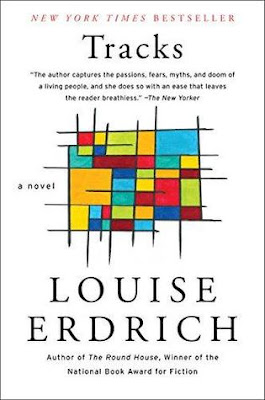
Erdrich, Louise "Tracks"

Erdrich, Louise "Tracks" - 1988

Reasoning for this book in our book club:

"We start the summer season by reading a book about the natives of North America. The story is the third in the book series, but is situated first in time. The author herself belongs to the indigenous people of Ojibway on her mother’s side and is one of the best known indigenous writers in North America. She has received many literary awards, most recently the 2021 Pulizer Price for Fiction."

Some of my friends have told me about Louise Erdrich and how much they love her. Well, either I read one of the books that wasn't just the right one for me or we should have started with the first book in the series. I felt I missed a lot of the story. For instance, there is a family tree at the beginning but many of the characters mentioned don't appear in the book and don't seem to have anything to do with the "families" whereas quite a few of those that are taking part in the book are not mentioned. So, that was no help at all.

I am not the greatest reader of "fantastic fiction" though I like some South American "magic realism" and had expected this to be a similar novel.

However, it was completely different. I am open to any form of lifestyle but if I read about one that is so different from mine, I like it to be explained a little more.

I usually like a story to be told from various sides but this one was just too confusing, none of the characters made any sense to me. You don't really get to know any of them. And why are the two families enemies? That doesn't come through, either.

All in all, I do not recommend to read this book first, no matter what people tell you. I had the feeling it would have been better to start where the author started and then look back together with her. I've seen that in many other series and it usually works well. Often, I felt I needed some background story in order to "get it".

The other members, however, seemed to like the book. I had hoped to be able to say something similar about the book but I couldn't find a connection. Still, here are the comments:

  • There were so many good things about the book, it really opened up the world of native peoples cultures, lives, histories and struggles of survival while being narrated by all the different characters in their own point of view and in a lovely varied and colorful language.
  • Many of the issues in the book also resonated very strongly with the political world today.
  • I really loved this book, it was dramatic, but so gripping, brutal and mystical, but also so full of feeling and culture, history, nature and the characters were so real. I would never have picked this book up without the book club again, but feel I absolutely could be interested in reading more from the author and definitely more books about native cultures.
  • I also liked the writing point of view from the different characters. We had an interesting discussion about what other books we have read with this kind of varying point of narrator views, one was Orhan Pamuk "My Name is Red".  
  • I was very disappointed. I know a few people who love this author but I just couldn't get into it. And no, "My Name is Red" is one of my favourite books by one of my favourite authors and the only thing these two books have in common is that it's told by different characters.
    I wouldn't mind reading more about native cultures, I read those kind of books a lot. Maybe that's why I was disappointed. I don't know.

We read this in our international online book club in June 2022.

Book Description:

"Set in North Dakota at a time in this century when Indian tribes were struggling to keep what little remained of their lands, Tracks is a tale of passion and deep unrest. Over the course of ten crucial years, as tribal land and trust between people erode ceaselessly, men and women are pushed to the brink of their endurance, yet their pride and humor prohibit surrender. The reader will experience shock and pleasure in encountering a group of characters that are compelling and rich in their vigor, clarity, and indomitable vitality."

Monday, 14 March 2022

Leky, Mariana "What You Can See From Here"

Leky, Mariana "What You Can See From Here" (German: Was man von hier aus sehen kann) - 2017

In 2017, this novel was awarded The Favourite Book of the Independents and that is the only reason I was made aware of it. I liked the first one I read from that list and every other one that I read subsequently. Because the one that received the prize last year still isn't available in paperback, I went to one of the older ones, this one.

And I am glad I did. This was such a lovely book, a story of a small village where everyone sticks together, no matter how hard it is sometimes, where everyone looks after everybody else, whether they like them or not. A great description of a functioning small community. The novel has been described as "warm". Yes, it is that but it is so much more. It's a love story as well as a philosophical quest, a coming of age story as well one about old age.

This book is described as "magic realism" and I have tagged it accordingly, though it really is more a touch of superstition in my eyes.

It is hard to describe the book without giving too much away, only this, there is a lot to be said about loss and how to deal with it and this book does it beautifully.

Mariana Leky is certainly an author to be watching out for, I will read more of her novels, so far she has written nine. Where do I begin?

From the back cover:

"In this international bestseller by the award-winning novelist Mariana Leky, What You Can See from Here, a heartwarming story unfolds about a small town, a grandmother whose dreams foretell a coming death, and the young woman forever changed by these losses and her loving, endearingly oddball community

On a beautiful spring day, a small village wakes up to an omen: Selma has dreamed of an okapi. Someone is about to die.

Luisa, Selma’s ten-year-old granddaughter, looks on as the predictable characters of her small world begin acting strangely. Though they claim not to be superstitious, each of her neighbors newly grapples with buried secrets and deferred decisions that have become urgent in the face of death.

Luisa’s mother struggles to decide whether to end her marriage. An old family friend, known only as the optician, tries to find the courage to tell Selma he loves her. Only sad Marlies remains unchanged, still moping around her house and cooking terrible food. But when the prophesied death finally comes, the circumstances fall outside anyone’s expectations. The loss forever changes Luisa and shapes her for years to come, as she encounters life’s great questions alongside her devoted friends, young and old.

A story about the absurdity of life and death, a bittersweet portrait of small towns and the wider world that beckons beyond, this charmer of a novel is also a thoughtful meditation on the way loss and love shape not just a person but a community. Mariana Leky’s
What You Can See from Here is a moving tale of grief, first love, reluctant love, late love, and finding one’s place in the world, even if that place is right where you started."

Wednesday, 1 December 2021

Rushdie, Salman "The Satanic Verses" Buddy-Read - Questions to Parts 6 to 9


The Satanic Verses
by Salman Rushdie
was first published in 1988
Literary fiction/magic realism
Goodreads

Discussion Questions Parts 6 to 9, Week5

Our buddy read comes to an end.

Here are Emma's last questions for this week.

Parts 6-9 and concluding thoughts
1. There is definitely more criticism against the Qur’an in these parts, especially regarding women. Though most of these are presented as Gibreel’s dreams. What do you think about this literary tool, inserting all these as dreams?
2. What do you think about the way the author describes London’s hospitality? Do you think the author would still write these words today?
3. As Salahuddin returns to Bombay, Zeeny gives him the following advice: "You should really try and make an adult acquaintance with this place, this time. Try and embrace this city, as it is, not some childhood memory that makes you both nostalgic and sick. Draw it close. The actually existing place. Make its faults your own. Become its creature; belong." Why these advice now, not about London, but about the character’s city of origin?
4. Gibreel is originally portrayed as the successful immigrant, with the divine and angelic images, but he is sick in his mind and ends up committing suicide. Chamcha, who has suffered most in his immigration experience, and was associated with devilish imagery, seems now the more normal and balanced of the two. How do you explain this reversal?
5. Why do you think Rushdie has chosen to tell the story of Saladin’s father’s death in this final chapter? How does it relate to the rest of the novel? What functions does it serve at the end of the book?
6. There’s a powerful passage on love vs. hate:
"He [Saladin] congratulated himself on being the sort of person who had found hatred impossible to sustain for long. Maybe, after all, love was more durable than hate; even if love changed, some shadow of it, some lasting shape, persisted…
Hatred was perhaps like a finger-print upon the smooth glass of the sensitive soul; a mere grease-mark, which disappeared if left alone. Gibreel? Pooh! He was forgotten; he no longer existed. There; to surrender animosity was to become free."
Any reflection on this?
7. What do you think about the structure of the book? Was it satisfying for you? What is its purpose?
8. Did you find the ending satisfactory?
9. What do you think is the author’s ultimate message?
10. Did the book fulfill your expectations of it? Did you like it, why or why not?
11. Would you consider The Satanic Verses as a good example of the magical realism genre?
12. Was there anything you wish was explored that wasn’t?
13. Are you planning on reading more books by Rushdie?
14. What did you think about our buddy-read experience? Is it something you would like to do again?

Please go and visit her post to read our answers and maybe contribute your own. 

Thanks to everyone who was part of this experience. I hope you all enjoyed this as much as we did.

And, please, feel free to add any comments or questions whenever you feel like it, even in a couple of years.

All posts about this buddy-read.
Introduction on Emma's blog
Introduction on my blog
Pre-discussion questions by Emma
- Link to that on my blog
Questions to parts 1 and 2 by Marianne
- Link to that on Emma's blog
Questions parts 3 and 4 by Emma
- Link to that on my blog
Questions to part 5 by Marianne
- Link to that on Emma's blog
Questions parts 6 to 9 by Emma
- Link to that on my blog

We also read this in our international online book club in November 2021.

Monday, 22 November 2021

Rushdie, Salman "The Satanic Verses" Buddy-Read - Questions to Part 5


The Satanic Verses
by Salman Rushdie
was first published in 1988
Literary fiction/magic realism
Goodreads

Discussion Questions Part 5, Week 4

We are almost nearing the end. This week we are discussing the third quarter of our book. As always, you can answer as many or as few of the questions as you like.

1.    What do you think about this chapter's title? Which city is meant and why is she both seen and unseen?

My answers (Marianne @ Let's Read):
    When I read the title "A City Visible but Unseen", I had to think about Schrödinger's cat. She's there and she isn't. That's the same with the city Rushdie describes. London is a city of immigrants but it's not the same whether you are an immigrant or a native, or rather, a European or non-European as to the colour of your skin. I think the title gives us a little view of the dilemma these people are in. I was an expat in a few countries, but nobody could see that I didn't belong there if I just walked the street, so I guess a lot of the experiences many immigrants have were spared to me. That doesn't mean I never experienced any animosities or even "racism".
    So, as an immigrant of a different skin colour, you better remain unseen by the majority, change your identity. Almost like with children who should be "seen but not heard".
Emma's answers (Emma @ Words and Peace):
    Thanks for these great questions. Unfortunately, I found this a very difficult part of the book, and most of the time, I had no idea what was going on. (Remark by me, Marianne: I totally agree.)
    The title of his part, "A city visible but unseen".
    When it is used in the part, it seems to refer to Gibreel’s mental illness: "He thought of himself as moving along a route on which, any moment now, a choice would be offered him, a choice -- the thought formulated itself in his head without any help from him -- between two realities, this world and another that was also right there, visible but unseen."
    But I think this is another way of relating the immigrant experience. The city visible and unseen could be both London and the Indian city some characters were coming from, it’s the case of Hind for instance.
    London is visible, as they now live there, but unseen in the sense that it’s totally foreign to their previous Indian experience.
    And Dhaka for instance is also unseen both for the British (they see the Indian immigrants without understanding the, without seeing them really), and for the immigrants themselves, as their current life is so foreign to them that they may tend to even forget, un-see what they used to know: "Where now was the city she [Hind] knew? Where the village of her youth and the green waterways of home? The customs around which she had built her life were lost, too, or at least were hard to find."
    Sadly, the only way she can keep in touch with her previous city is movies:  "for the endless supply of Bengali and Hindi movies on V C R through which (along with her ever-increasing hoard of Indian movie magazines) she could stay in touch with events in the ‘real world’".
    Everything is foreign: the language and its "alien sounds", the food, the weather!, the pace of life, "The customs around which she had built her life were lost, too, or at least were hard to find. Nobody in this Vilayet had time for the slow courtesies of life back home, or for the many observances of faith."
    The new city is so foreign that it seems to be on another planet: "Zeeny Vakil on that other planet, Bombay, at the far rim of the galaxy".
    And this is pushed even further: the new city is so foreign that Hind calls it "a demon city".
    And for Saladin, London becomes Hell: "Yes: this was Hell, all right. The city of London, transformed into Jahannum, Gehenna, Muspellheim."
    I love the hellish description of London: "From beneath the earth came tremors denoting the passage of huge subterranean worms that devoured and regurgitated human beings, and from the skies the thrum of choppers and the screech of higher, gleaming birds."
    The immigrants had opted for newness, but they get so much more than expected in terms of newness, to the point of losing their identity and being transformed into beasts.

2.    Why is Jumpy Joshi looking after Saladin? Do you think he is feeling guilty and trying to make amends? How does their relationship change during the chapter?

M:    I do think that the main reason is that he feels guilty about his adultery, not just about taking Saladin's wife. Adultery is forbidden in most religions. Even though the two believed Saladin was dead, there remains a part where he might admit that he could have checked better what really happened and probably confesses to himself, that he always wanted Pamela and saw this as his opportunity.
    The return of Saladin does not only intensify this feeling of guilt, it changes their whole lives through the situation Saladin is in.
E:    Not sure here. I see this more in Part VI. Yes, I think Jumpy is feeling guilty, but also scared of this man who seems to be back from the dead. For me, the evolution about their relationship says more about Saladin’s behavior. He seems to be embracing an attitude of submission to fate. Submission is a theme that occurs a few times in the book, obviously as a reference to the meaning of the word ‘islam’.

3.    Why do you think Saladin is upset when he hears that Gibreel is still alive? The author gives the resentment that he didn't help him with the police as a reason but could there be other, underlying ones?
M:    Gibreel and Saladin have a lot more in common than just falling out of the plane. They are both immigrants in England, they both come from India, they both are working in the entertainment industry. Their many dreams give them some sort of idea of their identity and their destiny. Of course, Saladin believes, Gibreel should be on his side, as they are both in the same boat and he should help him when he needs help. So, why doesn't Gibreel help him? And why would one be turned into an angel and the other one into Satan? I'm sure he is wondering why he got the bad part and resents Gibreel for that.
E:    I really have no idea! Besides the obvious fact that he may lose the woman he loves.

4.    Alleluia Cone is another immigrant, or descendent of immigrants. However, she is European and therefore not as easily recognizable as her Indian counterparts. How do you think does this contribute to the story? Do you think the understanding between European and non-European immigrants is larger than between immigrants and non-immigrants? Do you think it is easier for immigrants who look more like someone from the host nation?

M:    As I mentioned before, the story focuses on the way immigrants are treated. They tolerate them but don't want to have anything to do with them, don't want to acknowledge them at all. Also, saying you tolerate immigrants, but otherwise ignoring them means you don't see the racial tensions in your own country.
E:    Alleluia’s experience may help enlarge the story, and show that type of experience is not just specific to Indians arriving in England?
    And I believe that indeed, things get much more complicated if your hair, facial characteristics, and skin color are different from the ones most common in the host nation.

5.    Why do you think God calls himself "the Fellow Upstairs", Gibreel names him "the Guy from Underneath"?

M:    I read somewhere that God gets more and more like the author himself during the novel. If that is the case, he is not sure himself what his role is, both in life as well as in the novel.
    But even if that were not true, we can see this a lot in real life, people don't know whether God is really the "good guy" all the time, whatever is good for one of us, can be extremely bad for the next. All those questions: How can God allow this? Would God tolerate that? They mainly come from our doubts about his existence, our non-belief. Because, if we believe he is there, we don't need any signs.
E:    I can only think of common references to God and the devil.

6.    Why do you think his visions are explained with schizophrenia? Is it the easy way out?

M:    A lot of magic realism seems like visions to me, something that cannot be explained and isn't believed by people who don't have those ideas. I can't follow any of this, I just don't fancy "magic", no matter where someone applies it. Of course, it is always a good way to explain events that cannot otherwise be explained. So, I guess it often is schizophrenia (or another illness) when someone has "visions".
    So, this might already be the explanation to Gibreel's transformation into Gabriel, him believing he is a selected one.
E:    I wonder. Maybe as derision of some religious phenomenon, like so-called prophets who would actually just be people sick in their mind? Which would be fitting with Rushdie’s views of religion.
    And about the way people have been confusing mental illness with possession?
    And also to show how the experience of life as immigrants can be so very different from what they have known before, that this foreignness can lead to a split in personality and to mental illness? "He felt slow, heavy, distanced from his own consciousness."

7.    Do we think the subject of Good and Evil is well explored and explained in this chapter?
M:    I think everything is well explored in the whole book, whether it is always understandable to the ordinary mind (like mine), is another thing. We certainly cannot accuse him of not making an effort in trying to explore the subject.
E:    I don’t think it’s explored at all at the moral level. This is not at all Rushdie’s goal and perspective. This is not a theology book.
    One aspect that struck me is that Gibreel feels he is on a mission to save the devilish city with its bad influence, in reference to Jonah and Nineveh. "So: it was time to show the city a great sight, for when it perceived the Archangel Gibreel standing in all his majesty upon the western horizon, bathed in the rays of the rising sun, then surely its people would be sore afraid and repent them of their sins." This is actually a great scene, so hilarious and sad at the same time.
    So what was definitely a moral mission for Jonah turns out as a huge joke as Gibreel is just a human, and when he thinks he can enlarge himself for all the inhabitants of the city to see, and intervene in their lives through a massive apparition in a street, he ends up stepping in front of a car and be run over!
    Rushdie reduces the role to a cinematic one! There’s so much we could say about this, for so many characters, with so many references to major movies, and I read somewhere that even Gibreel’s and Chamcha’s first experience is even based on the life of two famous Indian actors.

E:    I also noted a couple other things.
    I have mentioned a few times how Rushdie had fun with words. Another way I believe, is the way he turned Saladin into a satyr, while writing his satire. I don’t think this is a coincidence.
    And obviously the play on words between Shaitan/Satan. Just like Seyton, Macbeth’s servant!
    One thing I wonder, in connection with some earlier questions we had about the role of women. How do you understand this about Rekha, "she claimed that his many tribulations had been of her making" ?
And about the importance of Allie, "determined to lead him [Gibreel] back to sanity"?

M:    Emma and I have answered the questions independently and I publish them as they are, that way other bloggers can follow our thoughts. And, same as Emma, I doubt that anything in the novel is a coincidence, every character, every sentence has its reason, of that I am sure.

All posts about this buddy-read.
Introduction on Emma's blog
Introduction on my blog
Pre-discussion questions by Emma
- Link to that on my blog
Questions to part 1 and 2 by Marianne
- Link to that on Emma's blog
Questions part 3 and 4 by Emma
- Link to that on my blog
Questions to part 5 by Marianne
- Link to that on Emma's blog
Questions parts 6 to 9 by Emma
- Link to that on my blog

Thursday, 18 November 2021

Rushdie, Salman "The Satanic Verses" Buddy-Read - Questions to Parts 3 and 4

The Satanic Verses
by Salman Rushdie
was first published in 1988
Literary fiction/magic realism
Goodreads

Discussion Questions Parts 3 and 4, Week 3

As you know, Emma and I take turns in asking our questions to our  buddy read. This week, it's Emma's turn.

Here are her questions for this week.

1.    Compared to Parts 1 and 2, does Rushdie use the same techniques here to introduce humor?
2.    What do you think about the transformations of the main protagonists here?
3.    We now see more clearly the focus on the theme of migration and exile. Any comments on that?
4.    How do you understand the whole episode between Gibreel and Rosa? What’s the point? Why is she the first to meet the main heroes after their fall?
5.    Ayesha appears in two forms. Why? What does she stand for? What about this whole thing about eating butterflies?
6.    And what about the character of the imam?
7.    And any other question you would like to address!

Please go and visit her post to read our answers and maybe contribute your own. 

Next week, we will ask questions about the third quarter of the book (part V. A City Visible but Unseen).

Happy Reading!

All posts about this buddy-read.
Introduction on Emma's blog
Introduction on my blog
Pre-discussion questions by Emma
- Link to that on my blog
Questions to parts 1 and 2 by Marianne
- Link to that on Emma's blog
Questions parts 3 and 4 by Emma
- Link to that on my blog
Questions to part 5 by Marianne
- Link to that on Emma's blog
Questions parts 6 to 9 by Emma
- Link to that on my blog

Monday, 8 November 2021

Rushdie, Salman "The Satanic Verses" Buddy-Read - Questions to Parts 1 and 2

The Satanic Verses
by Salman Rushdie
was first published in 1988
Literary fiction/magic realism
Goodreads

Discussion Questions Parts 1 and 2, Week 2

Have you all read the first quarter of our book (up to end of PART II. Stop before "Ellowen Deeowen")?

If yes, then you are ready for the next questions. I hope you will all be happy to particpate. Answer as many or as few of the questions as you like.

1.    What do you think of the narrator?


My answers (Marianne @ Let's Read):

    At the beginning, I didn't have the feeling there was a narrator, it was just a book I was reading. But the further you get into it, the more the narrating part gets larger as he talks to the reader directly from time to time. I think the narrator is important for us to see that it is a story, the author probably anticipated some of the trouble he would stir and therefore distanced himself from the book. Didn't work.
Emma's answers (Emma @ Words and Peace)
    I like its quirkiness, irony, and humor. I think its use also helps create distance between the content and the reader, which fits the satirical intent of this novel. And I see this metafictional trait as a signal to say, watch out, don't take this literally.
    Besides, it allows the author to have more fun, for instance to include himself in the novel when he describes Gibreel, especially with the "drooping eyelids", a disease (ptosis or blepharoptosis) Salman Rushdie was suffering from, to the point of needing surgery in 1999, so actually eleven years after the publication of this novel). Otherwise he would have been ultimately unable to open his eyes.
    As I mentioned irony, I would like to talk more about it here.
    I see two ironic effects in Rushdie's mix of intellectual words and references to colloquial and slang language, or oral language. I realized I understood better if I read aloud some passages, for instance the expression "no quesch". It's great fun to see how Rushdie glues some words together, as they would be heard, like "Gracekali".
    I also enjoyed his lists a lot! For instance, during the fall:
    "Above, behind, below them in the void there hung reclining seats, stereophonic headsets, drinks trolleys, motion discomfort receptacles, disembarkation cards, duty-free video games, braided caps, paper cups, blankets, oxygen masks."
    Indeed, the most funny part in the section we had to read for this week is for me the fall of the two heroes, with their "heraldic postures, rampant, couchant, pitting levity against gravity", falling "like titbits of tobacco from a broken old cigar", or like spermatozoa, or dropped by a stork, as their fall will allow them to be reborn again in another society.
    And their fall is also an allusion to Alice in Wonderland, quoted here as well.
    But behind their fall is a very serious question, "Is birth always a fall?" Does a part of us need to die to take our place in another society? Yes seems to be the answer for Salman Rushdie who did experience life as a migrant.
    And there are tons of plays on words, for instance chair-men in the context of the studio wheelchair-team; the mention of "the Man of a Thousand Voices and a Voice"; the name Eugene Dumsday; the travelling mat vs. the magic carpet; the hilarious confusion and conversation about "the Christian guard", and "Ellowen Deeowen", which I only understood by reading them aloud, trying to imitate an Indian accent!! And many more!

2.    In the opening, we hear about the fall of the two characters from the plane. Is the fall also to be seen figuratively and how does it introduce us to the novel?

M:
      The fall could be interpreted as the fall from grace, for the Christians the expulsion from paradise. As is said in the novel "to be born again, first you have to die" which could mean in order for them to become the archangel and the devil, they have to leave this life but I also think it might allude to their change of name and personality when leaving India and settling in the UK.
E:      Yes, definitely. It's about transformation and reinvention of self, about complexity of identity, and also, as far as I can see in this part of the book, about chaos and lack of meaning in parts of Indian society. Lack of meaning obviously also in religion, according to the narrator and the author. This obviously doesn't reflect my own thinking, but this is literature, not a book of theology.
    I will mention the theme of falling from the sky a bit more below, when talking more about Surah 53.

3.    Why do you think Saladin becomes the devil, Gibreel the angel?

M:
      I don't think Gibreel became an angel because he was a better person than Saladin. The novel tries to make us understand that we all are good and bad at the same time and that, even if we have been good (or bad) all our lives, we can turn around at any time.
E:      The main dimension of the book so far for me is that nothing is all black or all white, all bad or all evil. There can be room for interpretation and for evolution as well. Nothing is really static if it's alive. All the more so if you move between cultures, here between India and England.
      I think this is highlighted here by their names and transformation. All the more so as at one point during their fall, both characters seem to intertwine and become one. And even at one point their both names make only one: "Gibreelsaladin Farishtachamcha" (page 5).

4.    What about the women? What position do they have in the novel? How are the men portrayed to them?

M:
    There are all sorts of women in this novel. I think the author might have wanted to portray even more women than men in order to make us understand how many different people there can be and that we are not all subservient people but each of us is a person in our own right.
E:    They seem to occupy second place so far. I don't see them as major characters. However, they are instrumental in the development of the plot. Just as one example, and I could give more, Gibreel decided to leave and take the (fateful) plane because he was fed up with his mistress.
    But actually, maybe women do have a central place in the novel after all: after all, the Star surah which is at the center of the book is about three goddesses.


5.    Why do you think both men have changed their names? Farishta means "angel" in Urdu; Chamcha means "spoon".

M:
    I suppose both men changed their names as so many immigrants do if they want to immerse in their new country, assimilate, especially if they work in entertainment. That way, their names can be pronounced by the people who might admire them.
E:     Farishta's real name is Ismail Najbuddin. His Mom nicknamed him Farishta, which sounds common to me. Both in English and French, it's not unusual for mothers to refer to their young ones as my little angels. So this is the stage name he took. I see it as a direct connection to Gibreel, as he plays in "theological movies", and in his mental disorder believes he has a divine message to deliver (as Gabriel did).
    As for Chamcha, I think the colloquial meaning of his name is more relevant than the literal meaning of spoon. I have read it means "toady", which we can see at play in his career. If Gibreel is more the rebel, Chamcha wants to please. By the way, I have read here that the colloquial derivation of the literal meaning of "spoon" is probably from the time of the British Raj in India, when a "chumch" was a person who, imitating the British, used silverware for meals, whereas Indians generally ate with their bare hands.

6.    Have you learned anything about India, especially through the stories of the two main protagonists?

M:
    I have read many books about India before but there is always something new to learn. I thought it was interesting that this novel was banned in India first.
E:    The book highlights the chaos in some parts of the society, though this is not new to me. It seems also to show how vertical the society is ("Bombay was a culture of re-makes" - with also the double meaning, as the remake of a movie), with people trying hard to rise up the social ladder by reimagining themselves. What I had not realized is how many political candidates were originally in show business before, a perfect illustration of the latter point, and possible reason for the chaotic result!

7.    There are several different groups in the novel, fundamentalist Islamic groups, the Western and Indian governments, the news media, and the international community of authors. What do you think does this mean for the events?

M:
    It could be that the author wanted to have a wider outlook on his topic. Or he might just want to lash out on all those institutions and groups.
E:    I am not sure at this point.

8.    The novel has several magical and fantastical element. How do they contribute to the novel and why do you think the author uses them?

M:
   I am not a big fan of Magic Realism but I think this novel would be impossible without them.
E:    I think these are important writing techniques to open up more meaning. And to allow for the theme of relativity of interpretation, up to the point of presenting ideas as absurd.
    And I think we mustn't forget humor, as really the scene of the fall is totally hilarious.

9.    Looking at the reactions to the novel, do you think they were deserved? I read somewhere "Getting angry at a work of fiction says more about the reader than it does about the fiction." Do you agree?


M:
   I don't think any reaction like that is deserved. We should talk about problems we have with each other openly. But some people (or groups) think only they are right and won't accept other opinions. Therefore, we need more books like this to make us think.
E:   I agree with this quotation. I wouldn't approach fiction as a treatise of religion or philosophy. And I try to open a book with an open mind, not trying to impose my own thoughts on the intent of the author. If you can't do that, then maybe fiction is not the genre you should read. I actually find it fascinating to discover someone else's thinking and how they convey that into words.
    Now, as for the reactions to the novel, the more I read it, the more I'm actually surprised at the Muslim controversy the book unleashed, as really the book attacks about as much Hinduism (though the theme of reincarnation seems to be treated here more as a social event than as a metaphysical reality), and even Christianity (in a more subtle way).
    As for the "satanic verses" themselves, I read a bit more about the surah at stake here, and really it seems experts in Islam themselves don't all agree on its meaning, and there's indeed some leeway in what it actually means.
    To read more about the interpretation of this surah in Muslim circles themselves, see here.
    Surah [chapter] An-Najm, the 53rd Surah of the Koran, means The Star, which I think cannot be separated here from the fact that the two main protagonists were film stars. According to wikipedia, "The surah opens with the oath of the Divine One swearing by every one of the stars, as they descend and disappear beneath the horizon", a descending movement we find for our two star heroes as we open the book.
    I also don't think it's a coincidence that Annie Besant would be mentioned (top of page 24 in the old Viking edition), as she founded in India The Order of the STAR in the East, to prepare the world for the arrival of an ultimate messiah.
    Plus, the novel contains a lot of allegory, it's not to be taken literally. As if you would be reading the Book of Genesis as a contemporary nonfiction, thus totally ignoring everything about its real genre, and how common this genre was used at the time the book was written.  
    I don't want to fall into the too common current relativism, according to which everyone could have his/her own truth. But at the same time, if you look at individuals, if I look at myself, there's a part of good and of less good for sure. Each identity is complex and difficult to find. I think this is nicely said with this image: "he seemed to be roaming about inside his clothes like a man in search of something he had not quite managed to identify."
    Plus add the fact that when Gibreel received his message he was half asleep, like in a dream. And he suffers from schizophrenia, and considers himself as an angel (like Archangel Gabriel the divine messenger). And on top of that, he is an actor! So he definitely cannot be considered as a reliable messenger.
    I think it's also important to note that Gibreel used to play deities in his movies, and Chamcham earthly people. I see it as an added dimension to the theme of identity, and its complex dimensions. And I don't think the novel can be read as a religious message. We don't encounter awe here, just "stage fright" (page 112). And the fall of paradise is actually the fall of a plane (the name of the plane, Bostan, does mean paradise).
    We can also argue that the variation of the name Muhammad as Mahound could mainly be a reference to another major work of literature (not of theolog: Mahound is indeed presented as the devil incarnate in Dante's DivineComedy. The Mahound variation was common in the Middle Ages. And Dante was not far from Rushdie's thought, as we can see in the mention of "the first circle, the innermost ring".

* * *

We stopped this part at "Ellowen Deeowen". Apparently, this is an expression of incredulity, meaning "Try another outrageous lie on me, I don't believe this one." In German we say: "Go tell your grandma." Like, she might believe you, I don't.

Next week, our questions and answers will be on the second quarter of the book up to page 240 at the beginning of chapter V: "A City Visible but Unseen".

In the meantime, we are looking forward to your contributions. What are your answers to the questions? Do you have anything else to add?

All posts about this buddy-read.

Introduction on Emma's blog
Introduction on my blog
Pre-discussion questions by Emma
- Link to that on my blog
Questions to parts 1 and 2 by Marianne
- Link to that on Emma's blog
Questions parts 3 and 4 by Emma
- Link to that on my blog
Questions to part 5 by Marianne
- Link to that on Emma's blog
Questions parts 6 to 9 by Emma
- Link to that on my blog