Showing posts with label England. Show all posts

Monday, 16 February 2026

Bjørnson, Bjørnstjerne "Absalom's Hair"

Bjørnson, Bjørnstjerne "Absalom's Hair" (Norwegian: Absalons Haar) - 1894

I enjoy reading books by Nobel laureates from time to time. So when I came across this novel, I had to check it out. It's a novella, so not very long. A bit more plot certainly wouldn't have hurt the story. I wasn't particularly impressed. The narrative jumped around, and the protagonists lacked any compelling qualities. It's simply a very old book that hasn't aged well.

And if it was meant as a satire, I would have expected some humor.

Bjørnson also wrote the Norwegian national anthem, "Ja, vi elsker dette landet" (Yes, we love this country).

Book Description:

"Harald Kaas was sixty. He had given up his free, uncriticised bachelor life; his yacht was no longer seen off the coast in summer; his tours to England and the south had ceased; nay, he was rarely to be found even at his club in Christiania. His gigantic figure was never seen in the doorways; he was failing. Bandy-legged he had always been, but this defect had increased; his herculean back was rounded, and he stooped a little. His forehead, always of the broadest-no one else's hat would fit him-was now one of the highest, that is to say, he had lost all his hair, except a ragged lock over each ear and a thin fringe behind. He was beginning also to lose his teeth, which were strong though small, and blackened by tobacco; and now, instead of 'deuce take it' he said 'deush take it.'"

Bjørnstjerne Bjørnson received the Nobel Prize for Literature in 1903 "as a tribute to his noble, magnificent and versatile poetry, which has always been distinguished by both the freshness of its inspiration and the rare purity of its spirit".

I contribute to this page: Read the Nobels and you can find all my blogs about Nobel Prize winning authors and their books here.

Tuesday, 10 February 2026

Austen, Jane "The History of England"

Austen, Jane "The History of England: By a Partial, Prejudiced and Ignorant Historian" - 1791

This was the last of my Jane Austen reads in 2025, the #Reading Austen project.

The booklet has 55 pages, very small ones. Yet, only 18 of them are about the History of English, the rest of the book is taken up by the correspondence between (mainly) two girls at the beginning of the 19th century, a short story called Lesley Castle.

I really enjoyed the first part. It was interesting to read how the kings and queens of England were seen by a partial and prejudiced person. Jane like the York and hated the Lancastrians, so anything they did were seen through her rose- or black-tinted glasses. Hilarious, though, and not necessarily to be taken seriously. 

Also the second part has its hilarious moments. Like when women are judged by their height and being tall is supposed to be a fault. Just read it, it doesn't take long.

Book Description:

"'The History of England', written when Jane Austen was in her late teens, is a lively and somewhat disrespectful overview of the history of England's monarchy. She sees nothing reprehensible in Richard III, yet burns with contempt for Elizabeth I, and documents several reigns with breezy nonchalance.

This volume also contains 'Lesley Castle', a delightful and often hilarious correspondence detailing the mishaps and misapprehensions that befall five young ladies."

Monday, 22 December 2025

O'Farrell, Maggie "Hamnet"

O'Farrell, Maggie "Hamnet" - 2020

Somebody talked to me about this book. Someone who likes Maggie O'Farrell. I have a vague recollection of who it was but I can't find it again. So, maybe it was someone else. Sorry, whoever you are.

Anyway, it was nice to read about a part of Shakespeare's life that is not so well known. We know that his son died young. That his name was Hamnet and that his father wrote a play called Hamlet. As to the book, the spelling of the name is interchangeable, so it is more or less the same. I mean, Shakespeare himself had about 27 varieties of is last name. Or something like that.

The author mentions that this is a piece of fiction based on only the few facts I mentioned above. So, she lets us know her imagination and we can add to that.

But I still learned about Shakespeare and especially his wife, Anne Hathaway, who is called Agnes in the novel. Because I like to search for more information elsewhere whenever I read a book. Sometimes, you need a starter for that.

And what was also excellent is the description of the grief parents go through when losing a child. That was heartbreaking.

Maggie O'Farrell received several prizes for this book, i.a. the Women's Prize for Fiction 2020.

We discussed this book in our local book club in April 2026.

A few comments from our book club members:

  • Shakespeare's life in London wasn't given enough attention.
  • How is it that such a strong woman suffers so much from the death of her child?
  • We liked the way the transmission of the plague was described.

From the back cover:

"On a summer's day in 1596, a young girl in Stratford-upon-Avon takes to her bed with a fever. Her twin brother, Hamnet, searches everywhere for help. Why is nobody at home?

Their mother, Agnes, is over a mile away, in the garden where she grows medicinal herbs. Their father is working in London.

Neither parent knows that one of the children will not survive the week.

Hamnet is a novel inspired by the son of a famous playwright. It is a story of the bond between twins, and of a marriage pushed to the brink by grief. It is also the story of a kestrel and its mistress; flea that boards a ship in Alexandria; and a glovemaker's son who flouts convention in pursuit of the woman he loves. Above all, it is a tender and unforgettable reimagining of a boy whose life has been all but forgotten, but whose name was given to one of the most celebrated plays ever written."

Monday, 8 September 2025

Michell, Tom "The Penguin Lessons"

Michell, Tom "The Penguin Lessons: What I Learned from a Remarkable Bird" - 2015

I discussed this with my German book club in August 2025.

I'm not an animal person. I don't mean to say I'm totally against animals, but they don't particularly interest me.

The book was quite nicely written. I also found the accounts of the school where the author taught and his travels through South America very interesting. But the relationship with the penguin, well, okay. As I said, I'm probably the wrong person to describe this book. It just wasn't really my cup of tea.

The only thing that was interesting to me was the description of the people the author met, the anthropological aspect.

The other members, however, found the book very readable. Here are a few quotes:

  • I learned a lot about a species of animal I didn't really know much about.
  • I found the description of how he travels through the countries with youthful carefreeness and enthusiasm, and even saves the penguin, refreshing.
  • The parts where he describes how the school outcast can show off his talent were touching.
  • I particularly liked the scene in the swimming pool.
  • Mir hat das Buch gut gefallen. Interessant und klug geschrieben und oft sehr berührend, aber ohne Pathos.
  • I liked the book. It's interestingly and cleverly written, and often very touching, but without pathos.

From the back cover:

"'I was hoping against hope that the penguin would survive because as of that instant he had a name, and with his name came the beginning of a bond which would last a life-time.'

Set against Argentina's turbulent years following the collapse of the corrupt Peronist regime, this is the story of Juan Salvador the penguin, rescued by English schoolteacher Tom Michell from an oil slick in Uruguay just days before a new term. When the bird refuses to leave Tom's side, the young teacher has no choice but to take it with him and look after it. This is their story."

Tuesday, 10 June 2025

Hornby, Gill "Miss Austen"

Hornby, Gill "Miss Austen" - 2020

As I mentioned before, as part of the commemoration of Jane Austen's 250th birthday, the Classics Club has started a #Reading Austen project. We are reading a book by her every other month, and I want to do read something Austen-related by her in between.

In April, I read a German book by Catherine Bell, "Jane Austen und die Kunst der Worte" [Jane Austen and the Art of Words].  I was not impressed, I probably read too much about Jane Austen before and this one could have been written by any Jane Austen fan without doing any more research. Such a pity.

Mind you, "Miss Austen" wasn't all that much better, only a little. The Miss Austen mentioned in the title is not Jane but her sister Cassandra. We hear about her last self-given task, the intention to destroy the letters her sister had written that contained something Cassandra didn't want anyone to know, that would look bad on her sister's legacy. But, since those letters were destroyed, we don't know what it contained and the author just invented them.

I don't like people writing a sequel to a book where the original author died. I never did and I doubt I ever will. So, I guess my next book about Jane Austen (in August) will be a non-fiction again.

From the back cover:

"1840 : Cassandra Austen returns to the village of Kintbury.

She knows that, in some corner of the vicarage where she is staying, there is a cache of letters written by her sister Jane.

As Cassandra recalls her youth, she pieces together buried truths about Jane's history - and her own ; secrets which should not be revealed.

And she faces a stark choice : should she act to protect Jane's reputation?

Or leave the letters unguarded to shape her legacy..."

Monday, 19 May 2025

Cornwell, Bernard "The Last Kingdom"

Cornwell, Bernard "The Last Kingdom" (The Saxon Stories #1) - 2004

I love historical fiction. And this one is based on the real history of England. So, someone suggested I should read a book by this author. My husband loves him and we had this book at home, so I gave it a try.

While I liked the story of Uthred and his contemporaries, there was too much about fighting in the story and less about the "real life". Maybe, because there were few women - and even fewer stories about them - in the book. But this was not for me. I doubt I will read more about "The Last Kingdom", at least not in this series.

From the back cover:

"Uhtred is an English boy, born into the aristocracy of ninth-century Northumbria. Orphaned at ten, he is captured and adopted by a Dane and taught the Viking ways. Yet Uhtred's fate is indissolubly bound up with Alfred, King of Wessex, who rules over the only English kingdom to survive the Danish assault.

The struggle between the English and the Danes and the strife between christianity and paganism is the background to Uhtred's growing up. He is left uncertain of his loyalties but a slaughter in a winter dawn propels him to the English side and he will become a man just as the Danes launch their fiercest attack yet on Alfred's kingdom. Marriage ties him further still to the West Saxon cause but when his wife and child vanish in the chaos of the Danish invasion, Uhtred is driven to face the greatest of the Viking chieftains in a battle beside the sea. There, in the horror of the shield-wall, he discovers his true allegiance."

Monday, 31 March 2025

Weir, Alison "Katharine Parr. The Sixth Wife"

Weir, Alison "Katharine Parr. The Sixth Wife" (Six Tudor Queens #6) - 2021

The sixth wife of Henry VIII. And the sixth book in the Tudor Queens series by Alison Weir.

I think I knew far too little about Katharine Parr. She was Henry's last wife. She survived him. She had two husbands before him. She married again when he died only to die herself in childbed. That's about all I knew.

Of course, this is a novel based on the life of the queens. However, there is a lot in it that is history and where we can learn about that time in England.

We see through the eyes of Katharine Parr that women were just a commodity, and not worth a lot for that. At her first marriage, she doesn't even know the husband. Then she has to look for another one because otherwise a woman has no means to live. When she falls in love with Thomas Seymour, she has to marry the king who also wants her. What a life!

In any case, Alison Weir has brought the Tudor queens to life in a way no history book could ever have done. For that, I thank her profoundly.

From the back cover:

"Two husbands dead; a life marred by sadness. And now Katharine is in love for the first time in her life.

The eye of an ageing and dangerous king falls upon her. She cannot refuse him. She must stifle her feelings and never betray that she wanted another.

And now she is the sixth wife. Her queenship is a holy mission yet, fearfully, she dreams of the tragic parade of women who went before her. She cherishes the secret beliefs that could send her to the fire. And still the King loves and trusts her.

Now her enemies are closing in. She must fight for her very life.

KATHARINE PARR – the last of Henry’s queens.

Alison Weir recounts the extraordinary story of a woman forced into a perilous situation and rising heroically to the challenge. Katharine is a delightful woman, a warm and kindly heroine – and yet she will be betrayed by those she loves and trusts most.

Too late, the truth will dawn on her."

Friday, 28 February 2025

Worsley, Lucy "Jane Austen at Home"

Worsley, Lucy "Jane Austen at Home" - 2017

My favourite book of the month. As part of the commemoration of Jane Austen's 250th birthday, the Classics Club has started a #Reading Austen project. We are reading a book by her every other month, last month it was "Pride & Prejudice", next month will be "Sense & Sensibility". When it fits in with my other reading "duties" (book clubs and challenges), I want to do read something Austen-related by her in between.

This was a fabulous biography. Lucy Worsley really "visited" Jane Austen at home and accompanied her on all her visits to friends and family. It was so nice to read what she and her family, especially her sister Cassandra had been up to. You hear about the relationship between them and also any other person of their lifetime. Also, the way they lived. We all know that they had money problems but it is different today, at least in our countries. Also, the things Jane did for female authors and women in general are not to be underestimated.

After reading this book, I feel I got to know Jane Austen better, almost personally. I would love to have all biographies written like this. I think I love the author even more than I did before.

There are so many quotes I could mention but I leave it at this one  about my favourite novel: "Persuasion was … set precisely in the period of peace between the months June 1814 and February 1815, when Britian's naval officers were on shore leave." It shows how her novels relate to the time she lived in.

From the back cover:

"Historian Lucy Worsley visits Jane Austen at home, exploring the author's life through the places which meant the most to her.

On the 200th anniversary of Jane Austen's death, historian Lucy Worsley leads us into the rooms from which our best-loved novelist quietly changed the world.

This new telling of the story of Jane's life shows us how and why she lived as she did, examining the places and spaces that mattered to her. It wasn't all country houses and ballrooms, but a life that was often a painful struggle. Jane famously lived a 'life without incident', but with new research and insights Lucy Worsley reveals a passionate woman who fought for her freedom. A woman who far from being a lonely spinster in fact had at least five marriage prospects, but who in the end refused to settle for anything less than Mr Darcy."

The book also contains some interesting pictures that relate to Jane Austen's life.

Tuesday, 15 October 2024

Follett, Ken "The Armour of Light"

Follett, Ken "The Armour of Light" - 2023

"The grand master of gripping fiction is back. International No.1 bestseller Ken Follett returns to Kingsbridge with an epic tale of revolution and a cast of unforgettable characters."

Yes, he is a grand master indeed. After having written four books about Kingsbridge, their cathedral and the inhabitants, rich and poor from 997 until the 16th century, here is the follow-up for the Industrial Revolution.

With the story of  Kingsbridge, we also learn the story of England and the United Kingdom. Anytime we read about history and how people lived, we must be thankful to live today. Even though we also have political problems, we as "the little people" have a lot more rights than people ever had. And we owe this to people like those described here.

I hope the story of Kingsbridge will continue into modern times. Then we could just go on with the century trilogy.

In any case, this is THE series for lovers of historical fiction.

I missed a list of all the characters before and during the book. And, like I said before, I would have enjoyed a timeline of what happened at the time. Yes, I have the internet and plenty of other books where I can look this up but I find having it in the actual book I'm reading is actually very helpful.

From the back cover:

"Revolution is in the air

1792. A tyrannical government is determined to make England a mighty commercial empire. In France, Napoleon Bonaparte begins his rise to power, and with dissent rife, France’s neighbours are on high alert.

Kingsbridge is on the edge

Unprecedented industrial change sweeps the land, making the lives of the workers in Kingbridge’s prosperous cloth mills a misery. Rampant modernization and dangerous new machinery are rendering jobs obsolete and tearing families apart.

Tyranny is on the horizon

Now, as international conflict nears, a story of a small group of Kingsbridge people - including spinner Sal Clitheroe, weaver David Shoveller and Kit, Sal’s inventive and headstrong son - will come to define the struggle of a generation as they seek enlightenment and fight for a future free from oppression. . .

Taking the reader straight into the heart of history with the fifth novel in the ground-breaking Kingsbridge series, The Armour of Light is master storyteller Ken Follett’s most ambitious novel to date."

Monday, 23 September 2024

Evaristo, Bernhardine "Girl, Woman, Other"

Evaristo, Bernhardine "Girl, Woman, Other" - 2019

This was recommended by a member of our book club but it wasn't chosen.

I must admit, the novel wasn't what I thought it would be. I probably didn't read the description well enough but somehow I thought this was mainly about immigrants and racism in the UK. And it was, partly. But that was not the main topic, at least it didn't look like it. The first couple of women that the author talks about, are all lesbians, later we also have non-binary people. But there are so many people. Every chapter brings new characters that might or might not turn up again in later chapters. So it feels like a collection of short stories (which I don't really like). Only toward the end you get a feeling who belongs to who, where the links are between the chapters. It was all a tad confusing.

I've said this before and will say it again, I'm not a fan of Booker Prize winners, there's always something that doesn't go well with me. And often I can't even say what it is. I definitely would have liked more about the racism topic.

From the back cover:

"This is Britain as you've never read it.

This is Britain as it has never been told.

From the top of the country to the bottom, across more than a century of change and growth and struggle and life, Girl, Woman, Other follows twelve very different characters on an entwined journey of discovery.

It is future, it is past. It is fiction, it is history.

It is a novel about who we are now."

Monday, 11 March 2024

Brontë, Charlotte "The Professor"

Brontë, Charlotte "The Professor" - 1857

This novel has been on my wishlist for quite a while. It was recommended to me by another blogger who, like me, has also lived in Brussels and from her I learned that they have a Brontë society there now. Unfortunately, I knew nothing about that when I lived there but they might have started this after my time.

Anyway, if you have not read anything by Charlotte Brontë, you definitely must have heard of Jane Eyre, her most popular book, probably the most popular one of all the books by any of the Brontë sisters.

I have yet to find a book by any of them that I don't like at all, they are all fascinating and gripping. Just as this one. I must admit, I might like it even more because it takes place in Brussels but it would have been just as interesting had the protagonist lived elsewhere.

What makes this book as interesting as her others, you have the feeling you are in the midst of the story, even though it took place almost two centuries ago. It is so lively. You can feel the problems of the protagonists, you understand how difficult it was for women in former times and how much as changed and how much hasn't.

Unfortunately, like Jane Austen, the Brontës all died far too early.

From the back cover:

"Charlotte Bronte's first novel, The Professor, is narrated from the viewpoint of an ambitious and self-made man.

Rejecting his aristocratic inheritance William Crimsworth goes to Brussels to find his fortune. He takes a job teaching at a boarding school for young ladies, where he begins a flirtation with Zoraide Reuter, who, out of jealousy, attempts to frustrate his courtship of Frances Henri, an attractive young woman determined to make her way in the world.

In
The Professor Charlotte Bronte holds up to scrutiny the Victorian ideals of self-help and individualism. The result is an unusual love story, and a novel profoundly critical of a society in which the relationships between men and women are reduced to power struggles."

Monday, 9 October 2023

Bennett, Alan "The Clothes They Stood Up In"


Bennett, Alan "The Clothes They Stood Up in" - 2001

After reading "The Uncommon Reader" a while ago, our book club decided to read another book by Alan Bennett. I would have rather waited a little longer until reading another book by the same author, but it was decided by the majority and it wasn't very long (though that is not really a recommendation for me).

The story makes us think about the possessions we have and how important they are to us. How much do they make our lives?

But that is all. I didn't enjoy the story much, neither the writing nor the characters or the content. It was an alright story but - as so often - more would have been more. Too short for my liking. Not really as funny as announced. It might take a while until I pick up an Alan Bennett story again.

There was only one member in our group that liked the story, and her comments gave us a little more insight into it. That's always great about a book club.

From the back cover:

"The Clothes They Stood Up In is Alan Bennett's first story. Like Charles Dickens' novels which were first published in magazines, it originally appeared in the London Review of Books - which the author says 'seems to me (and not just because I occasionally contribute to it) the liveliest, most serious and also the most radical literary periodical we have'.

In the nationally bestselling novel The Clothes They Stood Up In, the Ransomes return from the opera to find their Regent’s Park flat stripped bare--right down to the toilet-paper roll. Free of all their earthly belongings, the couple faces a perplexing question: Who are they without the things they’ve spent a lifetime accumulating? Suddenly a world of unlimited, frightening possibility opens up before them.
"

Monday, 17 July 2023

Osman, Richard "The Man Who Died Twice"


Osman, Richard "The Man Who Died Twice" (Thursday Murder Club #2) - 2021

After reading "The Thursday Murder Club", I knew I would have to carry on reading his other books. Even though I am not a crime fun - his books are so much more than that.

The four elderly friends are on the path again to solve a crime, or rather several of them. And the suspense is really high. I am never someone to know whodunnit but I think this one is hard to solve even for the best sleuths.

The characters are as loveable as ever. And they all have their own little problems that aren't often as easy to solve as the murders. But that makes them even nicer and more normal.

Would be nice if everyone could be as active at the age of seventy plus as the four friends. In any case, I will carry on following their quests. As soon as the next book is out in paperback.

From the back cover:

"It's the following Thursday.

Elizabeth has received a letter from an old colleague, a man with whom she has a long history. He's made a big mistake, and he needs her help. His story involves stolen diamonds, a violent mobster, and a very real threat to his life.

As bodies start piling up, Elizabeth enlists Joyce, Ibrahim and Ron in the hunt for a ruthless murderer. And if they find the diamonds too? Well, wouldn't that be a bonus?

But this time they are up against an enemy who wouldn't bat an eyelid at knocking off four septuagenarians. Can the
Thursday Murder Club find the killer (and the diamonds) before the killer finds them?"

Monday, 7 November 2022

Follett, Ken "The Evening and the Morning"


Follett, Ken "The Evening and the Morning" - 2020

I love the Kingsbridge series. This one is just as fabulous as the ones before this, or the ones that come after, chronologically in the story.

You can read these books in any order but if you haven't started, yet, I would recommend you start with this one. Then you see how everything develops. The small place called "Dreng's Ferry" is going to become a very important town called Kingsbridge and you can see over the years how England and the world grows, how lives change from one century to the next, well the next but one. There are always about two hundred years between the stories, nobody from the book before is alive anymore, nobody knows anyone from the book before. However, the families are known and once you get to know them, you can follow their destiny.

This one is especially interesting since it takes place about a thousand years before us. A whole millennium. We can see how much has changed - and how much hasn't. Impressive.

Everyone is depicted in the novel, good people and bad people, rich and poor, intelligent and not so intelligent, ambitious and cruel, crafty and talented, just like in real life.

Most times were hard, there have been wars all the time, all over the world, this time is no exception. They were different from our times but they were not any better.

You can't read the 900 pages in a couple of days but you'll be surprised how quickly you get through this story. The further you get, the less you can await the end. Just a brilliant book by an amazing author.

From the back cover:

"It is 997 CE, the end of the Dark Ages. England is facing attacks from the Welsh in the west and the Vikings in the east. Those in power bend justice according to their will, regardless of ordinary people and often in conflict with the king. Without a clear rule of law, chaos reigns.

In these turbulent times, three characters find their lives intertwined. A young boatbuilder's life is turned upside down when the only home he's ever known is raided by Vikings, forcing him and his family to move and start their lives anew in a small hamlet where he does not fit in. . . . A Norman noblewoman marries for love, following her husband across the sea to a new land, but the customs of her husband's homeland are shockingly different, and as she begins to realize that everyone around her is engaged in a constant, brutal battle for power, it becomes clear that a single misstep could be catastrophic. . . . A monk dreams of transforming his humble abbey into a center of learning that will be admired throughout Europe. And each in turn comes into dangerous conflict with a clever and ruthless bishop who will do anything to increase his wealth and power.
"

And here are the other books in the series:
"The Pillars of the Earth" (Kingsbridge #1) - 1989
"World Without End" (Kingsbridge #2) - 2007
"A Column of Fire" (Kingsbridge #3) - 2017

I wouldn't mind reading another book from Kingsbridge, either from the year 800 or 1800, no matter.

Wednesday, 2 November 2022

Doyle, Arthur Conan "A Study in Scarlet"


Doyle, Arthur Conan "A Study in Scarlet" - 1887

We read this in our international online book club in October 2022.

I hardly ever read crime stories. I like to watch them on TV but they don't do much for me in written form. Now, this was chosen for our book club this month. Even on television, Sherlock Holmes has never been my favourite, except for the version with Benedict Cumberbatch but that has more to do with the actor than the stories (they called it "A Study in Pink" to make sure nobody complains, I guess).

Anyway, I read the chosen novel and found there was a huge difference between the book and the film, as usual. I quite liked the part where they explain how the murder came to pass, that was changed in the series, at least in my memory.

Still, it wasn't a bad book and if I enjoyed crime stories, I probably would love this. So, I can recommend it to anyone who likes this genre.

Some comments from other members of the book club:

  • Me, I love the character of Sherlock Holmes. He reminds me of so many smart people I know!It was very enjoyable.
  • A Study in Scarlet has aged well! The distinctive characters, their diverse interpretations of events, their small motivations, the intriguing clues, the unfolding of Holmes's revelations all combine to create such a satisfying tale. For me there was also an echo every few pages of my first reading, back when the world was young.
  • Does anyone know, if the depiction of the oppressive nature of Mormon culture was accurate?
  • Apparently the mormone culture was at the time of the writing of the book big shocking news in the British press, especially about the Danite faction.
  • The way Doyle described the Mormons reminded me of Scientology. When I worked for the airlines, I visited Salt Lake City, went to the temple and listened to their spiel. Utah is definitely composed of a very tight knit Mormon community to this day. Unfortunately, when they told their history at the Temple they failed to mention the darker side of this group which I no doubt existed in the wild west although I have no factual evidence. I loved the book although, it is interesting that a good portion of it was a digression into the Mormons. The rest of his books generally focus on Sherlock and Watson and their escapades. I love how he portrays the sincere bumbling of the constabulary. Enjoyed it so much.

From the back cover:

"When Dr John Watson takes rooms in Baker Street with amateur detective Sherlock Holmes, he has no idea that he is about to enter a shadowy world of criminality and violence. Accompanying Holmes to an ill-omened house in south London, Watson is startled to find a dead man whose face is contorted in a rictus of horror. There is no mark of violence on the body yet a single word is written on the wall in blood. Dr Watson is as baffled as the police, but Holmes's brilliant analytical skills soon uncover a trail of murder, revenge and lost love . . ."

Monday, 31 October 2022

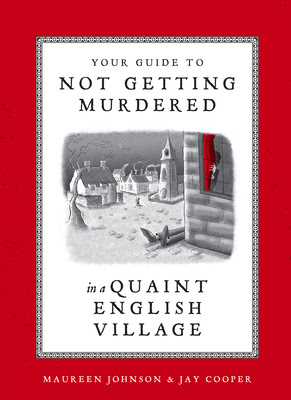
Johnson, Maureen; Cooper, Jay "Your Guide to Not Getting Murdered in a Quaint English Village"

Johnson, Maureen; Cooper, Jay "Your Guide to Not Getting Murdered in a Quaint English Village" - 2021

Most bloggers know that if you blog and always recommend books to other readers, you constantly get recommendations themselves. The disadvantage: your TBR pile grows and grows. The advantage: your TBR pile grows and grows. This is one of the recommendations I received from another reader who often finds the most interesting books (Christopher @ Plucked from the Stacks). And this one is no exception.

If, like me, you like to watch the British crime series "Midsomer Murders", the title jumps right into your eyes. And there is only one conclusion to be drawn. The authors must have watched the series, as well. And they drew their conclusions.

Once you start reading this, you know they did. They tell you what to avoid: the vicar, high places, low places, dark places, any places, empty houses, bridges and tunnels, any kind of events, village, sports or otherwise, any kind of family gatherings etc. etc.

No matter what the recommendations are, at the end it is always clear, you are going to get killed if you visit these places. So, the biggest advice is: Stay away!

They forgot one good advice I can give to anyone who wants to visit Midsomer County. Do not befriend the Chief Inspector's wife, no matter how nice and lovely she is. The victims always belong to her closest circle.

Why do I love Midsomer so much? I used to live in Buckinghamshire and I have actually been to quite a few of the places that appear in the series, larger towns or small hamlets. And I can tell you, they are really as pretty as shown in the series and the people are awfully nice. We lived there for six years and didn't encounter any murder.

Still, this book reminded me of the series as well as the area. So lovely. And funny. Oh, and the illustrations are both cute as well as hilarious. I guess even if you haven't seen the series, you would enjoy this book.

From the back cover:

"Thinking of a foray to a quaint English village? You'll think twice after reading this tongue-in-cheek illustrated guide to the countless murderous possibilities lurking behind these villages' bucolic façades  - from bestselling author Maureen Johnson and illustrator Jay Cooper.

A weekend roaming narrow old lanes, touring the faded glories of a country manor, and quaffing pints in the pub. How charming. That is, unless you have the misfortune of finding yourself in an English Murder Village, where danger lurks around each picturesque cobblestone corner and every sip of tea may be your last. If you insist on your travels, do yourself a favor and bring a copy of this little book. It may just keep you alive.

Brought to life with dozens of Gorey-esque drawings by illustrator Jay Cooper and peppered with allusions to classic crime series and unmistakably British murder lore, Your Guide to Not Getting Murdered in a Quaint English Village gives you the tools you need to avoid the same fate, should you find yourself in a suspiciously cozy English village (or simply dream of going). Good luck, and whatever you do, avoid the vicar.
"

Monday, 24 October 2022

Brontë, Charlotte "Shirley" - 1849


Brontë, Charlotte "Shirley" - 1849

This is my tenth Classic Spin and we were given #2.

One cannot read anything by Charlotte Brontë without comparing it to "Jane Eyre". Whilst that novel was about a poor girl with no relatives to help her, the poor girl in this story has an uncle who raises her. And cousins who like her. And a rich friend. So, a completely different story, one could say.

However, Shirley and her friend Caroline also show us the situation of women in the 19th century just as well as Jane Eyre. The story might not be as dramatic but it certainly is interesting. Charlotte Brontë shows quite a bit of humour in her narrative. Still, not my favourite.

From the back cover:

"Following the tremendous popular success of Jane Eyre, which earned her lifelong notoriety as a moral revolutionary, Charlotte Brontë vowed to write a sweeping social chronicle that focused on 'something real and unromantic as Monday morning.' Set in the industrializing England of the Napoleonic wars and Luddite revolts of 1811-12, Shirley (1849) is the story of two contrasting heroines. One is the shy Caroline Helstone, who is trapped in the oppressive atmosphere of a Yorkshire rectory and whose bare life symbolizes the plight of single women in the nineteenth century. The other is the vivacious Shirley Keeldar, who inherits a local estate and whose wealth liberates her from convention.

A work that combines social commentary with the more private preoccupations of Jane Eyre, Shirley demonstrates the full range of Brontë's literary talent. '
Shirley is a revolutionary novel,' wrote Brontë biographer Lyndall Gordon. 'Shirley follows Jane Eyre as a new exemplar but so much a forerunner of the feminist of the later twentieth century that it is hard to believe in her actual existence in 1811-12. She is a theoretic possibility: what a woman might be if she combined independence and means of her own with intellect. Charlotte Brontë imagined a new form of power, equal to that of men, in a confident young woman [whose] extraordinary freedom has accustomed her to think for herself.... Shirley [is] Brontë's most feminist novel'."

Here are all the books on my original Classics Club list.
And here is a list of all the books I read with the Classics Spin.

Monday, 13 December 2021

Follett, Ken "A Column of Fire"

Follett, Ken "A Column of Fire" - 2017

I love reading about the Tudors. And I loved the two first books of the Kingsbridge Series ("The Pillars of the Earth" and "World Without End"). So, this was definitely a win-win situation.

This is mostly the story of the Willard family. There is a Romeo and Juliet plot, villains and heroes, Catholics and Protestants, Queens Mary I, Elizabeth I and King James I of England, Mary Queen of Scots, the history of the St. Bartholomew's Day massacre, the Spanish Armada, the Gunpowder plot and many other political events. This book has it all.

A very impressive novel. Ken Follett's style is fantastic, his love for detail brilliant and the stories in his book exciting.

I thought the list of real-life characters at the end of the book was very helpful. I would have also enjoyed a timeline of what happened at the time. Yes, I have the internet and plenty of other books where I can look this up but I find having it in the actual book I'm reading is actually very helpful.

Now on to the prequel, "The Evening and the Morning".

From the back cover:

"As Europe erupts, can one young spy protect his queen? Ken Follett takes us deep into the treacherous world of powerful monarchs, intrigue, murder, and treason with his magnificent epic, A Column of Fire - the chronological latest in the Kingsbridge series, following The Pillars of the Earth, World Without End, and the prequel, The Evening and the Morning.

In 1558, the ancient stones of Kingsbridge Cathedral look down on a city torn apart by religious conflict. As power in England shifts precariously between Catholics and Protestants, royalty and commoners clash, testing friendship, loyalty, and love.

Ned Willard wants nothing more than to marry Margery Fitzgerald. But when the lovers find themselves on opposing sides of the religious conflict dividing the country, Ned goes to work for Princess Elizabeth. When she becomes queen, all Europe turns against England. The shrewd, determined young monarch sets up the country’s first secret service to give her early warning of assassination plots, rebellions, and invasion plans. Over a turbulent half century, the love between Ned and Margery seems doomed as extremism sparks violence from Edinburgh to Geneva. Elizabeth clings to her throne and her principles, protected by a small, dedicated group of resourceful spies and courageous secret agents.

The real enemies, then as now, are not the rival religions. The true battle pitches those who believe in tolerance and compromise against the tyrants who would impose their ideas on everyone else - no matter what the cost.

Exciting and ambitious, and set during one of the most turbulent and revolutionary times in history,
A Column of Fire will delight longtime fans of the Kingsbridge series and serve as the perfect introduction for readers new to Ken Follett."

See more comments on my ThrowbackThursday post in 2022.

Monday, 30 August 2021

Weir, Alison "Six Tudor Queens. Katheryn Howard"

Weir, Alison "Six Tudor Queens. Katheryn Howard. The Tainted Queen" (US Title: The Scandalous Queen) - 2020

I have read all of Alison Weir's Tudor Queen books and this is the one about Henry VIIIs fifth wife. I have always read about her as being frivolous which she probably was. But the background about her and her family, I never heard of that.

A poor little girl who lost her mother when she was very young is sent from one place to the next and gets her "education" mainly from other young women who want nothing else than their enjoyment.

Alison Weir lets us see Katheryn Howard from a whole different point of view and that is the main reason why I think everyone who is interested in the Tudors should read the book. In her book about Anna of Kleve she took some liberties and invented "facts" that cannot be proven. Maybe she also did this with Henry's next queen though I doubt it because she even mentioned the stuff she had invented about Anna in her epilogue.

A pleasant read, as always. Looking forward to the book about the sixth and last wife, Katharine Parr.

From the back cover:

"Alison Weir, historian and author of the Sunday Times-bestselling Six Tudor Queens series, relates one of the most tragic stories in English history: Katheryn Howard, Henry VIII's fifth queen.

A naïve young woman at the mercy of her ambitious family.

At just nineteen, Katheryn Howard is quick to trust and fall in love.

She comes to court. She sings, she dances.

She captures the heart of the King.

But Henry knows nothing of Katheryn's past - one that comes back increasingly to haunt her. For those who share her secrets are waiting in the shadows, whispering words of love ... and blackmail.

Katheryn Howard

The Fifth of Henry's Queens.

Her story.

History tells us she died too soon.

This mesmerising novel brings her to life.
"

There is also a non-fiction book by Alison Weir about all of the ladies: "The Six Wives of Henry VIII".

Friday, 30 July 2021

Clarke, Stephen "Merde actually"

Clarke, Stephen "Merde actually" (aka In the Merde for Love) - 2005

After reading "A Year in the Merde", I was sure I'd want to read more of his books (as mentioned in my review).

So, this one made it onto my TBR pile and since it sas "Paris in July" month, I had to read it now.

Paul West, the author's alter ego, I suppose, is still in Paris and has opened a British tea room. He struggles with the French authorities who don't accept anything not precisely written in French and with French girls, their families and the French in general. He picks on everyone, though, his English compatriots as well as any kind of tourists he comes across in his tearoom. Still quite funny, not as hilarious as the first one but a good sequel.

Again, a nice book to read as an expat but also for those who love to travel or France. The Times said he is "edgier than Bryson, hits harder than Mayle". While I agree with the latter, nobody can beat Bill Bryson, he is the best travel writer there is.

From the back cover:

"A year after arriving in France, Englishman Paul West is still struggling with some fundamental questions:

What is the best way to scare a gendarme? Why do French job applicants put sexually transmitted diseases on their CVs? Why are there no public health warnings on French nudist beaches? And how do you cope with a plague of courgettes?

Paul also mutates (temporarily) into a Parisian waiter, samples the pleasures of typically French hotel-room afternoons, and on a return visit to the United Kingdom, sees the full horror of a British office party through Parisian eyes. Meanwhile, he continues his search for the perfect French mademoiselle. But will Paul find l'amour eternel, or will it all end in merde?
"

Stephen Clarke has written more sequels to this story in the meantime (in addition to the ones I mentioned in my other review):

"The Merde Factor" - 2012
"Merde in Europe" - 2016

And some non-fiction:
"Dirtily Bertie: An English King Made in France" - 2014
"How the French Won Waterloo (or think they did) - 2016
"The French Revolution and What Went Wrong"- 2018

I think I will have to get at least one of them for next year's "Paris in July".