Showing posts with label France. Show all posts

Tuesday, 21 July 2026

Kishon, Ephraim "The Seasick Whale: An Israeli Abroad"

Kishon, Ephraim "The Seasick Whale: An Israeli Abroad. Book of Travels" (Hebrew: ספר המסעות/Sefer ha'masot) -  1995 

Ephraim Kishon is always worth picking up. In this volume, he recounts his travels to various European countries and the United States. Like few others, he manages to portray the quirks of the locals in such a way that even they have to laugh at them. And, in reality, his observations actually serve as a form of praise.

So, for anyone who wants to know how to get rid of a banana peel in Switzerland, why one should never take a gondola in Venice, and why it is advisable not to visit Las Vegas without having already booked and paid for the return journey, this book is worth its weight in gold.

Book Description:

"Every person dreams of travel in the world; Anyone going crazy to see the Niagara Falls outdated and disappointed them, or to flock to the picture of the Mona Lisa and find out the size of A4. The average Israeli is not a dream and we do not go crazy. He drives - especially in summer and winter, or the two seasons, going at all costs and at every opportunity. Citizen look in the mirror and say to 'I'm starting to resemble my passport photo, so it was time to go.

Ephraim Kishon's journeys proves his wonderful humor is independent of geography, is entertaining and hilarious in each country to which he invites the reader."

Monday, 16 February 2026

Bjørnson, Bjørnstjerne "Absalom's Hair"

Bjørnson, Bjørnstjerne "Absalom's Hair" (Norwegian: Absalons Haar) - 1894

I enjoy reading books by Nobel laureates from time to time. So when I came across this novel, I had to check it out. It's a novella, so not very long. A bit more plot certainly wouldn't have hurt the story. I wasn't particularly impressed. The narrative jumped around, and the protagonists lacked any compelling qualities. It's simply a very old book that hasn't aged well.

And if it was meant as a satire, I would have expected some humor.

Bjørnson also wrote the Norwegian national anthem, "Ja, vi elsker dette landet" (Yes, we love this country).

Book Description:

"Harald Kaas was sixty. He had given up his free, uncriticised bachelor life; his yacht was no longer seen off the coast in summer; his tours to England and the south had ceased; nay, he was rarely to be found even at his club in Christiania. His gigantic figure was never seen in the doorways; he was failing. Bandy-legged he had always been, but this defect had increased; his herculean back was rounded, and he stooped a little. His forehead, always of the broadest-no one else's hat would fit him-was now one of the highest, that is to say, he had lost all his hair, except a ragged lock over each ear and a thin fringe behind. He was beginning also to lose his teeth, which were strong though small, and blackened by tobacco; and now, instead of 'deuce take it' he said 'deush take it.'"

Bjørnstjerne Bjørnson received the Nobel Prize for Literature in 1903 "as a tribute to his noble, magnificent and versatile poetry, which has always been distinguished by both the freshness of its inspiration and the rare purity of its spirit".

I contribute to this page: Read the Nobels and you can find all my blogs about Nobel Prize winning authors and their books here.

Tuesday, 13 January 2026

Mann, Thomas "Confessions of Felix Krull, Confidence Man"

Mann, Thomas "Confessions of Felix Krull, Confidence Man" (German: Bekenntnisse des Hochstaplers Felix Krull) - 1954

Thomas Mann, one of my favorite authors, turned 150, and since I didn't want to end the year without reading at least one of his novels new to me, I went on a search. I had this book on my TBR pile, so the decision was easy.

I must confess, I had no idea that this book was unfinished. I now know that Mann worked on it for a long time and certainly made numerous notes about the plot, but only completed the first part and then died before writing the second.

What a shame, the beginning is already good. The second part would certainly have been just as excellent as anything by Thomas Mann.

In any case, the book has a lot of tongue-in-cheek humor. And even though Felix Krull manages to outwit many people, one can only admire his cunning.

The book is a very good read; I really enjoyed it.

I am not very happy with the translation of the word "Hochstapler" into "Confidence Man". Maybe that's my German thinking but the word "confidence" sounds far too nice to call someone who tricks other people. Impostor, cheater, trickster, swindler sound much more accurate to me.

Book Description:

"'The most astonishing work that Mann ever wrote and also one of the most perfect. . . with Felix Krull the world receives from Thomas Mann the gift which German literature has almost proverbially withheld from it: the great comic novel' - Edwin Muir

Waiter by day man about Paris by night, the young and good looking Felix Krull has created for himself a personality to charm and deceive the world of wealth. Then the Marquis de Venosta makes a proposal that he can't refuse."

Thomas Mann received the Nobel Prize for Literature in 1929 "principally for his great novel, 'Buddenbrooks', which has won steadily increased recognition as one of the classic works of contemporary literature".

I contribute to this page: Read the Nobels and you can find all my blogs about Nobel Prize winning authors and their books here.

Thursday, 23 October 2025

Hemingway, Ernest "In Our Time"

Hemingway, Ernest "In Our Time" - 1925

I chose this book because the year 1925 was given for our Read the Year challenge. A whole century ago. I had read a few books from that year already, so the choice was not exactly limited but there wasn't a single book on my wishlist that would fit the challenge. So, I went for an author that I like and that I wanted to read more from.

Had I chosen it if I'd been aware that this is a collection of short stories? Probably not. Granted, they were linked with each other, somehow. But it still wasn't enough to really grip me.

However, this was his first publication and we can see a lot of topics that will come up in his later work. Having read some of those helped.

So, not my favourite of his books.

Book Description:

"A strikingly original collection of short stories and accompanying vignettes that marked Ernest Hemingway’s American debut.

When In Our Time was first published in 1925, it was widely praised for its simple and precise use of language to convey a wide range of complex emotions, and earned Hemingway a place among the most promising American writers of that period. In Our Time contains several early Hemingway classics, including the famous Nick Adams stories 'Indian Camp' and 'The Three Day Blow', and introduces readers to the hallmarks of the Hemingway a lean, tough prose, enlivened by an ear for the colloquial and an eye for the realistic. His writing suggests, through the simplest of statements, a sense of moral value and a clarity of vision.

Now recognized as one of the most important short story collections of twentieth-century literature, In Our Time provides key insights into Hemingway’s later works."

Ernest Hemingway received the Nobel Prize for Literature in 1954 "for his mastery of the art of narrative, most recently demonstrated in 'The Old Man and the Sea' and for the influence that he has exerted on contemporary style".

I contribute to this page: Read the Nobels and you can find all my blogs about Nobel Prize winning authors and their books here.

Find all my Read The Year books here.

Monday, 20 October 2025

Hammond, Richard "As You Do"

Hammond, Richard "As You Do: Adventures With Evil, Oliver And The Vice President Of Botswana" - 2008

I have always loved Top Gear and especially Richard Hammond, "The Hamster" (see his book On the Edge). The adventures the guys had in their show, they were always hilarious albeit very scary.

Here, Richard Hammond has written about his race to the North Pole with a dog-driven sled against his friends in a car - with a lot of preparation beforehand (Polar Special, also known as the Polar Challenge). And about his trip through Africa in a car that he bought right there and kept later on because he had named it (Ollie) and you cannot sell a car with a name. LOL.

And there are other stories in the book, how he rescued some friends who were stuck in their house in the flood in Gloucestershire. And how he met Eviel Knievel, a guy I never was interested in and am even less after reading about him, even though he was one of the author's heroes.

In any case, this was a very interesting book with lots of funny scenes, almost like watching Top Gear. And it was an easy yet still worthy book to read.

From the back cover:

"The wry, honest and often hilarious chronicles of a very brave and clever TV presenter, Arctic Explorer and general drawer of the Short Straw. 

As one third of the BBC's Top Gear team, Richard Hammond's year since his near-fatal accident has been full of stunts and drama. From a race to the North Pole (with skis and dog-sled) to a journey through Botswana in a car named Oliver, and a seventeen-mile run through floods to his Gloucestershire home, in order to get to his daughter's birthday party, the year has been eventful, to say the least . . .

With his boundless optimism in the face of certain failure, Richard Hammond has become one of our funniest writers about a life (and a job) which constantly present a challenge."

Wednesday, 15 October 2025

Boyd, William "On the Yankee Station" - 1981

Boyd, William "On the Yankee Station" - 1981

Several people recommended William Boyd to me lately. And I had found one of his books in a used book sale. So, I decided to tackle this.

This is a collection of short stories about teenagers, young people, students, boarding school, murderers, all about people completely dissatisfied with their lives.

Short stories have never been my favourite and this book certainly didn't convice me otherwise. Please, if you have read his short stories and his novels and think the novels are so much better, tell me, otherwise this would be the last I have read of his stories.

From the back cover:

"Adolescent sex in a Scottish boys' public school ... Oddballs on the seedy side of America ... Murder in a quiet Devon cottage ... Comical, ironical or lacerating - wit is the keynote of these stories, which include two early adventures from the career of Morgan Leafy, glorious anti-hero of William Boyd's prize-winning novel 'A Good Man in Africa'.

Wiliam Boyd, winner of the Whitbread and Somerset Maugham Awards, introduces unlikely heroes desperate to redeem their unsatisfying lives.

From California poolsides to the battlegrounds of Vietnam, here is a world populated by weary souls who turn to fantasy as their sole escape from life's inequities. Stranded in an African hotel during a coup, an oafish Englishman impresses a young stewardess with stories of an enchanted life completely at odds with his sordid existence in 'The Coup'" In the title story, an arrogant, sadistic American pilot in Vietnam underestimaets the power of revenge when he relentlessly persecutes a member of his maintenance crew. With droll humor and rare compassion, Boyd's enthralling stories remind us of his stature as one of contemporary fiction's finest storytellers."

Wednesday, 6 August 2025

Barbery, Muriel "Une Rose Seule"

Barbery, Muriel "A Single Rose" (French: Une Rose Seule) - 2020

I read Muriel Barbery's "The Elegance of the Hedgehog" and found it truly beautiful.

This book was recommended to me as a lovely, light French book. Well, it was light, but perhaps a bit too long-winded for me. Asian thinking is foreign to me, I'm not a yoga or Zen fan, and I can't empathize with myself as much as is often desired.

The author and her protagonist certainly succeeded in doing this, but it wasn't really comprehensible to me. The first few chapters are all about landscapes, flowers, food and drink, temples, etc. I also couldn't warm to Rose, who only thawed out a bit towards the end.

And although I normally enjoy reading philosophical books, this was a bit too much of a good thing for me, too forced.

A Japanese story, a fairy tale, or a fable, was interspersed between the chapters. I found some of them interesting, while others made me wonder what they had to do with the book.

Well, it was nice to read a French book again, and also a good read for our "Paris in July" challenge, but that was about it.

From the back cover:

"From the bestselling author of The Elegance of the Hedgehog comes a story about a woman’s journey, in which she discovers the father she never knew and a love she never thought possible.

Rose has turned forty, but has barely begun to live. When her Japanese father dies and she finds herself an orphan, she leaves France for Kyoto to hear the reading of his will. Paul, her father’s assistant, takes Rose on a mysterious pilgrimage designed by her deceased father. Her bitterness is soothed by the temples, Zen gardens and teahouses, and by her encounters with her father’s friends. As she recognises what she has lost, and as secrets are divulged, Rose learns to accept a part of herself that she has never before acknowledged.

Through her father’s itinerary, he opens his heart posthumously to his daughter, and Rose finds love where she least expects it. This stunning fifth novel from international bestseller Muriel Barbery is a mesmerising story of second chances, of beauty born out of grief."

Monday, 30 June 2025

Groff, Lauren "Matrix"

Groff, Lauren "Matrix" - 2021

A member of our book club tried to convince us that this would be the best novel for our next book choice. But some members were not really convinced that they wanted to read it. So I "took pity" (LOL) and volunteered to be a guinea pig.

I love reading historical novels, especially about women and their fights against the prejudices of their times. So, I expected something really interesting. Many girls were sent to nunneries against their wishes and a few were quite successful in that world.

I tried to read more about the protagonist and found that the book is not really based on anything known from reality. It is what it says: pure fiction.

I thought I could learn more about the history of a person that was important in her lifetime. Unfortunately, I didn't. If you are looking for a novel without being interested in the background or whether that person existed, you might like this better. I was disappointed.

Overall, the novel was too superficial for me.

There are no footnotes or links to research pages that might support at least some of the stories.

From the back cover:

"Seventeen-year-old Marie, too wild for courtly life, is thrown to the dogs one winter morning, expelled from the royal court to become the prioress of an abbey. Marie is strange - tall, a giantess, her elbows and knees stick out, ungainly.

At first taken aback by life at the abbey, Marie finds purpose and passion among her mercurial sisters. Yet she deeply misses her secret lover Cecily and queen Eleanor.

Born last in a long line of women warriors and crusaders, women who flew across the countryside with their sword fighting and dagger work, Marie decides to chart a bold new course for the women she now leads and protects. She will bring herself, and her sisters, out of the darkness, into riches and power.

MATRIX is a bold vision of female love, devotion and desire from one of the most adventurous writers at work today."

Monday, 5 May 2025

Sartre, Jean-Paul "Nausea"

Sartre, Jean-Paul "Nausea" (French: La nausée) - 1938

We discussed this in our international online book club in April 2025.

An interesting book. Yes, it introduces us to existentialism. I gives us ideas for thoughts about our lives. But it's not really a novel, nothing much happens. At the beginning, I was quite bored. It picks up a little but it doesn't catch you.

I heard Sartre compared to Camus. I absolutely love Camus. Sartre doesn't come over as well, the story is not a real story. You don't know where they are going. There isn't a flow to his writing.

At the beginning, when the protagonist talks about his nausea, it  reminded me of depression, the big black dog, as people also call it. I thought it might go that way. But it didn't.

All in all, not an exciting book. I would have expected more. Maybe I read this too late.

Comments by other members:

"It was described very accurately by a funny Finnish word 'pitkäpiimäinen' = like rubbery sour milk, longwinded, boring.

We thought it was much more like a complete philosophy textbook than a story.

It was a very anxious story about a depressed and lonely person

It reminded us of many similar stories we have read over the years about loneliness and mental illness, for example: Steppenwolf, The Stranger, plus many more all with their own variety on the subject."

From the back cover:

"Jean-Paul Sartre's first published novel, Nausea is both an extended essay on existentialist ideals, and a profound fictional exploration of a man struggling to restore a sense of meaning to his life. This Penguin Modern Classics edition is translated from the French by Robert Baldick with an introduction by James Wood.

Nausea is both the story of the troubled life of an introspective historian, Antoine Roquentin, and an exposition of one of the most influential and significant philosophical attitudes of modern times - existentialism. The book chronicles his struggle with the realisation that he is an entirely free agent in a world devoid of meaning; a world in which he must find his own purpose and then take total responsibility for his choices. A seminal work of contemporary literary philosophy, Nausea evokes and examines the dizzying angst that can come from simply trying to live."

Jean-Paul Sartre received the Nobel Prize for Literature in 1964 "for his work, which rich in ideas and filled with the spirit of freedom and the quest for truth, has exerted a far-reaching influence on our age". He was awarded the prize even though he refused it.

I contribute to this page: Read the Nobels and you can find all my blogs about Nobel Prize winning authors and their books here.

Monday, 7 April 2025

Flaubert, Gustave "Madame Bovary"

Flaubert, Gustave "Madame Bovary" (French: Madame Bovary) - 1857

For the Classics Spin #40, we received #4 and this was my novel.

I have a love-hate relationship with French books. I love the French language. I absolutely love the books by Albert Camus, there are a few others I don't exactly dislike but, in general, they are not for me.

I had hoped that this one would be for me like my beloved English classics by Jane Austen, Charles Dickens, the Brontës, etc. etc. But it was not to be.

What did I dislike about the novel? Not the story itself, it was quite interesting to follow the story of Emma, a young girl who marries a doctor but finds her life beside him completely boring so looks for excitement in other men. Or maybe it was the story. It was as boring as the life of the protagonist. So, maybe that's exactly what he was trying to show. Then he succeded. But not with me.

From the back cover:

"Madame Bovary is the debut novel of French writer Gustave Flaubert, published in 1856. The character lives beyond her means in order to escape the banalities and emptiness of provincial life. When the novel was first serialized in La Revue de Paris between 1 October 1856 and 15 December 1856, public prosecutors attacked the novel for obscenity. The resulting trial in January 1857 made the story notorious. After Flaubert's acquittal on 7 February 1857, Madame Bovary became a bestseller in April 1857 when it was published in two volumes. A seminal work of literary realism, the novel is now considered Flaubert's masterpiece, and one of the most influential literary works in history."

Here are all the books on my original Classics Club list.
And here is a list of all the books I read with the Classics Spin.

Monday, 17 March 2025

Clarke, Stephen "Talk to the Snail"

Clarke, Stephen "Talk to the Snail. Ten Commandments for Understanding the French" - 2006

I have read two books by Stephen Clarke, so far. This was my third. While the others were fiction about an English guy living in Paris (well, the story is based on the author's life), this is a non-fiction book about the French people and the French language. Quite funny at times. Unless you're a very serious French person who doesn't have a sense of humour. I've lived abroad half of my life (though not in France) and I can see where some of his frustration comes from. 

There are so many parts in this book where I just nodded - or where I had to shake my head. There were a lot of things that I remarked in England, e.g. when he complains that the French don't use French words for illnesses or medication. I had that same experience in England. Unless it's a common cold, the use mainly Latin or Greek words, even for the doctors they go to. 

Then there are the international problems, like not getting on with your neighbours, that's not just a problem an Englishman in France has. And not getting served in a restaurant. How often do you have to dislocate your arm or should in order to get the attention of a waiter? Not just in France, I am sorry to say.

Still, there are a lot of helpful hints in the book, language- and otherwise. And the author hasn't lost his humour, either. Lovely book.

From the back cover:

"The only book you'll need to understand what the French really think, how to get on with them and, and most importantly, how to get the best out of them. With useful sections on:

  • Making sure you get served in a café
  • Harassing French estate agents
  • Living with bacteria
  • Pronouncing French swear-words
  • Surviving the French driving experience
  • Falling in amour, Paris-style
  • And beaucoup beaucoup more!

Don't go to France without reading this book!"

Tuesday, 15 October 2024

Follett, Ken "The Armour of Light"

Follett, Ken "The Armour of Light" - 2023

"The grand master of gripping fiction is back. International No.1 bestseller Ken Follett returns to Kingsbridge with an epic tale of revolution and a cast of unforgettable characters."

Yes, he is a grand master indeed. After having written four books about Kingsbridge, their cathedral and the inhabitants, rich and poor from 997 until the 16th century, here is the follow-up for the Industrial Revolution.

With the story of  Kingsbridge, we also learn the story of England and the United Kingdom. Anytime we read about history and how people lived, we must be thankful to live today. Even though we also have political problems, we as "the little people" have a lot more rights than people ever had. And we owe this to people like those described here.

I hope the story of Kingsbridge will continue into modern times. Then we could just go on with the century trilogy.

In any case, this is THE series for lovers of historical fiction.

I missed a list of all the characters before and during the book. And, like I said before, I would have enjoyed a timeline of what happened at the time. Yes, I have the internet and plenty of other books where I can look this up but I find having it in the actual book I'm reading is actually very helpful.

From the back cover:

"Revolution is in the air

1792. A tyrannical government is determined to make England a mighty commercial empire. In France, Napoleon Bonaparte begins his rise to power, and with dissent rife, France’s neighbours are on high alert.

Kingsbridge is on the edge

Unprecedented industrial change sweeps the land, making the lives of the workers in Kingbridge’s prosperous cloth mills a misery. Rampant modernization and dangerous new machinery are rendering jobs obsolete and tearing families apart.

Tyranny is on the horizon

Now, as international conflict nears, a story of a small group of Kingsbridge people - including spinner Sal Clitheroe, weaver David Shoveller and Kit, Sal’s inventive and headstrong son - will come to define the struggle of a generation as they seek enlightenment and fight for a future free from oppression. . .

Taking the reader straight into the heart of history with the fifth novel in the ground-breaking Kingsbridge series, The Armour of Light is master storyteller Ken Follett’s most ambitious novel to date."

Monday, 22 July 2024

🥐 Paris in July 2024 🥐

Welcome to another exciting month where we exchange reviews about books we read about Paris. Last year (2023), I posted the books I read where Paris is either the topic or at least part of the read and the books I read about France or the French language and the books I read last year for Paris in July.

I found the challenge at Lisbeth @ The Content Reader. Tamara @ Thyme for Tea has been hosting a Paris in July challenge for eleven years. Then, she hosted together with Deb @ Readerbuzz. In 2022, Emma @ Words and Peace kindly took over as the host and she continues to do so. The picture  at the top is also created by her.

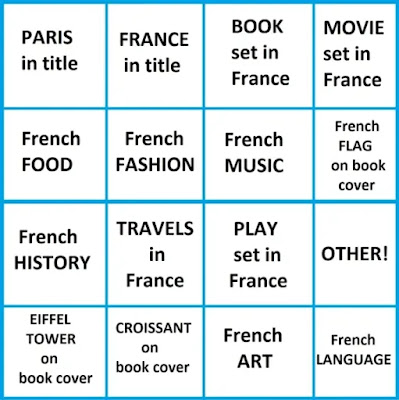
I don't have a lot of energy to participate this year by reading new books about Paris, but I tried to take part through the Paris Bingo. I will try to add books etc. I have not used in any of the Paris in July years before (though it is hard and therefore cannot be entirely avoided).
PARIS in title
Rutherfurd, Edward
"Paris" - 2013

FRANCE in title
Stein, Gertrude "Paris France" - 1940

BOOK set in France
Ernaux, Annie "The Years" (FR: Les années) - 2008

MOVIE set in France
Leroux, Gaston "The Phantom of the Opera" (French: Le Fantôme de l'Opéra) - 1910

French FOOD
Drinkwater, Carol "The Olive Farm" - 2001

French FASHION
Guiliano, Mireille "French Women Don’t Get Fat" - 2004

French MUSIC
Francis Cabrel "La Corrida"

French FLAG
Hugo, Victor "Les Misérables" (F: Les Misérables) - 1862

French HISTORY (not just French but funny)
Shaw, Karl "Royal Babylon: The Alarming History of European Royalty" - 1999

TRAVELS in France
Mayle, Peter "A Year in Provence" - 1989

PLAY set in France
Ionesco, Eugène "Rhinoceros" (French: Rhinocéros) - 1957

OTHER!
Voltaire "Candide, or Optimism" (F: Candide, ou l'Optimism) - 1757

EIFFEL TOWER
Dorling Kindersley "Eyewitness Guide Paris" and "Top 10 Paris" - 2020

CROISSANT
I haven't read a book that has a croissant on my edition but I found one that has a croissant on the Portuguese one:

Clarke, Stephen "A Year in the Merde" - 2004 - Um Ano Em França

French ART
Chevalier, Tracy "The Lady and the Unicorn" - 2003

French LANGUAGE
Némirovsky, Irène "La Proie" [The Prey] - 1938

I am looking forward to seeing many posts by other Paris enthusiasts.

🥐 Joyeux Juillet 🥐

Monday, 15 July 2024

Du Maurier, Daphne "Rebecca" - 1938

Du Maurier, Daphne "Rebecca" - 1938

"Last night I dreamt I went to Manderley again." Besides "Happy families are all alike; every unhappy family is unhappy in its own way" from Anna Karenina and "It was the best of times, it was the worst of times ..." from "A Tale of Two Cities" probably one of the best known first lines of any novel. Even people who never read the books have heard them.

I have wanted to read this novel for a long, long time. I don't know why it took me so long to start it but I am glad I finally did. What a story! Definitely one of my favourites of all time.

I remember watching the film at least forty years ago, I have never forgotten it. Sometimes you don't want to spoil a book by watching the movie, sometimes it is the other way around.

This has not disappointed me. On the contrary. I am glad I watched the film first because I might have not liked it as much. But his way it was good.

The writing of this book is just superb. Whether it's a conversation or the description of a situation or a landscape, it couldn't have been done any better.

The description of the book says it all, I don't want to add more to spoil it for those who have not read it.

Just one last question: Any ideas on the name of the narrator. My thought was Kirstin or Kristin or Christine or Kerstin or whatever variations of that name, I've seen so many of them. However, I guess there is a reason why the author decided not to give her a name, it goes well with her status in the book, with her self-confidence - or lack of it.

From the back cover:

"'Last night I dreamt I went to Manderley again.'

So the second Mrs. Maxim de Winter remembered the chilling events that led her down the turning drive past the beeches, white and naked, to the isolated gray stone manse on the windswept Cornish coast. With a husband she barely knew, the young bride arrived at this immense estate, only to be inexorably drawn into the life of the first Mrs. de Winter, the beautiful Rebecca, dead but never forgotten...her suite of rooms never touched, her clothes ready to be worn, her servant - the sinister Mrs. Danvers - still loyal. And as an eerie presentiment of the evil tightened around her heart, the second Mrs. de Winter began her search for the real fate of Rebecca...for the secrets of Manderley."

Monday, 15 April 2024

Joyce, Rachel "Miss Benson's Beetle"


Joyce, Rachel "Miss Benson's Beetle" - 2020

After reading "The Unlikely Pilgrimage of Harold Fry", I decided I didn't want to read another book by this author. Then a friend lent me her copy of this book and promised it was better. Well, it was, just a little. I think I just don't like the style of writing. And I prefer book with some content where I can learn something.

I really wanted to like this book but couldn't. I neither liked the characters nor could I really make any sense of their trials and tribulations it was all a little higgledy-piggledy, reminded me a little of the illogical sequences in sci-fi stories.

Not for me. And, after not liking two of her books, I can safely say that this was my last one by this author.

From the back cover:

"It is 1950. In a devastating moment of clarity, Margery Benson abandons her dead-end job and advertises for an assistant to accompany her on an expedition. She is going to travel to the other side of the world to search for a beetle that may or may not exist.

Enid Pretty, in her unlikely pink travel suit, is not the companion Margery had in mind. And yet together they will be drawn into an adventure that will exceed every expectation. They will risk everything, break all the rules, and at the top of a red mountain, discover their best selves.


This is a story that is less about what can be found than the belief it might be found; it is an intoxicating adventure story but it is also about what it means to be a woman and a tender exploration of a friendship that defies all boundaries.
"

Wednesday, 17 January 2024

Wells, Benedict "The End of Loneliness"

Wells, Benedict "The End of Loneliness" (German: Vom Ende der Einsamkeit) - 2016


A quiet book about a family that suddenly isn't a family anymore. How do children cope with the death of their parents, how do they get on?

In this story we can see what happens next.
Or not. How this loss accompanies a child throughout their entire life, how it shapes their life.

After the death of their parents, the children grow up in a boarding school, which is also described very impressively.
Here the author probably drew on his own experiences, as he too was at boarding school at the age of six.

This is a fabulous book that captures all facets of an entire life (or several).
Wonderfully written, a fascinating family story that is so comprehensive despite only being just over 350 pages long. Terrific. 

I think I will read more from this young author.

From the back cover:

"Jules Moreau’s childhood is shattered after the sudden death of his parents. Enrolled in boarding school where he and his siblings, Marty and Liz, are forced to live apart, the once vivacious and fearless Jules retreats inward, preferring to live within his memories - until he meets Alva, a kindred soul caught in her own grief. Fifteen years pass and the siblings remain strangers to one another, bound by tragedy and struggling to recover the family they once were. Jules, still adrift, is anchored only by his desires to be a writer and to reunite with Alva, who turned her back on their friendship on the precipice of it becoming more, but just as it seems they can make amends for time wasted, invisible forces - whether fate or chance - intervene.

A kaleidoscopic family saga told through the fractured lives of the three Moreau siblings alongside a faltering, recovering love story, The End of Loneliness is a stunning meditation on the power of our memories, of what can be lost and what can never be let go. With inimitable compassion and luminous, affecting prose, Benedict Wells contends with what it means to find a way through life, while never giving up hope you will find someone to go with you
."

"The End of Loneliness" has been chosen favourite book of the year 2016 by the German Indepent Book Shops and received the European Union Prize for Literature.

Monday, 30 October 2023

Voltaire "Candide"

Voltaire "Candide, or Optimism" (French: Candide, ou l'Optimisme) - 1759

For the Classics Spin #35, we received #2 and this was my novel.

An interesting take on the Age of Enlightenment.

Candide is a young guy who lives in Germany. He falls in love with a girl but is prevented from marrying her because of her parents. He learns the philosophy "All is for the Best" and travels around the world with this belief.

He probably encounters as many troubles as Homer's Odysseus in the "Odyssey" and solves them almost with the same vigour.

The novel promises to be funny and indeed it is. I have laughed quite a few times during the reading. How can a book be funny and philosophical at the same time? I'm not surprised Voltaire is still such a renowned author even more than two centuries later. I am really happy #2 was pulled for this challenge because I really enjoyed the story.

This novel reminded me a little of Eichendorff's "Life of a Good For Nothing", although it should be the other way around since this one was written earlier. Other than the German novel, I could see more philosophy in this book.

From the back cover:

"Candide tells of the hilarious adventures of the naïve Candide, who doggedly believes that 'all is for the best' even when faced with injustice, suffering, and despair. Controversial and entertaining, Candide is a book that is vitally relevant today in our world pervaded by - as Candide would say - 'the mania for insisting that all is well when all is by no means well.'"

Wednesday, 4 October 2023

Poe, Edgar Allan "The Murders in the Rue Morgue"

Poe, Edgar Allan "The Murders in the Rue Morgue and other stories" - 1841

Our international online book club read in August 2023.

Dark, gruesome, abysmal, that's what I read somewhere about the writings of Edgar Allan Poe. Yeah, I couldn't agree more. I know people who love this sort of writing but I don't. I was afraid I wouldn't like it but tried my best to discover something that might tempt me to read more by this author. Alas, that was not to be. This time, it was a good thing that the book wasn't that thick. Or maybe that added to my disenjoyment.

My biggest problem with stories like these, there is nothing to learn from them. Absolutely nothing. And that is my main reason for reading.

Our book club had chosen to read a collection of short stores. The trouble with this is always that there are different ones in different languages. These were the stories the Finnish members had:
The Tell-Tale Heart (1843)
The Imp of the Perverse (1845)
The Murders in the Rue Morgue (1841)
The Mystery of Marie Rogêt (1843)
The Purloined Letter (1844)
'Thou Art the Man' (1844)

And these were the ones in the English edition:
The Oval Portrait
Ligeia
Eleonora
Morella
Berenice
The Fall of the House of Usher
The Masque of the Red Death
Hop-Frog
The Pit and the Pendulum
The Cask of Amontillado
The Gold-Bug
The Murders in the Rue Morgue
The Mystery of Marie Rogêt
The Purloined Letter

The group had some other opinions. There was a really good discussion about Poe's works and life. Some had read some of the gruesome and terrible works but most of us had read a selection of a few different kinds, some of which are really clever and intelligent, and you clearly can see how he was starting a genre to influence literature for hundreds of years to follow.

From the back cover:

"Between 1841 and 1844, Edgar Allan Poe invented the genre of detective fiction with three mesmerizing stories about a young and eccentric French private detective named C. Auguste Dupin.

Introducing to literature the concept of applying reason to solving crime, these tales brought Poe fame and fortune, although much less of the second during his lifetime. Decades later, Dorothy Sayers would describe '
The Murders in the Rue Morgue' as 'almost a complete manual of detective theory and practice.' Indeed, Poe’s short Dupin mysteries inspired the creation of countless literary sleuths, among them Sherlock Holmes. Today, the unique Dupin stories still stand out as utterly engrossing page-turners."

Friday, 18 August 2023

Guiliano, Mireille "French Women Don’t Get Fat"

Guiliano, Mireille "French Women Don’t Get Fat" - 2004

I'm not a fan of self-help books. I didn't think this was one, I thought it was a sort of funny one but that wasn't the fact. It was a self-help book as most of them are: Only the author knows what's best and the rest of the world, or in this case, the American woman, has no idea.

I'm not American and I know a lot of Americans have weight problems, as do many Germans. But the way the author talks about Americans and American women was quite denigrating. I didn't care for that at all. You can give advice without being uppish. I love France and I have French friends and they are all really nice. And I always met lovely people in France. But this one sounded like she just wanted to confirm the prejudice that all French people are unfriendly. What a pity.

I must admit, though, that some of her advice certainly is not wrong, just the way she pronounced it.

From the back cover:

"Irresistible, chic, convincing, funny, wise, and very timely, this is the ultimate non-diet book, which nonetheless could radically change the way we think and live - showing us how to eat with balance, control and above all pleasure. Packed with wonderful recipes, this charming memoir teaches us how to enjoy our meals, like a French woman, without putting on weight."

Wednesday, 2 August 2023

Ernaux, Annie "The Years"

Ernaux, Annie "The Years" (French: Les années) - 2008

We read this in our international online book club in July 2023.

As so often, I had never heard of Annie Ernaux before she received the Nobel Prize. And that's why I always eagerly await the awards, in 99% of the case, the choice is excellent.

And it was this time. Annie Ernaux is a little older than me but I could find a lot of her experiences in my life. I think most women born in the middle of the last century share them, no matter where they're from. Maybe that's why I liked this book.

It wasn't at all what I expected. While the author grows up, she compares her life with her country, its politics, its developments, especially for women (always to slow). Her memories are haphazard, always in fragments, like a collage or a scrapbook. She uses the third person singular. I think that makes it easier for us to associate with her story, she doesn't give the impression as if she is just speaking about herself.

So, this is not just a biography about Annie Ernaux' life but a history of France after WWII. And a reminder to reflect on our own lives and what our country has done for us and to us. So I am sure it is also interesting for younger people who would like to hear about the generations before them.

I have not studied French (at university, I have learned it at school and speak it) but taken lots of classes and read a lot about French history and politics, visited the country, have friends there. So, not much was totally new for me. But I still enjoyed learning what history and society did to one single person, how she grew up the way she did and became the woman she is today. I will surely read more by her.

Some comments from the discussion:
  • "Beautiful language and picture of its time. The reading created a feeling of 'participation' or belonging, as she wrote the autobiography mostly in 'we' form.
  • I have read her biographies about her mother and father, and the abortion. With this The Years, I finally understood her writing style. I found it impressive, starting as glimpses of history, flowing, like a movie, and ended as glimpses again, the person grew along with the story also, reflecting her life in different ages, the perspective growing with the story, as she grew, her perspective of the world grew. Adding more and more observations the wider her perspective and reflection became. Much of the historical references and politics I missed. But an excellent brilliant book, for adults with some reflective skills.
  • A subjective culture history. I did not feel connected to the 'we' form of participation she tried to bring to the story, like she was taking power she doesn't have. The history interested me, but pop cultural references were not familiar to me.
  • The modern pop culture and freer availability of products came much earlier in France than in Finland, I felt.
  • The French perspective on Algeria before and in the later parts of the book felt written from a French born person, very one-sided, that turned around in the modern waves of anti-immigration feelings.
  • Language was very dense, containing a lot of information in small space of pages. Interesting to read about how influences from different parts of the world arrived and 'affected' the French population. What political news shocked them, what was passed over. What parts of Europe they observed, Yugoslavia, Eastern Europe, etc. and how the feelings and thoughts about these changed. The travelling, the Euro.
  • It was not an emotional book, but a very verbal one, she kept a distance to her history and feelings from youth, trying to keep neutral. Like a huge amount of source material (her life) summarized into this book, full of specifically chosen sayings and expressions. It made the book a beautiful experience to read or listen to. The translators were also skilled in translating these special sayings.
  • We also discussed listening to audiobooks, how we feel about it, experience it, and how we felt it affected reading this book.
  • It was interesting that she analysed her own book in the end, intention to write the book, how she wrote it, what perspective, etc."

From the back cover:

"Considered by many to be the iconic French memoirist’s defining work and a breakout bestseller when published in France in 2008.

The Years is a personal narrative of the period 1941 to 2006 told through the lens of memory, impressions past and present - even projections into the future - photos, books, songs, radio, television and decades of advertising, headlines, contrasted with intimate conflicts and writing notes from 6 decades of diaries.

Local dialect, words of the times, slogans, brands and names for the ever-proliferating objects, are given voice here. The voice we recognize as the author’s continually dissolves and re-emerges. Ernaux makes the passage of time palpable. Time itself, inexorable, narrates its own course, consigning all other narrators to anonymity. A new kind of autobiography emerges, at once subjective and impersonal, private and collective.

On its 2008 publication in France,
The Years came as a surprise. Though Ernaux had for years been hailed as a beloved, bestselling and award-winning author, The Years was in many ways a departure: both an intimate memoir 'written' by entire generations, and a story of generations telling a very personal story. Like the generation before hers, the narrator eschews the 'I' for the 'we' (or 'they', or 'one') as if collective life were inextricably intertwined with a private life that in her parents’ generation ceased to exist. She writes of her parents’ generation (and could be writing of her own book): 'From a common fund of hunger and fear, everything was told in the 'we' and impersonal pronouns.'"

Annie Ernaux received the Nobel Prize for Literature in 2022 "for the courage and clinical acuity with which she uncovers the roots, estrangements and collective restraints of personal memory".

I contribute to this page: Read the Nobels and you can find all my blogs about Nobel Prize winning authors and their books here.