Showing posts with label Cultural Revolution. Show all posts

Monday, 27 April 2015

Buck, Pearl S. "The First Wife and Other Stories"

Buck, Pearl S. "The First Wife and Other Stories" - 1933

Some wonderfully described stories about Chinese life up until the beginning of the 20th century. The author talks about the clash between the traditional Chinese and the Western way, something she must have experienced herself as the daughter of a US missionary in China. The title story talks about a guy who goes abroad and doesn't really relate to his coutry wife anymore so that he divorces her and takes a new one, something that would not have happened before.

But there are also other subjects in the various other stories, some talk about the revolution and what was going on at that time, the devastations after a great flood, daily life in China at the time.

This is a great book to see what changes in tradition and life can do to people. Not just in China. If I compare my chidlren's life with that of my grandparents, there is a huge difference and I don't think my grandparents would have understood any of it. Pearl S. Buck saw this when living in China, she saw how people struggled with the newness of everything adn how a lot of them couldn't cope with it.

A nice collection of stories.

Contents:
Old and new:
  • The first wife
  • The old mother
  • The frill
  • The quarrel
  • Repatriated
  • The rainy day
Revolution:
  • Wang Lung
  • The communist
  • Father Andrea
  • The new road
Flood
  • Barren spring
  • The refugees
  • Fathers and mothers
  • The good river 

Pearl S. Buck received the Nobel Prize for Literature in 1938 "for her rich and truly epic descriptions of peasant life in China and for her biographical masterpieces".

I contribute to this page: Read the Nobels and you can find all my blogs about Nobel Prize winning authors and their books here.

Wednesday, 2 January 2013

Mo, Yan "Red Sorghum"

Mo, Yan "Red Sorghum. A Novel of China" (Chinese: 红高粱家族 Hóng gāoliang jiāzú) - 1987

Every year I am eagerly awaiting the announcement of the Nobel Prize winner for Literature. I have found the most brilliant writers among them and always choose to read one of their novels. I haven't been disappointed so far and this year was no exception.

I hadn't heard of Chinese author Mo Yan before and was surprised to hear that he was the Chinese answer to Franz Kafka or Joseph Heller.

The story takes place during the second Sino-Japanese war between 1937 and 1945, so approximately the same time the whole world was at war. The narrator tells the story of his ancestors, mainly that of his father, who was a teenager at the time, and his grandfather and grandmother. As in most war stories, there is a lot of brutality in the book, the author has a very picturesque way of describing the atrocities committed by both parties. But he doesn't just talk about the war, we also get to know the way people used to live in the eastern part of China at the time.

Red Sorghum, the title of the book, means so much for the Chinese, it is not just food, it represents their country.

I thoroughly enjoyed reading this book. The writing style is at times a little confusing but very interesting to read, he paints the world in his own words. I have always been very interested in China, starting with the books of another Nobel Prize winner who wrote a lot about China, Pearl S. Buck. Mo Yan tells reports from another perspective, and from another era. Definitely worth the read.

See more comments on my ThrowbackThursday post in 2025.

From the back cover:

"Spanning three generations, this novel of family and myth is told through a series of flashbacks that depict events of staggering horror set against a landscape of gemlike beauty as the Chinese battle both the Japanese invaders and each other in the turbulent 1930s.

As the novel opens, a group of villagers, led by Commander Yu, the narrator's grandfather, prepare to attack the advancing Japanese. Yu sends his 14-year-old son back home to get food for his men; but as Yu's wife returns through the sorghum fields with the food, the Japanese start firing and she is killed.

Her death becomes the thread that links the past to the present and the narrator moves back and forth recording the war's progress, the fighting between the Chinese warlords and his family's history.
"

Mo Yan "who with hallucinatory realism merges folk tales, history and the contemporaryreceived the Nobel Prize for Literature in 2012.

I contribute to this page: Read the Nobels and you can find all my blogs about Nobel Prize winning authors and their books here.

Thursday, 9 August 2012

Gao, Xingjian "Soul Mountain"

 
Gao, Xingjian "Soul Mountain" (Chinese: 灵山, língshān) – 1989

An extraordinary book. A biography, a search for someone's soul in a world where the individual means nothing. A collection of stories from the now to the past, jumping to and fro but after a while, you get the hang of it. An introduction to the characters that are "I" and "you", "he", and "she" but they all seem to intermingle. A story about a traveler who discovers his own country and thereby discovers himself. And on the side, he introduces the reader to a lot of Chinese culture, religion, politics and history as well as his own story, the story of his father, his ancestors.

I also liked his insight into many problems that are out of his way, you would think he has other problems of his own to think about but, no, he comes up with quotes like "...when people assault nature [sic] nature inevitably takes revenge." or "... nature is not frightening, it's people who are frightening!"

One of my favourite passages: "I am perpetually searching for meaning, but what in fact is meaning? Can I stop people from constructing this big dam as an epitaph for the annihilation of their selves? I can only search for the self of the I who is small and insignificant like a grain of sand. I may as well write a book on the human self without worrying whether it will be published. But then of what consequence is it whether one book more, or one book less, is written? Hasn't enough culture been destroyed? Does humankind need so much culture? And moreover, what is culture?"

And then, as an Esperanto speaker myself, I love it when I find my language in a book: "He had a deep voice and could sing L'Internationale in Esperanto."

This is certainly not an easy read, something you read on the side to hear a "nice story". The author challenges you to try to understand his ways, his culture's ways. And by accompanying him on his search for Soul Mountain at the source of the You River, you can find a lot about yourself, as well.

See more comments on my ThrowbackThursday post in 2025.

From the back cover:

" In 1983, Chinese playwright, critic, fiction writer, and painter Gao Xingjian was diagnosed with lung cancer and faced imminent death. But six weeks later, a second examination revealed there was no cancer -- he had won 'a reprieve from death'. Faced with a repressive cultural environment and the threat of a spell in a prison farm, Gao fled Beijing and began a journey of 15,000 kilometers into the remote mountains and ancient forests of Sichuan in southwest China. The result of this epic voyage of discovery is Soul Mountain.

Bold, lyrical, and prodigious, Soul Mountain probes the human soul with an uncommon directness and candor and delights in the freedom of the imagination to expand the notion of the individual self."

Xingjian Gao received the Nobel Prize for Literature in 2000 "for an oeuvre of universal validity, bitter insights and linguistic ingenuity, which has opened new paths for the Chinese novel and drama".

I contribute to this page: Read the Nobels and you can find all my blogs about Nobel Prize winning authors and their books here.

Friday, 30 March 2012

Chang, Jung "Wild Swans"

Chang, Jung "Wild Swans: Three Daughters of China" - 1991

Jung Chang's grandmother was born at the beginning of the last century, when girls in China still had their feet bound. Her father gave her to a warlord as a concubine and she had Jung's mother. The mother was an active Communist and fell in love with a very important one with whom she had five children, Jung was the second. They go through all kinds of troubles in the China of Mao, from being high officials to being denounced, from being praised by everyone to being in prison. Nobody is allowed to chose any place in their lives, neither where they want to live nor what profession they want to do. So, when Jung gets the chance to study abroad, she takes it. In England, she writes this memoir of her youth, her parents' and grandparents life.

Apparently, this is the biggest grossing non-fiction paperback in publishing history. I am not surprised. Even more than a decade after it has been written and half a century after most of the events took place, this is still as actual today as it was back then.

Even though this looks like the story, the real story of a grandmother, mother and daughter, it really is a story of her family, the story of her people. Jung Chang manages to show what a lot of other fiction and non-fiction writers have not achieved, a true story of how people lived in Communist China, under Mao and his henchmen. "He was as evil as Hitler or Stalin, and did as much damage to mankind as they did," says the author. "And yet the world knows astonishingly little about him."

Yes, why do we know so little. At least 70 million people were killed, that is more than the population of most European countries. That is why this book is so important. To show us and future generations what people are able to do, atrocities you cannot even imagine, how did they come up with it? But not just the physical abusiveness was bad, the other aspects were even worse. I have read a lot about China but I knew nothing before. As so many others, I thought that intellectuals were sent to work in the countryside, next to the people who always lived and worked there. I had no idea that the impact was so bad, that you could go from being in the right position to being in the wrong position in no time whatsoever.

I was very sad about the family life people had - or better, didn't have. How they still managed to be so devoted to each other makes me admire them even more.

I admire the author's father who clung to his principles, there are few people like him on this earth, if we all were like that, we could live in peace. Everywhere.

This truly is an extraordinary book everybody should read.

Would love to read: "Mao: The Unknown Story" by the same author.

Just a few of her quotes that spoke to me:
"The upshot of this horrible reality was that we were all obsessed with who came from what family, and often people would ask the question outright in their first conversation with you. But meeting people in London, I sensed none of this pressure. Everyone seemed to be extraordinarily equal, and could not care less about one's background." Unbelievable in our world nowadays.

"Louisa May Alcott's Little Women was the first novel I read in English. I found women writers like her, Jane Austen, and the Brontë sisters much easier to read than male authors like Dickens, and I also felt more empathy with their characters." This was the same for me, it was one of the first novels I read in English, I do prefer women writers, most probably for the same reason.

And, about her father: "There was no place for him in Mao's China, because he had tried to be an honest man. He Had been betrayed by something to which he had given his whole life, and the betrayal had destroyed him."

There isn't really more to add.

See more comments on my ThrowbackThursday post in 2025.

From the back cover:

"The story of three generations in twentieth-century China that blends the intimacy of memoir and the panoramic sweep of eyewitness history - a bestselling classic in thirty languages with more than ten million copies sold around the world, now with a new introduction from the author.

An engrossing record of Mao’s impact on China, an unusual window on the female experience in the modern world, and an inspiring tale of courage and love, Jung Chang describes the extraordinary lives and experiences of her family members: her grandmother, a warlord’s concubine; her mother’s struggles as a young idealistic Communist; and her parents’ experience as members of the Communist elite and their ordeal during the Cultural Revolution. Chang was a Red Guard briefly at the age of fourteen, then worked as a peasant, a 'barefoot doctor,' a steelworker, and an electrician. As the story of each generation unfolds, Chang captures in gripping, moving - and ultimately uplifting - detail the cycles of violent drama visited on her own family and millions of others caught in the whirlwind of history.
"

Wednesday, 14 March 2012

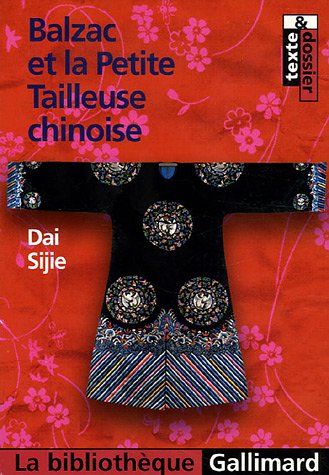
Dai, Sijie "Balzac and the Little Chinese Seamstress"

Dai, Sijie "Balzac and the Little Chinese Seamstress" (French: Balzac et la Petite Tailleuse Chinoise) - 2002

A great story about the Chinese Cultural Revolution in its later years. Two boys from an educated family are sent to a village for re-education. Through the stories of Balzac (whose books they find and steal), they get to know and fall in love with a village girl who is known as the Little Seamstress.

For someone growing up in Western Europe, it is hard to imagine what it means to be in the boys' situation. They have done nothing wrong, they have not harmed anyone, still, they get punished for being them and for having an education, their parents get punished for educating their children.

Apparently, this is a semi-autobiographical novel, so the author knows what he is writing about. And that is very obvious in his writing.

I think it is interesting that the author wrote his story in French and it was translated into his native language only after the book had been made into a movie and translated into 25 other languages.

See more comments on my ThrowbackThursday post in 2025.

From the back cover:

"In this enchanting tale about the magic of reading and the wonder of romantic awakening, two hapless city boys are exiled to a remote mountain village for reeducation during China's infamous Cultural Revolution. There they meet the daughter of the local tailor and discover a hidden stash of Western classics in Chinese translation. As they flirt with the seamstress and secretly devour these banned works, they find transit from their grim surroundings to worlds they never imagined."

Monday, 9 January 2012

Chang, Leslie T. "Factory Girls"

Chang, Leslie T. "Factory Girls" - 2008

Leslie T. Chang is a Chinese-American journalist who travelled to and lived in China for a couple of years to get to know the country of her ancestors. She interviewed several female migrant workers and portrayed their lives between the old and the new world, the poor families they were born into and the life in the modern Chinese towns. Quite different from what we in Western Europe expect from someone leaving their home to work in the city.

This was one of our book club reads. For various reasons, we were only a few people but, nevertheless, had a wonderful talk about this book. Some of us had already read other books about China, unfortunately the one that gives the most information ("Risse in der großen Mauer" by Jan-Philipp Sendker) has not been translated into English. But maybe one day, you never know.

Anyway, we really liked the way the author portrayed the different cultures. It was quite shocking at times how these girls moved on in this world,  how they changed from their rural life into city life between factories and other jobs.

Most of us didn't like that the author incorporated her family history into this work. It could have been a book on its own. The title of this one is "Factory Girls" and there is nothing about factories in her family history.

I am always amazed to learn about other lives, especially if they are completely different from ours. Often you have to go back in time for that - but not always, as this book proves.

See more comments on my ThrowbackThursday post in 2024.

From the back cover:

"An eye-opening and previously untold story, Factory Girls is the first look into the everyday lives of the migrant factory population in China.

China has 130 million migrant workers - the largest migration in human history. In
Factory Girls, Leslie T. Chang, a former correspondent for the Wall Street Journal in Beijing, tells the story of these workers primarily through the lives of two young women, whom she follows over the course of three years as they attempt to rise from the assembly lines of Dongguan, an industrial city in China's Pearl River Delta.

As she tracks their lives, Chang paints a never-before-seen picture of migrant life - a world where nearly everyone is under thirty; where you can lose your boyfriend and your friends with the loss of a mobile phone; where a few computer or English lessons can catapult you into a completely different social class. Chang takes us inside a sneaker factory so large that it has its own hospital, movie theater, and fire department; to posh karaoke bars that are fronts for prostitution; to makeshift English classes where students shave their heads in monklike devotion and sit day after day in front of machines watching English words flash by; and back to a farming village for the Chinese New Year, revealing the poverty and idleness of rural life that drive young girls to leave home in the first place. Throughout this riveting portrait, Chang also interweaves the story of her own family's migrations, within China and to the West, providing historical and personal frames of reference for her investigation.

A book of global significance that provides new insight into China,
Factory Girls demonstrates how the mass movement from rural villages to cities is remaking individual lives and transforming Chinese society, much as immigration to America's shores remade our own country a century ago."

We discussed this in our book club in December 2012.