Showing posts with label Spain. Show all posts

Monday, 11 November 2024

Barbal i Farré, Maria "Stone in a Landslide"

Barbal i Farré, Maria "Stone in a Landslide" (Catalan: Pedra de tartera) - 1985

I read another book by Maria Barbal before, "Campher" and when I saw this one, I just had to pick it up.

We have a great insight into the lives of the people in Catalonia at the beginning of the last century, how their lives were changed by the Spanish Civil War. Conxa tells us about her whole lifetime, from being a poor child given to relatives who didn't have any. I know this happened a lot in former times, people often had to many kids and then there were always those who didn't have any. Then one of the children from that family was given to relatives to "inherit" from them. I've heard this from my parents who knew quite a few examples in their youth.

While this is only a novella, the story is as rich as longer novels, there is so much in this. You almost have the feeling as if the author talks about her own life, even though she lived more than half a century later. But she must have heard a lot from her family, as we all did.

And it's not just about that part of our world or that time. War is awful at all times, and times were harsh anywhere (and still are for many, many people around the world). The author has a great eye for the people. And her style is extraordinary.

From the back cover:

"The beginning of the 20th century: 13-year-old Conxa has to leave her home village in the Pyrenees to work for her childless aunt. After years of hard labour, she finds love with Jaume - a love that will be thwarted by the Spanish Civil War. Approaching her own death, Conxa looks back on a life in which she has lost everything except her own indomitable spirit. This story presents a fascinating timeless voice, down to earth and full of human contradictory nuances. Its' the expression of someone who searches for understanding in a changing world but senses that ultimately there may be no such thing. The Catalan modern classic, first published in 1985, is now in its 50th edition, and has sold over 50 000 copies in the last two years in Germany alone."

Monday, 30 October 2023

Voltaire "Candide"

Voltaire "Candide, or Optimism" (French: Candide, ou l'Optimisme) - 1759

For the Classics Spin #35, we received #2 and this was my novel.

An interesting take on the Age of Enlightenment.

Candide is a young guy who lives in Germany. He falls in love with a girl but is prevented from marrying her because of her parents. He learns the philosophy "All is for the Best" and travels around the world with this belief.

He probably encounters as many troubles as Homer's Odysseus in the "Odyssey" and solves them almost with the same vigour.

The novel promises to be funny and indeed it is. I have laughed quite a few times during the reading. How can a book be funny and philosophical at the same time? I'm not surprised Voltaire is still such a renowned author even more than two centuries later. I am really happy #2 was pulled for this challenge because I really enjoyed the story.

This novel reminded me a little of Eichendorff's "Life of a Good For Nothing", although it should be the other way around since this one was written earlier. Other than the German novel, I could see more philosophy in this book.

From the back cover:

"Candide tells of the hilarious adventures of the naïve Candide, who doggedly believes that 'all is for the best' even when faced with injustice, suffering, and despair. Controversial and entertaining, Candide is a book that is vitally relevant today in our world pervaded by - as Candide would say - 'the mania for insisting that all is well when all is by no means well.'"

Wednesday, 28 June 2023

Brooks, Geraldine "People of the Book"

Brooks, Geraldine "People of the Book" - 2008

This is going to be one of my favourite books this year. Such a wonderful story about a book and its history. I have once read a similar story, well, not a similar story, just a book that tries to follow a piece of art, a painting from today into past until it was created. That was by Susan Vreeland and it was called "Girl in Hyacinth Blue". I loved that one and this was just as interesting.

The main "character" is the Sarajevo Haggada, a Jewish religious book that really exists (see here on Wikipedia or here on The National Museum of Bosnia and Herzegovina website) The word "haggada" is Hebrew for telling, story or account, the book "Haggadah" is a text that describes the order of the Passover Seder.

There are books, even ancient ones, where you know exactly where they come from and who made them. This is not one. The author has put down some ideas and made a wonderful story about it that travels around the whole world. From the Australian conservationist who tries to find some clues that sound just like a crime story we travel back from Bosnia-Herzegovina to Italy, Austria, Spain and to the shores of Ifriqiya (modern day Tunisia, parts of Algeria and Libya). In between, we visit the Untied States and the United Kingdom where the protagonist does not only find out more about the book but also about her family.

I absolutely loved the whole story, how we get to know the different kinds of people who contributed first to the creation of the book and then to the saving of it. Some of the ideas might even be true. Well, we can always dream.

Remarks from the book club:
I partly felt the book was really interesting and wanted to know more about the old stories from history.
The parts about WWII always feel a little too close for comfort anyway.
The author's experience as a journalist shone through the story. But the present day frame-story felt slightly "puff-piece" kind of full with story gaps.
Overall still give it 4/5 or maybe even 4,5/5.

We read this in our international online book club in October 2023.

From the back cover:

"During World War II a Bosnian Muslim risks his life to save the book from the Nazis; it gets caught up in the intrigues of hedonistic 19th-century Vienna; a Catholic priest saves it from burning in the fires of Inquisition. These stories and more make up the secret history of the priceless Sarajevo Haggadah - a medieval Jewish prayer book recovered from the smouldering ruins of the war-torn city.
Now it is in the skilled hands of rare-book restorer Hanna Heath. And while the content of the book interests her, it is the hidden history which captures her imagination. Because to her the tiny clues - salt crystals, a hair, wine stains - that she discovers in the pages and bindings are keys to unlock its mysteries.
"

Tuesday, 21 March 2023

Ruiz Zafón, Carlos "The City of Mist"

Ruiz Zafón, Carlos "The City of Mist" (Spanish: La Ciudad de Vapor) - 2020
(El cementerio de los libros olvidados #5)

Yes, we return to Barcelona, one last journey with a wonderful author who left a big hole in the literary world with his death. His fans can look forward to a last greeting. All stories that fit somewhere in his Cemetery of Forgotten Books. How it came about and what it has contributed to. One or the other story has already been read beforehand, e.g. "Gaudí in Manhattan" or "The Prince of Parnassus" (El Príncipe de Parnaso), but that doesn't detract from the joy of this book.

And if you haven't read the wonderful series yet, you should do so as soon as possible. These short stories are also good for getting in the mood. You can read all of his books in any order, they complement each other well.

From the back cover:

"Return to the mythical Barcelona library known as the Cemetery of Forgotten Books in this posthumous collection of stories from the New York Times bestselling author of The Shadow of the Wind and The Labyrinth of the Spirits.

Bestselling author Carlos Ruiz Zafón conceived of this collection of stories as an appreciation to the countless readers who joined him on the extraordinary journey that began with
The Shadow of the Wind. Comprising eleven stories, most of them never before published in English, The City of Mist offers the reader compelling characters, unique situations, and a gothic atmosphere reminiscent of his beloved Cemetery of Forgotten Books quartet.

The stories are mysterious, imbued with a sense of menace, and told with the warmth, wit, and humor of Zafón's inimitable voice. A boy decides to become a writer when he discovers that his creative gifts capture the attentions of an aloof young beauty who has stolen his heart. A labyrinth maker flees Constantinople to a plague-ridden Barcelona, with plans for building a library impervious to the destruction of time. A strange gentleman tempts Cervantes to write a book like no other, each page of which could prolong the life of the woman he loves. And a brilliant Catalan architect named Antoni Gaudí reluctantly agrees to cross the ocean to New York, a voyage that will determine the fate of an unfinished masterpiece.

Imaginative and beguiling, these and other stories in
The City of Mist summon up the mesmerizing magic of their brilliant creator and invite us to come dream along with him.

Blanca and the Departure
Nameless
A Young Lady from Barcelona
Rose of Fire
The Prince of Parnassus
A Christmas Tale
Alicia, at Dawn
Men in Grey
Kiss
Gaudí in Manhattan
Two-Minute Apocalypse"

Monday, 13 March 2023

Baker, Jo "Longbourn"

Baker, Jo "Longbourn" - 2013

I don't care much for novels that are based on someone else's work (so-called fan-fiction) and I might never have started reading this one if it hadn't been for a friend who had finished reading this and lent the book to me.

What can I say, it was an interesting read to learn about the servants at Longbourn, the house of the Bennets from "Pride & Prejudice". I think we know all more about their lives since watching "Downton Abbey".

While it is helpful to know the original story and thereby following the life of the Hills, Sarah, Polly and James, I don't think you necessarily need to have read it.

However, the author has gone a little too far with some of her assumptions and I doubt Jane Austen would have agreed with her protrayal of the family. I can only grant the author a lot of imagination. She should have written a book about a fictional house in the Regency Period with the main focus on the servants. Would have avoided a lot of silly allusions to the Bennet family.

Yeah, as I said before, not a fan of books written about other books. If you can't think of a storyline by yourself, leave it. I am sure it will be a long time until I pick up some fan-lit again.

From the back cover:

"It is wash-day for the housemaids at Longbourn House, and Sarah's hands are chapped and raw. Domestic life below stairs, ruled with a tender heart and an iron will by Mrs Hill the housekeeper, is about to be disturbed by the arrival of a new footman, bearing secrets and the scent of the sea."

Monday, 25 July 2022

Bellow, Saul "Humboldt's Gift"

Bellow, Saul "Humboldt's Gift" - 1975

I try to read the latest Nobel Prize winner for Literature and at least one former one every year. This was my fourth one since the last laureate was announced. I still need to get a copy of one of Abdulrazak Gurnah's books before the next announcements in October.

Apparently, this book didn't just get the Pulitzer Prize, it is also said that it won Saul Bellow the Nobel Prize. In his acceptance speech, he called on writers to be beacons for civilization and awaken it from intellectual torpor.

An intense book, there is so much to talk about. The relationship between Charlie Citrine, our protagonist, and his friend Von Humboldt Fleisher, a renowned author who takes Charlie under his wings. Whilst he is only at the beginning of this career, he tells us this story from the point of view when it has more or less ended.

When I was reading the book, I'd been wondering whether this might have been a biography, or at least partly a biography. I then found out, that this is a "roman à clef" (French for novel with a key), a novel about real-life events that is overlaid with a façade of fiction. The fictitious names in the novel represent real people, and the "key" is the relationship between the nonfiction and the fiction. Aha! In this case, it's about the author's friendship with the poet Delmore Schwartz with Bellow being Citrine. Well, I'd never heard of Delmore Schwartz and now I have learned a lot about him (not just form the book, I also looked him up on Google and Wikipedia.) Very interesting, read the information in the links.

While this is probably a good account of Bellow's and Schwartz' relationship, the book also tries to come to terms with the constant changes in the world, especially in culture. The difference between the ideal world and the real one is a big topic in this book that was only supposed to be a short story but then ended up with almost 500 pages.

Brilliant storytelling with lots of fields covered: literature, culture, divorce, relationships, parenting, alcoholism, madness … and also all types of characters from all levels social classes, including a Mafia boss. Oh, and there's quite a bit of humour in the story, as well.

The Times mentions that "Bellows is one of the most gifted chroniclers of the Western World alive today." Apart from the fact that he has passed away in the meantime, I totally agree. So, if you're in for a great read, this is worth picking up.

From the back cover:

"For many years, the great poet Von Humboldt Fleisher and Charlie Citrine, a young man inflamed with a love for literature, were the best of friends. At the time of his death, however, Humboldt is a failure, and Charlie's life has reached a low point: his career is at a standstill, and he's enmeshed in an acrimonious divorce, infatuated with a highly unsuitable young woman and involved with a neurotic mafioso. And then Humboldt acts from beyond the grave, bestowing upon Charlie an unexpected legacy that may just help him turn his life around."

Saul Bellow received the Nobel Prize for Literature in 1976 "for the human understanding and subtle analysis of contemporary culture that are combined in his work" and the Pulitzer Prize for "Humboldt's Gift" also in 1976.

I contribute to this page: Read the Nobels and you can find all my blogs about Nobel Prize winning authors and their books here.

Monday, 13 December 2021

Follett, Ken "A Column of Fire"

Follett, Ken "A Column of Fire" - 2017

I love reading about the Tudors. And I loved the two first books of the Kingsbridge Series ("The Pillars of the Earth" and "World Without End"). So, this was definitely a win-win situation.

This is mostly the story of the Willard family. There is a Romeo and Juliet plot, villains and heroes, Catholics and Protestants, Queens Mary I, Elizabeth I and King James I of England, Mary Queen of Scots, the history of the St. Bartholomew's Day massacre, the Spanish Armada, the Gunpowder plot and many other political events. This book has it all.

A very impressive novel. Ken Follett's style is fantastic, his love for detail brilliant and the stories in his book exciting.

I thought the list of real-life characters at the end of the book was very helpful. I would have also enjoyed a timeline of what happened at the time. Yes, I have the internet and plenty of other books where I can look this up but I find having it in the actual book I'm reading is actually very helpful.

Now on to the prequel, "The Evening and the Morning".

From the back cover:

"As Europe erupts, can one young spy protect his queen? Ken Follett takes us deep into the treacherous world of powerful monarchs, intrigue, murder, and treason with his magnificent epic, A Column of Fire - the chronological latest in the Kingsbridge series, following The Pillars of the Earth, World Without End, and the prequel, The Evening and the Morning.

In 1558, the ancient stones of Kingsbridge Cathedral look down on a city torn apart by religious conflict. As power in England shifts precariously between Catholics and Protestants, royalty and commoners clash, testing friendship, loyalty, and love.

Ned Willard wants nothing more than to marry Margery Fitzgerald. But when the lovers find themselves on opposing sides of the religious conflict dividing the country, Ned goes to work for Princess Elizabeth. When she becomes queen, all Europe turns against England. The shrewd, determined young monarch sets up the country’s first secret service to give her early warning of assassination plots, rebellions, and invasion plans. Over a turbulent half century, the love between Ned and Margery seems doomed as extremism sparks violence from Edinburgh to Geneva. Elizabeth clings to her throne and her principles, protected by a small, dedicated group of resourceful spies and courageous secret agents.

The real enemies, then as now, are not the rival religions. The true battle pitches those who believe in tolerance and compromise against the tyrants who would impose their ideas on everyone else - no matter what the cost.

Exciting and ambitious, and set during one of the most turbulent and revolutionary times in history,
A Column of Fire will delight longtime fans of the Kingsbridge series and serve as the perfect introduction for readers new to Ken Follett."

See more comments on my ThrowbackThursday post in 2022.

Thursday, 29 July 2021

McLain, Paula "The Paris Wife"

McLain, Paula "The Paris Wife" - 2012

A couple of years ago, everybody seemed to be reading "The Paris Wife". But I had read "The Time Traveler’s Wife" which I hated and I neither was too happy with "The Railwayman's Wife". So, I thought maybe I should keep away from "wife" books, as well. But at some point, I bought a copy. It still stayed on my TBR pile for a couple of years.

Then, one of my blogger friends introduced me to "Paris in July" and I thought it was time to read it. First of all, it has the word "Paris" in its title and it takes place in Paris. Also, I have read a few books by Ernest Hemingway (The Old Man and the Sea, For Whom the Bell Tolls) and have a few more on my wishlist. So, why not give it a go?

I was positively surprised about the book. Written from the perspective of the first of his four wives, we learn a lot about Hadley as well as Ernest and his second wife, Pauline.

The author remarks: "Although Hadley Richardson, Ernest Hemingway and other people who actually lived appear in this book as fictional characters, it was important for me to render the particulars of their lives as accurately as possible, and to follow the very well documented historical record."

I was aware throughout the whole book that this is a novel written in the form of a memoir, not a biography. That didn't change the fact that it was highly interesting to read about the lives of some extraordinary people. Hemingway was in an interesting circle of authors and artists and they all appear in the book.

I have lived in four different countries and I came from a small village into a big foreign town in my early twenties but life was different in our time. We didn't have the internet but there were books, there was the television and people had moved around, not many and often not far but nothing compared to the difference between Hadley's sheltered, very remote life before she met Ernest Hemingway and life in Paris. It must have been really, really hard for her.

There are also some small parts where Ernest tells us his side of the story. Of course, he has already been through and survived one war which always changes a man. But you also can tell there that they were two completely different personalities not just with different ideas but also with different goals. It's probably a miracle the marriage survived as long as it did.

The book is not just interesting concerning the life of the Hemingways but also the other characters are interesting as is the life in Paris in the twenties. We hear so much about it. This book helps us understanding it a little better. Definitely brilliantly written.

I'd love to read more of Paula McLain's books but definitely her memoir: "Like Family. Growing Up In Other People's Houses".

One quote by Ernest Hemingway: "I want to write one true sentence", he said. "If I can write one sentence, simple and true every day, I'll be satisfied". I think his writing shows that this was his goal and he achieved it.

At the end of the book, Paula McLain adds a list of her sources, all of them would be interesting to read if you like the subjects:

About the Hemingways:
Alice Hunt Sokoloff, Alice " Hadley: The First Mrs. Hemingway"
Diliberto, Gioia "Hadley"
Kert, Bernice "The Hemingway Women"
Baker, Carlos "Ernest Hemingway: A Life Story and Ernest Hemingway: Selected Letters 1917-1961"
Reynolds, Michael "Hemingway: The Paris Years and Hemingway: The American Homecoming"
Brian, Denis "The True Gen"

About Paris in the twenties
Wiser, Willam "The Crazy Years"
Flanner, Janet "Paris Was Yesterday"
Tomkins, Calvin "Living Well Is the Best Revenge"
Milford, Nancy "Zelda"
Fussell, Paul "The Great War and Modern Memory"

Other books by Ernest Hemingway:
"A Moveable Feast"
"In Our Time"
"The Sun Also Rises"
"The Garden of Eden"
"Death in the Afternoon"
"The Complete Short Stories"

From the back cover:

"Chicago, 1920: Hadley Richardson is a shy twenty-eight-year-old who has all but given up on love and happiness when she meets Ernest Hemingway and is captivated by his energy, intensity and burning ambition to write. After a whirlwind courtship and wedding, the pair set sail for France. But glamorous Jazz Age Paris, full of artists and writers, fuelled by alcohol and gossip, is no place for family life and fidelity. Ernest and Hadley's marriage begins to founder and the birth of a beloved son serves only to drive them further apart. Then, at last, Ernest's ferocious literary endeavours begin to bring him recognition - not least from a woman intent on making him her own."

Ernest Hemingway received the Nobel Prize for Literature in 1954 "for his mastery of the art of narrative, most recently demonstrated in 'The Old Man and the Sea' and for the influence that he has exerted on contemporary style" and the Pulitzer Prize for "The Old Man and the Sea" in 1953.

I contribute to this page: Read the Nobels and you can find all my blogs about Nobel Prize winning authors and their books here.

Monday, 10 August 2020

Booth, Cathleen "Mercy & Grace on the Camino de Santiago"

Booth, Cathleen "Mercy & Grace on the Camino de Santiago" - 2020

"Sometimes it’s doing the thing that terrifies you that really helps you grow."

Before I begin with the review and you wonder why I'm so fascinated by this story, the author is a friend of mine. (Although, having said that, you probably won't wonder because she is a great storyteller.) For years, we've been attending the same church and since our birthdays are only a couple of days apart, we've been enjoying a coffee or lunch together in between. I have taught not just her daughter Madeleine in RE but also the other girls that walked the Camino with them. And my whole family knows all of the "Eleven Amigos", as the group called themselves (great name, by the way) and their families. They are some of the loveliest people I have ever met in my life and reading about their experience was so wonderful for me. Thank you, Cathleen, for including me in this trip in this unique way. I know I can't give you enough credit with my humble review but I hope it will instigate a few people to read the book.

And here I am right in the middle of it. I am sure anyone who reads this book must feel the same, whether you know the pilgrims or not. I knew Cathleen could write since she had written a personal blog for years (much more personal than my book blog).

In her prologue, she tells us how the idea started, how she wanted to go but was too afraid. I totally understand, I would have been, as well. Actually, I am, that's why I never went even though I know a lot of people who did. But with my back problems, I couldn't even do a quarter let alone half the walks they did, even without a backpack or "mochila". No, that train has left.

But here I am with Cathleen and her friends, listening to (or rather reading about) them as they plan and prepare their trip, as they meet to drive to the airport, as they join the next members somewhere between here and Santander. We hear about the first dinner, the first night in one of the albergues, the first breakfast. They leave the hostel every morning and walk for a while before settling down for breakfast in one of the many cafés along the way.

Their walks tend to be between twenty and thirty kilometres. Hats off, Cathleen and friends. Even though you seem to be at the end of your tether from time to time, you soldier on and don't lose sight of your goal. Together you are strong. I am also grateful that Cathleen belongs to the slower part of the group because that's where I always end up. Makes it more authentic for me.

They meet a lot of lovely people along the way. I have always heard that from anyone who walked the Camino. If you're on that way, everyone is your friend. How lovely to tackle this in such a wonderful community.

There are many wonderful stories in the book about companionship, soul-searching, finding your way to yourself and to God but there are also some hilarious stories, as well. No wonder, when Cathleen and Lila (the friend who invited her to the trip) are together. I remember having been told many of them eye-to-eye, so reading about them makes it almost as if they were here.

I know all the kids have made it into adulthood and listening to their parents they have become just as wonderful adults as they were children. Well done, everyone.

But thank you, Cathleen, for this wonderful report about your Camino. We all can learn from your big heart.

You can find more information (and more pictures) on her website.

I always enjoy reading about other parts of the world and get to know them but I also love reading about the parts that I know. And here, not only did I know all the members of the group, I also know the area where Cathleen lived (as we can see in her pictures in "Training Days", I was also there when our friend Maria showed her pictures in church which was when many of us heard from someone who had experienced the pilgrim themselves.

I also loved that Jim Forrest, another author I highly admire, wrote the introduction.

I have read another book about someone on the Camino de Santiago, German humourist Hape Kerkeling. Also, a great story about someone whose life changed after doing this spiritual journey.
Kerkeling, Hape "I'm off then: Losing and Finding Myself on the Camino de Santiago" (German: Ich bin dann mal weg. Meine Reise auf dem Jakobsweg). I think, the fact that his account has been translated into English says it all.

From the back cover:

"'Sometimes it’s doing the thing that terrifies you that really helps you grow.'
These words, spoken in love by a friend, motivated 300-pound Cathleen Booth off her couch and onto the Camino de Santiago. Cathleen’s physical limitations quickly shattered any illusions of self-sufficiency and pride. On a muddy mountainside in Spain - at her most vulnerable - Cathleen would experience from her friend a self-sacrificial love that would ultimately change her from the inside out. Equal parts humor, humility, and heart, Mercy & Grace on the Camino de Santiago invites the reader on a deeply intimate and human spiritual journey."

And if you want to know about Cathleen's sense of humour, Mercy and Grace is what she called her walking boots.

Friday, 19 June 2020

Carlos Ruiz Zafón †


This is a sad day for readers.

I was quite shocked when I saw this morning that one of my favourite authors passed away. Carlos Ruiz Zafón, author of some great books, especially "The Cemetary of Forgotten Books" (El cementerio de los libros olvidados) tetralogy.

He had been diagnosed with colon cancer in 2018 and succumbed to it yesterday at the age of only 55.

I was always looking forward to his next one. Now I know there won't be any. Tragic.

According to many, he was "one of the best contemporary novelists", and I totally agree with that. He wrote eight novels which were translated into more than 40 different languages and sold 38 million copies.

He received several literature prizes, unfortunately, the Nobel Prize wasn't among them. What a loss. Maybe you remember, I had suggested him in my Nobel Prize post earlier this year.

Rest in Peace!

Here is my list of his books:
- "Gaudí in Manhattan" (E: La Mujer de Vapor) - Gaudí in Manhattan
- "Marina" (E: Marina)
- "The Angel's Game" (E: El juego del ángel - El cementerio de los libros olvidados #2) 
- "The Labyrinth of the Spirits" (E: laberinto de los espíritus - El cementerio de los libros olvidados #4)
- "The Midnight Palace" (El Palacio de la Medianoche)
- "The Prince of Mist" (E: El príncipe de la niebla)
- "The Prisoner of Heaven" (E: El prisionero del cielo - El cementerio de los libros olvidados #3)  
- "The Shadow of the Wind" (E: La sombra del viento - El cementerio de los libros olvidados #1) *
- "Watcher in the Shadows" (E: Las luces de Septiembre)

Wednesday, 14 November 2018

Nadal, Rafel "The Last Son's Secret"

Nadal, Rafel "The Last Son's Secret" (Spanish: La maldición de los Palmisano) - 2015

I do like Spanish authors in general and am always happy when I find another one to add to the list. The author is introduced with "Rafel Nadel can write better than play tennis". Good one! I have no idea how well he plays tennis but I can assure you, he writes very well.

This story takes us to Italy. A visitor notices that a village lost 42 sons in the first world war and that half of them carry the name Palmisano. Then, in the second one, there is not a single one with that name but again a family that covers half the list: the family Convertini. We get to know both the families in this book, and the secret they carry.

A very interesting story, well written, amiable characters, and some hateful ones, of course. We get a glimpse into the life of Italians during the wars, the followers of the evil powers as well as those who choose to become partisans, we get to like the people, get to understand their motives. The link between fiction and non-fiction is very well done.

All in all, I really enjoyed this book and I think, even if you don't like to read about the war, this story has a lot to give.

From the back cover:

"In the hot, dusty square of a small village in Puglia, there are two memorials: one to those killed in the First World War, and one to those lost in the Second World War. On the first, every single member of the Palmisano family is listed, and on the second all the names are members of the Covertini family. In total, 44 men, all dead.

In this sweeping and heartbreaking tale of the fate of a tiny hilltop village, Vitantonio and Giovanna are born moments apart just as the First World War ends, and just as their two fathers are killed on the front. But growing up among the olive groves of southern Italy, war seems far away - until clouds begin to gather on the horizon as the Second World War looms ...

A huge international bestseller, this sweeping and heartbreaking tale of the fate of a tiny hilltop village in Italy during the two World Wars will stay with you for ever."

Friday, 15 June 2018

Ruiz Zafón, Carlos "Gaudí in Manhattan"

Ruiz Zafón, Carlos "Gaudí in Manhattan" (Spanish: La Mujer de Vapor) - 2009

A short story about a young architecture student who can go to New York with his much admired hero Antonio Gaudí. A very short story. But it was by one of my favourite authors, so I had to read it. And it was just as beautiful as his novels. I just don't get why he didn't make it into a whole book.

A rich person offers Gaudí to pay for the rest of the Sagrada Familia and it turns out to be a young woman … or was it all a dream? A magic realism story like no other. Plus, there were some great illustrations and pictures in the booklet.

See more comments on my ThrowbackThursday post in 2023.

From the back cover (translated):

"A young student of architecture accompanies the famous architect to America, where Antonio Gaudí is to receive the order to build a skyscraper. But when they arrive in Manhattan, things take a different course."

Thursday, 19 April 2018

Ruiz Zafón, Carlos "The Labyrinth of the Spirits"

Ruiz Zafón, Carlos "The Labyrinth of the Spirits" (Spanish: El laberinto de los espíritus) - 2016 
(El cementerio de los libros olvidados #4)

It was a lucky day in 2001 when I first stumbled upon my first book by Carlos Ruiz Zafón. Finally the fourth book in the series of the Cemetery of Forgotten books has been published and was available as a paperback in translation. You can't imagine how I have waited for this.

And I was not disappointed. The fourth novel was just as exciting as the first three that had originally been called a trilogy but - luckily - the author decided to turn it into a tetralogy. Maybe he'll even write a fifth one? No matter what, if he is writing another book, I am going to read it.

We have learned a lot about the family Sempere and the authors they read, their friends and their lives, esp. the lives of the people in Catalonia during the Franco regime. It must have been horrible. But the author manages to describe all the incidents meticulously, with so much detail that you can imagine having been there yourself.

In this novel, he gets behind the scenes of a minister and his evil deeds. The Sempere family is involved again and we also hear about some of the characters from the previous episodes. Apparently, you can read the series in whatever order you want, there is always some information from the other books. I intend to re-read all the other three books soon.

These are the first books in the series:
- "The Shadow of the Wind" (La Sombra del Viento)
- "The Angel’s Game" (El Juego del Ángel)
- "The Prisoner of Heaven" (El Prisionero del Cielo)

From the back cover:

"The internationally acclaimed New York Times bestselling author returns to the magnificent universe he constructed in his bestselling novels The Shadow of the Wind, The Angel’s Game, and The Prisoner of Heaven in this riveting series finale - a heart-pounding thriller and nail-biting work of suspense which introduces a sexy, seductive new heroine whose investigation shines a light on the dark history of Franco’s Spain.

In this unforgettable final volume of Ruiz Zafón’s cycle of novels set in the universe of the Cemetery of Forgotten Books, beautiful and enigmatic Alicia Gris, with the help of the Sempere family, uncovers one of the most shocking conspiracies in all Spanish history.

Nine-year-old Alicia lost her parents during the Spanish Civil War when the Nacionales (the fascists) savagely bombed Barcelona in 1938. Twenty years later, she still carries the emotional and physical scars of that violent and terrifying time. Weary of her work as investigator for Spain’s secret police in Madrid, a job she has held for more than a decade, the twenty-nine-year old plans to move on. At the insistence of her boss, Leandro Montalvo, she remains to solve one last case: the mysterious disappearance of Spain’s Minister of Culture, Mauricio Valls.

With her partner, the intimidating policeman Juan Manuel Vargas, Alicia discovers a possible clue - a rare book by the author Victor Mataix hidden in Valls’ office in his Madrid mansion. Valls was the director of the notorious Montjuic Prison in Barcelona during World War II where several writers were imprisoned, including David Martín and Victor Mataix. Traveling to Barcelona on the trail of these writers, Alicia and Vargas meet with several booksellers, including Juan Sempere, who knew her parents.

As Alicia and Vargas come closer to finding Valls, they uncover a tangled web of kidnappings and murders tied to the Franco regime, whose corruption is more widespread and horrifying than anyone imagined. Alicia’s courageous and uncompromising search for the truth puts her life in peril. Only with the help of a circle of devoted friends will she emerge from the dark labyrinths of Barcelona and its history into the light of the future.

In this haunting new novel, Carlos Ruiz Zafón proves yet again that he is a masterful storyteller and pays homage to the world of books, to his ingenious creation of the Cemetery of Forgotten Books, and to that magical bridge between literature and our lives."

Favourite quotes:
"You drink to remember, you write to forget." David Martín
and
"The Semperes travelled through books, not the map."

See more comments on my ThrowbackThursday post in 2022.

Monday, 10 July 2017

Hemingway, Ernest "For Whom the Bell Tolls"

Hemingway, Ernest "For Whom the Bell Tolls" - 1940

After reading this book, I don't understand why I didn't read it earlier. This is one of the "must read" classics, a book that tells us so much about a terrible time, not just a particular terrible time about the guerillas in the Spanish Civil War, but about war in general. War isn't jsut a number of how many people died or how many fights were won or lost. War is horrible. War is brutal. War is everything nobody wants. And yet, we still have wars.

You can tell that a lot of experience flowed into this piece. Ernest Hemingway faught himself in the Spanish Civil War. He must have lived through lot of the actions described here.

This novel is a brilliant account of the partisans, their fight, their effort, their dreams. A strong story about a fight that we all know was lost and cost many Spaniards dearly in the following years.

I never watched the movie with Gary Cooper and Ingrid Bergman, two actors I really loved. I probably should. They received nine Oscar nominations for it.

From the back cover:
"High in the pine forests of the Spanish Sierra, a band of anti-fascist guerrilla prepares to blow up a strategically vital bridge. Robert Jordan, a young American volunteer, has been sent to handle the dynamiting. There, in the mountains, he finds the dangers and the intense comradeship of war. And there he discovers Maria, a young woman who has escaped from Franco's rebels."

Ernest Hemingway received the Nobel Prize for Literature in 1954 "for his mastery of the art of narrative, most recently demonstrated in 'The Old Man and the Sea' and for the influence that he has exerted on contemporary style" and the Pulitzer Prize for "The Old Man and the Sea" in 1953.

I contribute to this page: Read the Nobels and you can find all my blogs about Nobel Prize winning authors and their books here.

Monday, 10 April 2017

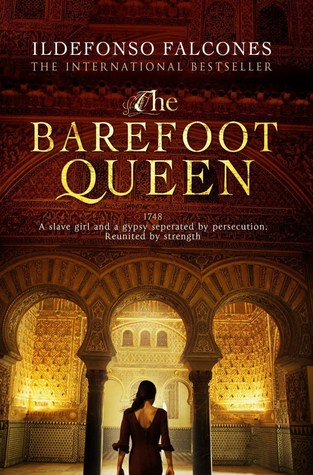
Falcones, Ildefonso "The Barefoot Queen"

Falcones, Ildefonso "The Barefoot Queen" (Spanish: La Reina Descalza) - 2013

As with his former books "Cathedral of the Sea" and "The Hand of Fatima", Ildefonso Falcones does not disappoint with his newest novel. Whether he talks about Barcelona in the 14th century, Muslims in the 16th century or gypsies in the 18th, he seems to know all the characters personally and introduces us to their lives and struggles. This time, it's the gypsies and their problems in a country where they are not welcome, well, where are they ever? They can't make a living by staying somewhere because they are not allowed to work in many many jobs but they also can't travel. And when the Spanish crown decides to lock them all up in order to conduct the perfect genocide. Well, luckily, there is no perfect genocide, there are always members of a race that are willing to fight until the very end.

Ildefonso Falcones is a great storyteller, he can make you love the characters and feel with them through their dramatic lives. And in addition to that, it's also a fantastic history lesson. We don't just learn about Spain in the 18th century, we also learn about slaves in Cuba, tobacco planting and and working, trading and smuggling. There is so much in this story. Even though Caridad, a former slave, is supposed to be the protagonist, her friend Milagros with her grandfather Melchor and their family are also quite important to the story.

Can't wait until his newest book "Los herederos de la tierra" (2016), the follow-up to "Cathedral of the Sea" is translated.

From the back cover:

"A historical epic full of bravery and romance that follows two women as they make a life for themselves in 18th-century Spain.

It's January of 1748. Caridad is a recently freed Cuban slave wondering the streets of Seville. Her master is dead and she has nowhere to go. When her path crosses with Milagros Carmona's-a young, rebellious gypsy-the two women are instantly inseparable. Milagros introduces Caridad to the gypsy community, an exotic fringe society that will soon change her life forever. Over time they each fall in love with men who are fiercely loyal and ready to fight to the death for their rights as a free people. When all gypsies are declared outlaws by royal mandate, life in their community becomes perilous. They soon find themselves in Madrid-a city of passion and dancing, but also a treacherous one full of smugglers and thieves. Caridad and Milagros must help in the gypsy's struggle against society and its laws in order to stay together; it's a dangerous battle that cannot, and will not, be easily won. From the tumultuous bustle of Seville to the theatres of Madrid, The Barefoot Queen is a historical fresco filled with characters that live, love, suffer, and fight for what they believe."

Wednesday, 16 March 2016

Anonymous "Lazarillo de Tormes"

Anonymous "Lazarillo de Tormes" (Spanish: La vida de Lazarillo de Tormes y de sus fortunas y adversidades) - 1554

I found the title of this book in Jane Smiley's "13 Ways of Looking at the Novel" and thought it would be interesting to read.

And so it was. I have thoroughly enjoyed this book that was written almost 500 years ago, a great classic that you can read quite quickly because it is so short but there is a lot of action going on. This young, poor boy called Lazarillo, has to fend for himself, he has several masters and tells us his stories with them in this novel/novella.

I wouldn't exactly compare it to Cervantes' "Don Quixote" even though both books are only written about a hundred years apart and come from about the same area but there are some similarities. I loved the humour in this book, the humour you often find in those people who are less fortunate than others, who have to work hard for their living, who have no hope that it will ever get better. This is one such person and his humour does not leave him, no matter how hard the times.

The author managed to draw a very realistic sounding view of life in the 16th century, he was witty and intelligent, as is his protagonist Lazarillo. I just assume the author was a "he" because at the time, few women would write and they would probably have had totally different experiences.

A lovely book that introduces us to a genre that is called picaresque, novels that describe adventures of young boys of a lower social class. Some other books that belong to this genre, most of them are well known from television if people have not read the novels:

Berger, Thomas "Little Big Man"
Böll, Heinrich "The Clown"
Cervantes, Miguel de "Don Quixote"
Defoe, Daniel "Moll Flanders"
Eco, Umberto "Baudolino"
Fielding, Henry "Tom Jones"
Grass, Günter "The Tin Drum"
Grimmelshausen, Hans Jakob Christoffel von "Simplicius Simplicissimus"
Guareschi, Giovanni "Don Camillo and Peppone"
Hašek, Jaroslov "The Good Soldier Švejk"
Ilf, Ilja; Petrow, Jewgeni "The Twelve Chairs"
Jonasson, Jonas "The Hundred-Year-Old Man Who Climbed Out the Window and Disappeared"
Mann, Thomas "Confessions of Felix Krull" (Bekenntnisse des Hochstaplers Felix Krull)

I think I need to put them all on my wishlist.

What a shame the author is unknown and there are not more novels by him.

See more comments on my ThrowbackThursday post in 2026.

From the back cover:

"Long considered by many scholars to be the first picaresque novel (or the precursor of all such novels), Lazarillo de Tormes made its initial appeared in Spain in the middle of the 16th century, on the heels of an era of novels of chivalry and romance. Despite the Inquisition's disapproval, this brief, simply told tale of a young rogue's adventures and misadventures became popular immediately and defied attempts to suppress it. Ever since, it has been recognized as one of the gems of Spanish literature, full of laconic cynicism and spiced with puns and word play."

Monday, 8 February 2016

Lalami, Laila "The Moors' Account"


Lalami, Laila "The Moors' Account" - 2014

What a fantastic way of retelling history. "The Moors' Account" tells us a story that has been told before - but by Spanish people, white people who came as conquerors to the new continent to be called America. This is told by one of their slaves, a guy from Morocco, who survives a lot of ordeals because of his determination to get back home again. Out of the 600 people who went on an expedition in 1527, only four survive and Mustafa, who was renamed Estebanico by the Spaniards, was one of them.

We don't just learn about the expedition and how life in America was before the Europeans arrived, we also learn about life in Morocco at the time.

Totally interesting story, told in alternating chapters, switching from Morocco to American and back. I also loved that we hear the history from another side.

It's interesting to learn that we only have one line about Mustafa in an account of one of the three others (Cabeza de Vaca): "The fourth [survivor] is Estevanico, an Arab Negro from Azamor." It's amazing, how Laila Lalami fashioned such a great story from it.

"The Moor's Account" was on both the Pulitzer Prize and Booker Prize longlist. Totally deserved it. I'm looking forward to more books by this author.

See more comments on my ThrowbackThursday post in 2026.

From the back cover:

"In 1527 the Spanish conquistador Pánfilo de Narváez arrived on the coast of modern-day Florida with hundreds of settlers, and claimed the region for Spain. Almost immediately, the expedition was decimated by a combination of navigational errors, disease, starvation and fierce resistance from indigenous tribes. Within a year, only four survivors remained: three noblemen and a Moroccan slave called “Estebanico”.

The official record, set down after a reunion with Spanish forces in 1536, contains only the three freemen’s accounts. The fourth, to which the title of Laila Lalami’s masterful novel alludes, is Estebanico’s own.

Lalami gives us Estebanico as history never did: as Mustafa, the vibrant merchant from Azemmur forced into slavery and a new name, and reborn as the first black explorer of the Americas, discovering and being discovered by various tribes both hostile and compassionate.

In Estebanico’s telling, the survivors’ journey across great swathes of the New World transforms would-be conquerors into humble servants and fearful outcasts into faith healers. He remains ever-observant, resourceful and hopeful that he might one day find his way back to his family, even as he experiences an unexpected (if ambiguous) camaraderie with his masters.

The Moor’s Account illuminates the ways in which stories can transmigrate into history, and how storytelling can offer a chance for redemption, reinvention and survival."
 
Laila Lalami was a finalist for the Pulitzer Prize for "The Moors Account" in 2014.

Tuesday, 29 December 2015

Kerkeling, Hape "I'm off then"

Kerkeling, Hape "I'm off then: Losing and Finding Myself on the Camino de Santiago" (German: Ich bin dann mal weg. Meine Reise auf dem Jakobsweg) - 2006

I am Catholic. But I would have never even thought about doing a pilgrimage and certainly not one like this one, described by a German comedian. Yes, true, a comedian who makes the Camino de Santiago. And not just the last 100 kilometres but the whole way from the French border, 800 kilometres entirely.

Why did I pick up this book? It is a very popular book in Germany and a lot of people have been talking about it. But mainly, I love the author, he is one of the funniest guys alive, one of the best German comedians. I know, a lot of my foreign friends will say "German comedian?" Isn't that a contradiction in terms? But believe me, if only you would understand him, you'd laugh just as much as all his fans.

Personally, I know quite a few people who have undertaken the pilgrimage after reading the book, or after seeing other people who had read the book doing it. So, on the whole, he did a great job, is probably one of their best promoters.

But even if you're not Catholic or German, this is a fantastic book. It tells us about what we can achieve. I know I would never be able to achieve what Hape (Hans-Peter) Kerkeling did, wouldn't have the time to do it all in one go, for example, but he gives us hope, he describes a fantastic journey through a very interesting part of our continent, tells us about friendships he made along the way and how he had to fight with a big enemy - himself.

And since the book has been translated into several languages in the meantime, there is no reason why you shouldn't start it. (I just hope the translations are good.) I will certainly look out for more books by one of my favourite comedians.

See more comments on my ThrowbackThursday post in 2025.

From the back cover:

 "I'm Off Then has sold more than three million copies in Germany and has been translated into eleven languages. The number of pilgrims along the Camino has increased by 20 percent since the book was published. Hape Kerkeling's spiritual journey has struck a chord.

Overweight, overworked, and disenchanted, Kerkeling was an unlikely candidate to make the arduous pilgrimage across the Pyrenees to the Spanish shrine of St. James, a 1,200-year-old journey undertaken by nearly 100,000 people every year. But he decided to get off the couch and do it anyway. Lonely and searching for meaning along the way, he began the journal that turned into this utterly frank, engaging book. Filled with unforgettable characters, historic landscapes, and Kerkeling's self-deprecating humour,
I'm Off Then is an inspiring travelogue, a publishing phenomenon, and a spiritual journey unlike any other.
 
Friends of mine have done the Camino, as well, and one of them has written a book about it. So, if you want to know how a non-celebrity (well, sort of) did the pilgrimage, check out this one:
Booth, Cathleen "Mercy & Grace on the Camino de Santiago" - 2020

Tuesday, 31 December 2013

Ruiz Zafón, Carlos "The Prisoner of Heaven"

Ruiz Zafón, Carlos "The Prisoner of Heaven" (Spanish: El Prisionero del Cielo) - 2011
(El cementerio de los libros olvidados #3)  

The third book in the series of stories around the Cemetery of Forgotten Books and the Sempere & Sons bookshop after "The Shadow of the Wind" and "The Angel's Game". We see some familiar faces again and go further back in time but also further forward. We meet Daniel Sempere from the former and David Martín from the latter but also their mutual friend Fermín Romero de Torres who is the main character of this novel and whose story before meeting Daniel is told.

Like the two other books, this is a fantastic story. It brings together the characters from the two previous ones, creates the link from one to the other. I really liked that.

I would have liked more visits to the Cemetery of Forgotten Books, though. I can't wait for his next book. Get writing, Señor Ruiz Zafón. Please.

From the back cover:

"Barcelona, 1957. It is Christmas, and Daniel Sempere and his wife, Bea, have much to celebrate. They have a beautiful new baby son named Julián, and their close friend Fermín Romero de Torres is about to be wed. But their joy is eclipsed when a mysterious stranger visits the Sempere bookshop and threatens to divulge a terrible secret that has been buried for two decades in the city’s dark past.

His appearance plunges Fermín and Daniel into a dangerous adventure that will take them back to the 1940s and the early days of Franco’s dictatorship. The terrifying events of that time launch them on a search for the truth that will put into peril everything they love, and will ultimately transform their lives.
"

Within just a few years, Carlos Ruiz Zafón has become one of my favourite authors. Read more about his other books here.

Must learn better Spanish so I can read his books in the original. And I'd love to go to Barcelona and visit all the places. One day I will and then I'll report about it. Watch this space. ;-)

See more comments on my ThrowbackThursday post in 2022.

Thursday, 15 August 2013

Cabré, Jaume "Confessions"

Cabré, Jaume "Confessions" (Catalan: Jo Confesso) - 2011

After reading "Les veus del Pamano" by the same author, I was eagerly awaiting his next book. I thought it was completely different form the first one. Not worse, not better, just extremely different. This book always plays on different levels, different times and stories, they all run alongise each other. The life of a Nazi henchman is interwoven with that of a Spanish inquisitor from the Middle Ages. And that way you find a lot of similarities. Not a bad thought. But also not an easy book to read, he jumps from one thought to the next, from the third person to the first and back again within one sentence and talking about the same person. He jumps between centuries and locations, you really have to pay attention to his train of thoughts. His style is unique.

This novel is as well the story of Adrià Ardèvol and his tumultous life, starting with his earliest memories as a boy until his memories vanish in old age as well as that of a violin whose life is even more exciting.

Apparently, the novel makes reference to Emile Zola's famous "J'accuse" which I haven't read, yet. Should probably go on my wishlist.

See more comments on my ThrowbackThursday post in 2025.

From the back cover:

"Jaume Cabré is currently the Catalan author par excellence for reasons of prizes, number of readers, and international impact.

An instant bestseller in nine languages, Confessions is an astonishing story of one man's life, interwoven with a narrative that stretches across centuries to create an addictive and unforgettable literary symphony. At 60 and with a diagnosis of early Alzheimer's, Adrià Ardèvol re-examines his life before his memory is systematically deleted. He recalls a loveless childhood where the family antique business and his father s study become the centre of his world; where a treasured Storioni violin retains the shadows of a crime committed many years earlier. His mother, a cold, distant and pragmatic woman leaves him to his solitary games, full of unwanted questions. An accident ends the life of his enigmatic father, filling Adrià s world with guilt, secrets and deeply troubling mysteries that take him years to uncover. Ambitious, powerful and deeply moving, with an overwhelming theme of guilt and redemption, Confessions is a consummate masterpiece in any language, with an ending that will not just leave you thinking, but probably change the way you think forever."