Showing posts with label Philosophy. Show all posts

Wednesday, 11 March 2026

Turgenev, Ivan "Fathers and Sons"

Turgenev, Ivan "Fathers and Sons" (Russian: Отцы и дети/Otzy i deti) - 1862
I love Russian authors, as all my friends know. But I had never read a book by Turgenjew. So, I was happy that #2 was chosen for our classic spin this term.

Was it as good as most of the other Russian authors I read? Yes, it was. I loved reading about life in Russia in the middle of the nineteenth century, when times started to change, farmers got more freedom, serfdom started to be abolished and the whole order of society was questioned.

Almost any kind of character was described in this book, diffferent ages, different social status, different education, different housholds, town and countryside, students and farmers, parents and children, women and men (which doesn't happen often in those books).

According to Wikipedia, this is considered the first modern Russian novel. I can well believe that. Changes were coming and the author managed to put that situation to paper.

In any case, I can highly recommend this book. And not just to those who love classics and/or Russian literature.

From the back cover:

"Bazarov—a gifted, impatient, and caustic young man—has journeyed from school to the home of his friend Arkady Kirsanov. But soon Bazarov’s outspoken rejection of authority and social conventions touches off quarrels, misunderstandings, and romantic entanglements that will utterly transform the Kirsanov household and reflect the changes taking place across all of nineteenth-century Russia.

Fathers and Sons enraged the old and the young, reactionaries, romantics, and radicals alike when it was first published. At the same time, Turgenev won the acclaim of Flaubert, Maupassant, and Henry James for his craftsmanship as a writer and his psychological insight. Fathers and Sons is now considered one of the greatest novels of the nineteenth century.

A timeless depiction of generational conflict during social upheaval, it vividly portrays the clash between the older Russian aristocracy and the youthful radicalism that foreshadowed the revolution to come—and offers modern-day readers much to reflect upon as they look around at their own tumultuous, ever changing world."

Here are all the books on my original Classics Club list.
And here is a list of all the books I read with the Classics Spin.

Monday, 8 December 2025

Goethe, Johann Wolfgang von "Faust"

Goethe, Johann Wolfgang von "Urfaust. Faust: Erster und zweiter Teil" (German: Faust I + II) - 1772-1808

After reading "The Sound and the Fury" for our classics spin challenge, I thought I will never get through Faust in time if that gets chosen, so I started it right away.

The story is said to be the greatest work of German literature and I can well believe that. 250 years have passed in the meantime but I don't believe that there has been a single book that is as well-known around the world than this.

Even though my edition had more than a thousand pages, I got through it faster than I thought. I mentioned it a lot of times, I am no fan of reading plays, it's not so easy to follow through. However, I didn't find this too bad. Maybe because, growing up in Germany, I've come across descriptions and fragments of the story before. And I found a lot of aphorisms, metaphors, symbols and sayings that we use in German often, quite often. Goethe is our Shakespeare, he has moulded the language more than anyone.

The story itself, well, what can I say? It shows the view of women at the time, of the religion and beliefs of people. The morale of the time is depicted just as well as the internal struggles of the protagonist. And even for non-Germans, the play shows so much of people that would be valid anywhere.

My edition didn't just have the Faust that we know today but also the Urfaust, his early work. It shows all versions in parallel which helps in seeing what he changed and what he added. Totally interesting.

I can well believe that Goethe needed about sixty years to write the whole tale, starting with the Gretchen story and then passing on to Helena. Part I was first published as "Faust. A Tragedy".

All in all, I am really happy I finally read this.

Book Description:

"Goethe's Faust is a classic of European literature. Based on the fable of the man who traded his soul for superhuman powers and knowledge, it became the life's work of Germany's greatest poet. Beginning with an intriguing wager between God and Satan, it charts the life of a deeply flawed individual, his struggle against the nihilism of his diabolical companion Mephistopheles.

Part One presents Faust's pact with the Devil and the harrowing tragedy of his love affair with the young Gretchen. Part Two shows Faust's experience in the world of public affairs, including his encounter with Helen of Troy, the emblem of classical beauty and culture. The whole is a symbolic and panoramic commentary on the human condition and on modern European history and civilisation.

This new translation of both parts of Faust preserves the poetic character of the original, its tragic pathos and hilarious comedy. In addition, John Williams has translated the Urfaust, a fascinating glimpse into the young Goethe's imagination, and a selection from the draft scenarios for the Walpurgis Night witches' sabbath - material so ribald and blasphemous that Goethe did not dare publish it."

Wednesday, 6 August 2025

Barbery, Muriel "Une Rose Seule"

Barbery, Muriel "A Single Rose" (French: Une Rose Seule) - 2020

I read Muriel Barbery's "The Elegance of the Hedgehog" and found it truly beautiful.

This book was recommended to me as a lovely, light French book. Well, it was light, but perhaps a bit too long-winded for me. Asian thinking is foreign to me, I'm not a yoga or Zen fan, and I can't empathize with myself as much as is often desired.

The author and her protagonist certainly succeeded in doing this, but it wasn't really comprehensible to me. The first few chapters are all about landscapes, flowers, food and drink, temples, etc. I also couldn't warm to Rose, who only thawed out a bit towards the end.

And although I normally enjoy reading philosophical books, this was a bit too much of a good thing for me, too forced.

A Japanese story, a fairy tale, or a fable, was interspersed between the chapters. I found some of them interesting, while others made me wonder what they had to do with the book.

Well, it was nice to read a French book again, and also a good read for our "Paris in July" challenge, but that was about it.

From the back cover:

"From the bestselling author of The Elegance of the Hedgehog comes a story about a woman’s journey, in which she discovers the father she never knew and a love she never thought possible.

Rose has turned forty, but has barely begun to live. When her Japanese father dies and she finds herself an orphan, she leaves France for Kyoto to hear the reading of his will. Paul, her father’s assistant, takes Rose on a mysterious pilgrimage designed by her deceased father. Her bitterness is soothed by the temples, Zen gardens and teahouses, and by her encounters with her father’s friends. As she recognises what she has lost, and as secrets are divulged, Rose learns to accept a part of herself that she has never before acknowledged.

Through her father’s itinerary, he opens his heart posthumously to his daughter, and Rose finds love where she least expects it. This stunning fifth novel from international bestseller Muriel Barbery is a mesmerising story of second chances, of beauty born out of grief."

Monday, 5 May 2025

Sartre, Jean-Paul "Nausea"

Sartre, Jean-Paul "Nausea" (French: La nausée) - 1938

We discussed this in our international online book club in April 2025.

An interesting book. Yes, it introduces us to existentialism. I gives us ideas for thoughts about our lives. But it's not really a novel, nothing much happens. At the beginning, I was quite bored. It picks up a little but it doesn't catch you.

I heard Sartre compared to Camus. I absolutely love Camus. Sartre doesn't come over as well, the story is not a real story. You don't know where they are going. There isn't a flow to his writing.

At the beginning, when the protagonist talks about his nausea, it  reminded me of depression, the big black dog, as people also call it. I thought it might go that way. But it didn't.

All in all, not an exciting book. I would have expected more. Maybe I read this too late.

Comments by other members:

"It was described very accurately by a funny Finnish word 'pitkäpiimäinen' = like rubbery sour milk, longwinded, boring.

We thought it was much more like a complete philosophy textbook than a story.

It was a very anxious story about a depressed and lonely person

It reminded us of many similar stories we have read over the years about loneliness and mental illness, for example: Steppenwolf, The Stranger, plus many more all with their own variety on the subject."

From the back cover:

"Jean-Paul Sartre's first published novel, Nausea is both an extended essay on existentialist ideals, and a profound fictional exploration of a man struggling to restore a sense of meaning to his life. This Penguin Modern Classics edition is translated from the French by Robert Baldick with an introduction by James Wood.

Nausea is both the story of the troubled life of an introspective historian, Antoine Roquentin, and an exposition of one of the most influential and significant philosophical attitudes of modern times - existentialism. The book chronicles his struggle with the realisation that he is an entirely free agent in a world devoid of meaning; a world in which he must find his own purpose and then take total responsibility for his choices. A seminal work of contemporary literary philosophy, Nausea evokes and examines the dizzying angst that can come from simply trying to live."

Jean-Paul Sartre received the Nobel Prize for Literature in 1964 "for his work, which rich in ideas and filled with the spirit of freedom and the quest for truth, has exerted a far-reaching influence on our age". He was awarded the prize even though he refused it.

I contribute to this page: Read the Nobels and you can find all my blogs about Nobel Prize winning authors and their books here.

Monday, 24 March 2025

Thoreau, Henry David "Walden"

Thoreau, Henry David "Walden; or, Life in the Woods" - 1854

Everyone told me I should read the book. I like to think about and speak about philosophy. But this was not for me. I saw it as the ramblings of a guy who thinks the world of himself. He reminded me of a certain president of these days ….

Yes, he had the idea to live on his own with no support from anyone. But he met people all the time, didn't live far from civilization where he could get help if he needed it. And - he didn't just live of nothing. He had a house to live in, albeit a cabin that was small and had just the bare essentials, but many, many people had to live with less than that. And still have. Not exactly the heroism he likes to portray.

I thought maybe it would get better and I could learn something in the end. I didn't.

Book Description:

"Originally published in 1854, Walden; or, Life in the Woods, is a vivid account of the time that Henry D. Thoreau lived alone in a secluded cabin at Walden Pond. It is one of the most influential and compelling books in American literature. This new paperback edition-introduced by noted American writer John Updike-celebrates the 150th anniversary of this classic work. Much of Walden's material is derived from Thoreau's journals and contains such engaging pieces as 'Reading' and 'The Pond in the Winter

Other famous sections involve Thoreau's visits with a Canadian woodcutter and with an Irish family, a trip to Concord, and a description of his bean field. This is the complete and authoritative text of Walden - as close to Thoreau's original intention as all available evidence allows. For the student and for the general reader, this is the ideal presentation of Thoreau's great document of social criticism and dissent."

Friday, 14 March 2025

Wilde, Oscar "Only Dull People Are Brilliant at Breakfast"

Wilde, Oscar "Only Dull People Are Brilliant at Breakfast" - 1946

This is only a short book of 52 pages. Easy to take along on short trips.

And what a lovely title. I suppose Oscar Wilde considered himself a very boring person at breakfast.

While this sounds like another one of his not-so-well-known writings, it is really a collection of his aphorisms, quotes, anecdotes, witticisms. A delight to read. Again and again.

After reading this, I would have wished to be friends with him. I'm sure we would have really liked each other.

One of my favourite quotes, still as relevant today as it was a hundred years ago, especially with regard to certain politics:
"Selfishness is not living as one wishes to live, it is asking others to live as one wishes to live."

From the back cover:

"Wilde's celebrated witticisms on the dangers of sincerity, duplicitous biographers, the stupidity of the English - and his own genius.

'It would be unfair to expect other people to be as remarkable as oneself'. Oscar Wilde"

This is a "Penguin Little Black Classics" edition and it looks like there are lots of other authors who 

There is even a box set with the following description:

"A stunning collection of all 80 exquisite Little Black Classics from Penguin

This spectacular box set of the 80 books in the Little Black Classics series showcases the many wonderful and varied writers in Penguin Black Classics. From India to Greece, Denmark to Iran, the United States to Britain, this assortment of books will transport readers back in time to the furthest corners of the globe. With a choice of fiction, poetry, essays and maxims, by the likes of Chekhov, Balzac, Ovid, Austen, Sappho and Dante, it won't be difficult to find a book to suit your mood. Little Black Classics celebrate the huge range and diversity of the Penguin Classics list - from drama to poetry, from fiction to history, with books taken from around the world and across numerous centuries."

It would be worth getting.

Monday, 30 December 2024

Haig, Matt "The Midnight Library"

Haig, Matt "The Midnight Library" - 2020

We read this in our international online book club in December 2024. And before I begin, let me tell you, this was my favourite of our selection this year, besides "Morning and Evening". And I did not think I would like it at all because this is so not my genre.

Have you ever wondered what your life might have been if something had or hadn't happened? If you hadn't visited that school you went to, if you had decided to get another profession, if you had met another partner in life? Well, here you can find how it might be if you could explore your life in different circumstances.

Imagine a library on the way between life and death. Nora, our protagonist, finds herself just there and tries quite a few different alternatives.

It's so wonderful to see what choices she could have made and where they would have led. Brilliant story.

From the back cover:

"Between life and death there is a library.

When Nora Seed finds herself in the Midnight Library, she has a chance to make things right. Up until now, her life has been full of misery and regret. She feels she has let everyone down, including herself. But things are about to change.

The books in the Midnight Library enable Nora to live as if she had done things differently. With the help of an old friend, she can now undo every one of her regrets as she tries to work out her perfect life. But things aren't always what she imagined they'd be, and soon her choices place the library and herself in extreme danger.

Before time runs out, she must answer the ultimate question: what is the best way to live?"

Monday, 30 October 2023

Voltaire "Candide"

Voltaire "Candide, or Optimism" (French: Candide, ou l'Optimisme) - 1759

For the Classics Spin #35, we received #2 and this was my novel.

An interesting take on the Age of Enlightenment.

Candide is a young guy who lives in Germany. He falls in love with a girl but is prevented from marrying her because of her parents. He learns the philosophy "All is for the Best" and travels around the world with this belief.

He probably encounters as many troubles as Homer's Odysseus in the "Odyssey" and solves them almost with the same vigour.

The novel promises to be funny and indeed it is. I have laughed quite a few times during the reading. How can a book be funny and philosophical at the same time? I'm not surprised Voltaire is still such a renowned author even more than two centuries later. I am really happy #2 was pulled for this challenge because I really enjoyed the story.

This novel reminded me a little of Eichendorff's "Life of a Good For Nothing", although it should be the other way around since this one was written earlier. Other than the German novel, I could see more philosophy in this book.

From the back cover:

"Candide tells of the hilarious adventures of the naïve Candide, who doggedly believes that 'all is for the best' even when faced with injustice, suffering, and despair. Controversial and entertaining, Candide is a book that is vitally relevant today in our world pervaded by - as Candide would say - 'the mania for insisting that all is well when all is by no means well.'"

Monday, 28 November 2022

Sendker, Jan-Philipp "A Well-Tempered Heart"

Sendker, Jan-Philipp "A Well-Tempered Heart" (Burma Trilogy #2) (German: Herzenstimmen) - 2012

After reading "The Art of Hearing Heartbeats" (Das Herzenhören), the first part of the Burma Trilogy, I naturally had to know how the story continues.

Julia Win, whom we already know from the first book, suddenly hears a voice inside her. She is advised to go back to Burma to find out what the voice is trying to tell her. I don't believe in such mystical experiences, but Julia's story on her return visit is very interesting. She learns the history of Burma, meets new people, finds a new love, sees her life with different eyes. And the reader learns a lot about the differences between East and West.

As always, Jan-Philipp Sendker has written a wonderful story about Asia. His language is captivating and this is a very good sequel to a wonderful book.

From the back cover:

"Almost ten years have passed since Julia Win came back from Burma, her father’s native country. Though she is a successful Manhattan lawyer, her private life is at a crossroads; her boyfriend recently left her, she has suffered a miscarriage, and she is, despite her wealth, unhappy with her professional life. Julia is lost and exhausted.

One day, in the middle of an important business meeting, she hears a stranger’s voice in her head that causes her to leave the office without explanation. In the following days, her crisis only deepens. Not only does the female voice refuse to disappear, but it starts to ask questions Julia has been trying to avoid. Why do you live alone? To whom do you feel close? What do you want in life?

Interwoven with Julia’s story is that of a Burmese woman named Nu Nu who finds her world turned upside down when Burma goes to war and calls on her two young sons to be child soldiers. This spirited sequel, like The Art of Hearing Heartbeats, explores the most inspiring and passionate terrain: the human heart."

Friday, 30 September 2022

Goethe, Johann Wolfgang von "Wilhelm Meister's Apprenticeship"

Goethe, Johann Wolfgang von "Wilhelm Meister's Apprenticeship" (German: Wilhelm Meisters Lehrjahre) - 1795/96

I love classic literature and I love chunky tomes. So this would actually be the perfect book for me. I was very pleased when my reading group chose it for our summer reading.

But I didn't feel very comfortable with the book from the start. The whole story seems interesting, but somehow the author (Goethe!!!) fails to bring the characters to life. It's far too excessive, a number of topics are touched on that have little to do with the story. One could quickly regard it as a philosophical work if it weren't for the story of Wilhelm and his theatre people.

I know that this text is very important, not only for German literature but in general, but I just couldn't make friends with Wilhelm Meister. I can only agree with one other blogger who thought he was sexist. It was probably like that at the time, but that still doesn't mean you have to like it.

All in all, a classic that I will definitely not read again. Too bad.

When I was halfway through the book, the first members of the reading group asked if we wouldn't rather read something else. Instead, we opted for Bernhard Schlink's "Abschiedsfarben" [Colours of Goodbye] which wasn't a bad idea.

In the meeting in September 2022, all members were of the same opinion, as well. The word "waffling" was mentioned.


Book Description:

"Wilhelm Meister's Apprenticeship, a novel of self-realization greatly admired by the Romantics, has been called the first Bildungsroman and has had a tremendous influence on the history of the German novel. The story centers on Wilhelm, a young man living in the mid-1700s who strives to break free from the restrictive world of economics and seeks fulfillment as an actor and playwright. Along with Eric Blackall's fresh translation of the work, this edition contains notes and an afterword by the translator that aims to put this novel into historical and artistic perspective for twentieth-century readers while showing how it defies categorization."

Monday, 29 August 2022

Kafka, Franz "The Metamorphosis"


Kafka, Franz "The Metamorphosis" (German: Die Verwandlung) - 1912

Kafka was one of the writers I had to read in school and I found terrifying to read. Especially this story here. That was probably the first step that put any "fantastic literature" on my negative list.

I can't relate to that kind of idea. At the time, I even wished that Kafka's friend, who had promised him to destroy all his works after Kafka's death, had fulfilled this. Unfortunately, he didn't, and so students have to struggle forever and ever with reading his stories.

What does the author want to tell us with this story? No idea. And I really don't want to know either.

From the back cover:

"One morning, traveling salesman Gregor Samsa wakes from an anxious dream to discover that he has inexplicably changed into a monstrous insect. Nonetheless, life goes on, and poor Gregor is left to deal not only with the existential questions of who or what he now is but also with more mundane concerns: his job (which he fears he’ll lose), his loved ones (whom he fears he disgusts), and the daily indignities of everyday life (which continue apace). Soon, even those who sympathize with his bizarre predicament begin to lose their patience…

A darkly comic examination of social mores, family dynamics, and the nature of identity itself, Kafka’s unsettling masterpiece has inspired a century of literary debate and interpretive theories. But its enduring power lies in the simplicity of its audacious premise, its deadpan surrealism, and its humane sensitivity.
"

Monday, 16 May 2022

Watterson, Bill "Calvin & Hobbes"

Watterson, Bill "Calvin & Hobbes" - 1985-95

My sons absolutely loved Calvin when they were younger. I believe they still do. But they were part of their lives and hence the life or our whole family for so long. Wherever I went, there was a "Calvin & Hobbes" book somewhere in the house.

This is a picture of the first book about little Calvin and his stuffed pet Hobbes. Everyone thinks, Hobbes is just a toy tiger but for Calvin, he is real and they talk all the time. That is definitely part of the charm of this series. But that's not all. Calvin is precocious and cheeky. In German I would call him a "neunmalkluger Dreikäsehoch" (word by word: nine times smart - three cheese high guy). But he is so cute, he makes fun of everyone, his parents, his teachers but also of himself. My favourite stories are when he builds all kind of snowmen. They make me laugh every time. Well, all his stories do.

Unfortunately, the cartoonist seems to be a very private person, didn't just forbid any merchandizing of his characters but stopped drawing them altoghether after ten years. What a shame. But, at least we have the 18 books he produced during his productive years. They can all be found in "The Complete Calvin and Hobbes" from 2005 (see below).

From the back cover:

"This is the first collection of the popular comic strip that features Calvin, a rambunctious 6-year-old boy, and his stuffed tiger, Hobbes, who comes charmingly to life."

Wednesday, 23 March 2022

Eichendorff, Joseph von "Life of a Good-For-Nothing"

Eichendorff, Joseph von "Life of a Good-For-Nothing" aka "Memoirs of a Good-For-Nathing" (German: Aus dem Leben eines Taugenichts und andere Novellen) - 1826

German is a good language for romanticism. We can wallow in words, we can praise nature and anything we like to praise with overwhelming expressions. And that is just what Joseph von Eichendorff does.

As in any book by this genre, don't expect too much deep thinking or philosophy, even though it is in there, just on a low level. Nowadays, I would certainly classify this as chick lit, a novel about someone who doesn't fit in and finds a happy end.

From the back cover:

"Following a row with his father, a young man leaves home, and - following a series of picturesque wanderings - eventually finds love with the girl of his dreams. Deeply imbued with the style of German Romanticism, this classic story is at once an exhilarating romp and an exemplary distillation of 19th-century thought."

Monday, 14 March 2022

Leky, Mariana "What You Can See From Here"

Leky, Mariana "What You Can See From Here" (German: Was man von hier aus sehen kann) - 2017

In 2017, this novel was awarded The Favourite Book of the Independents and that is the only reason I was made aware of it. I liked the first one I read from that list and every other one that I read subsequently. Because the one that received the prize last year still isn't available in paperback, I went to one of the older ones, this one.

And I am glad I did. This was such a lovely book, a story of a small village where everyone sticks together, no matter how hard it is sometimes, where everyone looks after everybody else, whether they like them or not. A great description of a functioning small community. The novel has been described as "warm". Yes, it is that but it is so much more. It's a love story as well as a philosophical quest, a coming of age story as well one about old age.

This book is described as "magic realism" and I have tagged it accordingly, though it really is more a touch of superstition in my eyes.

It is hard to describe the book without giving too much away, only this, there is a lot to be said about loss and how to deal with it and this book does it beautifully.

Mariana Leky is certainly an author to be watching out for, I will read more of her novels, so far she has written nine. Where do I begin?

From the back cover:

"In this international bestseller by the award-winning novelist Mariana Leky, What You Can See from Here, a heartwarming story unfolds about a small town, a grandmother whose dreams foretell a coming death, and the young woman forever changed by these losses and her loving, endearingly oddball community

On a beautiful spring day, a small village wakes up to an omen: Selma has dreamed of an okapi. Someone is about to die.

Luisa, Selma’s ten-year-old granddaughter, looks on as the predictable characters of her small world begin acting strangely. Though they claim not to be superstitious, each of her neighbors newly grapples with buried secrets and deferred decisions that have become urgent in the face of death.

Luisa’s mother struggles to decide whether to end her marriage. An old family friend, known only as the optician, tries to find the courage to tell Selma he loves her. Only sad Marlies remains unchanged, still moping around her house and cooking terrible food. But when the prophesied death finally comes, the circumstances fall outside anyone’s expectations. The loss forever changes Luisa and shapes her for years to come, as she encounters life’s great questions alongside her devoted friends, young and old.

A story about the absurdity of life and death, a bittersweet portrait of small towns and the wider world that beckons beyond, this charmer of a novel is also a thoughtful meditation on the way loss and love shape not just a person but a community. Mariana Leky’s
What You Can See from Here is a moving tale of grief, first love, reluctant love, late love, and finding one’s place in the world, even if that place is right where you started."

Wednesday, 9 March 2022

Harari, Yuval Noah "21 Lessons for the 21st Century"

Harari, Yuval Noah "21 Lessons for the 21st Century" - 2018

A brilliant follow-up to "Sapiens" and "Homo Deus". This is another book that I think everyone should read. The author shows us what the future might have in mind for us and how we should get prepared. And I don't talk about the fear of war or natural disasters due to climate change but about everyday life. What should we study to get a decent job? More importantly, what should our children study in order to get through their lives? My parents and grandparents would leave school at age 14 or 15, do an apprenticeship and many of them worked in the same company for the rest of their lives. Once they finished their apprenticeship, they could do what they learn for decades without having to learn anything new. That is not the case anymore. That wasn't the case for my generation, that isn't the case for tomorrow's generation and it certainly will not be the case for the next generation after that.

So, we need clever people like Yuval Harari to tell us what might happen, what we can do in order not to be afraid of the future. He does exactly that. His recommendations make sense and are well-founded, he explains every single remark he makes. What's even better, he explains it in such a way that even people who don't understand much about science (like myself) can follow his explanations. And also about politics, global economy, anything that concerns us and influences our lives.

I heartily recommend this and his other books. They are just fantastic. I hope he will write more.

From the back cover:

"Sapiens showed us where we came from. Homo Deus looked to the future. 21 Lessons for the 21st Century explores the present.

How can we protect ourselves from nuclear war, ecological cataclysms and technological disruptions? What can we do about the epidemic of fake news or the threat of terrorism? What should we teach our children?

Yuval Noah Harari takes us on a thrilling journey through today’s most urgent issues. The golden thread running through his exhilarating new book is the challenge of maintaining our collective and individual focus in the face of constant and disorienting change. Are we still capable of understanding the world we have created?
"

Monday, 31 January 2022

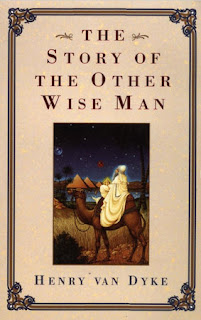
Van Dyke, Henry "The Story of the Other Wise Man"

Van Dyke, Henry "The Story of the Other Wise Man" - 1896

The title of this little story reminded me of "The Tale of Three Trees" which I used to read to my RE students every Easter.

It's not exactly like that story but comparable, a nice story to imagine what the wise men were up to, why they came to the stable where Jesus was born. Not just as nice story for kids but I would include it in my classes nowadays. A lovely little tale.

From the back cover:

"'I do not know where this little story came from - out of the air, perhaps. One thing is certain, it is not written in any other book, nor is it to be found among the ancient lore of the East. And yet I have never felt as if it were my own. It was a gift, and it seemed to me as if I knew the Giver.' Henry Van Dyke

Long, long ago, a wise man named Artaban, a priest of the Magi, discerned from heavenly signs that the time was at hand for the fulfillment of an ancient prophecy - the birth among the Hebrews of a holy Prince and Deliverer of Man. Hastening to join three fellow Magi for the long journey into Judaea, he paused to help a dying man and was left behind. And so Artaban began his pilgrimage alone, striking out not toward the realization of his life's deepest longing, as he hoped, but only toward misfortune and suffering. Or so he believed until one blessed, radiant moment.
"

Wednesday, 12 January 2022

Singer, Isaac Bashevis "Yentl the Yeshiva Boy"

Singer, Isaac Bashevis "Yentl the Yeshiva Boy" (Yiddish: נטל בחור ישיבה/Yenṭl der Yeshive-boḥer) - 1983

I am a huge Barbra Streisand fan and have seen quite a few of her films. And one of my favourite movies ever (not just by and with Barbra) is "Yentl". So, I was surprised to only now find out that it was based on a book. Of course, I could have guessed, such a great story, even if they changed quite a few important parts from the story in the film. So, it's probably a good thing I saw the movie first.

Unfortunately, it's only a short story, I'm sure Nobel Prize winner Isaac B. Singer would have had more ideas to describe Yentl and her life. But, nevertheless, it is a fantastic story and I hope to read more by this brillant author.

From the back cover:

"Recognizing that Yentyl seems to have the soul and disposition of a man, her father studies the Torah and other holy books with her. When he dies, Yentyl feels that she no longer has a reason to remain in the village, and so, late one night, she cuts off her hair, dresses as a young man, and sets out to find a yeshiva where she can continue her studies and live secretly as a man."

Isaac Bashevis Singer received the Nobel Prize for Literature in 1978 "for his impassioned narrative art which, with roots in a Polish-Jewish cultural tradition, brings universal human conditions to life".

I contribute to this page: Read the Nobels and you can find all my blogs about Nobel Prize winning authors and their books here.

Wednesday, 13 October 2021

Hesse, Hermann "Narcissus and Goldmund"

Hesse, Hermann "Narcissus and Goldmund" (German: Narziss und Goldmund) - 1930

A friend of mine was surprised that I never read this book. Well, we can't have read all the books available and I had read three other books by Hermann Hesse before. Still, she had a DVD of the film they made in 2020 (see here) and then she lent me her copy of the book. Thanks, Elisabeth.

They are both great works though, as so often with films, you cannot compare the two. The ending is pretty different and there are parts that are larger in the book than in the film and vice versa. Why do they always have to do that? I have no idea.

This is a much acclaimed book and supposedly one of Hesse's best. I can well understand that. It is a great novel with many layers and much information about life in the middle ages.

I have enjoyed the book very much though I find it hard to say why. Certainly, the writing is superb and the description not just of the two main characters but also all the other ones is fantastic. Maybe I just say it's magical and - like magic - not explainable.

Of course, I cannot vouch for any translations as I have read this book in the original German language.

From the back cover:

"Narcissus and Goldmund is the story of two diametrically opposite men: one, an ascetic monk firm in his religious commitment, and the other, a romantic youth hungry for worldly experience. Hesse was a great writer in precisely the modern sense: complex, subtle, allusive: alive to the importance of play. Narcissus and Goldmund is his very best. What makes this short book so limitlessly vast is the body-and-soul-shaking debate that runs through it, which it has the honesty and courage not to resolve: between the flesh and spirit, art and scientific or religious speculation, action and contemplation."

And another one:

"Narcissus is a teacher at Mariabronn, a monastery in medieval Germany, and Goldmund his favourite pupil. While Narcissus remains detached from the world in prayer and meditation, Goldmund runs away from the monstery in pursuit of love. Thereafter he lives a picaresque wanderer's life, his amatory adventures resulting in pain as well as ecstasy. His eventual reunion with Narcissus brings into focus the diversity between artist and thinker, Dionysian and Apollonian".

Hermann Hesse received the Nobel Prize for Literature in 1946 "for his inspired writings which, while growing in boldness and penetration, exemplify the classical humanitarian ideals and high qualities of style".

Hermann Hesse received the Peace Prize of the German Book Trade (Friedenspreis) in 1955.

I contribute to this page: Read the Nobels and you can find all my blogs about Nobel Prize winning authors and their books here.

Thursday, 26 August 2021

Marx, Karl; Engels, Friedrich "The Communist Manifesto"

Marx, Karl; Engels, Friedrich "The Communist Manifesto" (German: Das Kommunistische Manifest) - 1848

It's unbelievable that this book is almost two centuries old. It's as contemporary and accurate as it was in 1848. I have always said, and I still believe it is correct, Marx and Engels would turn in their grave if they saw what has been made from their ideas. Unfortunately, they forgot to include one aspect into their theories, the human factor. As we have seen during the last two years of this pandemic, there are always greedy, selfish people around and they will not change their mind for the common good, often they are not smart enough to understand that and cannot think further than their own nose. So we should forgive them. But, honestly, I don't want to. I hate selfishness more than anything.

I live in a country with a good health system which is regarded by many outsiders as communist. We have free education and a good insurance for when we lose our jobs. We look after each other in our system and I am happy about that. But there are still too many rich people who could do more for the rest of the population. Again, the human factor. But I am glad we have the system we have and wouldn't want to live in some other countries, even if they claim to have more money. My son lived in Sweden for a while and their system is even further than Germany, a great system with high taxes but the people are generally a lot happier than those in other countries. I think that speaks for itself.

Karl Marx is a great philosopher; he has been named one of the most well-known thinkers in the world. We should give his thoughts more consideration.

Quotes:
"Political power, properly so called, is merely the organised power of one class for oppressing another."
Unfortunately, Karl Marx was right here, as always.

"The ruling ideas of each age have ever been the ideas of its ruling class."
So true, those who rule the country tell us what we should think.

"Then the world will be for the common people, and the sounds of happiness will reach the deepest springs. Ah! Come! People of every land, how can you not be roused."
Good question. If people don't want to understand, they won't.

"You are horrified at our intending to do away with private property. But in your existing society, private property is already done away with for nine-tenths of the population."
Also this is still truer than ever.

"Let the ruling classes tremble at a Communistic revolution. The proletarians have nothing to lose but their chains. They have a world to win.
Workingmen of all countries unite!
"
The trouble is, many of the suppressed people believe their oppressors that this is wrong and will end in a disaster for them. No, it will end in a disaster for the rich.

"Society as a whole is more and more splitting up into two great hostile camps."
Still the same!

And last but not least:
"Communism deprives no man of the power to appropriate the products of society; all that is does is to deprive him of the power to subjugate the labour of others by means of such appropriation."

From the back cover:

"A rousing call to arms whose influence is still felt today

Originally published on the eve of the 1848 European revolutions,
The Communist Manifesto is a condensed and incisive account of the worldview Marx and Engels developed during their hectic intellectual and political collaboration. Formulating the principles of dialectical materialism, they believed that labor creates wealth, hence capitalism is exploitive and antithetical to freedom.

One of the most profoundly defining documents ever published in history.
The Communist Manifesto has forever realigned political faultlines worldwide, and its aftershock resonates to this day. In the 150 years since its publication, no other treatise has inspired such a dividing and violent debate, and after the recent collapse of several regimes which had initially embraced it, a retrospective interpretation of the essential ideas it advocates is presented in this comprehensive volume."
 

Thursday, 27 May 2021

Sapolsky, Robert M. "Behave"

Sapolsky, Robert M. "Behave: The Biology of Humans at Our Best and Worst" - 2017

This was probably the toughest book I ever read even compared to "Ulysses" or "The Odyssey" and some other heavy and long classics). I guess anyone who read this and can repeat all of that deserves at least a master's degree.

I was never good at any science subject in school. Mainly because I wasn't interested in it. My teachers did not succeed in getting me enthusiastic about the subjects. If I had had a teacher like Robert Sapolsky, that might have been a different matter.

It still doesn't mean that I'd ever become an expert. There was far too much to-ing and fro-ing to my liking. That was just above my head.

The author says it himself in one of his last chapters:
"If you had to boil this book down to a single phrase, it would be 'It's complicated.' Indeed it is. But it is a complicated subject and I'm glad I read the book."

And one final quote:
"The opposite of hate is not love, its opposite is indifference." Elie Wiesel whose book "Night" is a publication everyone should read.

This was our international online "extra" book club read in May 2021.

Some comments:

  • The book is massive and we agreed, that it lacks structure. Or at least, none of us found a helpful structure.
  • Indeed, this was a tough read. The author could have taken more care about structure. I took 14 pages of hand written notes and I think, I needed them.
  • Sapolsky organizes a huge amount of technical neuroscience into a logical and memorable structure, so that the context and significance of all that info is clear. He emphasizes the interplay of various factors. Then he discusses the personal, social, political and legal consequences of that information, forming a coherent view of humanity. Brilliant! 717 pages
  • The chapter outline indicates the structure of the book and that helped me to maintain my orientation while reading.
  • We plan to set up another meeting and discuss parts of the book to make up for the missing structure. If we discuss the whole book in just one hour with several people it may get a bit chaotic.
  • We might then post questions for maybe one chapter at a time.

From the back cover:

"Why do human beings behave as they do?

We are capable of savage acts of violence but also spectacular feats of kindness: is one side of our nature destined to win out over the other?

Every act of human behaviour has multiple layers of causation, spiralling back seconds, minutes, hours, days, months, years, even centuries, right back to the dawn of time and the origins of our species.

In the epic sweep of history, how does our biology affect the arc of war and peace, justice and persecution? How have our brains evolved alongside our cultures?

This is the exhilarating story of human morality and the science underpinning the biggest question of all: what makes us human?
"

For those of you who think, this might be a little too heavy but are still interested in "science for beginners", start with one of these:

Bryson, Bill "A Short History of Nearly Everything" - 2003
- "The Body. A Guide for Occupants" - 2019

Harari, Yuval Noah "Sapiens. A Brief History of Mankind" (Hebrew: קיצור תולדות האנושות/Ḳizur Toldot Ha-Enoshut) - 2014
- Noah "Homo Deus. A Brief History of Tomorrow"- 2016