Showing posts with label Short Stories. Show all posts

Tuesday, 21 July 2026

Kishon, Ephraim "The Seasick Whale: An Israeli Abroad"

Kishon, Ephraim "The Seasick Whale: An Israeli Abroad. Book of Travels" (Hebrew: ספר המסעות/Sefer ha'masot) -  1995 

Ephraim Kishon is always worth picking up. In this volume, he recounts his travels to various European countries and the United States. Like few others, he manages to portray the quirks of the locals in such a way that even they have to laugh at them. And, in reality, his observations actually serve as a form of praise.

So, for anyone who wants to know how to get rid of a banana peel in Switzerland, why one should never take a gondola in Venice, and why it is advisable not to visit Las Vegas without having already booked and paid for the return journey, this book is worth its weight in gold.

Book Description:

"Every person dreams of travel in the world; Anyone going crazy to see the Niagara Falls outdated and disappointed them, or to flock to the picture of the Mona Lisa and find out the size of A4. The average Israeli is not a dream and we do not go crazy. He drives - especially in summer and winter, or the two seasons, going at all costs and at every opportunity. Citizen look in the mirror and say to 'I'm starting to resemble my passport photo, so it was time to go.

Ephraim Kishon's journeys proves his wonderful humor is independent of geography, is entertaining and hilarious in each country to which he invites the reader."

Monday, 8 June 2026

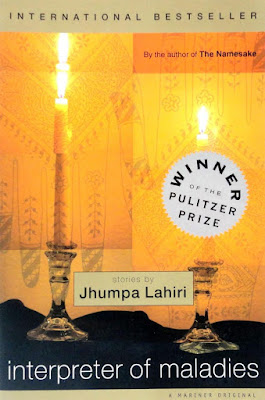
Lahiri, Jhumpa "Interpreter of Maladies"

Lahiri, Jhumpa "Interpreter of Maladies" - 1999

I have read this book in 2015. This was my review back then:

"As most of my friends know, I am not a big fan of short stories. However, I read 'The Namesake' by the same author and really loved it. And several of my friends had recommended 'Interpreter of Maladies' to me, one had even left a copy to me when she was moving, I just had to read it.

I was pleasantly surprised. What a lovely collection of short stories, some of them even interlink, so it doesn't seem like there are a hundred small stories that you forget right away. On the contrary, Jhumpa Lahiri has created some wonderful characters that you won't forget that easily. She incorporates all sorts of problems anyone might face who lives in a culture different from the one they or their parents grew up with. She describes some lovely people (and some not so lovely ones) who are all confronted with a life in two different parts of this world. Since the author is Indian herself and grew up in the United States, this is the background to almost all her stories. Having lived abroad (though not in such a different culture as the characters in the book) almost half of my life myself, I can certainly relate to a few of them.

Jhumpa Lahiri has a good, elegant style, her stories just flow, I will certainly read more of her writings."

A while ago, I joined an online group called Literary Wives and this was the next book on our list. So, I re-read the book because it was a while ago that I read it and we read it with a different topic in mind. What does the author say about the wives in his book?

Most of these stories take place in India and/or around Indian couples.

A Temporary Matter

We look at the end of a marriage. A couple suffers from the loss of a baby that was stillborn. They have nothing to say to each other even though they try hard.

When Mr. Pirzada Came to Dine

In this story, a woman remembes a man from East Pakistan/Bangladesh coming to visit her Indian family in the States while his family is back home. It is more a story about the man than about this particular wife but it still gives us an insight into the life of the Indian wives in the US.

Interpreter of Maladies

This is about an Indian American family visiting the country of their heritage. We learn even more about the life of such a wife, she is so lonely. I can relate because as a non-working wife abroad, you don't have the sort of social life your husband and children habe and it is hard work to try and find your place.

A Real Durwan (doorkeeper)

This story is about an eldery woman who is a stairsweeper and lives on the roof ot the building she works in.

While this is less about the situation of a wife, it tells us about poverty and how you can be even poorer than all the others around you.

Sexy

We're back in the US. Again, not the story of a wife but of a mistress. And of a husband who is leaving his wife. A good reflection about this kind of situation from every point of view, the wife and the mistress. 

Mrs. Sen's

Her we have the story of an Indian woman living in the States who doesn't drive and doesn't have any contact outside the house. She looks after an eleven year old boy after school and teaches him about their food. Probably one of my favourite stories. I really felt for the lady.

This Blessed House

A yound married Indian couple in Connecticat who moves into their new house and find many Christian relics. The wife puts them on the mantel of the fireplace. A good story about how different people can have different opinions about what to keep and what not and what to embrace. And how they have to work on your marriage.

The Treatment of Bibi Haldar

A woman suffers from seizures and a doctor recommends to marry her off. But it costs money to get married and you have to find a suitor. So, her relatives rather let her live on the roof. This story focuses on the treatment of illness and of prejudices.

The Third and Final Continent

This guy has moved from India to London and then to the States where he rents a room from a 103-year-old lady. They develop a good connection until he gets married and moves out. We follow his and his wife's life and how they get to know each other.

As I mentioned in the stories, they are not all about the wives, some of them don't relate to their status at all, they are just there. But where they are mentioned, we learn a lot about the differences between Indian and (mainly) American wives, their rights and their duties.

I think it also helps to understand why immigrants so often stay among themselves. It is not just about the language, though that doesn't help if nobody teaches them the host language, it is more about the culture and understanding each other. Especially the wives are invisible, they disappear in the crowd. Especially if it has been an arranged marriage, the husband often doesn't understand his wife.

From the back cover:

"Navigating between the Indian traditions they've inherited and the baffling new world, the characters in Jhumpa Lahiri's elegant, touching stories seek love beyond the barriers of culture and generations. In 'A Temporary Matter,' published in The New Yorker, a young Indian-American couple faces the heartbreak of a stillborn birth while their Boston neighborhood copes with a nightly blackout. In the title story, an interpreter guides an American family through the India of their ancestors and hears an astonishing confession. Lahiri writes with deft cultural insight reminiscent of Anita Desai and a nuanced depth that recalls Mavis Gallant."

Jhumpa Lahiri received the Pulitzer Prize for "Interpreter of Maladies" in 2000.

And here are the reviews of the other literary wives:

Becky from Sydney of Aidanvale

Kate from Melbourne of booksaremyfavoriteandbest

Rebecca from Maryland, USA of Bookish Beck

Kay from Washington State, USA of What? Me Read?

Monday, 20 April 2026

Ephron, Nora "Scribble Scribble"

Ephron, Nora "Scribble Scribble. Notes on the Media" - 1978 

I love Nora Ephron and must have read every novel she ever wrote. And some of her non-fiction publications. A while ago, I read "Crazy salad. Some things about women" which was written in the Seventies, at a time where we had no internet and not as much information about what was going on across the pond as it is now.

Same as in that book, we find articles she wrote for a magazine, this time Esquire. I have never seen that publication and I didn't know many of the celebrities or newspapers or events she writes about. But she has such a lovely way of writing, you want to dig into all those stories and find out what the background was, though she does give quite some information about that already.

So, if you like Nora Ephron, you might want to pick up this book. If you haven't read anything by her, I suggest you start with one of her wonderful novels (see here).

There would be a lot of quotes I could put here, but I just leave it with three:

About "People" magazine:
"A celebrity is anyone People writes about; I know the magazine is filling some nameless, bottomless pit of need for gossip and names but I haven't got room in my life for so many lights."
Nothing seems to have changed here.

About two of my least favourite authors (Capote and Kerouac)
"Russell Baker: Capote's famous comment on Kerouac - that's not writing, it's typing."
I could say that for both of them but I will remember this quote the next time I come across a book like this.

About "Gourmet" magazine:
"I don't actually read it. I sort of look at it in a fairly ritualistc manner.
I love cook books and cooking and baking magazines. And I think it's that same for me, I just love looking at the recipes and imagine I would make them all. Mind you, I usually try a few of the recipes

Book Description:

"Twenty-five tussles with the American media and its various faults and glories reveal an incisive journalist's dislike of such episodes as Haldeman on CBS and the New York Magazine takeover and her passion for such gifts as Upstairs, Downstairs and the Double-Crostic.

This volume is a collection of the columns the author wrote for Esquire magazine from 1975 to 1977. Her subject was the media, especially print journalism."

Thursday, 23 October 2025

Hemingway, Ernest "In Our Time"

Hemingway, Ernest "In Our Time" - 1925

I chose this book because the year 1925 was given for our Read the Year challenge. A whole century ago. I had read a few books from that year already, so the choice was not exactly limited but there wasn't a single book on my wishlist that would fit the challenge. So, I went for an author that I like and that I wanted to read more from.

Had I chosen it if I'd been aware that this is a collection of short stories? Probably not. Granted, they were linked with each other, somehow. But it still wasn't enough to really grip me.

However, this was his first publication and we can see a lot of topics that will come up in his later work. Having read some of those helped.

So, not my favourite of his books.

Book Description:

"A strikingly original collection of short stories and accompanying vignettes that marked Ernest Hemingway’s American debut.

When In Our Time was first published in 1925, it was widely praised for its simple and precise use of language to convey a wide range of complex emotions, and earned Hemingway a place among the most promising American writers of that period. In Our Time contains several early Hemingway classics, including the famous Nick Adams stories 'Indian Camp' and 'The Three Day Blow', and introduces readers to the hallmarks of the Hemingway a lean, tough prose, enlivened by an ear for the colloquial and an eye for the realistic. His writing suggests, through the simplest of statements, a sense of moral value and a clarity of vision.

Now recognized as one of the most important short story collections of twentieth-century literature, In Our Time provides key insights into Hemingway’s later works."

Ernest Hemingway received the Nobel Prize for Literature in 1954 "for his mastery of the art of narrative, most recently demonstrated in 'The Old Man and the Sea' and for the influence that he has exerted on contemporary style".

I contribute to this page: Read the Nobels and you can find all my blogs about Nobel Prize winning authors and their books here.

Find all my Read The Year books here.

Wednesday, 15 October 2025

Boyd, William "On the Yankee Station" - 1981

Boyd, William "On the Yankee Station" - 1981

Several people recommended William Boyd to me lately. And I had found one of his books in a used book sale. So, I decided to tackle this.

This is a collection of short stories about teenagers, young people, students, boarding school, murderers, all about people completely dissatisfied with their lives.

Short stories have never been my favourite and this book certainly didn't convice me otherwise. Please, if you have read his short stories and his novels and think the novels are so much better, tell me, otherwise this would be the last I have read of his stories.

From the back cover:

"Adolescent sex in a Scottish boys' public school ... Oddballs on the seedy side of America ... Murder in a quiet Devon cottage ... Comical, ironical or lacerating - wit is the keynote of these stories, which include two early adventures from the career of Morgan Leafy, glorious anti-hero of William Boyd's prize-winning novel 'A Good Man in Africa'.

Wiliam Boyd, winner of the Whitbread and Somerset Maugham Awards, introduces unlikely heroes desperate to redeem their unsatisfying lives.

From California poolsides to the battlegrounds of Vietnam, here is a world populated by weary souls who turn to fantasy as their sole escape from life's inequities. Stranded in an African hotel during a coup, an oafish Englishman impresses a young stewardess with stories of an enchanted life completely at odds with his sordid existence in 'The Coup'" In the title story, an arrogant, sadistic American pilot in Vietnam underestimaets the power of revenge when he relentlessly persecutes a member of his maintenance crew. With droll humor and rare compassion, Boyd's enthralling stories remind us of his stature as one of contemporary fiction's finest storytellers."

Wednesday, 17 September 2025

Ephron, Nora "Crazy Salad"

Ephron, Nora "Crazy Salad: Some Things About Women" - 1975

I absolutely love Nora Ephron. Shes was a fantastic author as well as a fantastic human being. Everything she says is close to my heart and I felt nodding along, no matter what I was reading about. If you ever felt like the odd one out, as if nothing you did would be acknowledged by others and they would always find a new excuse why, this is the book for you.

Of course, this book was written in the Seventies, at a time where we had no internet and not as much information about what was going on across the pond as it is now. I remember a game I played with some American friends  about thirty years ago where we had to guess celebrities and I had never heard of Ruth Bader Ginsberg. She just wasn't in our news until then. Neither were many of the women in Nora Ephron's book, some of them I read about in the meantime (Gloria Steinem, for example) but others I had never heard about. So, I had a lot of extra reading to do but that was alright because it gave me a larger insight into the US of A of the time.

So, whether you are American or not, if you are a fan of "When Harry Met Sally", you would want to read this.

Book Description:

"The classic Crazy Salad by screenwriting legend and novelist Nora Ephron, is an extremely funny, deceptively light look at a generation of women (and men) who helped shape the way we live now. In this distinctive, engaging, and simply hilarious view of a period of great upheaval in America, Ephron turns her keen eye and wonderful sense of humor to the media, politics, beauty products, and women's bodies. In the famous A Few Words About Breasts, for example, she tells us: 'If I had had them, I would have been a completely different person. I honestly believe that.' Ephron brings her sharp pen to bear on the notable women of the time, and to a series of events ranging from Watergate to the Pillsbury Bake-Off. When it first appeared in 1975, Crazy Salad helped to illuminate a new American era - and helped us to laugh at our times and ourselves. This new edition will delight a fresh generation of readers."

Monday, 15 September 2025

Dostoevsky, Fyodor "A Little Hero"

Dostoevsky, Fyodor "A Little Hero" (Russian: Маленький герой/Malen'kiy geroy) - 1857

Novel in Nine Letters - 1847
A Gentle Creature - 1876
A Little Hero - 1849

This booklet consists of three short stories, but I liked the "Novel in Nine Letters" the best. It's the correspondence between two men who somehow always manage to miss each other. 

Dostoevsky said of this: "When I was penniless the other day, I visited Nekrasov. While I was sitting with him, the idea came to me to write a novel in nine letters. When I returned home, I finished the novel in one night. In the morning, I brought the manuscript to Nekrasov and received 125 rubles for it."

In this story, you can tell that Pyotr Ivanych wants something from Ivan Petrovich and vice versa. One excuse for why the meeting doesn't take place follows another. Very funny.

I had already read "The Gentle One" in another collection. (see here) Also an interesting story about the beginning and end of a relationship and how it all came about.

I found the actual story, or rather the one that adorns the title, rather boring. An eleven-year-old falls in love with his cousin, and the "gentlewomen" of society make this the subject of their amusement, making fun of him, and embarrassing him. Nevertheless, it's a Dostoyevsky story and therefore worth reading in its own right.

From the back cover:

"At that time I was nearly eleven, I had been sent in July to spend the holiday in a village near Moscow with a relation of mine called T., whose house was full of guests, fifty, or perhaps more.... I don't remember, I didn't count. The house was full of noise and gaiety. It seemed as though it were a continual holiday, which would never end. It seemed as though our host had taken a vow to squander all his vast fortune as rapidly as possible, and he did indeed succeed, not long ago, in justifying this surmise, that is, in making a clean sweep of it all to the last stick."

Monday, 21 July 2025

Wodehouse, P.G. "Leave it to Psmith"

Wodehouse, P.G. "Leave it to Psmith" - 1923

We already know P.G. Wodehouse from the Jeeves & Wooster novels, all of which are simply delightful.

So I thought a book about his other protagonist would certainly be quite good. And it was. P.G. Wodehouse is more of a mix of Jeeves & Wooster, and I think that's excellent.

Rupert Psmith (Ronald in this book, though) is a jack of all trades, trying to make ends meet through all sorts of odd jobs after leaving his uncle's fish business. He doesn't shy away from the occasional petty crime. But he's also a true gentleman and is concerned about the welfare of his people.

This was the last book in the Psmith series, but that didn't bother me at all. I want to read the others as well.

This book is truly delightful, hilarious and gripping at the same time.

From the back cover:

"Ronald Psmith ('the 'p' is silent, as in pshrimp') is always willing to help a damsel in distress. So when he sees Eve Halliday without an umbrella during a downpour, he nobly offers her an umbrella, even though it’s one he picks out of the Drone Club’s umbrella rack. Psmith is so besotted with Eve that, when Lord Emsworth, her new boss, mistakes him for Ralston McTodd, a poet, Psmith pretends to be him so he can make his way to Blandings Castle and woo her. And so the farce begins: criminals disguised as poets with a plan to steal a priceless diamond necklace, a secretary who throws flower pots through windows, and a nighttime heist that ends in gunplay. How will everything be sorted out? Leave it to Psmith!"

Friday, 14 March 2025

Wilde, Oscar "Only Dull People Are Brilliant at Breakfast"

Wilde, Oscar "Only Dull People Are Brilliant at Breakfast" - 1946

This is only a short book of 52 pages. Easy to take along on short trips.

And what a lovely title. I suppose Oscar Wilde considered himself a very boring person at breakfast.

While this sounds like another one of his not-so-well-known writings, it is really a collection of his aphorisms, quotes, anecdotes, witticisms. A delight to read. Again and again.

After reading this, I would have wished to be friends with him. I'm sure we would have really liked each other.

One of my favourite quotes, still as relevant today as it was a hundred years ago, especially with regard to certain politics:
"Selfishness is not living as one wishes to live, it is asking others to live as one wishes to live."

From the back cover:

"Wilde's celebrated witticisms on the dangers of sincerity, duplicitous biographers, the stupidity of the English - and his own genius.

'It would be unfair to expect other people to be as remarkable as oneself'. Oscar Wilde"

This is a "Penguin Little Black Classics" edition and it looks like there are lots of other authors who 

There is even a box set with the following description:

"A stunning collection of all 80 exquisite Little Black Classics from Penguin

This spectacular box set of the 80 books in the Little Black Classics series showcases the many wonderful and varied writers in Penguin Black Classics. From India to Greece, Denmark to Iran, the United States to Britain, this assortment of books will transport readers back in time to the furthest corners of the globe. With a choice of fiction, poetry, essays and maxims, by the likes of Chekhov, Balzac, Ovid, Austen, Sappho and Dante, it won't be difficult to find a book to suit your mood. Little Black Classics celebrate the huge range and diversity of the Penguin Classics list - from drama to poetry, from fiction to history, with books taken from around the world and across numerous centuries."

It would be worth getting.

Monday, 12 August 2024

Pamuk, Orhan "To Look Out the Window"

Pamuk, Orhan "To Look Out the Window" aka "Pieces from the View: Life, Streets, Literature" (Turkish: Manzaradan Parçalar: Hayat, Sokaklar, Edebiyat) - Der Blick aus meinem Fenster. Betrachtungen - 2008

An interesting book by Orhan Pamuk in which he discusses many topics. Whether it's his childhood in Istanbul, his family, politics or his job as a writer, literature, art, he simply has something interesting and worth knowing to say about everything.

That is certainly the main reason why this author is one of my favorites. I hope he writes a new novel soon.

Book description (translated from the German copy):

"Whether it's the crumbling plaster of Istanbul houses or the Turkish flag, whether it's his father or the terrifying nature of Dostoyevsky's demons - with Orhan Pamuk everything becomes a complex universe. Pamuk observes coolly and tells moving stories. Autobiographical, narrative, politics, art and literature: his essays are the sum of different and contradictory experiences - an incredible stroke of luck."

As you can see from my Wikipedia link, there is an English title, though I could not find the book. Still, I hope it has been translated into English.

Orhan Pamuk "who in the quest for the melancholic soul of his native city has discovered new symbols for the clash and interlacing of cultures" received the Nobel Prize for Literature in 2006.

Orhan Pamuk received the Peace Prize of the German Book Trade (Friedenspreis) in 2005.

I contribute to this page: Read the Nobels and you can find all my blogs about Nobel Prize winning authors and their books here.

Read my original review here

Wednesday, 4 October 2023

Poe, Edgar Allan "The Murders in the Rue Morgue"

Poe, Edgar Allan "The Murders in the Rue Morgue and other stories" - 1841

Our international online book club read in August 2023.

Dark, gruesome, abysmal, that's what I read somewhere about the writings of Edgar Allan Poe. Yeah, I couldn't agree more. I know people who love this sort of writing but I don't. I was afraid I wouldn't like it but tried my best to discover something that might tempt me to read more by this author. Alas, that was not to be. This time, it was a good thing that the book wasn't that thick. Or maybe that added to my disenjoyment.

My biggest problem with stories like these, there is nothing to learn from them. Absolutely nothing. And that is my main reason for reading.

Our book club had chosen to read a collection of short stores. The trouble with this is always that there are different ones in different languages. These were the stories the Finnish members had:
The Tell-Tale Heart (1843)
The Imp of the Perverse (1845)
The Murders in the Rue Morgue (1841)
The Mystery of Marie Rogêt (1843)
The Purloined Letter (1844)
'Thou Art the Man' (1844)

And these were the ones in the English edition:
The Oval Portrait
Ligeia
Eleonora
Morella
Berenice
The Fall of the House of Usher
The Masque of the Red Death
Hop-Frog
The Pit and the Pendulum
The Cask of Amontillado
The Gold-Bug
The Murders in the Rue Morgue
The Mystery of Marie Rogêt
The Purloined Letter

The group had some other opinions. There was a really good discussion about Poe's works and life. Some had read some of the gruesome and terrible works but most of us had read a selection of a few different kinds, some of which are really clever and intelligent, and you clearly can see how he was starting a genre to influence literature for hundreds of years to follow.

From the back cover:

"Between 1841 and 1844, Edgar Allan Poe invented the genre of detective fiction with three mesmerizing stories about a young and eccentric French private detective named C. Auguste Dupin.

Introducing to literature the concept of applying reason to solving crime, these tales brought Poe fame and fortune, although much less of the second during his lifetime. Decades later, Dorothy Sayers would describe '
The Murders in the Rue Morgue' as 'almost a complete manual of detective theory and practice.' Indeed, Poe’s short Dupin mysteries inspired the creation of countless literary sleuths, among them Sherlock Holmes. Today, the unique Dupin stories still stand out as utterly engrossing page-turners."

Tuesday, 21 March 2023

Ruiz Zafón, Carlos "The City of Mist"

Ruiz Zafón, Carlos "The City of Mist" (Spanish: La Ciudad de Vapor) - 2020
(El cementerio de los libros olvidados #5)

Yes, we return to Barcelona, one last journey with a wonderful author who left a big hole in the literary world with his death. His fans can look forward to a last greeting. All stories that fit somewhere in his Cemetery of Forgotten Books. How it came about and what it has contributed to. One or the other story has already been read beforehand, e.g. "Gaudí in Manhattan" or "The Prince of Parnassus" (El Príncipe de Parnaso), but that doesn't detract from the joy of this book.

And if you haven't read the wonderful series yet, you should do so as soon as possible. These short stories are also good for getting in the mood. You can read all of his books in any order, they complement each other well.

From the back cover:

"Return to the mythical Barcelona library known as the Cemetery of Forgotten Books in this posthumous collection of stories from the New York Times bestselling author of The Shadow of the Wind and The Labyrinth of the Spirits.

Bestselling author Carlos Ruiz Zafón conceived of this collection of stories as an appreciation to the countless readers who joined him on the extraordinary journey that began with
The Shadow of the Wind. Comprising eleven stories, most of them never before published in English, The City of Mist offers the reader compelling characters, unique situations, and a gothic atmosphere reminiscent of his beloved Cemetery of Forgotten Books quartet.

The stories are mysterious, imbued with a sense of menace, and told with the warmth, wit, and humor of Zafón's inimitable voice. A boy decides to become a writer when he discovers that his creative gifts capture the attentions of an aloof young beauty who has stolen his heart. A labyrinth maker flees Constantinople to a plague-ridden Barcelona, with plans for building a library impervious to the destruction of time. A strange gentleman tempts Cervantes to write a book like no other, each page of which could prolong the life of the woman he loves. And a brilliant Catalan architect named Antoni Gaudí reluctantly agrees to cross the ocean to New York, a voyage that will determine the fate of an unfinished masterpiece.

Imaginative and beguiling, these and other stories in
The City of Mist summon up the mesmerizing magic of their brilliant creator and invite us to come dream along with him.

Blanca and the Departure
Nameless
A Young Lady from Barcelona
Rose of Fire
The Prince of Parnassus
A Christmas Tale
Alicia, at Dawn
Men in Grey
Kiss
Gaudí in Manhattan
Two-Minute Apocalypse"

Tuesday, 17 January 2023

Adichie, Chimamanda Ngozi "We Should All Be Feminists"

Adichie, Chimamanda Ngozi "We Should All Be Feminists" - 2014

A small book, a short book. But a very meaningful book. If you only read one non-fiction book this year, let it be this one.

The author has written a few very important books already, "Half of a Yellow Sun" probably being the most important one.

This booklet is short, yet very powerful, very important. Chimamanda Ngozi Adichie tells us about her life as a woman, a story that can probably be told by many women all over the world. We have fewer chances to get anywhere in the world, we earn less money, our voices are not heard as well.

Therefore, we should all listen to this and try to be more assertive when it comes to our battle for more recognition.

From the back cover:

"A personal and powerful essay from Chimamanda Ngozi Adichie, the bestselling author of 'Americanah' and 'Half of a Yellow Sun', based on her 2013 TEDx Talk of the same name.

What does 'feminism' mean today? That is the question at the heart of We Should All Be Feminists, a personal, eloquently-argued essay - adapted from her much-viewed Tedx talk of the same name - by Chimamanda Ngozi Adichie, the award-winning author of '
Americanah' and 'Half of a Yellow Sun'. With humour and levity, here Adichie offers readers a unique definition of feminism for the twenty-first century  one rooted in inclusion and awareness. She shines a light not only on blatant discrimination, but also the more insidious, institutional behaviours that marginalise women around the world, in order to help readers of all walks of life better understand the often masked realities of sexual politics.

Throughout, she draws extensively on her own experiences - in the U.S., in her native Nigeria - offering an artfully nuanced explanation of why the gender divide is harmful for women and men, alike. Argued in the same observant, witty and clever prose that has made Adichie a best-selling novelist, here is one remarkable author’s exploration of what it means to be a woman today - and an of-the-moment rallying cry for why we should all be feminists.
"

Monday, 19 December 2022

Hermann, Judith "The Summerhouse, Later"

Hermann, Judith "The Summerhouse, Later" (German: Sommerhaus, später) - 1998

These short stories mainly take place in Germany. As the description says, there are nine different characters, each with a different life. There's a taxi driver. And a young woman who remembers her great-grandmother. People like you and me who live in Berlin. An interesting mix. But anyone who knows me will also know what I think of it. Nine individual books would have been better.

Book Description:

"'The little jewellery box also held the red coral bracelet from Nikolai Sergeyevich. Its six hundred and seventy-five little coral beads were strung onto a silken thread, and they glowed as red as rage. My great-grandmother put the hairbrush down in her lap. She closed her eyes for a long time. Then she opened her eyes again, took the red coral bracelet from the little box and fastened it around her left wrist. Her skin was very white. That evening, for the first time in three years, she shared a meal with my great-grandfather.'

Coral bracelets 'as red as rage' from Russian lovers; a sad old woman who nonetheless 'sometimes sang and winked with her left eye and laughed till the tears came’; country houses ‘away from Berlin, linden trees out front, chestnuts in the back, sky above':
'The Summer House, Later' is an elegant, measured, reflective collection of stories which captures beautifully the promise of bright colours lying just out of reach of our grey daily routines.

Set in and around Europe's fastest-growing, fastest-living city, these stories take as their starting point the monotony of modern urban life - the endless antennas and chimneys, the pigeons in the gutters - and looks beyond them to 'the narrow strip of sky over the rooftops'. The literary sensation of the year in her native Germany, Judith Hermann is a wonderfully talented young writer whose ability to find drama and beauty in the smallest, most trivial moments makes
'The Summer House, Later' a very special debut indeed."

"In nine luminous stories of love and loss, loneliness and hope, Judith Hermann's stunning debut collection paints a vivid and poignant picture of a generation ready and anxious to turn their back on the past, to risk uncertainty in search of a fresh, if fragile, equilibrium. An international bestseller and translated into twelve languages, 'The Summerhouse, Later' heralds the arrival of one of Germanys most arresting new literary talents."

Monday, 21 November 2022

Greywoode, Josephine "Why We Read"

Greywoode, Josephine (ed.) "Why We Read. 70 Writers on Non-Fiction" - 2022

It's Non-fiction November and if you haven't had a chance to participate, here is a short book that tells us a lot about non-fiction books and might instigate us to read some.

70 authors have written about the reason why we read, especially why we read non-fiction. A brilliant collection of thoughts by some great minds. I could repeat the whole book here - but I recommend you get it yourself and read what they have to say. You won't regret it.

And here are just some snippets that might entice you starting the read yourself:

"Poetry in translation is, like Guinness outside Dublin, just a shadow of the real thing." Ananyo Bhattacharya

"And whatever kind of book you are reading, you get to rest for a while in the author's mind and share their unique way of looking at things and putting them together. In a few hours you will learn, without effort, everything this other person has laboured for years to know and understand." Clare Carlisle

"The pictures are better. No fancy computer-enhanced video can compete with reading, and re-reading, the actual text. Imagination is the key to enjoying good literature." Paul Davies

"And sometimes I read as a way of keeping a grip on the world, a grip on myself in the world, a tiny speck, in the rushing darkness that I am. Hold fast. Reading for my life, I guess." Nicci Gerrard

"Education: This is not just the obvious help that reading gives to the formal process of learning at school or university. Reading is a wonderful gift for life-long learning. I read to learn more about more, to educate myself further, to extend my knowledge. That is something that never ends." Ian Kershaw

"Consider this: reading is a strange, modern behaviour that we never evolved to do. Of the 300,000 or so years in which our species has existed, humans started reading only about 5,000 years ago. That's barely 1 per cent of our existence. What is more, until the Industrial Revolution, just a handful of humans had to privilege of reading. From an evolutionary perspective, reading is nearly as novel and strange as driving cars or using credit cards." Daniel Lieberman

"Governments want to tell you that "science, technology, engineering, maths" (STEM) are the most important subjects. But reading is the real stem. Understanding what a fact means understanding how to read. A fact is an interpretation of date: a reading." Timothy Morton

"Studies of the effects of education confirm that educated people really are more enlightened. They are less racist, sexist, xenophobic, homophobic and authoritarian. They place a higher value on imagination, independence and free speech. They are more likely to vote, volunteer, express political views and belong to civic associations such as unions, political parties and religious and community organizations. They are also likelier to trust their fellow citizens - a prime ingredient of the precious elixir called social capital, which gives people the confidence to contract, invest, and obey the law without fearing that they are chumps who will be shafted by everyone else.
For all these reasons, literacy is an engine of human progress, material, moral, spiritual.
" Steven Pinker

"Non-fiction books matter because we are what we read." Daniel Susskind

And some book recommendations by Emma Jane Kirby:
Hamel, Christopher de "Meetings with Remarkable Manuscripts"
MacGregor, Neil "A History of the World in 100 Objects" (I read "Germany. Memories of a Nation")
MacDonald, Helen "H is for Hawk"
Nicholson, Christopher "Amon the Summer Snow"
Winterson, Jeanette "Oranges are Not the Only Fruit"
Winterson, Jeanette "Why be Happy When You Can be Normal"
Wynn, Raynor "The Salt Path"

From the back cover:

"Why read non-fiction? Is it just to find things out? Or is it for pleasure, challenge, adventure, meaning? Here, in seventy new pieces, some of the most original writers and thinkers of our time give their answers.

From Hilton Als on reading as writing's dearest companion to Nicci Gerrard on reading for her life; from Malcolm Gladwell on entering the minds of others to Michael Lewis on books as secret discoveries; and from Lea Ypi on the search for freedom to Slavoj Žižek on violent readings, each offers their own surprising perspective on the simple act of turning a page. The result is a celebration of seeing the world in new ways - and of having our minds changed.
"

Friday, 18 November 2022

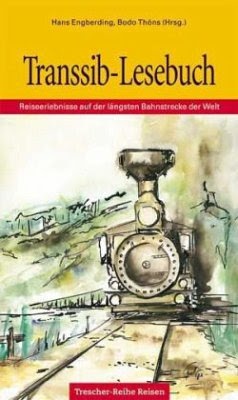
Engberding, Hans; Thöns, Bodo "Transsib Reader"

Engberding, Hans; Thöns, Bodo (Ed.) "Transsib-Lesebuch: Reiseerlebnisse auf der längsten Bahnstrecke der Welt" [Transsib Reader: Travel Experiences On The Longest Railway Line In The World] - 2002

Usually, I don't review books that have not been translated into English. But I promised to do so in this case. And some of the articles have been written in English. Whenever I found the original title (or the translation into English), I added it in bold.

I found this collection at an antiquarian bookstore. It contains articles, excerpts from books, short stories by well-known writers who have all at some point traveled the Trans-Siberian Railway and recorded their experiences in writing. The first description is from 1901, the last from 2001, i.e. a report that goes back over a hundred years in which a lot has happened.

The authors all have an interesting point of view, everyone experiences the trip differently, even if they travel around the same time. While some accept any inconvenience as if it were the most natural thing in the world and are happy to be able to gain this insight into a culture that is foreign to them, others get upset about small things that would probably have happened to them on other routes, as well. And then there are those who support communism (or rather Stalinism) a hundred percent that everything is glorified.

In any case, it is fascinating to see how the railway was built, how it has changed over time, especially when the political situation has changed.


John Foster Fraser, Sir, UK, 1868-1936
Das wahre Sibirien (1901)
The Real Siberia

Eugen Zabel, D, 1851-1925
Auf der sibirischen Bahn nach China (1903)

Karl Tanera, D, 1849-1904
Zur Kriegszeit auf der sibirischen Bahn und durch Rußland (1904)

O.T. Tuck, UK, 1876-?
Tagebuch (1909)

Marcus Lorenzo Taft, US,
Fremdes Sibirien (1909)

Fridtjof Nansen, N, 1861-1930 - Nobel Prize for Peace 1922
Sibirien ein Zukunftsland (1913)
Through Siberia the Land of the Future/Gjennem Sibirien

Otto Goebel, D, 1872-1955
Über Sibirien nach Ostasien (1914)

Sven Hedin, S, 1865-1952
Von Peking nach Moskau (1923)

Richard Tröger, D, 1879-1965
Tagebuch über eine Rußland-Japan-Reise (1929)

Kurt Faber, D, 1883-1929
Weltwanderers letzte Fahrten und Abenteuer (1930)

Peter Fleming, UK, 1907-74 (Ian Fleming's brother)
Mit mir allein. Eine Reise nach China (1933)
One's Company: A Journey to China in 1933

Erik Bergengren, S, 1900-1977
Gelbe Gesichter. Sibirische Nächte und japanische Tage (1936)

Mildred Widmer Marshall, US
Zwei Schullehrerinnen aus Oregon reisen um die Welt (1937)

Sławomir Rawicz, PL/BY, 1915-2004
Flucht durch Steppe und Wüste (1939)
The Long Walk?

Sigrid Undset, DK, 1882-1949 - Nobel Prize for Literature 1928
Wieder in die Zukunft (1940)
Back to the future/Tilbake til fremtiden

Ryszard Kapuscinski, PL/BY, 1932-2007
Imperium. Sowjetische Streifzüge (1958)
Imperium

Siegfried Meissgeier, D, 1924-1988 and Günter Linde, D, 1925-1992
Sibirien ohne Geheimnisse (1959)

Paul Theroux, USA, 1922-
Abenteuer Eisenbahn. Auf Schienen um die halbe Welt (1965)
The Great Railway Bazaar

Hugo Portisch, SLK, 1927-2021
So sah ich Sibirien (1966)

Vittorio Lojacono, I
Die Straße der Gefahr (1969)

Eric Newby, UK, 1919-2006
Auf der großen roten Bahn (1977)
The Big Red Train Ride

Hans-Otto Meissner, D/F, 1909-1992
Sibirien-Expreß (1979)

Wolfgang Seidl, D, 1933-
Ins rote Reich des gelben Drachens (1984)

Hardy Krüger, D, 1928-2022
Sibirienfahrt (1984)

Johanna Hornef-Blau
Unterwegs mit der Transsibirischen Eisenbahn (1994)

Colin Thubron, UK, 1939-
Sibirien. Schlafende Erde - Erwachendes Land (1998)
In Siberia

Kurt Drawert, D, 1956-
Nach Osten ans Ende der Welt (1999)

Mark Bauch, D 1971-
Transsibirisch Reisen (2001)
Das wahre Sibirien (1901)

Pictures by Claudia Mathea (D, 1969-) complement the stories.

Book Description (translation):

"The Trans-Siberian Railway has fascinated travelers from all over the world for a century now. This beautifully designed reader brings together prominent and less prominent Trans-Siberian travelers from all decades of the 20th century, who report on their journey on what is probably the world's most famous railway line.

Lively descriptions of the day-to-day organization of life on the Trans-Siberian Railway, the events on the train and the experiences with fellow travelers stand alongside historical observations from the checkered history of Russia, Mongolia and China. This creates a diverse picture of the countries traveled through.

Sven Hedin, Fridtjof Nansen, Hardy Krüger, Paul Theroux, Sigrid Undset, Peter Fleming and many others take the reader on an adventurous journey through the Siberian expanse.
The Transsib Reader is the ideal complement to the Transsib Handbook.
"

Wednesday, 9 November 2022

Mandelstam, Ossip "The Noise of Time"

Mandelstam, Ossip "The Noise of Time" aka "The Din of Time (RUS: Шум времени/Shum vremeni) - 1925

A story of a childhood at the turn of the last century, the author was born in 1891. His memories of his father and mother, leather smell on the bookshelf, memories of poetry, memories of Jewish customs and festivities. The author gives us a good survey of life at the beginning of the 20th century, that of his contemporaries and of his own, the reflections of his sense of alienation in the Soviet system.

While this book is only a compilation of short stories, it still gives us insights into the life of a Jewish boy in a country that didn't want any criticism, and who gave his life for his beliefs: "Only in Russia is poetry respected, it gets people killed. Is there anywhere else where poetry is so common a motive for murder?"

He mentions the "propertyless intellectual who needs no memories. It should be enough for him to tell of the books he has read."

And then he mentions in the "Mensheviks in Georgia" (written 1922-1927): "Everyone, Georgians, Armenians, Greeks, Persians, Englishmen and Italians spoke Russian. A wild Volapük, a Russian Black Sea Esperanto buzzed in the air." Esperanto was created in 1887 and it seemed normal to Ossip Mandelstam that everyone should know what he was talking about.

"The Noise of Time" is an interesting collection of stories that will surely please not only fans of Russian literature.

From the back cover:

"Collected prose works by one of Russia's towering literary figures. Osip Mandelstam has in recent years come to be seen as a central figure in European modernism. Though known primarily as a poet, Mandelstam worked in many styles: autobiography, short story, travel writing, and polemic. Mandelstam's biographer, Clarence Brown, presents a collection of the poet's prose works that illuminates his far-ranging talent and places him within the canon of European modernism.

This volume includes Mandelstam's
'The Noise of Time,' a series of autobiographical sketches; 'The Egyptian Stamp,' a novella echoing Gogol and Dostoevsky; 'Fourth Prose,' and the famous travel memoirs 'Theodosia' and 'Journey to Armenia.'"

Monday, 18 July 2022

Meier, Peg/Wood, Dave "The Pie Lady of Winthrop"

Meier, Peg/Wood, Dave "The Pie Lady of Winthrop: And Other Minnesota Tales" - 1985

How did I come by this book, a collection of reports by two Minnesotan reporters about interesting and remarkable people in their area in the eighties? Well, a blog friend of mine talked about it, her great great grandmother was "The Pie Lady of Winthrop". The book sounded interesting and I ordered a used copy (it's out of print).

These stories take me back to the eighties, to a time when most situations were very different than they are today. I wouldn't say, people like Mina Peterson who work hard all their lives and still don't stop at a certain age don't exist anymore. Let's just agree that there are fewer of them.

So, we don't just get to know this lovely Swedish-born lady who, at the age of 94 gets up early in the morning so there are fresh pies in the café. And she's been doing it for forty years, beginning after the death of her husband.

There are lots of other tales about immigrants and other folks, former slaves who get together with a huge amount of family, Norwegian-born, Swedish-born, Jewish, any kind of person that doesn't just try to live a quiet life and think about their own family but people who are there for the community.

I decided, after reading a couple of stories, that I liked the ones written by Peg Meier best. They seem to come from the heart, Dave Wood's are also good but more the style of a reporter who will write about anything. You could tell before even turning to the index that lists all the stories with the respective author.

Nice book, even though I'm not very fond of short stories. But these talk about everyday people who make a difference.

From the back cover:

"As reporters for the Neighbors section of the Minneapolis Star and Tribune, Peg Meier and Dave Wood have written about fascinating people and places in all parts of Minnesota. In 'The Pie Lady of Winthrop' you'll meet some of their favorites, including the powder room attendant at Murray's restaurant in Minneapolis, Cedric Adams' old troupe, the sausage makers of New Prague and a 10-year-old kid in Rollingstone. You'll also visit such places as a funeral parlor in Kenyon, two saloons in Minneapolis and the old jail in Taylors Falls."

Wednesday, 8 December 2021

Christie, Agatha "Murder on the Orient Express"

Christie, Agatha "Murder on the Orient Express" (Hercule Poirot #10) - 1934

Who hasn't watched "Murder on the Orient Express"? I know I have watched it about a hundred times. First with Albert Finney as Monsieur Poirot, then Alfred Molina, then THE Hercule Poirot, David Suchet, and last but definitely not least, the great Kenneth Branagh.

So, I thought it was about time that I read the book. All those films I watched are all slightly different and I always wondered which one was closest to the book. Well, they all left something out or changed who said what or even who was who. But they are all close to the book. Agatha Christie had a huge imagination and this novel shows us again how wonderful her stories are.

From the back cover:

"Just after midnight, the famous Orient Express is stopped in its tracks by a snowdrift. By morning, the millionaire Samuel Edward Ratchett lies dead in his compartment, stabbed a dozen times, his door locked from the inside. One of his fellow passengers is the murderer.

Isolated by the storm and with a killer in their midst detective Hercule Poirot must find the killer among a dozen of the dead man's enemies, before the murderer decides to strike again …"

Wednesday, 24 November 2021

Hauff, Wilhelm "The Heart of Stone"

Hauff, Wilhelm "The Heart of Stone" aka The Cold Heart or the Marble Heart) (German: Das kalte Herz) - 1837

I was reminiscing about books from my youth and school years and noticed that I never reviewed one of my favourite novels we read in school.

This story is from the first half of the 19th century and even though we live in different times now, the message of the book still applies. We need empathy and feelings in our lives, otherwise it is completely meaningless.

Wilhelm Hauff's fairy tales cannot be compared to those by the Brothers Grimm, they have a very dark streak.

Peter Munk is a woodsman in the Black Forest. He lives with his mother and produces and charcoal. He falls in love with a village girl but since he is poor, he can't marry her. Because he was born on a Sunday, he can ask the forest spirits to help him. First, he turns the small "Glasmännlein" (little glass man). He first wishes for wealth but he loses all his money. Then he asks the dark forest spirit, "Holländer-Michel" (Dutch Michel). He also grants him wealth but wants his heart which he replaces with a stone as he has done with all the rich villagers before him.

From the back cover (translated):

"'The Cold Heart' is a Black Forest fairy tale in which the poet describes the fate of the Sunday child Peter Munk. After serious mistakes, Peter Munk's fate is finally brought to a happy end by the friendly elemental spirit of the little glass man. "

Remark by Goodreads:

"This work has been selected by scholars as being culturally important and is part of the knowledge base of civilization as we know it.

Scholars believe, and we concur, that this work is important enough to be preserved, reproduced, and made generally available to the public.
"