I love Charles Frazier. I have read four of his books, "Cold Mountain" is still one of my favourite books ever, I've read it several times. But if I had to list his stories, this one would come last. It was an alright read because he is a good writer but the story is nothing compared to his other books. You can always imagine being right there with the characters. Only, I didn't really like any of them. That makes it harder to connect to them, harder to like the book. And it didn't really grab my attention, the story was too slow.
Just one quote that I really liked and by which I live (my friends will certainly back me up there): "First rule of hosting, excess is always preferable to shortage."
From the back cover:
"Hurtling past the downtrodden communities of Depression-era America, painter Val Welch travels westward to the rural town of Dawes, Wyoming. Through a stroke of luck, he's landed a New Deal assignment to create a mural representing the region for their new Post Office.
A wealthy art lover named John Long and his wife Eve have agreed to host Val at their sprawling ranch. Rumors and intrigue surround the couple: Eve left behind an itinerant life riding the rails and singing in a western swing band. Long holds shady political aspirations, but was once a WWI sniper--and his right hand is a mysterious elder cowboy, a vestige of the violent old west. Val quickly finds himself entranced by their lives.
One day, Eve flees home with a valuable painting in tow, and Long recruits Val to hit the road with a mission of tracking her down. Journeying from ramshackle Hoovervilles to San Francisco nightclubs to the swamps of Florida, Val's search for Eve narrows, and he soon turns up secrets that could spark formidable changes for all of them.
In The Trackers, singular American writer Charles Frazier conjures up the lives of everyday people during an extraordinary period of history that bears uncanny resemblance to our own. With the keen perceptions of humanity and transcendent storytelling that have made him beloved for decades, Frazier has created a powerful and timeless new classic."
After a couple of pages, it was the first time that I would have liked to throw this book away. But it was a book for our international online book club and I hoped it would get better. It didn't.
I am not the biggest fan of all those mystical stories but I thought this might be interesting. It wasn't. And the worst bit, the author had a terrible style of organizing his writing, he was jumping from one part to the next without any warning or any connection between the parts. And I'm not prude but could have done without the detailed description of sexual abuse, violence and gay activities.
But I seem to have been the only one with such a strong reaction. Here are remarks from the group:
Kiss of the Fur Queen is considered a semi-autobiographical novel. In his 2021 memoir 'Permanent Astonishment' Tomson Highway recounts the early years of his life with his younger brother Rene Highway. (1954-1990)
Comment: This absolutely makes perfect sense. I did not look it up, but felt there was real history behind much of the story, and very well researched, if not all personal experiences.
I had mixed feelings about Kiss of the Fur Queen, but overall I am glad I read it. The story follows two Cree brothers from northern Canada from somewhere around 1950s into the late 1980s. Through their lives, the book shows the effects of the Canadian residential school system and the pressure placed on Indigenous people to abandon their language, culture, and traditions.
What interested me most was learning about Cree culture, mythology, and traditional stories. I enjoy reading about different cultures and legends, and this was something I knew very little about before reading the book. The mysterious Fur Queen character and the mythological elements gave the story a unique atmosphere. At the same time, I appreciated the deeper themes of identity, faith, culture, and how people cope with trauma. The brothers are caught between Cree traditions and Christianity, and I thought the novel explored this conflict in a powerful way.
The writing is often beautiful, especially the descriptions of nature, dreams, and traditional stories. At the same time, this is a very dark novel. Much of the story deals with abuse, violence, loss, and the long-lasting effects of trauma. There were parts that I found difficult to read. However, I do not think these elements were included only for shock value. They are connected to real historical experiences, which makes them important to the story, even when they are uncomfortable.
This is not an easy book, and I can understand why some readers may dislike it because of the difficult subject matter. In some places I felt the focus on suffering was overwhelming. At the same time, I think the novel offers an important perspective that many of us outside Canada may not know much about. For me, it was a valuable read because it combined history, culture, mythology, and personal stories in a memorable way.
There you have it, some people were glad they had read this. I didn't.
Book Description:
"Born into a magical Cree world in snowy northern Manitoba, Champion and Ooneemeetoo Okimasis are all too soon torn from their family and thrust into the hostile world of a Catholic residential school. Their language is forbidden, their names are changed to Jeremiah and Gabriel, and both boys are abused by priests.
As young men, estranged from their own people and alienated from the culture imposed upon them, the Okimasis brothers fight to survive. Wherever they go, the Fur Queen--a wily, shape-shifting trickster--watches over them with a protective eye. For Jeremiah and Gabriel are destined to be artists. Through music and dance they soar."
Grann, David "The Wager: A Tale of Shipwreck, Mutiny and Murder" - 2023
What an interesting story. Not just because of what happened with this ship in particular but about life on a ship at the time. I have read a few books about voyages on a boat (e.g. Master and Commander) and they are always interesting. This one is about life during a war on a ship, a shipwreck, a mutiny. This is the background to many novels we read from that time where there are sailors, I think especially about stories by Jane Austen whose brothers were sailors and who included seafaring men as well as the clergy (which represented her father and a brother) in most of her books. This book adds to those stories.
So, if you want to know more about the life on those vessels, this is the book for you.
Oh, did I mention that this is based on a true story?
Book Description:
"A page-turning story of shipwreck, survival, and savagery, culminating in a court martial that reveals a shocking truth. The powerful narrative reveals the deeper meaning of the events on the Wager, showing that it was not only the captain and crew who ended up on trial, but the very idea of empire.
On January 28, 1742, a ramshackle vessel of patched-together wood and cloth washed up on the coast of Brazil. Inside were thirty emaciated men, barely alive, and they had an extraordinary tale to tell. They were survivors of His Majesty's Ship the Wager, a British vessel that had left England in 1740 on a secret mission during an imperial war with Spain. While the Wager had been chasing a Spanish treasure-filled galleon known as 'the prize of all the oceans,' it had wrecked on a desolate island off the coast of Patagonia. The men, after being marooned for months and facing starvation, built the flimsy craft and sailed for more than a hundred days, traversing nearly 3,000 miles of storm-wracked seas. They were greeted as heroes.
But then . . . six months later, another, even more decrepit craft landed on the coast of Chile. This boat contained just three castaways, and they told a very different story. The thirty sailors who landed in Brazil were not heroes - they were mutineers. The first group responded with countercharges of their own, of a tyrannical and murderous senior officer and his henchmen. It became clear that while stranded on the island the crew had fallen into anarchy, with warring factions fighting for dominion over the barren wilderness. As accusations of treachery and murder flew, the Admiralty convened a court martial to determine who was telling the truth. The stakes were life-and-death--for whomever the court found guilty could hang.
The Wager is a grand tale of human behavior at the extremes told by one of our greatest nonfiction writers. Grann's recreation of the hidden world on a British warship rivals the work of Patrick O'Brian, his portrayal of the castaways' desperate straits stands up to the classics of survival writing such as The Endurance, and his account of the court martial has the savvy of a Scott Turow thriller. As always with Grann's work, the incredible twists of the narrative hold the reader spellbound."
Honeyman, Gail "Eleanor Oliphant is Completely Fine" - 2017
Eleanor Oliphant is definitely not fine. Saying that she struggles with social skills as they do in the description is quite an understatement. I am sure she has some sort of mental illness or suffers from an event that happened earlier in her life.
I had some trouble getting into the story or into Eleanor. I am very sociable, I always like to have lots of people around me and can talk to anyone who is only lightly inclined to respond. I am sure Eleanor would not appreciate me. And I don't want to intrude, so I guess I would speak a sentence with her and that would be it. I am sorry about that but that's just it. She doesn't really want to talk to anyone, right?
The story itself was quite interesting, though, how she meets this colleague who helps her getting acquainted with this world, the writing wasn't bad, either. But I couldn't warm to this story.
Two quotes that I completely agree with:
"... the front door of the hospital ... a woman in a wheelchair – she’d brought her drip out with her, on wheels, so that she could destroy her health at the same time as taxpayers’ money was being used to try and restore it."
I always get mad when I see people smoking in front of a hospital, especially just right outside a hospital where everyone has to pass, sick people, visitors ... Hospitals and its surroundings should be a smoke-free zone.
and
"Sport is a mystery to me. In primary school, sports day was the one day of the year when the less academically gifted students could triumph, winning prizes for jumping fastest in a sack, or running from Point A to Point B more quickly than their classmates. How they loved to wear those badges on their blazers the next day! As if a silver in the egg-and-spoon race was some sort of compensation for not understanding how to use an apostrophe."
... or get your times-tables right or do anything that will get you somewhere in this life!
"Our book club had a very positive discussion about the book. Most members rated it highly, and one of the strongest shared reactions was how much our view of Eleanor changed as the novel progressed. She may initially seem rigid, socially awkward, overly formal, or emotionally distant, but by the end we felt genuine warmth toward her, were invested in her future, and sincerely wished her well.
A major part of the conversation focused on Eleanor’s neurodivergent traits and how they were portrayed. Given the nature of our group, this aspect of her character was immediately recognizable rather than speculative. Her literal thinking, reliance on routine, difficulty reading unspoken social norms, and unusual communication style all felt authentic to many readers. What interested us more was how these traits intersected with trauma, loneliness, and years of isolation. The novel was praised for allowing that complexity without reducing her to any single label.
Loneliness was another central theme in the discussion. Many readers felt the book captured a particularly modern kind of isolation: someone who is intelligent, employed, capable, and outwardly functioning, yet profoundly disconnected from other people. Eleanor is not excluded from society in any obvious sense, but instead seems to exist beside it, unable to fully participate. This subtle portrayal of loneliness resonated strongly with the group.
We also talked extensively about trauma, addiction, and coping mechanisms. Eleanor’s drinking was generally seen not as recklessness, but as a form of self-medication and emotional numbing. Her routines, detachment, and narrow life structure felt less like random dysfunction and more like survival strategies that had become fixed over time. Several members noted how realistically the novel shows pain becoming embedded in everyday habits.
Spoiler:
The revelation of the dead mother led to one of the most engaged parts of the conversation. Readers saw this as a powerful representation of how abuse can continue internally long after the abuser is gone. The mother’s voice remains active through criticism, shame, and control, shaping Eleanor’s life even in death. Many felt this was one of the novel’s strongest psychological insights.
* * *
Relationships were another important topic. We appreciated that the story avoids a simplistic romantic rescue arc. Raymond was especially valued because his everyday kindness, patience, and consistency give Eleanor a model of safe human connection. Rather than dramatically 'saving' her, he helps create the conditions in which she can slowly begin to emerge from isolation and reconnect with life. Many readers felt this understated portrayal of friendship was one of the book’s greatest strengths. (I do agree there.)
Language and translation also became a particularly interesting part of the discussion. Some members read the novel in English, some in Finnish, and one in Russian, which allowed for direct comparison. Eleanor’s character is strongly shaped through voice: her formal diction, blunt literalism, unusual phrasing, and emotional reserve. We discussed how each translation inevitably influences how readers perceive her. The portrayal of the mother was especially interesting here, since tone, cruelty, manipulation, and emotional pressure can shift subtly depending on language.
We also discussed the novel’s balance of humour and pain. Eleanor’s voice often creates comedy through precision, bluntness, and social mismatch, yet beneath that humour lies real emotional suffering. Many readers felt the book handled this contrast skilfully, allowing warmth and sadness to coexist without either feeling forced.
Overall, the group agreed that Eleanor Oliphant Is Completely Fine is an intelligent, humane, and emotionally perceptive novel. It succeeds not only as a story of trauma and recovery, but as a reminder that people who seem merely difficult, odd, or distant are often carrying far more complexity than others realise. The fact that Eleanor ended as someone we genuinely cared about was, for many of us, the clearest sign of the book’s success."
Book Description:
"Meet Eleanor Oliphant: She struggles with appropriate social skills and tends to say exactly what she’s thinking. Nothing is missing in her carefully timetabled life of avoiding social interactions, where weekends are punctuated by frozen pizza, vodka, and phone chats with Mummy.
But everything changes when Eleanor meets Raymond, the bumbling and deeply unhygienic IT guy from her office. When she and Raymond together save Sammy, an elderly gentleman who has fallen on the sidewalk, the three become the kinds of friends who rescue one another from the lives of isolation they have each been living. And it is Raymond’s big heart that will ultimately help Eleanor find the way to repair her own profoundly damaged one.
Soon to be a major motion picture produced by Reese Witherspoon, Eleanor Oliphant Is Completely Fine is the smart, warm, and uplifting story of an out-of-the-ordinary heroine whose deadpan weirdness and unconscious wit make for an irresistible journey as she realizes. . ."
Godfrey, Jennie "The List of Suspicious Things" - 2024
This book was chosen unanimously by our local German book club for our discussion in March 2026. An interesting story about two girls who want to find a killer. A serial killer. What they mainly do is "investigating" the people around them, i.e. nosing around. Of course, as we can imagine, they cause more evil than good with that.
I might never have picked up this book in the book shop, it looked more like chick lit than anything else. And it being a Sunday Times bestseller doesn't really recommend it to me, either. But, the member who suggested it, had read it and said it was good. And I know she has a great taste.
Besides the story of the "Yorkshire Ripper", there are many different subjects in this book, growing up, first love, mental illness, racism, almost any topic that can come up.
While I quite liked the book overall, I was not too keen on the ending. Maybe the author wanted to get away from something too cozy but it could have been different. It should have been different.
We had a wonderful conversation about this book. So many fates were touched upon.
We also found out that "the cover features a raven to symbolize the themes of curiosity, intelligence, and the menacing atmosphere and the milk bottle represents British school life from the time. The bird is the dark, dangerous intrusion of the outside world, reflecting the fear felt in Yorkshire during the time of the murders." (AI)
From the Back cover:
"Maggie Thatcher is prime minister, drainpipe jeans are in, and Miv is convinced that her dad wants to move their family Down South.
Because of the murders.
Leaving Yorkshire and her best friend Sharon simply isn’t an option. So, Miv and Sharon decide to make a list: a list of all the suspicious people and things down their street. People they know. People they don’t.
But their search for the truth reveals more secrets in their neighbourhood, within their families - and between each other - than they ever thought possible.
What if the real mystery Miv needs to solve is the one that lies much closer to home?"
Apparently, this is one of the most important books of the last century. I read that somewhere but can't find that remark anymore. Still, it seems to have had a great success.
When I
read the description, I was afraid this wasn't a book for me and I might not like it. But the description is a little different from the book itself. The story is not as much about the natives but about some criminals in the woods.
Still, the book is totally mesmerizing. And tense. There is so much going on, the trip the four men take is about one of the most horrifying stories I ever read.
Thanks to Karin for the minutes which I will include in the spoiler:
"The book club had a very positive discussion about Deliverance. Almost everyone rated the novel 4/5 or higher, and several readers felt it was close to a five-star book. One of the most praised aspects was the translation, which many felt captured the tone, tension, and atmosphere exceptionally well.
A big part of the conversation focused on how efficiently the novel is built. Compared to many large contemporary literary novels — where hundreds of pages may be spent on background — Deliverance manages to establish its characters, themes, and emotional stakes in about fifty pages. Readers appreciated how tightly the story is framed: first the buildup before the trip, then the intense three days on the river, and finally the aftermath. This clear structure made the story feel focused and impactful.
The characters were widely seen as believable and vividly drawn. We talked a lot about how people react differently in crisis situations: one person freezes while another unexpectedly finds strength, and even serious injury doesn’t necessarily stop someone from acting. The novel felt realistic because the characters make flawed and sometimes foolish decisions in recognizably human ways. Their journey begins partly out of boredom and a desire to escape everyday life, which makes what follows feel even more unsettling.
The discussion also touched on trauma and its aftermath. Rather than being neatly explained, the characters’ experiences linger in ambiguous ways — in memory, in the body, and even in sleep. This subtle psychological impact was something many readers found especially powerful. Several participants noted how the trauma seems disorganized and difficult to articulate, reflecting how real experiences often remain unresolved rather than clearly understood.
Moral questions sparked lively debate. Was it necessary for the characters to hide what happened? Would they have survived if they had trusted the authorities? Would justice have treated them fairly? The novel’s ambiguity — what exactly happened, who was responsible, and how events should be interpreted — kept the discussion open-ended and engaging.
Several readers noticed the careful use of foreshadowing and 'Chekhov’s gun,' where details introduced early gain importance later. The tight pacing and chapter structure were seen as key strengths: nothing feels unnecessary, yet the characters and world feel fully developed.
We also discussed broader themes, including human behavior under pressure, the thin boundary between civilization and survival, encounters with wilderness, and the portrayal of rural stereotypes. Many agreed that the book 'gets under your skin' — even for readers who wouldn’t normally choose this genre.
Notes on the Film Adaptation Some members had seen the film adaptation and recommended it alongside the book. The movie was described as very effective in showing the physical danger and tension of the river journey. While the novel focuses more on the characters’ inner thoughts and moral uncertainty, the film emphasizes action and atmosphere with the actors even doing their own dangerous stunt work. The group felt the two versions work well together: the book offers psychological depth, and the film adds a strong visual and emotional experience".
Overall Takeaway "Overall, the group agreed that Deliverance is a balanced, well-crafted novel that combines suspense with psychological depth. Even when it wasn’t stylistically everyone’s personal favorite, it left a strong and lasting impression and proved to be an excellent choice for discussion — a book that continues to provoke thought long after finishing it."
"The heart-stopping classic 1970 novel--an unforgettable tale of violent adventure and profound inner discovery.
Four middle-class men from suburban Altana decide to embark on a three-day canoe trip down a particularly wild section of a river in Georgia. For them the trip represents a break in the domestic routine, a chance for adventure with few real risks, and the last occasion to see a beautiful valley before the river is dammed up. Their leader, an enthusiastic outdoorsman and champion archer, is obsessed by the desire to pit himself against nature.
When two of the group are attacked viciously by sinister mountain men, a mildly adventurous canoe trip explodes into a nightmare of horror and murder. Men stalk and are stalked by other men, the treacherous river becomes a graveyard for those without the strength or the luck to survive, and one man, forced to assume the leadership of the group, must call up his resources to try to achieve deliverance."
I have always loved books by Joyce Carol Oates and often said, she should receive the Nobel Prize for Literature.
I have read many of her books but she has written so many that I won't get to all of them soon.
When one of my blogger friends (Lisa @ Captivated Reader) talked about a buddy read she had started with another reader, I was very keen to join in. They had already started and I still had to get the book, so I joined in a little too late. It was still interesting to have someone to talk to directly.
Lisa already warned everyone that this is the darkest novel she read by JCO and that is something to say because her books usually are pretty dark. And she is right. It's about child abduction and abuse, lots of psychological problems that come along with it.
The author has a great way of describing the trauma of the abduction by describing it five times from different angles. As always, the author uses fantastic ways to let us into the story.
I would love to write more but don't want to say too much.
If you are interested in the buddy read, here is the discussion I had with Lisa. But there are spoilers!
Chapter I - 1 - 5 Abduction
Ypsilanti, MI, 11.04.06
M: At first I was a little surprised that the abduction was described five times. But it is a good way of introducing us to the whole story. How did it all happen? How did the abductor manage to snatch away little Robbie?
L: Yes, the abduction is described in five slightly different ways... At first, I was wondering why JCO was describing the abduction so many times. But, I felt describing the abduction of Robbie was a very cinematic way of sharing the traumatic event with readers giving us a slightly different perspective/feel with each retelling of the abduction. Additionally, I felt that perhaps describing the abduction this many times gives us a view of how traumatic it was for Robbie's mother physically, mentally, and emotionally. I can't even begin to imagine being a mother of a child and having my child snatched from me in such a horrific manner. So, perhaps this is another way of showing how this event affected Dinah so very deeply. It seems to me that Dinah most definitely had PTSD. How could she not after what happened to her son and herself? We (or at least myself) felt the guilt that Dinah had over losing her son. Dinah blames herself for not protecting Robbie enough and being too tired, giving me the feeling that if she'd been more alert then perhaps things would have turned out differently... And perhaps, Robbie would not have been abducted from her. Classic case of mother's guilt.
I also felt like the first five chapters were very atmospheric.
JCO really knows how to deep dive into the minds of her characters. JCO is such an excellent writer. Even though Daddy Love is a difficult read due to the subject matter, it is a very readable book in and of itself. I found that I was able to read this novel really quickly.
Chapter I - 6-10
6 Church of Abiding Hope, Detroit, MI, 12.04.06
7 I-80 East, Michigan, OH, 13.-14.04.06
8 I-80 East, Ohio, PA, 14.04.06
9 I-80 East, PA, NJ, 15.-16.04.06
10 Kittatinny Falls, NJ, 27.04.06
Introduction to Daddy Love and how he grooms Robbie
M: So, we get introduced to "Daddy Love" and how he grooms Robbie. Certainly not chapters for the faint-hearted. But a good description to find empathy amongst the readers. Poor little Robbie. You always ask yourself how children, once taken from their real parents, don't look for them, don't alert anyone. Now we know why. JCO has described this so well. Robbie couldn't because he didn't know any better. He believed "Daddy Love" who found great arguments to tell him why his parents didn't want him any longer. And he was too young to really remember how all that happened.
We also get introduced to the Church of Abiding Hope. I never trust those sects, no matter how they always insist of being "free churches. Or any kind of over-religious people, even from the main-stream ones.
L: We're into the meat of Robbie's abductor, Daddy Love (AKA Chet Cash). Boy, isn't Chet a piece of work!? It's interesting to see how JCO lays out the storyline for Daddy Love. I've read Zombie by JCO and Daddy Love is shaping up to be similarly creepy as a character. It was interesting to read about Chet's background and his previous abductions. We see how he has evolved in stalking and abducting children and separating them from their parents.
Chet/Daddy Love is a real narcissist as he fantasizes about a made for tv movie about his life. In chapter 9, we hear Robbie now being addressed as Gideon now by Daddy Love. We learn that Gideon means Brave Warrior. Seems like the meaning of Brave Warrior may be a bit of foreshadowing to come later on in this novel as Robbie just may live up to the meaning of his new moniker.
Chet/Daddy Love understands the way to brainwash and manipulate young minds through repeated abuse and isolation. Young children, Robbie's age, are easily controlled after being abducted. They can only rebel for so long before succumbing to the brainwashing. Additionally, young children of Robbie's age do not have enough life experience or understanding to know enough about how the real world works in order to escape initially.
Chapter I - 11-14
11 Ypsilanti, MI, 05/06.06
12 Kittatinny Falls, NJ, 07/08.06
13 Kittatinny Falls, NJ, 08/09.06
14 Ypsilanti, MI, 08/09.06
M: Here we get to see what this whole abduction has done not only to the child but also to the parents. I cannot see how someone can get through that, how they still can live. Only the hope to see the child again, the wish to be there should he turn up again, can make them stay halfway sane. Oh gosh, how can you get through this? We have to wonder how any marriage can get through such an upheaval.
L: As far as Daddy Love goes, it's a tough read! When I wrote my blog review of this novel I mentioned that this novel is not for everyone due to the trigger warnings of physical, mental, emotional, and sexual abuse of minors. But I think Daddy Love is very much worth reading for everyone despite the subject matter and I can get into that once you've finished this novel, if you like.
Yes, the killing of the dog was cruel and uncalled for by Daddy Love. Daddy Love was angry with "Gideon" because of the way the teacher fawned over "Gideon" to Daddy Love. Daddy Love's retribution was to kill the dog that "Gideon" loved so much. Daddy Love never liked the dog anyway.... Everyone and everything is a "tool" to be used by Daddy Love and this is apparent throughout the entire novel. Daddy Love is a true sociopath and narcissist. He doesn't care for anyone or anything beyond its usefulness to himself.
Chapter II - 1-5 II 04-05.12
1-3 Kittatinny Falls, NJ, 04/12
4 Church of Abiding Hope, Trenton, NJ, 05/12
5 NJ Transit Station, Trenton, NJ, 05/12
M: How weird that the teachers did not dig deeper. I mean, something was obviously wrong with "Gideon". My son and his friends once were beaten by other children at a birthday party in an indoor playground and since he inherited getting marks all over the body just from hitting a chair or so, I told the teachers so they wouldn't think it was us. They said, don't worry, kids who get beaten at home always show other signs, as well. And "Gideon" did show a lot of other signs.
Killing the dog was another huge cruelty that should have been noticed by someone. What about those other "religious" people? As I said earlier, they only think of themselves and pretend to be "good" people.
And the incident in the transit station. That guy gets worse all the time. And why did Robbie not take the chance and ran away? Because he wasn't aware of that possibility and that's what "Chet" wanted to try. But, oh so cruel!
L: Yes, I agree with you that you'd think the teachers would think that "Gideon" was being abused, but Daddy Love was always so pleasant when interacting with people in the outside world and this included "Gideon's" teachers that I think the teachers would have had a difficult time coming to terms that Daddy Love was an abusers. Daddy Love seemed to be a good con artist in this way. Daddy Love seemed to have a dual personality. I think this came about when Daddy Love spent time in Juvenile Hall as a youngster for his crime and had faked his behavior to his probation officer after being released in order to make it seem like he'd been rehabilitated for the world outside.
Yes, it's difficult to understand how people turn out badly under some circumstances, while others have trauma, but still manage to be normal and not turn into monsters.
Chapter II 04-05
1-3 Kittatinny Falls, NJ, 04/12
4 Church of Abiding Hope, Trenton, NJ, 05/12
5 NJ Transit Station, Trenton, NJ, 05/12
M: That church again. They pretend to care so much about people but don't see through such a huge betrayal. I mean, how does nobody wonder why "Chet" always turns up with different boys who then disappear? Does anyone really care about anything than their own soul? I don't think so.
And what about that episode with the transit station? I suppose he watched "Gideon" to see whether he can trust him now. But it's all completely weird. Well, we should never try to understand such a cray person, might be contagious.
L: Yes, the killing of the dog was cruel and uncalled for by Daddy Love. Daddy Love was angry with "Gideon" because of the way the teacher fawned over "Gideon" to Daddy Love. Daddy Love's retribution was to kill the dog that "Gideon" loved so much. Daddy Love never liked the dog anyway.... Everyone and everything is a "tool" to be used by Daddy Love and this is apparent throughout the entire novel. Daddy Love is a true sociopath and narcissist. He doesn't care for anyone or anything beyond its usefulness to himself.
Yes, I agree with you that you'd think the teachers would think that "Gideon" was being abused, but Daddy Love was always so pleasant when interacting with people in the outside world and this included "Gideon's" teachers that I think the teachers would have had a difficult time coming to terms that Daddy Love was an abusers. Daddy Love seemed to be a good con artist in this way. Daddy Love seemed to have a dual personality. I think this came about when Daddy Love spent time in Juvenile Hall as a youngster for his crime and had faked his behavior to his probation officer after being released in order to make it seem like he'd been rehabilitated for the world outside.
Chapter II 06-10
6-9 Kittatinny Falls, NJ, 05/12
10 Ypsilanti, MI, 05/12
M: The killing of the dog was definitely not a surprise. I think I said that I am not a great animal lover and would never want a dog but that doesn't mean I would want to kill an innocent animal. Just shows what type of character he is. I mean, he also killed those children, right?
As to the teachers. I think I told you the story about my son and the bruises. Those teachers would have said something. And I have seen it in classes where my kids were that the teachers had an extra eye on children with "weird" behaviour. "Gideon" certainly fit that description. And they know that some parents behave differently in the open than at home.
It gets worse and worse. We find out that he not only abuses his victims but also uses them for his work. Well, another thing that doesn't surprise.
And while we fear the worst by the Evil One's announcement that he is looking for a "little brother", we can also see how things get worse in the original family. My goodness, how much compassion I feel for them, especially the mother
L: Have you read the parts yet where Gideon essentially turns into a criminal!! Gideon visits his teacher's home and starts a fire was mind blowing!! Gideon did this all because his teacher had told Daddy Love what a great art student Gideon was and Daddy Love didn't take it well. It's like Gideon thinks it is his teacher's fault and not Daddy Love's fault. the kid has been brainwashed for sure! Then there's a child labor issue with daddy using Gideon to macrame items to sell at boutiques and then pawning it off as his own to sell and make money. Or the story about Daddy/Chet taking Gideon with him to rob those rich people while they are away from home. Then Gideon being left for a long time at the bus station by Daddy Love!! Gideon had no idea if he was being left behind or what.
Chapter III
III Ann Arbor, MI, 09/12
M: That is the conclusion of the novel. Robbie getting back to being Robbie, being reunited with his family, one he barely remembers. No wonder he is reluctant. No wonder they all need professional help. And I am sure they'll be getting there. There is so much love from the parents. And in time, Robbie will see the advantage of a real family. At least we can all hope for it.
L: I didn't like the ambiguous ending for Daddy Love! I like solid endings and was hoping to see/hear a satisfactory outcome to Daddy Love's/Chet's trial. I was telling another friend about the ambiguous ending and was told that JCO writes ambiguous endings frequently. It's been a while since I've read anything by JCO, so I don't recall if this is the case or not. Maybe the ambiguous ending was due to the fact there could be no satisfactory ending to this story. Robbie is damaged and may never be normal again even with years of therapy. We already saw him turning into Daddy Love/Chet in this last of five chapters as he doesn't care about school anymore, starts acting out towards teachers, thinks poorly of women like Daddy Love (calling them cunts), thinks the new kid Daddy Love brought home is whiney, believes the lies Daddy Love/Chet said about his parents giving him up, and does various acts of arson and bomb he made and left behind. Robbie seems to have two personalities due to the abuse by Daddy Love. Robbie hides behind a mask and is guarded, not letting anyone know his true feelings. So, I'm left wondering if Robbie will ever trust anyone again or show his true self. And, who is the unidentified man at the end!? Did you ever draw a conclusion about the person Robbie/Gideon was eating lunch with when his mom found him? M: I never realized that a lot of JCO's books end that way but now that you mention it, I can see it. I don't mind them so much. A "final" end would have been too happy-endish, if you know what I mean. It will take a long time, if ever, before the family can start a new life.
Same as you, I have no idea who the guy at the end was, if he had any meaning at all. But the final sentence gave me hope. "Hi Mom".
I am still thinking about the review I am going to write. I will definitely include the link to your post. The rest, I will have to see. I usually try not to give away too much to the readers but might include some of your thoughts. If that's alright with you.
******
"Have they found him? Have they found Robbie? They waited. Each hour of the day they waited. No one told her, the latest news, for the latest news was usually no news. A day, a night, two days, several days, a week and finally twelve days - and then, fifteen days: no news."
Book Description:
"Daddy Love, aka Reverend Chester Cash, has for years abducted, tortured, and raped young boys. His latest victim is Robbie, now renamed 'Gideon,' and brainwashed into believing that he is Daddy Love's real son. Any time the boy resists or rebels he is met with punishment beyond his wildest nightmares. As Robbie grows older he begins to realize that the longer he is locked in the shackles of this demon, the greater chance he'll end up like Daddy Love's other 'sons' who were never heard from again. Somewhere within this tortured boy lies a spark of rebellion... and soon he will see just what lengths he must go to in order to have any chance at survival."
There are tons of quotes but I just leave it at this one: "After all these years, Joyce Carol Oates can still give me the creeps." Marilyn Stasio, New York Times Book Review
A book found by a friend who was nice enough to lend it to me. She wasn't a hundred percent sure whether I would love it but she thought I might like it. And she was right, a great and interesting book.
What I didn't realize at first was that I read a book by the same author years ago and I really liked that one: "The Piano Tuner".
The description on the back of this book was useless as it was interspersed with critics' laudations. But here it is (better version from Goodreads at the end):
"Over four centuries, A single house dep in the woods of New England Is the Home to runaways and visionairies, inseparable twins, a lovelorn painer, a desperat mother and a ruthless con man. Each of them has a story to tell. Prepare to be changed."
The set-up reminded me of another book I really loved where the author describes the life or a painting: Vreeland, Susan "Girl in Hyacinth Blue" - 1999
And that again had reminded me of a film about the life of a violin: "The Red Violin" - 1998
All these stories go over centuries and we get to know the owners or, in this case, inhabitants of the house. Here, we see all kinds of different people (or, in one case, even an animal) live in the house in the woods. For a long time, they grow the best apples that ever exist. How would I have loved to taste one of those Wonder apples.
In any case, I can highly recommend this novel.
The book received the JCO Award in 2020. I had not heard about this prize even though I am a huge Joyce Carol Oates fan. They have given out awards since 2017. I might have to read more of the winners.
Book Description:
"When two young lovers abscond from a Puritan colony, little do they know that their humble cabin in the woods will become the home of an extraordinary succession of human and nonhuman characters alike. An English soldier, destined for glory, abandons the battlefields of the New World to devote himself to growing apples. A pair of spinster twins navigate war and famine, envy and desire. A crime reporter unearths an ancient mass grave—only to discover that the earth refuse to give up their secrets. A lovelorn painter, a sinister con man, a stalking panther, a lusty beetle: As the inhabitants confront the wonder and mystery around them, they begin to realize that the dark, raucous, beautiful past is very much alive.
This magisterial and highly inventive novel from Pulitzer Prize finalist Daniel Mason brims with love and madness, humor and hope. Following the cycles of history, nature, and even language, North Woods shows the myriad, magical ways in which we’re connected to our environment, to history, and to one another. It is not just an unforgettable novel about secrets and destinies, but a way of looking at the world that asks the timeless question: How do we live on, even after we’re gone?"
Andrew, Sally "Recipes for Love & Murder. A Tannie Maria Mystery" - 2015
I don't really read many crime stories but we love watching them. Hubby found this gem on TV, a newspaper columnist in South Africa who loves to cook and shares all her recipes in order to help people. Her recipes sound so great and there is even a cookbook. Unfortunately, it's only availabe in South Africa and they don't ship abroad. If one of my readers lives there or has connections, please, let me know. I'd love that book.
Anyway, Tannie Maria is a very active woman who can stand up for herself. And she has to prove that as her town is chased by an evil killer. Together with her two (female) colleagues, she hunts the hunter.
A lovely gripping murder mystery.
On page 250, there is an important comment for which I am very grateful. "… most doctors … don't even bother to test for lactose allergy. The truth is many people can't digest lactose properly and in some this develops into a severy allergy. It may worsen with age, ..." There is more but I think this is enough to show of the severity of lactose intolerance. I suffer from it heavily and often peole just laugh about it. I always say, if you ever had Gastroenteritis, imagine you get that every time you only have food with a little lactose. You would avoid it like the plague. Unfortunately, many restaurants and especially cafés don't cater for that at all. I am always happy if they at least offer vegan food, that is alright for me.
From the back cover:
"Meet Tannie Maria: A woman who likes to cook a lot and write a little. Tannie Maria writes recipes for a column in her local paper, the Klein Karoo Gazette.
One Sunday morning, as Maria savours the breeze through the kitchen window whilst making apricot jam, she hears the screech and bump that announces the arrival of her good friend and editor Harriet. What Maria doesn't realise is that Harriet is about to deliver the first ingredient in two new recipes (recipes for love and murder) and a whole basketful of challenges.
A delicious blend of intrigue, milk tart and friendship, join Tannie Maria in her first investigation. Consider your appetite whetted for a whole new series of mysteries ..."
Dickens, Charles "Martin Chuzzlewit. The Life and Adventures of Martin Chuzzlewit" - 1843-44
I'm a huge fan of Charles Dickens and am glad I read this novel. But I wouldn't recommend it if you haven't read anything else by him. For me, this was one of his worst novels.
Too many characters, even though he was able to include many interesting names. This also meant that some things got lost, such as the main love story, which is what everything supposedly revolves around. But it's barely portrayed. We hardly see the couple together. Otherwise, too much confusion, chaos, one catastrophe after another.
I read somewhere that this is Dickens' most underrated book. I wouldn't say that; I think it landed exactly where it belongs, somewhere at the very bottom of all his fantastic books.
"Old Martin Chuzzlewit believes that greed is so endemic in his family that he disinherits his grandson and hinders his courtship of Mary Graham. As the intricacies of he plot develop the story passes from sunny comedy to the grimmest depths of criminal psychology. Domestic tyranny is tellingly depicted through the household of Mr Pecksniff and public villainy - leading to blackmail and murder - revealed in the activities of the Anglo-Bengalee Disinterested Loan and Life Assurance Company...
A brilliant satire on selfishness and hypocrisy revolving around a stubborn young protagonist. Martin Chuzzlewit is also one of Dickens's comic masterpieces. Peopled with a cast of characters - including Mrs. Gamp, Poll Sweedlepipe, Montague Tigg and Chevy Slyme - unequalled elsewhere in his novels."
Rushdie, Salman "Knife: Meditations After an Attempted Murder" - 2024
This was my third book by Salman Rushdie. I have enjoyed them all but this one was probably the most personal and therefore very special and highly impressive.
He doesn't just tell us about the attack and its consequences, both physically and mentally, he also recounts the problems he had during and with the fatwa. How can people go and attack someone who has a different opinion? We don't go and attack those that attack him. If their God was the most important one of all the Gods, he would probably not tell them to kill everyone who is against him.
The whole book is quotable, therefore you should absolutely read it. But here are some very quotable thoughts:
"Chance determines our fates at least as profoundly as choice, or those nonexistent notions karma, qismat, 'destiny'".
"… we would not think in the long term. We would be grateful for each day … and live it as fully as we could."
"I understand that for many people religion provides a moral anchor and seems essential. And in my view, the private faith of anyone is nobody's business except that of the individual concerned. I have no issue with religion when it occupies this private space and doesn't seek to impose its values on others. But when religion becomes politicized, even weaponized, then it's everybody's business, because of its capacity for harm."
"When the faithful believe that what they believe must be forced upon others who do not believe it, or when they believe that nonbelievers should be prevented from the robust or humorous expression of their nonbelief, then there's a problem."
I think if this story teaches us anything, it's that you cannot kill people's opinions. There will always be supporters who will continue; now more than ever. Therefore, whoever supports terrorists, know that you might kill people but will never be able to kill an idea.
As an old German song says: Thoughts are free!
From the back cover:
"From internationally renowned writer and Booker Prize winner Salman Rushdie, a searing, deeply personal account of enduring—and surviving—an attempt on his life thirty years after the fatwa that was ordered against him
On the morning of August 12, 2022, Salman Rushdie was standing onstage at the Chautauqua Institution, preparing to give a lecture on the importance of keeping writers safe from harm, when a man in black—black clothes, black mask—rushed down the aisle toward him, wielding a knife. His first thought: So it’s you. Here you are.
What followed was a horrific act of violence that shook the literary world and beyond. Now, for the first time, and in unforgettable detail, Rushdie relives the traumatic events of that day and its aftermath, as well as his journey toward physical recovery and the healing that was made possible by the love and support of his wife, Eliza, his family, his army of doctors and physical therapists, and his community of readers worldwide.
Knife is Rushdie at the peak of his powers, writing with urgency, with gravity, with unflinching honesty. It is also a deeply moving reminder of literature’s capacity to make sense of the unthinkable, an intimate and life-affirming meditation on life, loss, love, art—and finding the strength to stand up again."
My husband and I are big Agatha Christie fans. I haven't read all of her books but we must have watched every screen adaptation under the sky. The only story not known to us is "The Mousetrap" and I wasn't even aware that there is a book you can buy. So, when the Read the Year Club decided we would read 1952 this time, I stumbled upon this story. I was really happy because I don't think we'll get to London that quickly and who knows whether it is possible to watch the play then.
Anyway, the story is just typical for Agatha Christie. Lots of suspects, everyone could be the murderer. And it is all so puzzling, confusing. Just like any other Agatha Christie story.
So, if you have the chance to visit the play, go ahead. And if not, read the play. I'm not a big fan of reading plays but this one was really easy to read. And entertaining.
From the back cover:
"The play 'The Mousetrap' revolves around a couple who set up a guesthouse for the first time and find that their visitors are not what they seem - that every visitor seems to have some connection to the couple, expected or unexpected. This is not made known until much later when a ski-happy policeman Trotter arrives on the scene, and starts connecting the Monkswell manor (the house) to a violent death scene in Paddington a few hours ago, where a notebook was left behind at the crime scene with the words 'Monkswell Manor' written on it. Trotter then gets everyone hyped up over this murderer's identity. This play is good because it showed that everyone could be a suspect, and that element of scariness cannot be missed in this very exciting play, a play that delves back into the histories of its characters. Suspense abounds as the murderer's identity is slowly revealed. A great book - not to be missed."
I have been a fan of Victoria Hislop since I read her first book "The Island". I have only been to Greece once, and not even to the mainland but to Crete. But through this author, I have come to love the country and this one is one of her best.
The heroine of the book, Helena, has a Scottish father and a Greek mother. And her family does the best thing one can do to a bi-cultural child, they send her to her grandparents for the holidays so that she becomes a fully bilingual child.
The story is so exciting, not just from the language or the Greek point of view, there is so much going on and we can follow Greek history recent and ancient in this one novel. Fantastic.
I don't know which one is my favourite, "The Island" or this one but it certainly is one of the two. Such a beautiful story.
From the back cover:
"'Her love for Greece shines through and transports readers to a brilliantly drawn world' Independent
'Family turmoil, unanswered questions, romance and betrayal, all served up against the backdrop of Greece and its enchanting history' Daily Express
An unputdownable read with a family's dark history giving a unique glimpse into Greece's troubled past. Athens sparkles in Victoria Hislop's imagination. Concealed beneath the dust sheets in the Athens apartment she has inherited from her grandparents, Helena McCloud discovers a hidden hoard of rare antiquities, amassed during a dark period in Greek history when the city and its people were gripped by a brutal military dictatorship. Helena's fascination for archaeology, ignited by a summer spent on a dig on an Aegean island, tells her that she must return these precious artefacts to their rightful place. Only then will she be able to allay the darkness of the past and find the true meaning of home - for cultural treasures and for herself."
"The Secret History" has been on my wishlist ever since I read "The Goldfinch". And this year, I finally got to it.
And a very impressive story it is. But it's difficult to get into details without giving out spoilers. Just this much. A group of students does something really bad and can only get out of it by doing something even worse. The characters are not really likeable but they get under your skin. You can't follow their actions but somehow you can.
A challenging book that will probably stay with me forever.
Quotes
on migraines: "Henry, flat on his back in a dark room, ice packs on his head and a handkerchief tied over his eyes.
'I don't get them so often as I once did. When I was thirteen or fourteen I had them all the time. But not it seems that when tey do come - sometimes only once a year - they're much worse. ...'"
on death: "Is death really so terrible a thing? It seems terrible to you, because you are young, ... It does not do to be frightened of things you know nothing ..."
From the back cover:
"Under the influence of their charismatic classics professor, a group of clever, eccentric misfits at an elite New England college discover a way of thinking and living that is a world away from the humdrum existence of their contemporaries. But when they go beyond the boundaries of normal morality their lives are changed profoundly and for ever."
Tokarczuk, Olga "Drive Your Plow Over the Bones of the Dead" (Polish: Prowadź swój pług przez kości umarłych) - 2009
I have read one book by Olga Tokarczuk (Primeval and Other Times) when she received her Nobel Prize for Literature. And I wanted to read more by her since then. A bookclub member lent me one now and I read it in more or less one go, it is so exciting. Janina Duszejko is such an interesting character. And the story is starting so quietly, you don't even notice at the beginning that it is a crime story which are not my favourites.
Even though she is the protagonist of the novel, you don't see her as such at the beginning. Janina is a middle-aged, slightly weird woman living in the middle of nowhere in the mountains at the Polish-Czech border where she looks after the summer houses of some rich people. She works with astrology and translates poems by William Blake. She loves animals and she is a conservationist. A remarquable woman.
Where this story leads to, I don't know. But I recommend this book to anyone who is interested in great literature.
From the back cover:
"One of Poland's most imaginative and lyrical writers, Olga Tokarczuk presents us with a detective story with a twist in DRIVE YOUR PLOW OVER THE BONES OF THE DEAD. After her two dogs go missing and members of the local hunting club are found murdered, teacher and animal rights activist Janina Duszejko becomes involved in the ensuing investigation. Part magic realism, part detective story, DRIVE YOUR PLOW OVER THE BONES OF THE DEAD is suspenseful and entertaining reimagining of the genre interwoven with poignant and insightful commentaries on our perceptions of madness, marginalised people and animal rights."
And why the German translation is called "Der Gesang der Fledermäuse" (The Song of the Bats) is still a mystery to me.
Olka Tokarczuk received the Nobel Prize for Literature in 2018 "for her narrative imagination that with encyclopedic passion represents the crossing of boundaries as a form of life".
I contribute to this page: Read the Nobels and you can find all my blogs about Nobel Prize winning authors and their books here.
I have read most of the books by Charles Dickens by now but there are still a few left. So, I was happy that this number got drawn. So, here was the chance to devour one more of his fabulous books.
And fabulous it was. It had everything a Dickens novel needs: villains and virtues, rogues and good people, a helicopter mother from the Georgian era, just a caleidoscope of people from his time with lots of intrigues. Not to forget the great names he gives his characters: The Cheerybles, The Crummles, Sir Mulberry Hawk, Newman Noggs, Peg Sliderskew, Wackford Squeers, one of them funnier than the last.
Of course, this is a novel against social injustice. And while we might think that is better today, some things never change.
Obviously, a lot happens in the story, much of it is already given in the synopsis, so I wouldn't want to add to that in order not to spoil it for the first-time readers. Therefore, I finish with a quote from Oscar Wilde (in "The Importance of Being Earnest"): "The good ended happily, and the bad unhappily. That is what fiction means".
From the back cover:
"When Nicholas Nickleby is left penniless after his father's death, he appeals to his wealthy uncle to help him find work and to protect his mother and sister. But Ralph Nickleby proves both hard-hearted and unscrupulous, and Nicholas finds himself forced to make his own way in the world. His adventures gave Dickens the opportunity to portray an extraordinary gallery of rogues and eccentrics, such as Wackford Squeers, the tyrannical headmaster of Dotheboys Hall, a school for unwanted boys; the slow-witted orphan Smike, rescued by Nicholas; and the gloriously theatrical Mr. and Mrs. Crummles and their daughter, the 'infant phenomenon'. Like many of Dickens's novels, Nicholas Nickleby is characterised by his outrage at cruelty and social injustice, but it is also a flamboyantly exuberant work, revealing his comic genius at its most unerring."
I must say, I expected more from this novel. But I don't want to spoil it for anyone who still wants to read this. I really would welcome comments from those who have.
Spoiler:
As you can see from the book description, a couple who cannot have a child "finds" one and decides to keep it. Even when they know where it belongs, they don't tell the truth.
An interesting topic. Is it correct to keep a baby if you think it might have been abandoned? Is it correct to keep it even if you know it isn't? I would say no in both cases. Someone who is not able to have children but would love to have them, might think different but I think about the mother whose baby is stolen. Yes, stolen. I would have killed anyone who would have done that to me.
An interesting subject but the writing has not enticed me to read anything else by this author. It was a little to "chick-litty" for me.
From the back cover:
"Tom Sherbourne, released from the horrors of the First World War, is now a lighthouse keeper, cocooned on a remote island with his young wife Izzy, who is content in everything but her failure to have a child.
One April morning, a boat washes ashore carrying a dead man - and a crying baby. Safe from the real world, Tom and Izzy break the rules and follow their hearts.
Şafak, Elif "10 Minutes 38 Seconds in This Strange World" - 2019
"Now he has again preceded me a little in parting from this strange world. This has no importance. For people like us who believe in physics, the separation between past, present and future has only the importance of an admittedly tenacious illusion." Albert Einstein upon the death of his closest friend, Michele Besso
This is my fifth novel by Elif Şafak and I have enjoyed them all tremendously. Well, as far as you can talk about enjoyment when reading about the murder of a woman.
We follow Leila from the minute of her birth until several minutes after her death and then her friends. We learn about the way she lived, how she ended up in her situation, how her friends found themselves in their situations. We hear about Istanbul and Leila's hometown Van in Eastern Anatolia, right near the border to Iran.
The idea that you can still be conscious several minutes after your death is something I had never heard of before. But this gives us an opportunity to get all aspects of Leila's life and death, that of her friends and how she met them. All of them social outcasts, they form their own kind of family and fight for it, even beyond death.
The book is divided into three parts, each of them different from the other but they all contribute to our understanding of the life.
In the first part, we read about Leila's thoughts in the first minutes after her death, she thinks about her family and her friends. All the memories are included in the story. In the second part, Leila is dead and we follow her friends who try to bury her somewhere decent. The third part is about Leila's soul.
This novel is extraordinary. An extraordinary book about an extraordinary woman in an extraordinary town.
Book Description:
"'In the first minute following her death, Tequila Leila's consciousness began to ebb, slowly and steadily, like a tide receding from the shore...'
For Leila, each minute after her death recalls a sensuous memory: spiced goat stew, sacrificed by her father to celebrate the birth of a yearned-for son; bubbling vats of lemon and sugar to wax women's legs while men are at prayer; the cardamom coffee she shares with a handsome student in the brothel where she works. Each fading memory brings back the friends she made in her bittersweet life - friends who are now desperately trying to find her …
10 Minutes 38 Seconds in This Strange World is an intensely powerful and richly evocative novel from one of the greatest storytellers of our time."
So far, I have only read one book by Knut Hamsun, "Pan". That was part of our international book club. One of our members was from Norway, and Knut Hamsun was her favourite author. I liked "Pan", it's a great novel and probably a good one for a book club since it's not too large.
"Growth of the Soil" was just as great. Apparently, this gained him the Nobel Prize for Literature. You can tell that the author loves nature and what it does for us. In this case, Isak, the protagonist, comes to an area where nobody lives and which seems hard to farm. He makes something of it and becomes one of the richest man in the area after some others follow.
It's not just the story, it's the way the people are described, their hard work, their love of nature, their will to become more, also those who don't agree with that style of life.
It's a quiet story, a calming story. An epic story about a time long gone.
From the back cover:
"The epic novel of man and nature that won its author the Nobel Prize in Literature, in the first new English translation in more than ninety years
When it was first published in 1917, Growth of the Soil was immediately recognized as a masterpiece. More than one-hundred years later it still remains a transporting literary experience. In the story of Isak, who leaves his village to clear a homestead and raise a family amid the untilled tracts of the Norwegian back country, Knut Hamsun evokes the elemental bond between humans and the land. Newly translated by the acclaimed Hamsun scholar Sverre Lyngstad, Hamsun's novel is a work of preternatural calm, stern beauty, and biblical power - and the crowning achievement of one of the greatest writers of the twentieth century."
Knut Hamsun received the Nobel Prize for Literature in 1920"for his monumental work, 'Growth of the Soil'".
I contribute to this page: Read the Nobels and you can find all my blogs about Nobel Prize winning authors and their books here.
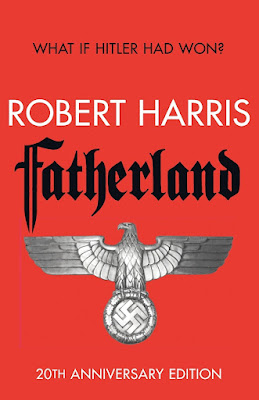
What an awful thought. Hitler resp. the Nazis had won the war. I always say, the Germans didn't lose the war, that were the Nazis. The Germans effectively won the war. In this book (and in various others, like my favourite "The Children's War") we can all see why.
The story itself concentrates on one particular case. A policemen who is not a fan of the Nazis but still has to wear their uniform for his job, tries to find the secret behind a murder. And with that, he could transform the whole world.
We need people like that everywhere, people who don't just blindly follow some dicatators, even if it is an advantage for them.
I think, right now is the right time to read this book again. Right now, where the Right is on the rise in many, many countries. Too many, if you ask me. How can people forget what it was? Even if you haven't lived during the war, most of us haven't, lets be honest. My parents would have been ninety had they still lived. And they were five when the Nazis were elected, so anyone responsible for the regime must be about a hundred. Not many of them alive anymore. But we have to remember what our parents or grandparents told us and see where we are heading if we elect those idiots that tell us the foreigners are our enemies. Nope, those who want to abolish our hard-earned democracy are.
We should all be happy that the war ended the way it did, this book shows us what could have been had it been different.
From the back cover:
"April 1964.
The naked body of an old man floats in a lake on the outskirts of Berlin. In one week it will be Adolf Hitler’s 75th birthday. A terrible conspiracy is starting to unravel…