Showing posts with label Esperanto. Show all posts

Tuesday, 11 January 2022

Top Ten Tuesday ~ Book(ish) Christmas Presents


"Top Ten Tuesday" is an original feature/weekly meme created on the blog "The Broke and the Bookish". This feature was created because they are particularly fond of lists at "The Broke and the Bookish". It is now hosted by Jana from That Artsy Reader Girl.

Since I am just as fond of them as they are, I jump at the chance to share my lists with them! Have a look at their page, there are lots of other bloggers who share their lists here.

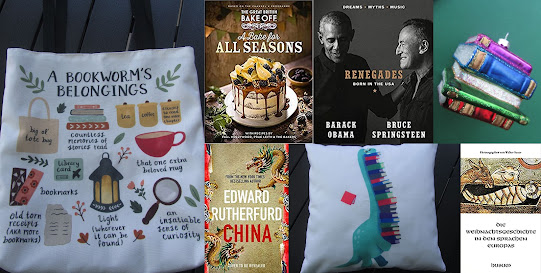
This week, our topic is Most Recent Additions to My Book Collection and I didn't even have to twist that topic as much as usual. I just chose my bookish Christmas presents.

The Bake-Off Team "The Great British Bake Off: A Bake for all Seasons" - 2021 (Goodreads)

Obama, Barack; Springsteen, Bruce "Renegades: Born in the USA" - 2021 (Goodreads)

Rutherfurd, Edward "China" - 2021

Sauer, Walter, Hrsg. "Die Weihnachtsgeschichte in den Sprachen Europas" [The Christmas story in the languages of Europe] - 1995
(Goodreads)

Whilst the first three were on my wishlist, I hadn't even heard of the last one. My brother found it this summer and knew it was the perfect Christmas present for me. And it was. It contains all European languages including e.g. Basque and some languages I had never heard of as well as my native language Lower German and Esperanto. Brilliant.

The non-books among my bookish presents are a large and sturdy tote for all of the "bookworm's belongings" (including a tote, LOL), a pillow with a dinosaur carrying lots and lots of books and a Christmas ornament that went directly on our tree.

The most beautiful Christmas present, however, was that my sons made it home this year.

Monday, 28 September 2020

Sanders, Ella Frances "Lost in Translation


Sanders, Ella Frances "Lost in Translation. An Illustrated Compendium of Untranslatable Words from Around the World" - 2014

I recently read that a linguaphile is a person who loves language and words. They can be interested in many different things such as learning to speak several different languages or simply nerding out about words in general.

I think they definitely go together. You just want everyone to partake in your wisdom you acquired by learning those languages. LOL. I certainly nerd out everyone in my environment and thoroughly enjoy it.

So, a book like "Lost in Translation" is just the right one for me. I saw words I know well like "gezellig" from the Dutch = The feeling of butterflies in your stomach, usually when something romantic or cute takes place. Mind you, the Dutch also use it in the same form as the Danes use "hygge". Or "Kummerspeck" from German, literally meaning "grief-bacon". It's excess weight we gain from emotional overeating. And "Ubuntu", meaning "I find my worth in you, and you find your worth in me." More or less human kindness. While this is a Bantu word and I don't speak that language, I've learned this word through my Esperanto life, just another reason to learn the international language. And "Tsundoku", from the Japanese, which means you leave a book unread after buying it. This, of course, I know because I tend to do that, as well. Another word from my native language you might like is "Kabelsalat", literally "cable salad", it describes a mess of very tangled cables, as one can imagine when one hears the word.

These are just a few of the many interesting words the author has put together and illustrated with her beautiful drawings. A great book for any language nerd.

From the back cover:

"Did you know that there's a Finnish word, PORONKUSEMA, meaning the distance a reindeer can travel before needing to rest?


Or that in Germany they have the very handy KUMMERSPECK: literally, grief-bacon, the weight we gain from emotional overeating?


Ever wished there was a word to convey the time it takes to eat a banana (approximately 2 minutes)? No sweat, in Malay it's PISANZAPRA?


This delightful compendium celebrates the words from across the globe that remains stubbornly - tantalizingly - not quite translatable.
"

P.S.: Don't confuse this with the following, though that is also brilliant:
Croker, Charlie "Løst in Tränšlatioπ. Misadventures in English Abroad" (Lost in Translation) - 2006

Thursday, 20 August 2020

Orth, Stephan "Couchsurfing in Russia"

Orth, Stephan "Couchsurfing in Russia: Friendships and Misadventures Behind Putin’s Curtain" (German: Couchsurfing in Russland. Wie ich fast zum Putin-Versteher wurde) - 2017

I have read two books by Stephan Orth (so far) and this was the first one of those that has been translated.
Initially, for my list, I had translated the title from German into English: "Couchsurfing in Russia. How I almost started to understand Putin".
But, the publishers have decided to give it another title: "Behind Putin's Curtain: Friendships and Misadventures Inside Russia". In the meantime, the author regrets having chosen that original German subtitle because he fears it might lead to misunderstandings.

The author did what thousands of young people do every year (or used to before Covid put a stop to almost anything), he traveled the world through CouchSurfing. It gives people the opportunity to stay at other private homes and get to know the people in the country a lot better than if they went to a hotel. And, of course, it's a lot cheaper. The host also gets his reward, he can learn about other countries without having to travel. I have known this concept since the 1970s when I started to learn Esperanto. We call it Pasporta Servo (Passport Service). I've been hosting many people from different countries that way. It's always a lot of fun.

Anyway, Stephan Orth travels through countries where it isn't easy to travel alone and/or privately, usually both. In this book, he went through Russia, but he's also been to China and Iran.
"Couchsurfing im Iran: Meine Reise hinter verschlossenen Türen" (Couchsurfing in Iran: Revealing a Hidden World/Couchsurfing in Iran: My journey behind closed doors) - 2015
"Couchsurfing in China. Durch die Wohnzimmer der neuen Supermacht" (Couchsurfing in China. Through the living rooms of the new super power) - 2019

This is a brilliant book. It's not the usual travel book where someone lists all the attractions a country can offer. No, it does a lot more, it shows us how ordinary people live in these countries, how they study, earn their money, live. We get to know their lives and their customs. He doesn't just visit the big cities that everyone talks about, he goes to the "outbacks", he visits unusual sites that are still very interesting, even if (or maybe because) they don't attract millions of people.

He has a great writing style. Humorous, witty, informative. It's lovely to follow him around the country in his investigative and unprejudiced way and thereby learning more about this big country than in many history or political books.

From the back cover:

"'In the late summer of 2016,’ writes award-winning travel writer Stephan Orth, ‘a journey to Russia feels like visiting enemy territory. In this humorous and thought-provoking book, Orth ventures through that vast and mysterious territory to uncover the real, unfiltered Russia not seen in today’s headlines: authentic, bizarre, dangerous, and beautiful. Sidestepping the well-trod tourist path, he travels the country from Moscow to Vladivostok - across seven time zones and almost 9,500 kilometres i making stops in Chechnya, Saint Petersburg, Siberia, and beyond. Staying with an eclectic array of hosts, he bumps into gun nuts, internet conspiracy theorists, faux shamans, and Putin fans; learns to drive in death-defying Russian style; and discovers how to cure hangovers by sniffing rye bread. But he also sees a darker side of the country, witnessing firsthand the effects of Putin’s influence in the run-up to the 2016 American election and the power of propaganda in this ‘post-fact’ era. Weaving everything together with thoughtfulness and warmth, Orth follows the acclaimed Couchsurfing in Iran with another complex, funny, and personal travelogue - a colourful portrait of a fascinating and misunderstood country."

Thursday, 9 May 2019

Ondaatje, Michael "Warlight"

Ondaatje, Michael "Warlight" - 2018

"In 1945 our parents went away and left us in the care of two men who may have been criminals."

That's how the novel starts. At the beginning, I had no idea whether I would like it at all and how I would feel about it, there is another quote that I think goes with the feeling I had:

"Mahler put the word schwer beside certain passages in his musical scores. Meaning difficult. Heavy."

I think this was the intention of the author, he wanted us to be just as confused as the protagonists.

So, these two teenagers, Nathaniel and Rachel, are left in the care of a stranger, someone who lived in their house as a lodger for a short while. Their parents are going to Asia. But it's all a little weird, they don't trust the guy, they don't trust the people he brings into his house, they have a strange feeling.

The author manages to convey this strange feeling onto the reader which in itself is a good achievement. And his writing is superb.

Over the next hundred pages, you start to like the protagonist as well as the other characters and get more and more interested in what is going on.

In the end, everything is revealed and it is a highly interesting story. An extraordinary book.

I read "Anil's Ghost" by Michael Ondaatje several years ago. Very different story, just as great a book. And I still haven't read "The English Patient".

One more quote from the book which I have to comment on:
"He spoke French, as well as other languages, though he never referred to this ability.
Perhaps he assumed he would be mocked. There was even a rumour, or was it a joke, that he knew Esperanto, the supposed universal language, which no one spoke."

First, why would anybody mock someone for speaking several languages. I have always only encountered admiration for that.

Second, even before and during the Second World War, there was a huge number of people who spoke Esperanto. Both Stalin and Hitler did not like that very much as it enables more people to talk to foreigners. They not only forbid it but several of the speakers ended up in concentration camps and/or were killed. That led to a decrease of speakers after the war but in the meantime, numbers have grown again. I know thousands of people who speak it, including myself. But, of course, there are probably still people around who believe that nobody knows it and it's not good for anything whereas, in reality, it is a great language to know which enables you to communicate with people all over the world, now more than ever.

From the back cover:

"In a story as shadowed and luminous as memory itself, Warlight sets the careless freedom of adolescence against the turmoil of post-war England.  It is 1945, and London is recovering from the years of war.  Fourteen-year-old Nathaniel and his sister, Rachel, unexpectedly abandoned by their parents, are left in the care of an enigmatic figure named The Moth.  They suspect he might be a criminal, and grow both more convinced and less concerned as they get to know his eccentric crew of friends: men and women with a shared history, who seem determined to protect, and educate (in rather unusual ways), Nathaniel and Rachel.  But are they really what and who they claim to be?

Caught up in the escapades of youth and first love, Nathaniel ignores the uncertain signs of danger.  A dozen years later, he sets out to piece together - as much through recollection and imagining as through the truths he uncovers - all he didn’t know or understand in that times: a journey that will draw him in to a morally ambivalent, secret world."

Monday, 21 November 2016

Štimec, Spomenka "Croatian War Nocturnal"

Štimec, Spomenka "Croatian War Nocturnal" (Kroata Milita Noktlibro) - 1993

This is not just the diary of a girl who speaks Esperanto about her life during the Balkan wars, her life and that of her family and friends, and often about their deaths, as well. It is a view into life during wartime. Snippets of several lives that are affected that build a big picture together.

I bought this book because it was written in Esperanto but there are several translations available, i.a. in English. The title is a word play. Day-book is the Esperanto word for diary (same as in many other languages) but because she wrote this mainly during the night, she calls it her night-book. She had to type it in the bathroom because it was the only room in the house without a window where she could use light at night - whenever they had some.

I doubt that this book is available in a normal bookshop but if you can find it, it is totally worth reading. * It is a story about how from one minute to another, love can turn to hate, how you can more or less be "given" an enemy. Neighbours and friends turn against each other all of a sudden because you don't belong to the same group as they do. What a nightmare! And you know what? I see this happening all the time and I'm afraid if someone is given the chance, they will do what the politicians in former Yugoslavia have done and start a civil war or an even greater one. We all need to stick together because in the end, we are all the same. None of us is better or worse than someone else because of where we come from.

I therefore hope, that everyone will follow the words of one of the widows in the story whose speech at her husband's funeral is on the back cover:

"Friends, relatives, neighbours, colleagues - now is the time to end the hate. It does not matter who started first and how often. I do not feel anger against anyone because my husband was killed. But stop! For the mortal remains of my husband, I beg you - forgive and forget all open bills! Let us go forward. Do not let our children and grandchildren fight against each other again. Whether this happens depends on us. Let us do what is in our power. Let us be the beginning of peace, of which everyone is talking."

Books she mentions:
Krleža, Miroslav "Croatian God Mars" (Hrvatski bog Mars) - 1922
Zamenhof, Ludwig L. "Call to the Diplomats" (Post la randa milito - Alvoko al diplomatoj) - 1915
Auld, William "The Infant Race" (La infana raso) - 1956

* The book has been published in English in the meantime, see my link to Goodreads. (as always also through the picture)

Thursday, 9 August 2012

Gao, Xingjian "Soul Mountain"

 
Gao, Xingjian "Soul Mountain" (Chinese: 灵山, língshān) – 1989

An extraordinary book. A biography, a search for someone's soul in a world where the individual means nothing. A collection of stories from the now to the past, jumping to and fro but after a while, you get the hang of it. An introduction to the characters that are "I" and "you", "he", and "she" but they all seem to intermingle. A story about a traveler who discovers his own country and thereby discovers himself. And on the side, he introduces the reader to a lot of Chinese culture, religion, politics and history as well as his own story, the story of his father, his ancestors.

I also liked his insight into many problems that are out of his way, you would think he has other problems of his own to think about but, no, he comes up with quotes like "...when people assault nature [sic] nature inevitably takes revenge." or "... nature is not frightening, it's people who are frightening!"

One of my favourite passages: "I am perpetually searching for meaning, but what in fact is meaning? Can I stop people from constructing this big dam as an epitaph for the annihilation of their selves? I can only search for the self of the I who is small and insignificant like a grain of sand. I may as well write a book on the human self without worrying whether it will be published. But then of what consequence is it whether one book more, or one book less, is written? Hasn't enough culture been destroyed? Does humankind need so much culture? And moreover, what is culture?"

And then, as an Esperanto speaker myself, I love it when I find my language in a book: "He had a deep voice and could sing L'Internationale in Esperanto."

This is certainly not an easy read, something you read on the side to hear a "nice story". The author challenges you to try to understand his ways, his culture's ways. And by accompanying him on his search for Soul Mountain at the source of the You River, you can find a lot about yourself, as well.

See more comments on my ThrowbackThursday post in 2025.

From the back cover:

" In 1983, Chinese playwright, critic, fiction writer, and painter Gao Xingjian was diagnosed with lung cancer and faced imminent death. But six weeks later, a second examination revealed there was no cancer -- he had won 'a reprieve from death'. Faced with a repressive cultural environment and the threat of a spell in a prison farm, Gao fled Beijing and began a journey of 15,000 kilometers into the remote mountains and ancient forests of Sichuan in southwest China. The result of this epic voyage of discovery is Soul Mountain.

Bold, lyrical, and prodigious, Soul Mountain probes the human soul with an uncommon directness and candor and delights in the freedom of the imagination to expand the notion of the individual self."

Xingjian Gao received the Nobel Prize for Literature in 2000 "for an oeuvre of universal validity, bitter insights and linguistic ingenuity, which has opened new paths for the Chinese novel and drama".

I contribute to this page: Read the Nobels and you can find all my blogs about Nobel Prize winning authors and their books here.

Friday, 27 July 2012

Esperanto

Esperanto celebrated its 125th birthday on 26 July 2012.

This is a good reason to have a list with many links to interesting Esperanto pages. I will update this post regularly. So, wait for more.

Lots of information about Esperanto
How to learn Esperanto - in many languages
Dr. Zamenhof created the international language - Esperanto
BBC Radio 4 feature about Esperanto
Esperanto on Wikipedia
The International Language - Esperanto
How is Esperanto easier to learn than other languages
Kontakto - Esperanto magazine
Personal Stories - why people learn and speak Esperanto
Duoblilo - Allows you to type texts with Esperanto signs without having to use ASCII codes all the time.

German article "Das Linux der Sprachen" (The Linux of the Languages)
Esperanto article "Mondlingvo por malmultaj" (World Language for a few)

Songbook from the Esperanto Scouts - Kantlibro de la Skolta Esperanto Ligo

Series about Esperanto
Part 1 - Esperanto is a language you can use for everything
Part 2 - Esperanto is a language with many traits
Part 3 - Esperanto is a language used in many ways
Part 4A - Esperanto is a language everybody can and should learn
Part 4B - Esperanto is a language everybody can and should learn
Part 5 - Esperanto is a language associated with a colourful movement
Part 6 - Esperanto is the language of the future

Thursday, 5 January 2012

Löwenstein, Anna "The Stone City"

Löwenstein, Anna "The Stone City" (Esperanto: La Ŝtona Urbo) - 1999

I love historical novels, this book appeared in Esperanto, I even know the author, so, of course, I had to read this book. Granted, I usually prefer to read books in the original but since this one has been translated by the author herself and I know how perfect her Esperanto is, I gave it a try. And have not been disappointed.

A gripping story that exists in three parts and every single one is just as exciting as the other ones. A young girl, Bivana, grows up in Britain in the first century. We learn a lot about the lifestyle of this Celtic people. The Romans arrive and capture her. She is transported to a place outside of Rome and has to work as a slave. Again, a great description of life in a Roman villa and the fate of Barbara, how the Romans call our heroine, and various other slaves. The last part is in Rome itself where we see the first steps of Europe into Christianity. Incredible how much the author managed to put into one book, there is so much material, it certainly could have been three books. But I am glad this was all united in one.

If you can get a hold of this book, it is definitely worth reading.

See more comments on my ThrowbackThursday post in 2024.

From the back cover:

"Snatched from her peaceful homestead in Celtic Britain, Bivana is transported to the legendary city of Rome. Struggling to come to terms with the loss of everyone and everything she has ever known, but determined to survive, she slowly adapts to a life of slavery and to the alien culture which surrounds her. Her relationship with the slave Philon seems to promise a fresh start, but it also brings her into contact with the Nazarenes, activists in a fanatical new religious movement. When her own family is drawn into a clash with the authorities, she is forced to draw on all her resources to save them. --- Since its first publication in 1999, 'The Stone City' has become well known and loved in its Esperanto translation, and has been translated by fans into French and Hungarian. This revised edition of the original English version includes several additional scenes."

Visit the author's website here.

Friday, 22 April 2011

Interesting Links

The web is full of interesting links, links to books I read, links to subjects covered in the books I read, links to subjects not covered in the books I read. Some are helpful, some are interesting, some are just funny.

I would like to share some of those links that interest me, hopefully they will be interesting for some of you, too.


Everything about books
"Ten best bookshops in the world" - nice page about some great bookshops
"Tien beste bookhandels/mooiste ter wereld" - and another one in Dutch (but the shops are also all over the world.
And here some interesting bookshelves.
The Book Surgeon - what one person can do with books.
Best Sellers the week you were born
Bookmans does dominoes
Did you know the BOOK?

For a better world
Half the Sky - How women can get help all over the world
A Walk to Beautiful - a fascinating movie about how Ethiopian women get help
The Girl Effect - how a twelve year old girl could be the solution to what the world needs now.
The Kindness Movement - it started with a small idea

Languages
"Third Culture Kids" - a helpful site for everyone who raises their children abroad or who grew up in a different country from their parents.
Bilinguals see the world in a different way - an article about the studies to this .
The English Spelling Society - Spelling Poems
The worst language I've ever seen
Top list of the Hardest Languages to learn

Esperanto
You will find a lot of information about Esperanto in my Esperanto List.

Health
"The Spoon Theory" - someone with a chronic disease explains how it feels to someone who is always healthy.
How to understand someone with Chronic Pain
There are more links about migraine in my list "Migraine Books and Links".

My talented friends:
The Artwork of Ardith Goodwin
Hanka and Frank Koebsch 

Other Art Pages

Other topics
The True Size of Africa
Learn Morse Code
Evolution - a video all girls (and boys) should see

Some fun
London Underground Anagram Map
Cheap Flights by Fascinating Aida - great explanation how we end up paying a lot anyway
Axis of Awesome - 4 Chord Song
The Perils of Voice Recognition Technology