Showing posts with label History. Show all posts

Monday, 18 May 2026

Grann, David "The Wager: A Tale of Shipwreck, Mutiny and Murder" - 2023

Grann, David "The Wager: A Tale of Shipwreck, Mutiny and Murder" - 2023

What an interesting story. Not just because of what happened with this ship in particular but about life on a ship at the time. I have read a few books about voyages on a boat (e.g. Master and Commander) and they are always interesting. This one is about life during a war on a ship, a shipwreck, a mutiny. This is the background to many novels we read from that time where there are sailors, I think especially about stories by Jane Austen whose brothers were sailors and who included seafaring men as well as the clergy (which represented her father and a brother) in most of her books. This book adds to those stories.

So, if you want to know more about the life on those vessels, this is the book for you.

Oh, did I mention that this is based on a true story?

Book Description:

"A page-turning story of shipwreck, survival, and savagery, culminating in a court martial that reveals a shocking truth. The powerful narrative reveals the deeper meaning of the events on the Wager, showing that it was not only the captain and crew who ended up on trial, but the very idea of empire.

On January 28, 1742, a ramshackle vessel of patched-together wood and cloth washed up on the coast of Brazil. Inside were thirty emaciated men, barely alive, and they had an extraordinary tale to tell. They were survivors of His Majesty's Ship the Wager, a British vessel that had left England in 1740 on a secret mission during an imperial war with Spain. While the Wager had been chasing a Spanish treasure-filled galleon known as 'the prize of all the oceans,' it had wrecked on a desolate island off the coast of Patagonia. The men, after being marooned for months and facing starvation, built the flimsy craft and sailed for more than a hundred days, traversing nearly 3,000 miles of storm-wracked seas. They were greeted as heroes.

But then . . . six months later, another, even more decrepit craft landed on the coast of Chile. This boat contained just three castaways, and they told a very different story. The thirty sailors who landed in Brazil were not heroes - they were mutineers. The first group responded with countercharges of their own, of a tyrannical and murderous senior officer and his henchmen. It became clear that while stranded on the island the crew had fallen into anarchy, with warring factions fighting for dominion over the barren wilderness. As accusations of treachery and murder flew, the Admiralty convened a court martial to determine who was telling the truth. The stakes were life-and-death--for whomever the court found guilty could hang.

The Wager is a grand tale of human behavior at the extremes told by one of our greatest nonfiction writers. Grann's recreation of the hidden world on a British warship rivals the work of Patrick O'Brian, his portrayal of the castaways' desperate straits stands up to the classics of survival writing such as The Endurance, and his account of the court martial has the savvy of a Scott Turow thriller. As always with Grann's work, the incredible twists of the narrative hold the reader spellbound."

Tuesday, 24 February 2026

Lanschot, Reinier van "We are Europe"

Lanschot, Reinier van "We are Europe" (Dutch: Wij zijn Europa: een nieuw Europees verhaal) - 2024

A Christmas present from one of my sons. One of his bosses had written a book about Europe. History. Present. Problems. Future.

I grew up in the middle of Europe with the European Economic Community. We had the same age. I saw a lot of controversy. Many people who were against it. Especially the farmers in our area though a lot of them benefitted from the butter mountain and other agricultural grants. I also lived in England while they were members of the EU and heard a lot of negativity there, they take away our measurements etc. The same moaning in both countries, we pay more into the community than we get out.

But do we really? I never believed that story because I know how much our market grew, I could see how we all participated in the prosperity.

Reinier van Lanschot observes this very well. He is the next generation and he gives us hope. As long as there are people like him who work toward a better future, who understand the problems and try to find solutions, so long we can have hope. The right wingers shout louder but I grew up with the conviction "He who shouts the loudest is in the wrong". And that's always right.

The EU is our biggest hope against nationalism, racism and all the other -isms who think they are better than others because … usually no reason at all, they just made one up.

There are a lot of facts in this book that tell us what has led to some events like Brexit but many stories that have to convince us that Europe is the only hope for the future.

I can only recommend this book to anyone who has the slightest interest in Europe and needs good points to convince others.

P.S. In his acknowledgements, the author also mentions Geert Mak, one of my favourite Dutch authors who has written a lot of great non-fiction books about our century, his country and Europe. And quite a few of his books have been translated into English. Try them, he is great.

Some quotes:

"When death and decline are all around and there appears to be no light left, this is frequently when the most brilliant plans emerge. And it is also when the strength to carry them out becomes possible." Mathieu Segers
The author says: "This was exactly the context in which European cooperation was born. After the devastation of the Second World War, Europe found itself in a precarious position."

On the Peace of Augsburg in 1555:
"This treaty introduced the principle of cuius regio, euius religion ('whose realm, his religion') granting rulters the authority to determine the official faith of their territories."

In German, we have a saying "Wes Brot ich ess, des Lied ich sing". (He whose bread I eat, his song I sing.) The Dutch say the same "Wiens brood men eet, diens woord men spreekt". That's about the same as "He who pays the piper calls the tune."

To explore how the EU affects your daily life, region, or interests, it is well worth visiting the webiste called What Europe Does For Me.
This is a good site that especially anyone who is against the EU should read.

From the back cover:

"We are living in a time of profound change. In Brussels, decisions are made every day that affect the lives of 450 million Europeans and shape the wider world. European cooperation is unique, far-reaching, and remarkably successful. Yet that story is rarely told in our national media or in everyday conversations.

In 'We Are Europe', Reinier van Lanschot takes readerson a journey across the continent. With historical perspective and vivid anecdotes, he reveals the real story behind European cooperation, its bold achievements and its serious shortcomings.

Van Lanschot does not shy away from Europe’s flaws. By examining today’s greatest challenges, he exposes the weaknesses of the current system and argues for the fundamental changes needed to safeguard our future. What emerges is a clear and hopeful vision for a renewed European project.

This book is both a wake-up call and an invitation: to recognise that Europe is not something distant, but something we all shape. Because the truth is simple – we are Europe."

Tuesday, 10 February 2026

Austen, Jane "The History of England"

Austen, Jane "The History of England: By a Partial, Prejudiced and Ignorant Historian" - 1791

This was the last of my Jane Austen reads in 2025, the #Reading Austen project.

The booklet has 55 pages, very small ones. Yet, only 18 of them are about the History of English, the rest of the book is taken up by the correspondence between (mainly) two girls at the beginning of the 19th century, a short story called Lesley Castle.

I really enjoyed the first part. It was interesting to read how the kings and queens of England were seen by a partial and prejudiced person. Jane like the York and hated the Lancastrians, so anything they did were seen through her rose- or black-tinted glasses. Hilarious, though, and not necessarily to be taken seriously. 

Also the second part has its hilarious moments. Like when women are judged by their height and being tall is supposed to be a fault. Just read it, it doesn't take long.

Book Description:

"'The History of England', written when Jane Austen was in her late teens, is a lively and somewhat disrespectful overview of the history of England's monarchy. She sees nothing reprehensible in Richard III, yet burns with contempt for Elizabeth I, and documents several reigns with breezy nonchalance.

This volume also contains 'Lesley Castle', a delightful and often hilarious correspondence detailing the mishaps and misapprehensions that befall five young ladies."

Wednesday, 29 October 2025

Adkins, Roy & Lesley "Eavesdropping on Jane Austen's England"

Adkins, Roy & Lesley "Eavesdropping on Jane Austen's England: How our ancestors lived two centuries ago" (aka "Jane Austen's England) - 2013

Part of my #Reading Austen project is to read a book by the author in the uneven months and a book about the author and/or her books in the even ones. This is my October read.

And it was a very interesting and detailed book. We get several maps right at the beginning where we cannot just see where Jane Austen lived during her lifetime but also some other contemporary characters with a similar background. Something that always adds to the explanations in any book, fiction or non-fiction.

But it's not only that. They explain how the pounds, shillings and pennies were divided, how the weights and measurements were calculated, all those nitty-gritty bits that are in the books of that time but not explained because the readers would have known what it was. The same as what it meant when someone had £10,000 pounds a year. 

They tell us everything about weddings at the time, about the aristocracy and who was who, education was as much talked about as what was going on in home and kitchen. The fashion of the time (of which we read a lot in Jane's books) is described, the religion, work and hobbies, crimes, illnesses, just everything that was important to the people of the 19th century.

So, if you want to know more about Jane's life, this is the book for you.

From the back cover:

"Jane Austen, arguably the greatest novelist of the English language, lived from 1775 to 1817. Her fiction focuses on the gentry and aristocracy, and her heroines are young women looking for love. Yet the comfortable, tranquil country that she brilliantly devised is a complete contrast to the England in which she actually lived. For twenty-nine of Jane Austen's forty-one years, the country was embroiled in war.

Eavesdropping on Jane Austen's England explores the real England of that time. Roy and Lesley Adkins vividly portray fascinating aspects of the daily lives of ordinary people, from forced marriages and the sale of wives in marketplaces to boys and girls working down mines or as chimney sweeps, this book eavesdrops on the daily chore of fetching water, the horror of ghosts and witches, Saint Monday, bull baiting, sedan chairs, highwaymen, the stench of corpses swinging on roadside gibbets and the horrors of surgery without anaesthetics.

Giving a voice to these forgotten people and revealing how they worked, played and struggled to survive, Eavesdropping on Jane Austen's England is an authoritative and gripping account that is sometimes humorous, often shocking, but always entertaining."

Monday, 18 August 2025

Sullivan, Margaret C. "The Jane Austen Handbook"

Sullivan, Margaret C. "The Jane Austen Handbook. A Sensible Yet Elegant Guide to Her World" - 2007

Part of my #Reading Austen project is to read a book by the author in the uneven months and a book about the author and/or her books in the even ones. This month, it was a book about her time with a lot of background information to why some characters acted the way they did. There were a lot of lovely illustrations and even more funny allusions to the novels.

I can heartily recommend this little book to any Jane Austen fan. Whether you have read her books or watched them on TV or in the cinemas (hopefully both), you will be delighted by this. And if time travelling was a thing, you could even learn how to behave in Regency times without anyone noticing you're from the future.

From the back cover:

"Jane Austen published her first novel in 1811, but today she's more popular than ever. Film adaptations of her books are nominated for Academy Awards. Chick lit bestsellers are based on her plots. And a new biopic of Austen herself Becoming Jane arrives in theaters this spring.

For all those readers who dream about living in Regency England, The Jane Austen Handbook offers step-by-step instructions for proper comportment in the early nineteenth century. You'll discover:

How to Become an Accomplished Lady
How to Run a Great House
How to Indicate Interest in a Gentleman Without Seeming Forward
How to Throw a Dinner Party
How to Choose and Buy Clothing

Full of practical directions for navigating the travails of Regency life, this charming illustrated book also serves as a companion for present-day readers, explaining the English class system, currency, dress, and the nuances of graceful living."

Monday, 11 August 2025

Pierce, Patricia "Jurassic Mary"

Pierce, Patricia "Jurassic Mary: Mary Anning and the primeval monsters" - 2006

Ever since I read "Remarkable Creatures" by Tracy Chevalier, I've been interested in the life of Mary Anning who lived from 1799 to 1847 and was the first person who discovered dinosaur bones.

And this was on my wishlist, so my son bought it for me. It was just as nice as I had hoped.

A thorough account of the life of a young girl who would become one of the most important figure in discovering dinosaurs. But, because she was only a woman, she didn't have a lot to say. Even though there were some men who acknowledged her, most of them only used her findings for their won. She didn't really get any recognition. What else is new?

From the back cover:

"Spinster Mary Anning, uneducated and poor, was of the wrong sex, wrong class and wrong religion, but fate decreed that she was exactly the right person in the right place and time to pioneer the emerging science of palaeontology, the study of fossils. Born in Lyme Regis in 1799, Mary learned to collect fossils with her cabinet-maker father. The unstable cliffs and stealthy sea made the task dangerous but after her father died the sale of fossils sustained her family. Mary’s fame started as an infant when she survived a lightning strike that killed the three adults around her. Then, aged twelve, she caught the public’s attention when she unearthed the skeleton of a ‘fish lizard’ or Ichthyosaurus. She later found the first Plesiosaurus giganteus, with its extraordinary long neck associated with the Loch Ness monster, and, dramatically, she unearthed the first, still rare, Dimorphodon macronyx, a frightening ‘flying dragon’ with hand claws and teeth.Yet her many discoveries were announced to the world by male geologists like the irrepressible William Buckland and Sir Henry De La Beche and they often received the credit. In Jurassic Mary Patricia Pierce redresses this imbalance, bringing to life the extraordinary, little-known story of this determined and pioneering woman."

Monday, 12 May 2025

Kishon, Ephraim "So sorry we won"

Kishon, Ephraim "So sorry we won" (Pardon, wir haben gewonnen. Vom Sechstagekrieg bis zur Siegesparade ein Jahr danach) - 1967

This book was written in 1967, shortly after the Six-Day War. What would Kishon say about the situation today? Much of it is no longer understandable from today's perspective.

In any case, this is not a typical Kishon book. There's no humour. He doesn't make fun of his fellow sufferers, compatriots, family, or anyone else. He tries to see his country from the perspective of a war won. If that interests you, read this book.

From the back cover:

"This book features the satires of Ephraim Kishon and the cartoons of Kariel Gardosh (Dosh), most of which were published in Ma'ariv as comments on the Six-Day war and under its influence. They are now collected in this anthology in their original form."

Monday, 28 April 2025

Mak, Geert "The Dream of Europe"

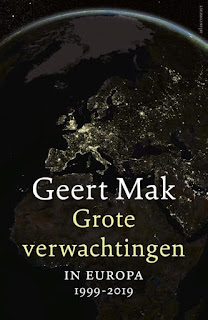
Mak, Geert "The Dream of Europe. Travels in a Troubled Continent" (Dutch: Grote verwachtingen. In Europa 1999-2019) - 2019

This book was a present by my son for Christmas. While I usually try to read Dutch books in Dutch, this was an English edition. In the end, I was not unhappy about that because now I can pass it on to my sons. They both speak Dutch but wouldn't read such a large book in that language.

I have read a few book by this fantastic journalist and author. All of them having to do with the changes of our continent in modern times. Totally interesting and very well examined and described.

He wrote this book six years ago and he predicted many events that are true today. That shows how well he observes. This can be seen as a follow-up to "In Europe. Travels through the Twentieth Century". A very-well deserved and very well executed follow-up. His observations about the first twenty years of our century are shocking and frightening. We should listen what he has to say about the future.

And here are some important quotes (from many):

"I wrote Enraged Citizens to show how it ought to be. The Capital (Die Hauptstadt)  is what it actually is." Robert Menasse

"But let all those idiots gather together in politics without sufficient resistance of any kind and you get a dictatorship of idiocy". Jacques de Kadt, Dutch essayist, in 1936

"He [one of the Republican candidates in 2015] lacked even the most basic respect for facts, institutions and democratic principles. To him, political opponents were enemies, a compromise was not a dignified agreement but a capitulation …" Doesn’t that apply to all of them???

From the back cover:

'Mak is the history teacher everyone should have had' Financial Times

How did the great European dream turn sour? And where do we go from here? From the author of the internationally acclaimed In Europe, a stunning history of our present,examining the first two decades of this most fragile and fraught new millennium. The great European project was built out of a common desire for peace, prosperity and freedom; a wish for a united Europe striving towards a common goal. The EU was to set an an arena for close cooperation, tackling crucial shared concerns from climate change to organized crime, promoting open borders and social security. But the first two turbulent decades of this century have been times of rapid and profound change. From the shores of Lampedusa to Putin's Moscow, the continent threatens to tear itself apart. What's happened to Europe's optimism and euphoria? How has it given way to nostalgia, frustration and fear, the fragile European dream in danger of turning into a nightmare?

In The Dream of Europe, Geert Mak, one of Europe's best-loved commentators, charts the seismic events that have shaped people's lives over the past twenty years. Mak's monumental book In Europe defined the continent on the verge of a new millennium. The Dream of Europe brings us up to the present day, through the rocky expansion of the EU, the aftermath of 9/11 and terrorist attacks across Europe, the 2008 financial crash and the euro crisis, the tragedy of the migrant crisis in the Mediterranean, the rise of right-wing populism and Brexit.

Like no other, Mak blends history, politics and culture with the stories and experiences of the many Europeans he meets on his travels. He brings this continent to life, and asks what role does Europe play now, and how might we face our challenges together, in the spirit of solidarity and connection.

'A powerful, humane and serious mind' Guardian

'Mak is a truly cosmopolitan chronicler' Independent"

Wednesday, 28 August 2024

Garfield, Simon "To the Letter: A Curious History of Correspondence - A Celebration of the Lost Art of Letter Writing"

Garfield, Simon "To the Letter: A Curious History of Correspondence - A Celebration of the Lost Art of Letter Writing" - 2013

I read a book by Simon Garfield a couple of years ago: "On the Map. Why the World Looks the Way it Does".

I really loved it. And since I love letters just as much as I love maps, I just had to get this one.

It is an interesting book about the development of letters, how they came into existence in the first place, how they changed over the centuries, what they mean today in a world of e-mails and phone messages.

I used to be a keen letter writer and was really looking forward to this book. And though it is a good survey into the habit of letter writing and contained some nice anecdotes, I found it a little boring at times. I don't mind jumping around in a story but this was all a little too haphazardly.

That might have been one of the reasons why I didn't read this in one go, I just couldn't get my head around his structure.

Also, he mentions a lot of authors and books in his work, a table of contents would have been nice.

I still like writing letters.

A nice quote:

"Today is the tomorrow we worried about yesterday."

He also mentions a letter subscripion where you receive an actual letter by one of your favourite authors twice a month. It still exists and you can find all about it here at "The Rumpus". I couldn't find out whether they also send something abroad but there are quite a few US readers here, so maybe something for them.

From the back cover:

"To the Letter tells the story of our remarkable journey through the mail. From Roman wood chips discovered near Hadrian's Wall to the wonders and terrors of email, Simon Garfield explores how we have written to each other over the centuries and what our letters reveal about our lives.

Along the way he delves into the great correspondences of our time, from Cicero and Petrarch to Jane Austen and Ted Hughes (and John Keats, Virginia Woolf, Jack Kerouac, Anaïs Nin and Charles Schulz), and traces the very particular advice offered by bestselling letter-writing manuals. He uncovers a host of engaging stories, including the tricky history of the opening greeting, the ideal ingredients for invisible ink, and the sad saga of the dead letter office. As the book unfolds, so does the story of a moving wartime correspondence that shows how letters can change the course of life.

To the Letter is a wonderful celebration of letters in every form, and a passionate rallying cry to keep writing."

Thursday, 18 April 2024

Orwell, George "The Road to Wigan Pier"

Orwell, George "The Road to Wigan Pier" - 1937

I read this for the "1937 Club".

I have read a few books by George Orwell already and they were all highly interesting. This one started off a little tedious, many numbers that would have been easier to understand had they been converted to today's currencies or at least given the money in context. How am I supposed to know how much 15s. or 3s. 6d. are? How much do people have to pay for a piece of bread? How much does a good earner receive?

But the book improves after the author goes on to mention the conditions under which people live.
We are in the year 1937. A year that was very important. As another blogger wrote: "A LOT of good writing came out of the 30's. Turbulent times tend to do that...." (see here, thanks Cyberkitten)

And yes, we have similar turbulent times again and if we don't pay attention, history might repeat itself.

A quote from the book:
"They [Socialists] have never made it sufficiently clear that the essential aims of Socialism are justice and liberty. With their eyes glued to economic facts, they have proceeded on the assumption that man has no soul, and explicitly or implicitly they have set up the goal of a materialistic Utopia. As a result Fascism has been able to play upon every instinct that revolts against hedonism and a cheap conception of ‘progress’. It has been able to pose as the upholder of the European tradition, and to appeal to Christian belief, to patriotism, and to the military virtues. It is far worse than useless to write Fascism off as 'mass sadism', or some easy phrase of that kind. If you pretend that it is merely an aberration which will presently pass off of its own accord, you are dreaming a dream from which you will awake when somebody coshes you with a rubber truncheon."

We shouldn't forget these famous words by Martin Niemöller.
"First they came for the socialists, and I did not speak out - because I was not a socialist.
Then they came for the trade unionists, and I did not speak out - because I was not a trade unionist.
Then they came for the Jews, and I did not speak out - because I was not a Jew.
Then they came for me - and there was no one left to speak for me.
"
If we don't pay attention, we will be there again. And sooner than we would like to think.

From the back cover:

"In the 1930s, commissioned by a left-wing book club, Orwell went to the industrial areas of northern England to investigate and record the real situation of the working class. Orwell did more than just investigate; he went down to the deepest part of the mine, lived in dilapidated and filthy workers' houses, and used the tip of his pen to vividly reveal every aspect of the coal miners' lives. Reading today, 80 years later, Still shockingly true. The despair and poverty conveyed by this picture have a terrifying power that transcends time and national boundaries. At the same time, the Road to Wigan Pier is also Orwell's road to socialism as he examines his own inner self. Born in the British middle class, he recalled how he gradually began to doubt and then hate the strict class barriers that divided British society at that time. Because in his mind, socialism ultimately means only one concept: 'justice and freedom.'"


Monday, 8 April 2024

Tomalin, Claire "Jane Austen - A Life"

Tomalin, Claire "Jane Austen - A Life" - 1997

Jane Austen is one of my favourite authors. I have read all her novels, even the ones she didn't finish, some letters and short stories, so: a lot about her.

Claire Tomalin is a British journalist and biographer. She has a good reputation, especially for her biographies.

After reading this book, I understand why. I think she put together whatever is known about Jane Austen and her life, her family, her works, her illness, her death, anything. And she also tells us a lot about the era the author lived in, how female authors were regarded, how women were regarded, how people lived. You just have the feeling you lived with them.

We also get to see many of her writings, not all the letters as a whole but many excerpts that give us a glimpse of the author's life.

It's a shame Jane Austen was not able to write more books but this is a good supplement to her literature.

From the back cover:

"At her death in 1817, Jane Austen left the world six of the most beloved novels written in English - but her shortsighted family destroyed the bulk of her letters; and if she kept any diaries, they did not survive her.  Now acclaimed biographer Claire Tomalin has filled the gaps in the record, creating a remarkably fresh and convincing portrait of the woman and the writer.

While most Austen biographers have accepted the assertion of Jane's brother Henry that '
My dear Sister's life was not a life of events,' Tomalin shows that, on the contrary, Austen's brief life was fraught with upheaval.  Tomalin provides detailed and absorbing accounts of Austen's ill-fated love for a young Irishman, her frequent travels and extended visits to London, her close friendship with a worldly cousin whose French husband met his death on the guillotine, her brothers' naval service in the Napoleonic wars and in the colonies, and thus shatters the myth of Jane Austen as a sheltered and homebound spinster whose knowledge of the world was limited to the view from a Hampshire village."

Wednesday, 20 March 2024

Dorling Kindersley "Brussels"

Dorling Kindersley (Hewetson, Zöe) "Brussels. Bruges, Ghent & Antwerp" - 2000
A Dorling Kindersley Travel Guide

One of the DK Travel Guides I have used frequently. Brussels is my favourite city. I have lived there. I have met my husband there. We have been going more than once every year since we moved away and now our youngest son lives there, right in the area where my husband and I met.

I love the Eyewitness Guides and also their little sister, The Travel Guides. Even if you are not able to visit a city (or a country), you can see exactly what it looks like and get a lot of information about the town, the people, the buildings, the parks, the museums, the food, just about everything you would like to know about a certain place.

The guide is divided into the areas of the city: the Lower Town, the Upper Town, Greater Brussels, Beyond Brussels, it gives you all the information a traveller needs: Where to stay, restaurants, cafés and bars, Shopping in Brussels, there is a survival guide with practical and travel information, everything you need to know.

Brussels is such a beautiful city with so many historic places, it's hard to know where to begin. A must is definitely the Grand Place with all its picturesque guild houses. You certainly can't miss this. It's beautiful to sit in one of the restaurants and observe the bustling life around you. But we usually just have a coffee there and go for dinner in one of the cheaper places just off the market or in another quarter, the food is so much better, as well.

In every even year, there is a flower carpet on the Grand Place, always around Assumption Day (of Mary, 15 August), a national holiday in Belgium.

One place we visit almost every time is the Cinquantenaire which is close by my old living place. There's a beautiful parc and a palace built by Leopold II on the occasion of the fiftieth anniversary (cinquantenaire) of Belgium. Him being German, he based the memorial arcade on the Brandenburg Gate but it also looks like the Arc de Triomphe in Paris.

Then there's the Quartier Royal with its Royal Palace and the Parc de Bruxelles, one of the most beautiful parcs you can imagine. And, of course, lots of wonderful museums for anyone interested in art and history. The palace is open to the public in the summer. Definitely worth another visit.

And there are places you should visit, if you happen to be in Brussels for longer or at a certain time. First of all, the symbol of Brussels, the Atomium, originally constructed as the centrepiece of the 1958 Brussels World's Fair (Expo 58). Definitely worth it, especially since its renovation about two decades ago. Six of the spheres are accessible to the public and they show permanent as well as temporary exhibitions on the 50s, the Expo, the construction as well as modern art or anything of current interest.

Then there are the Royal Greenhouses of Laeken which are open to the public once a year for two weeks in April/May.

You can also do tours around Brussels to admire the Art Nouveau houses, doors, windows, entrances (you can get a cheap map at the info centre at the Grand Place). There is also such a map for all the comic related street art. Tintin and his friends are all over the place. And if you arrive at the Gare Central (central station) and leave the place, don't forget to look up when you pass under the passage of the Putterie.

Brussels also has beautiful metro stations, a ride on the metro is always interesting.

There is so much more to see that it is impossible to write in just one post. You will have to go and see for yourself why I love this town so much.

Of course, all the other cities mentioned in the title and the book are also very much worth visiting.

Book description:

"Highlights Lower Town, Upper Town, Greater Brussels, as well as sited beyond the city.

Recognized the world over by frequent flyers and armchair travelers alike, Eyewitness Travel Guides are the most colorful and comprehensive guides on the market. With beautiful commissioned photographs and spectacular 3-D aerial views revealing the charm of each destination, these amazing travel guides show what others only tell.

'
DK Eyewitness Travel Guide: Brussels, Bruges, Ghent & Antwerp' is your indispensable guide to this beautiful part of the world. The fully updated guide includes unique cutaways, floor plans and reconstructions of the must-see sights, plus street-by-street maps. The also is packed with photographs and illustrations leading you straight to the best attractions these cities offer.

With insider tips and essential local information, this uniquely visual DK Eyewitness Travel guide highlights everything you'll need to know to make your vacation special, from local festivals and markets to day trips around the countryside. Detailed listings will guide you to the best hotels, restaurants, bars, and shops for all budgets, while practical information will help you to get around by train, bus, or car.


'DK Eyewitness Travel Guide: Brussels, Bruges, Ghent & Antwerp' will help you effortlessly explore every corner of Brussels, Bruges, Ghent & Antwerp."

Thursday, 15 February 2024

Uusma, Bea "The Expedition"


Uusma, Bea "The Expedition: a Love Story: Solving the Mystery of a Polar Tragedy" (Swedish: Expeditionen: min kärlekshistoria) - 2013

This was our international online book club book for January 2024.

We don't read many non-fiction books in our online book club, so this was quite a change. And a good one.

The story is very old. It started at the end of the 19th century when three Swedes wanted to go to the North Pole in a balloon.

Unfortunately, they didn't make it. For 33 years, nobody heard from that or knew what had happened. Until some fishermen found their bodies.

But what really might have happened, was still a big mystery. Until Bea Uusma, a Swedish author, illustrator and medical doctor happened upon the story and got curious. She found a lot of evidence and put together the story as it most possibly happened.

Quite an interesting story, even if some parts of the puzzle will never be solved. I thought it was nice to follow the author on her quest to finding the key to the riddle.

A lot of pictures and illustration complete the report about the search.

From the back cover:

"11 July, 1897. Three men set out in a hydrogen balloon bound for the North Pole. They never return. Two days into their journey they make a crash landing then disappear into a white nightmare.

33 years later. The men's bodies are found, perfectly preserved under the snow and ice. They had enough food, clothing and ammunition to survive. Why did they die?

66 years later. Bea Uusma is at a party. Bored, she pulls a books off the shelf. It is about the expedition. For the next fifteen years, Bea will think of nothing else...

Can she solve the mystery of
The Expedition?"

Wednesday, 2 August 2023

Ernaux, Annie "The Years"

Ernaux, Annie "The Years" (French: Les années) - 2008

We read this in our international online book club in July 2023.

As so often, I had never heard of Annie Ernaux before she received the Nobel Prize. And that's why I always eagerly await the awards, in 99% of the case, the choice is excellent.

And it was this time. Annie Ernaux is a little older than me but I could find a lot of her experiences in my life. I think most women born in the middle of the last century share them, no matter where they're from. Maybe that's why I liked this book.

It wasn't at all what I expected. While the author grows up, she compares her life with her country, its politics, its developments, especially for women (always to slow). Her memories are haphazard, always in fragments, like a collage or a scrapbook. She uses the third person singular. I think that makes it easier for us to associate with her story, she doesn't give the impression as if she is just speaking about herself.

So, this is not just a biography about Annie Ernaux' life but a history of France after WWII. And a reminder to reflect on our own lives and what our country has done for us and to us. So I am sure it is also interesting for younger people who would like to hear about the generations before them.

I have not studied French (at university, I have learned it at school and speak it) but taken lots of classes and read a lot about French history and politics, visited the country, have friends there. So, not much was totally new for me. But I still enjoyed learning what history and society did to one single person, how she grew up the way she did and became the woman she is today. I will surely read more by her.

Some comments from the discussion:
  • "Beautiful language and picture of its time. The reading created a feeling of 'participation' or belonging, as she wrote the autobiography mostly in 'we' form.
  • I have read her biographies about her mother and father, and the abortion. With this The Years, I finally understood her writing style. I found it impressive, starting as glimpses of history, flowing, like a movie, and ended as glimpses again, the person grew along with the story also, reflecting her life in different ages, the perspective growing with the story, as she grew, her perspective of the world grew. Adding more and more observations the wider her perspective and reflection became. Much of the historical references and politics I missed. But an excellent brilliant book, for adults with some reflective skills.
  • A subjective culture history. I did not feel connected to the 'we' form of participation she tried to bring to the story, like she was taking power she doesn't have. The history interested me, but pop cultural references were not familiar to me.
  • The modern pop culture and freer availability of products came much earlier in France than in Finland, I felt.
  • The French perspective on Algeria before and in the later parts of the book felt written from a French born person, very one-sided, that turned around in the modern waves of anti-immigration feelings.
  • Language was very dense, containing a lot of information in small space of pages. Interesting to read about how influences from different parts of the world arrived and 'affected' the French population. What political news shocked them, what was passed over. What parts of Europe they observed, Yugoslavia, Eastern Europe, etc. and how the feelings and thoughts about these changed. The travelling, the Euro.
  • It was not an emotional book, but a very verbal one, she kept a distance to her history and feelings from youth, trying to keep neutral. Like a huge amount of source material (her life) summarized into this book, full of specifically chosen sayings and expressions. It made the book a beautiful experience to read or listen to. The translators were also skilled in translating these special sayings.
  • We also discussed listening to audiobooks, how we feel about it, experience it, and how we felt it affected reading this book.
  • It was interesting that she analysed her own book in the end, intention to write the book, how she wrote it, what perspective, etc."

From the back cover:

"Considered by many to be the iconic French memoirist’s defining work and a breakout bestseller when published in France in 2008.

The Years is a personal narrative of the period 1941 to 2006 told through the lens of memory, impressions past and present - even projections into the future - photos, books, songs, radio, television and decades of advertising, headlines, contrasted with intimate conflicts and writing notes from 6 decades of diaries.

Local dialect, words of the times, slogans, brands and names for the ever-proliferating objects, are given voice here. The voice we recognize as the author’s continually dissolves and re-emerges. Ernaux makes the passage of time palpable. Time itself, inexorable, narrates its own course, consigning all other narrators to anonymity. A new kind of autobiography emerges, at once subjective and impersonal, private and collective.

On its 2008 publication in France,
The Years came as a surprise. Though Ernaux had for years been hailed as a beloved, bestselling and award-winning author, The Years was in many ways a departure: both an intimate memoir 'written' by entire generations, and a story of generations telling a very personal story. Like the generation before hers, the narrator eschews the 'I' for the 'we' (or 'they', or 'one') as if collective life were inextricably intertwined with a private life that in her parents’ generation ceased to exist. She writes of her parents’ generation (and could be writing of her own book): 'From a common fund of hunger and fear, everything was told in the 'we' and impersonal pronouns.'"

Annie Ernaux received the Nobel Prize for Literature in 2022 "for the courage and clinical acuity with which she uncovers the roots, estrangements and collective restraints of personal memory".

I contribute to this page: Read the Nobels and you can find all my blogs about Nobel Prize winning authors and their books here.

Monday, 24 July 2023

Fermor, Patrick Leigh "Between the Woods and the Water"


Fermor, Patrick Leigh "Between the Woods and the Water: On Foot to Constantinople from the Hook of Holland" - 1986

This travel book was recommended to me by a book club member, she loved it and since we often like the same books, I was willing to read it. This is the second part in a trilogy, the first one being "A Time of Gifts: On Foot to Constantinople: from the Hook of Holland to the Middle Danube", the last one "The Broken Road: From the Iron Gates to Mount Athos".  Maybe I should have read the first one first as that has the better reviews but this is the book that was lent to me with the remark, it doesn't matter in which order you read them.

I love travel books and this trip from Hungary through Romania to the Bulgarian border seemed interesting. Written before the faschists took over in Europe, it was alos an interesting time-frame.

However, I did not care much for the writing. It seemed more like the diary of a teenager written for himself, and that's probably what it was since the author was only 18 when he made this journey.

I liked the historical parts that he probably added later but as a travel book, it was far too boring. He does mention the people he meets and tells a few stories but one does not have the feeling that we are there, that we travel with him.

He might have improved in later years as he received a knighthood but I doubt I will pick up one of his books soon again.

From the back cover:

"The acclaimed travel writer's youthful journey - as an 18-year-old - across 1930s Europe by foot began in A Time of Gifts, which covered the author's exacting journey from the Lowlands as far as Hungary. Picking up from the very spot on a bridge across the Danube where his readers last saw him, we travel on with him across the great Hungarian Plain on horseback, and over the Romanian border to Transylvania. The trip was an exploration of a continent which was already showing signs of the holocaust which was to come. Although frequently praised for his lyrical writing, Fermor's account also provides a coherent understanding of the dramatic events then unfolding in Middle Europe. But the delight remains, 20 years after first publication, in travelling with him in his picaresque journey past remote castles, mountain villages, monasteries and towering ranges."

Monday, 19 June 2023

Dumbach, Annette E. "Sophie Scholl and the White Rose"

Dumbach, Annette E.; Newborn, Jud; Gierlichs, Annerose "Sophie Scholl and the White Rose" (German: Die Geschichte der weißen Rose) - 2002

As I already wrote in my description of "The White Rose" by Inge Aicher-Scholl: If there are any books that everyone should read, the story of the White Rose is definitely one of them.

This is another book on the subject.
While Inge Aicher-Scholl was the sister of siblings Hans and Sophie, the authors of this book were journalists who researched the life of the group.
Another point of view that brings us even more information about the life and work of these young people. You just have to admire them and ask yourself: What would I have done in their place?

A few quotes from Sophie Scholl that we should all take to heart:


Stand up for what you believe in even if it means you stand alone.

Offer passive resistance – resistance – wherever you may be, forestall the spread of this atheistic war machine before it is too late ... (from the first leaflet; 1942)

I still believe I did the best I could for my people right now.
Therefore, I do not regret my actions and I want to accept the consequences that arise from my actions.

I am, now as before, of the opinion that I did the best that I could do for my nation. I therefore do not regret my conduct and will bear the consequences that result from my conduct.


And from Hans:
Long live freedom!

From the back cover:

"In the spring and summer of 1942, five young German students and one professor at the University of Munich crossed the threshold of toleration to enter the realms of resistance, danger and death. Protesting in the name of principles Hitler thought he had killed forever, Sophie Scholl and other members of the White Rose realized that the 'Germanization' Hitler sought to enforce was cruel and inhuman, and that they could not be content to remain silent in its midst."

In addition to the Scholl siblings, we should not forget the other members who were also executed:
Alexander Schmorell, Christoph Probst, Willi Graf and the university professor Kurt Huber.

Tuesday, 4 April 2023

Keefe, Patrick Radden "Say Nothing"

Keefe, Patrick Radden "Say Nothing. A True Story of Murder and Memory in Northern Ireland" - 2018

My son, who did an exchange semester in Belfast, recommended this book to me. We have come to love Ireland very much, both the North and the South. It is a troubled country but the people are ever so nice.

This was a tough read. Not because of the writing, the writing was perfect. The research seems to be impeccable, the understanding for everyone involved very empathic.

It was both tough as well as brilliant. The author managed to show all the terror of "The Troubles" (with a capital T) from all sides. I always had a problem with the description of this civil war as mere troubles. No, it was a real war that has never really led to a good peace agreement.

Patrick Radden Keefe starts with the description of the abduction and subsequent disappearance of a widowed mother of ten children. Then he introduces two sisters and their joining of the IRA with all its implications.

Seamus Heaney, Nobel Prize Winner of Literature in 1995 wrote a Poem about the Troubles: "Whatever You Say, Say Nothing." This is what the IRA members told each other in case they were caught.

One can think about the IRA whatever one wants but, as in most cases, they were not the cause of the conflict. The author highlights this wonderfully in his book. It is not good what they did but neither is the cause of the conflict. And, it is often regarded as a religious conflict because it was Protestants against Catholics. But if you really look at it, it was the Irish against their occupants. As so often, religion is just a protective shield to hide the real causes.

If you want to know more about this, I highly recommend reading the book.

I doubt this country will ever be at peace as long as part of it is occupied by others.

Book Description:

"Patrick Radden Keefe writes an intricate narrative about a notorious killing in Northern Ireland and its devastating repercussions.

In December 1972, Jean McConville, a thirty-eight-year-old mother of ten, was dragged from her Belfast home by masked intruders, her children clinging to her legs. They never saw her again. Her abduction was one of the most notorious episodes of the vicious conflict known as The Troubles. Everyone in the neighborhood knew the I.R.A. was responsible. But in a climate of fear and paranoia, no one would speak of it. In 2003, five years after an accord brought an uneasy peace to Northern Ireland, a set of human bones was discovered on a beach. McConville's children knew it was their mother when they were told a blue safety pin was attached to the dress - with so many kids, she had always kept it handy for diapers or ripped clothes.

Patrick Radden Keefe's mesmerizing book on the bitter conflict in Northern Ireland and its aftermath uses the McConville case as a starting point for the tale of a society wracked by a violent guerrilla war, a war whose consequences have never been reckoned with. The brutal violence seared not only people like the McConville children, but also I.R.A. members embittered by a peace that fell far short of the goal of a united Ireland, and left them wondering whether the killings they committed were not justified acts of war, but simple murders."

Monday, 27 March 2023

Kampfner, John "Why the Germans Do it Better"

Kampfner, John "Why the Germans Do it Better. Notes from a Grown-Up Country" - 2020

Another Christmas gift by one of my sons. They know what I'm interested in.

This book gives us an overview of the Germany's post-war politics, economics, and social history. The title might be a little misleading, John Kampfner does not only praise Germany for everything. He compares it mainly with the United Kingdom and their recent politics with which he doesn't seem to agree - well, neither do I. We should all strive for more unity and not drift apart. In that, I seem to be more German than I ever thought I might be.

All in all, the author sees Germany with the eyes of a foreigner who lived here long enough to judge. Many of my compatriots complain about our social security system, our health insurances, anything, really. But they don't know how it is elsewhere. Especially healthcare is still a top priority and every German has a right to medical care. Unfortunately, it's not like that everywhere. But also our politics is exemplary, according to the author. In the book description, we are even described as an eternally fascinating country. I think many Germans would be surprised to hear that. Unfortunately, not all foreigners would agree with John Kampfner. Many still live in the 1940s and see us as the eternal enemy.

A big part of the book is how Germany was rebuilt after the Second World War, how it helped building a united Europe, how it faced the challenges after reunification and how it welcomed many more refugees from Syria than most other countries. He mentions, that "in Germany there had long been a consensus around the principles of generous contributions directly from the pay packet in return for high-quality service. There is similiarly broad support for the principles underlying higher taxation and the role of the state - that you are paying not just for your own benefit, and that of your family, but for the needs of society at large. That way of thinking has been in place for decades."

And about the challenges the reunification posed, he asks: "Could any other nation have dealt with a situation such as that with so little upheaval?"

Mind you, the book is not just written with rose-tinted glasses. The author doesn't just mention the good parts, he also describes what could be better and what could lead to problems in the future. However, he has been asked by many Germans to change the title and include more about what we get wrong.

Still, an interesting book that is probably even more interesting for Germans than it might be for outsiders.

From the back cover:

"Emerging from a collection of city states 150 years ago, no other country has had as turbulent a history as Germany or enjoyed so much prosperity in such a short time frame. Today, as much of the world succumbs to authoritarianism and democracy is undermined from its heart, Germany stands as a bulwark for decency and stability.

Mixing personal journey and anecdote with compelling empirical evidence, this is a critical and entertaining exploration of the country many in the West still love to hate. Raising important questions for our post-Brexit landscape, Kampfner asks why, despite its faults, Germany has become a model for others to emulate, while Britain fails to tackle contemporary challenges. Part memoir, part history, part travelogue,
Why the Germans Do It Better is a rich and witty portrait of an eternally fascinating country."

Monday, 20 February 2023

Gray, Martin "For those I loved"

Gray, Martin "For those I loved" (French: Au nom de tous les miens) - 1971

I read this book many years ago, but it is one that has never left me. The life that Martin Gray led, no, that he had to experience, was so hard. One loss after another. I don't know how he got through it. First the Warsaw ghetto, then Treblinka and later, when he found a family, a fire destroyed his whole life again.

Apparently, not everything happened exactly as described in the book. But the key data of the author's life is correct, and that's bad enough.

An impressive work.

From the back cover:

"Martin Gray was in his fourteenth year when the Nazis marched into Poland ; on his nineteenth birthday he entered Berlin with the Red Army. In the intervening years - in the Warsaw Ghetto, in the death camp at Treblinka, with the partisans and the NKVD - Martin Gray grew up in a hell on earth.

For Those I Loved is a classic account of survival against incredible and horrific odds.

Martin has come full circle since his boyhood world was turned upside down by the German invasion of Poland in 1939. Overnight, the teenage Martin and his family were immersed in the horrors of the Holocaust and held captive in the Warsaw Ghetto. It was a nightmare of brutality, starvation, and death. Martin became a clever smuggler to help his family survive - until the 'butchers' of Treblinka took his mother and brothers. Against impossible odds, Martin survived and returned to fight in the Warsaw Ghetto Uprising. As the Nazis incinerated the ghetto, he escaped to fight with the partisans, and then the Red Army.

After the war, Martin made his way to New York. The cunning and skills he developed during the war enabled him to learn the language and create a successful business. At 35, he retired to France with a fortune and a beautiful Dutch wife, starting a family and living in happiness and peace. But his world was shattered once again by a forest fire that engulfed his fleeing family. In a tragic repeat of history, Martin alone survived.

Martin Gray's past could be our future if we don't heed his call to be the change. In this 35th anniversary expanded edition of
For Those I Loved, a book beloved by millions of readers worldwide, Martin reminds us that the past is connected to the present. Only we can ensure that history is not repeated.

Martin Gray still lives in the South of France (*) and has devoted his life to his family, writing, human rights, and environmental and cultural causes. He received the United Nations Dag Hammar-skjold Award and the Gold Medal of European Merit.
"

* He died in 2016, after the book was published.

Tuesday, 10 January 2023

Illies, Florian "1913: The Year before the Storm"

Illies, Florian "1913: The Year before the Storm" (German: 1913: Der Sommer des Jahrhunderts) - 2012

How did the First World War come about? This question is asked frequently and attempts are made to answer it just as frequently. But that is not the purpose of this book. The author brings a contemporary testimony here. How was life the year before? When people still lived peacefully and thought of no evil. We hear about writers like Thomas Mann, Franz Kafka, James Joyce, Marcel Proust and others, painters like Ernst Macke, Ernst Ludwig Kirchner, Marcel Duchamp, musicians like Igor Stravinsky, psychologists Sigmund Freud and C.G. Young, that Stalin and Hitler were in Vienna at the same time (if only they had met and smashed each other's heads!), how the Austrian Emperor Franz Joseph I and his heir to the throne Franz-Ferdinand were doing.

Many, many people are portrayed here, month after month we follow their lives and society in general and know that everyone's lives will be completely different in the next, never quite the same.

A good history book.

From the back cover:


"The year 1913 heralds a new age of unlimited possibility. Louis Armstrong learns to play the trumpet. Kafka is in love and writes endlessly long, endlessly beautiful letters to Felice Bauer. Charlie Chaplin signs his first movie contract.

Yet everywhere there is the premonition of ruin - the number thirteen is omnipresent, and in London, Paris, Vienna, Berlin and Trieste, artists begin to act as if there were no tomorrow. In a hotel lobby, Rilke and Freud discuss beauty and transience; Proust sets out in search of lost time; and while Stravinsky celebrates The Rite of Spring with industrial cacophony, in Munich an Austrian postcard painter by the name of Adolf Hitler sells his conventional cityscapes.