Showing posts with label Europe. Show all posts

Wednesday, 11 March 2026

Turgenev, Ivan "Fathers and Sons"

Turgenev, Ivan "Fathers and Sons" (Russian: Отцы и дети/Otzy i deti) - 1862
I love Russian authors, as all my friends know. But I had never read a book by Turgenjew. So, I was happy that #2 was chosen for our classic spin this term.

Was it as good as most of the other Russian authors I read? Yes, it was. I loved reading about life in Russia in the middle of the nineteenth century, when times started to change, farmers got more freedom, serfdom started to be abolished and the whole order of society was questioned.

Almost any kind of character was described in this book, diffferent ages, different social status, different education, different housholds, town and countryside, students and farmers, parents and children, women and men (which doesn't happen often in those books).

According to Wikipedia, this is considered the first modern Russian novel. I can well believe that. Changes were coming and the author managed to put that situation to paper.

In any case, I can highly recommend this book. And not just to those who love classics and/or Russian literature.

From the back cover:

"Bazarov—a gifted, impatient, and caustic young man—has journeyed from school to the home of his friend Arkady Kirsanov. But soon Bazarov’s outspoken rejection of authority and social conventions touches off quarrels, misunderstandings, and romantic entanglements that will utterly transform the Kirsanov household and reflect the changes taking place across all of nineteenth-century Russia.

Fathers and Sons enraged the old and the young, reactionaries, romantics, and radicals alike when it was first published. At the same time, Turgenev won the acclaim of Flaubert, Maupassant, and Henry James for his craftsmanship as a writer and his psychological insight. Fathers and Sons is now considered one of the greatest novels of the nineteenth century.

A timeless depiction of generational conflict during social upheaval, it vividly portrays the clash between the older Russian aristocracy and the youthful radicalism that foreshadowed the revolution to come—and offers modern-day readers much to reflect upon as they look around at their own tumultuous, ever changing world."

Here are all the books on my original Classics Club list.
And here is a list of all the books I read with the Classics Spin.

Thursday, 26 February 2026

Chevalier, Tracy "The Glassmaker"

Chevalier, Tracy "The Glassmaker" - 2024

I have read quite a few novels by Tracy Chevalier and they were all highly interesting, always about different people in different areas at different times.

But this was special. From the descriptions, I first thought this was a little like the stories by Edward Rutherfurd who guides us through centuries by introducing several people from several families. Well, this was a little different. The story starts in 1494 Orsola Rossa, the protagonist, lives in Murano with her family of glassmakers. After 500 years, she is in her sixties and has lived through a plague, several wars, many changes in the lives of people, especially women.

While I was first a little dismayed by this way of telling the story, I really loved the people in Murano and Venice. Not all, but most of them. And the story of the family and how they got through all the upheavals, was also fantastic. 

You can tell, that Tracy Chevalier put a lot of time and effort into the research. I especially loved to learn about all the details of glassmaking. Well done.

I doubt I will ever get to see Venice but this is a good substitute.

From the back cover:

"Across the lagoon lies Murano. Time flows differently here – like the glass the island’s maestros spend their lives perfecting.

In secret, Orsola Rosso learns to craft glass. As a woman, she must flout convention to save her family from ruin. We follow her through hundreds of years of war and plague, tragedy and triumph, love and loss.

Skipping like a stone across the centuries, The Glassmaker is a virtuoso portrait of a woman, a family and a city that are as everlasting as glass."

Tuesday, 24 February 2026

Lanschot, Reinier van "We are Europe"

Lanschot, Reinier van "We are Europe" (Dutch: Wij zijn Europa: een nieuw Europees verhaal) - 2024

A Christmas present from one of my sons. One of his bosses had written a book about Europe. History. Present. Problems. Future.

I grew up in the middle of Europe with the European Economic Community. We had the same age. I saw a lot of controversy. Many people who were against it. Especially the farmers in our area though a lot of them benefitted from the butter mountain and other agricultural grants. I also lived in England while they were members of the EU and heard a lot of negativity there, they take away our measurements etc. The same moaning in both countries, we pay more into the community than we get out.

But do we really? I never believed that story because I know how much our market grew, I could see how we all participated in the prosperity.

Reinier van Lanschot observes this very well. He is the next generation and he gives us hope. As long as there are people like him who work toward a better future, who understand the problems and try to find solutions, so long we can have hope. The right wingers shout louder but I grew up with the conviction "He who shouts the loudest is in the wrong". And that's always right.

The EU is our biggest hope against nationalism, racism and all the other -isms who think they are better than others because … usually no reason at all, they just made one up.

There are a lot of facts in this book that tell us what has led to some events like Brexit but many stories that have to convince us that Europe is the only hope for the future.

I can only recommend this book to anyone who has the slightest interest in Europe and needs good points to convince others.

P.S. In his acknowledgements, the author also mentions Geert Mak, one of my favourite Dutch authors who has written a lot of great non-fiction books about our century, his country and Europe. And quite a few of his books have been translated into English. Try them, he is great.

Some quotes:

"When death and decline are all around and there appears to be no light left, this is frequently when the most brilliant plans emerge. And it is also when the strength to carry them out becomes possible." Mathieu Segers
The author says: "This was exactly the context in which European cooperation was born. After the devastation of the Second World War, Europe found itself in a precarious position."

On the Peace of Augsburg in 1555:
"This treaty introduced the principle of cuius regio, euius religion ('whose realm, his religion') granting rulters the authority to determine the official faith of their territories."

In German, we have a saying "Wes Brot ich ess, des Lied ich sing". (He whose bread I eat, his song I sing.) The Dutch say the same "Wiens brood men eet, diens woord men spreekt". That's about the same as "He who pays the piper calls the tune."

To explore how the EU affects your daily life, region, or interests, it is well worth visiting the webiste called What Europe Does For Me.
This is a good site that especially anyone who is against the EU should read.

From the back cover:

"We are living in a time of profound change. In Brussels, decisions are made every day that affect the lives of 450 million Europeans and shape the wider world. European cooperation is unique, far-reaching, and remarkably successful. Yet that story is rarely told in our national media or in everyday conversations.

In 'We Are Europe', Reinier van Lanschot takes readerson a journey across the continent. With historical perspective and vivid anecdotes, he reveals the real story behind European cooperation, its bold achievements and its serious shortcomings.

Van Lanschot does not shy away from Europe’s flaws. By examining today’s greatest challenges, he exposes the weaknesses of the current system and argues for the fundamental changes needed to safeguard our future. What emerges is a clear and hopeful vision for a renewed European project.

This book is both a wake-up call and an invitation: to recognise that Europe is not something distant, but something we all shape. Because the truth is simple – we are Europe."

Wednesday, 3 December 2025

Kivi, Alexis " Seven Brothers"


Kivi, Alexis " Seven Brothers" (Finnish: Seitsemän veljestä) - 1870

This is supposedly the most famous and best classic Finnish book. Well, I haven't read much Finnish literature, but this was definitely not the best. As the title and description suggest, it's about seven brothers. One expects, or at least I expected, the story of a "normal" Finnish family from that era. I would have liked to learn about the life of an average family.

Instead, we only hear about fights and drinking bouts; the language is described as "rustic" but "coarse" or "crude" is still too flattering even with the most charitable interpretation. The brothers' behaviour towards each other was more like that of  pre-school or young school children; they displayed manners that one should have outgrown by the 1920s.

Some readers might find this amusing, but I didn't. What a shame.

And here are some of the comments from the discussion:

The book didn’t lead to dramatic reactions, but it did give us plenty to think about regarding its themes, its style, and its place in Finnish literature.

Most of us found the novel demanding. The older language, long passages, and slow pacing required some adjusting to.
It took a while to get into, but once I accepted the rhythm, the brothers’ development started to feel clear and honest.
Overall, many appreciated how the novel shows growth—learning responsibility, patience, and how to live with others.

We also talked about some of the more chaotic and difficult scenes, which help define the book’s realism:
The early conflicts with the village and authorities underline how unprepared the brothers are for adult responsibilities.
Their retreat to the forest isn’t peaceful: they burn down their own sauna-house during a careless moment, leaving themselves without shelter.
They face real danger, including the well-known scene where they end up killing a herd of bulls in self-defense.
Their years in the forest are marked by hunger, failed attempts to farm, heavy drinking, and frequent arguments.
These moments show the harsher side of rural life, and the distance the brothers must travel—practically and personally—before they can return to society.

We also revisited why Seven Brothers is so central in Finnish literary history:
Published in 1870, it was among the first major works written in Finnish at a time when Finnish-language literature was still new and culturally fragile.
Many expected Finnish literature to focus on noble, heroic, or uplifting themes. Instead, Kivi wrote about ordinary rural men, their flaws, and the unembellished reality of their lives.
Early critics found the book too rough and thought it gave a poor image of the Finnish people.
Over time, it became recognized as a groundbreaking work of realism—depicting rural life without idealization.
The brothers’ gradual journey from isolation and impulsiveness toward responsibility and community echoes broader changes happening in Finland at the time.

Our overall view was that Seven Brothers isn’t an easy read, but understanding its historical context and the realism behind its scenes helped us appreciate its significance. The rough edges and difficult moments give weight to the brothers’ eventual maturity, and the novel remains an important milestone in Finnish literature precisely because it chose honesty over idealization.

This was our read in our international online book club in November 2025.

From the back cover:

"Along with The Kalevala, Aleksis Kivi's Seven Brothers is Finland's most celebrated literary treasure. The crowning accomplishment of Finland's first literary genius, Seven Brothers remains 'the greatest Finnish novel of all time', the classic among the classics in Finnish literature. Published in 1870, in the author's 36th year and two years before his untimely death, Seven Brothers laid the foundation for what Kai Laitinen later called 'The Great Tradition in Finnish Prose'. This tradition is characterized by realism, humor, respect for the common people, and depiction of nature as both friend and foe. Received at the time of publication by uncomprehending arbiters of literary taste, who still delighted in romantic approaches to literature, Seven Brothers fared poorly in early reviews. Posterity, however, has resurrected the reputation of Aleksis Kivi, and critics, scholars, and readers at large continue to praise the virtues of this trail-blazing, exceedingly rich novel. Richard Impola's superb English translation captures the brothers' rustic milieu and the exceptional dynamics of Kivi's creative style and artistic conception."

Monday, 20 October 2025

Hammond, Richard "As You Do"

Hammond, Richard "As You Do: Adventures With Evil, Oliver And The Vice President Of Botswana" - 2008

I have always loved Top Gear and especially Richard Hammond, "The Hamster" (see his book On the Edge). The adventures the guys had in their show, they were always hilarious albeit very scary.

Here, Richard Hammond has written about his race to the North Pole with a dog-driven sled against his friends in a car - with a lot of preparation beforehand (Polar Special, also known as the Polar Challenge). And about his trip through Africa in a car that he bought right there and kept later on because he had named it (Ollie) and you cannot sell a car with a name. LOL.

And there are other stories in the book, how he rescued some friends who were stuck in their house in the flood in Gloucestershire. And how he met Eviel Knievel, a guy I never was interested in and am even less after reading about him, even though he was one of the author's heroes.

In any case, this was a very interesting book with lots of funny scenes, almost like watching Top Gear. And it was an easy yet still worthy book to read.

From the back cover:

"The wry, honest and often hilarious chronicles of a very brave and clever TV presenter, Arctic Explorer and general drawer of the Short Straw. 

As one third of the BBC's Top Gear team, Richard Hammond's year since his near-fatal accident has been full of stunts and drama. From a race to the North Pole (with skis and dog-sled) to a journey through Botswana in a car named Oliver, and a seventeen-mile run through floods to his Gloucestershire home, in order to get to his daughter's birthday party, the year has been eventful, to say the least . . .

With his boundless optimism in the face of certain failure, Richard Hammond has become one of our funniest writers about a life (and a job) which constantly present a challenge."

Monday, 15 September 2025

Dostoevsky, Fyodor "A Little Hero"

Dostoevsky, Fyodor "A Little Hero" (Russian: Маленький герой/Malen'kiy geroy) - 1857

Novel in Nine Letters - 1847
A Gentle Creature - 1876
A Little Hero - 1849

This booklet consists of three short stories, but I liked the "Novel in Nine Letters" the best. It's the correspondence between two men who somehow always manage to miss each other. 

Dostoevsky said of this: "When I was penniless the other day, I visited Nekrasov. While I was sitting with him, the idea came to me to write a novel in nine letters. When I returned home, I finished the novel in one night. In the morning, I brought the manuscript to Nekrasov and received 125 rubles for it."

In this story, you can tell that Pyotr Ivanych wants something from Ivan Petrovich and vice versa. One excuse for why the meeting doesn't take place follows another. Very funny.

I had already read "The Gentle One" in another collection. (see here) Also an interesting story about the beginning and end of a relationship and how it all came about.

I found the actual story, or rather the one that adorns the title, rather boring. An eleven-year-old falls in love with his cousin, and the "gentlewomen" of society make this the subject of their amusement, making fun of him, and embarrassing him. Nevertheless, it's a Dostoyevsky story and therefore worth reading in its own right.

From the back cover:

"At that time I was nearly eleven, I had been sent in July to spend the holiday in a village near Moscow with a relation of mine called T., whose house was full of guests, fifty, or perhaps more.... I don't remember, I didn't count. The house was full of noise and gaiety. It seemed as though it were a continual holiday, which would never end. It seemed as though our host had taken a vow to squander all his vast fortune as rapidly as possible, and he did indeed succeed, not long ago, in justifying this surmise, that is, in making a clean sweep of it all to the last stick."

Monday, 16 June 2025

Osman, Richard "We Solve Murders"

Osman, Richard "We Solve Murders" - 2024

I absolutely loved Richard Osman's first books because I do love him as a person and also got to love him as an author, So, I was quite happy, when my son gave me this for Christmas.

If this was a movie, this would be an action thriller rather than a murder mystery. I love watching murder mysteries (though I don't read them much) but I really don't like action movies. Far too loud for me.

I must say, this was almost the same with this book. I heard people complain about his first books that there were too many characters and that you did confused. Well, if you got confused with the first lot, this one will certainly not do for you. It took me quite a while to even understand who was who and what they were up to. My book has 464 pages and I think I got into the story at around page 200. Far too late and I would have given up if it weren't for the author.

There is some humour in this book but not the humour I am used to from Richard Osman. Such a pity.

From the back cover:

"Steve Wheeler is enjoying retired life. He does the odd bit of investigation work, but he prefers his familiar habits and routines: the pub quiz, his favorite bench, his cat waiting for him when he comes home. His days of adventure are over: adrenaline is daughter-in-law Amy’s business now.

Amy Wheeler thinks adrenaline is good for the soul. As a private security officer, she doesn’t stay still long enough for habits or routines. She’s currently on a remote island keeping world-famous author Rosie D’Antonio alive. Which was meant to be an easy job...

Then a dead body, a bag of money, and a killer with their sights on Amy have her sending an SOS to the only person she trusts. A breakneck race around the world begins, but can Amy and Steve stay one step ahead of a lethal enemy?"

Tuesday, 10 June 2025

Hornby, Gill "Miss Austen"

Hornby, Gill "Miss Austen" - 2020

As I mentioned before, as part of the commemoration of Jane Austen's 250th birthday, the Classics Club has started a #Reading Austen project. We are reading a book by her every other month, and I want to do read something Austen-related by her in between.

In April, I read a German book by Catherine Bell, "Jane Austen und die Kunst der Worte" [Jane Austen and the Art of Words].  I was not impressed, I probably read too much about Jane Austen before and this one could have been written by any Jane Austen fan without doing any more research. Such a pity.

Mind you, "Miss Austen" wasn't all that much better, only a little. The Miss Austen mentioned in the title is not Jane but her sister Cassandra. We hear about her last self-given task, the intention to destroy the letters her sister had written that contained something Cassandra didn't want anyone to know, that would look bad on her sister's legacy. But, since those letters were destroyed, we don't know what it contained and the author just invented them.

I don't like people writing a sequel to a book where the original author died. I never did and I doubt I ever will. So, I guess my next book about Jane Austen (in August) will be a non-fiction again.

From the back cover:

"1840 : Cassandra Austen returns to the village of Kintbury.

She knows that, in some corner of the vicarage where she is staying, there is a cache of letters written by her sister Jane.

As Cassandra recalls her youth, she pieces together buried truths about Jane's history - and her own ; secrets which should not be revealed.

And she faces a stark choice : should she act to protect Jane's reputation?

Or leave the letters unguarded to shape her legacy..."

Monday, 28 April 2025

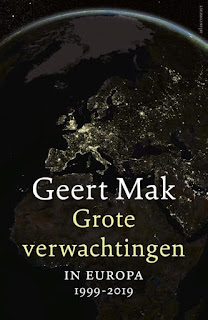
Mak, Geert "The Dream of Europe"

Mak, Geert "The Dream of Europe. Travels in a Troubled Continent" (Dutch: Grote verwachtingen. In Europa 1999-2019) - 2019

This book was a present by my son for Christmas. While I usually try to read Dutch books in Dutch, this was an English edition. In the end, I was not unhappy about that because now I can pass it on to my sons. They both speak Dutch but wouldn't read such a large book in that language.

I have read a few book by this fantastic journalist and author. All of them having to do with the changes of our continent in modern times. Totally interesting and very well examined and described.

He wrote this book six years ago and he predicted many events that are true today. That shows how well he observes. This can be seen as a follow-up to "In Europe. Travels through the Twentieth Century". A very-well deserved and very well executed follow-up. His observations about the first twenty years of our century are shocking and frightening. We should listen what he has to say about the future.

And here are some important quotes (from many):

"I wrote Enraged Citizens to show how it ought to be. The Capital (Die Hauptstadt)  is what it actually is." Robert Menasse

"But let all those idiots gather together in politics without sufficient resistance of any kind and you get a dictatorship of idiocy". Jacques de Kadt, Dutch essayist, in 1936

"He [one of the Republican candidates in 2015] lacked even the most basic respect for facts, institutions and democratic principles. To him, political opponents were enemies, a compromise was not a dignified agreement but a capitulation …" Doesn’t that apply to all of them???

From the back cover:

'Mak is the history teacher everyone should have had' Financial Times

How did the great European dream turn sour? And where do we go from here? From the author of the internationally acclaimed In Europe, a stunning history of our present,examining the first two decades of this most fragile and fraught new millennium. The great European project was built out of a common desire for peace, prosperity and freedom; a wish for a united Europe striving towards a common goal. The EU was to set an an arena for close cooperation, tackling crucial shared concerns from climate change to organized crime, promoting open borders and social security. But the first two turbulent decades of this century have been times of rapid and profound change. From the shores of Lampedusa to Putin's Moscow, the continent threatens to tear itself apart. What's happened to Europe's optimism and euphoria? How has it given way to nostalgia, frustration and fear, the fragile European dream in danger of turning into a nightmare?

In The Dream of Europe, Geert Mak, one of Europe's best-loved commentators, charts the seismic events that have shaped people's lives over the past twenty years. Mak's monumental book In Europe defined the continent on the verge of a new millennium. The Dream of Europe brings us up to the present day, through the rocky expansion of the EU, the aftermath of 9/11 and terrorist attacks across Europe, the 2008 financial crash and the euro crisis, the tragedy of the migrant crisis in the Mediterranean, the rise of right-wing populism and Brexit.

Like no other, Mak blends history, politics and culture with the stories and experiences of the many Europeans he meets on his travels. He brings this continent to life, and asks what role does Europe play now, and how might we face our challenges together, in the spirit of solidarity and connection.

'A powerful, humane and serious mind' Guardian

'Mak is a truly cosmopolitan chronicler' Independent"

Monday, 31 March 2025

Weir, Alison "Katharine Parr. The Sixth Wife"

Weir, Alison "Katharine Parr. The Sixth Wife" (Six Tudor Queens #6) - 2021

The sixth wife of Henry VIII. And the sixth book in the Tudor Queens series by Alison Weir.

I think I knew far too little about Katharine Parr. She was Henry's last wife. She survived him. She had two husbands before him. She married again when he died only to die herself in childbed. That's about all I knew.

Of course, this is a novel based on the life of the queens. However, there is a lot in it that is history and where we can learn about that time in England.

We see through the eyes of Katharine Parr that women were just a commodity, and not worth a lot for that. At her first marriage, she doesn't even know the husband. Then she has to look for another one because otherwise a woman has no means to live. When she falls in love with Thomas Seymour, she has to marry the king who also wants her. What a life!

In any case, Alison Weir has brought the Tudor queens to life in a way no history book could ever have done. For that, I thank her profoundly.

From the back cover:

"Two husbands dead; a life marred by sadness. And now Katharine is in love for the first time in her life.

The eye of an ageing and dangerous king falls upon her. She cannot refuse him. She must stifle her feelings and never betray that she wanted another.

And now she is the sixth wife. Her queenship is a holy mission yet, fearfully, she dreams of the tragic parade of women who went before her. She cherishes the secret beliefs that could send her to the fire. And still the King loves and trusts her.

Now her enemies are closing in. She must fight for her very life.

KATHARINE PARR – the last of Henry’s queens.

Alison Weir recounts the extraordinary story of a woman forced into a perilous situation and rising heroically to the challenge. Katharine is a delightful woman, a warm and kindly heroine – and yet she will be betrayed by those she loves and trusts most.

Too late, the truth will dawn on her."

Friday, 7 March 2025

Backman, Fredrik "Britt-Marie was here"

Backman, Fredrik "Britt-Marie was here" (Swedish: Britt-Marie var här) - 2014

This was my second book by Fredrik Backman. And my last. The first one was quite nice, funny, but I couldn't care for this one. I didn't like the protagonist, Britt-Marie because I'm not OCD even though I like order, I don't like football, so that didn't allure me, either. The story is described as "funny and moving", I couldn't find either.

This was a book club book, otherwise I might not have finished it.

We read this in our international online book club in February 2025.

Some comments from the other members:

"It scored pretty low by most others in the discussion.

Some commented that it felt more like a movie script than a real novel. Which makes sense as Backman's books have many of them been filmed both in Sweden and internationally. For me it was a nice light humorous read, maybe more like a fun summer read than real thought raising literature. This despite me hating the main character from the very start. I guess much of Backman's stories are like that, with quite stereotypical characters, and predictable plot and then an uplifting twist at the end. The timeline of the book felt familiar in terms of what was happening in small towns here in the Nordics in maybe 90-s or early 00s. Services being closed down and some neighbourhoods being quite poor. Not really something I believe can be saved by one determined lady and the community. But a nice thought."

From the back cover:

"Britt-Marie can’t stand mess. A disorganized cutlery drawer ranks high on her list of unforgivable sins. She is not one to judge others—no matter how ill-mannered, unkempt, or morally suspect they might be. It’s just that sometimes people interpret her helpful suggestions as criticisms, which is certainly not her intention.

But hidden inside the socially awkward, fussy busybody is a woman who has more imagination, bigger dreams, and a warmer heart that anyone around her realizes.

When Britt-Marie walks out on her cheating husband and has to fend for herself in the miserable backwater town of Borg—of which the kindest thing one can say is that it has a road going through it—she finds work as the caretaker of a soon-to-be demolished recreation center. The fastidious Britt-Marie soon finds herself being drawn into the daily doings of her fellow citizens, an odd assortment of miscreants, drunkards, layabouts. Most alarming of all, she’s given the impossible task of leading the supremely untalented children’s soccer team to victory. In this small town of misfits, can Britt-Marie find a place where she truly belongs?

Funny and moving, sweet and inspiring, Britt-Marie Was Here celebrates the importance of community and connection in a world that can feel isolating."

Tuesday, 15 October 2024

Follett, Ken "The Armour of Light"

Follett, Ken "The Armour of Light" - 2023

"The grand master of gripping fiction is back. International No.1 bestseller Ken Follett returns to Kingsbridge with an epic tale of revolution and a cast of unforgettable characters."

Yes, he is a grand master indeed. After having written four books about Kingsbridge, their cathedral and the inhabitants, rich and poor from 997 until the 16th century, here is the follow-up for the Industrial Revolution.

With the story of  Kingsbridge, we also learn the story of England and the United Kingdom. Anytime we read about history and how people lived, we must be thankful to live today. Even though we also have political problems, we as "the little people" have a lot more rights than people ever had. And we owe this to people like those described here.

I hope the story of Kingsbridge will continue into modern times. Then we could just go on with the century trilogy.

In any case, this is THE series for lovers of historical fiction.

I missed a list of all the characters before and during the book. And, like I said before, I would have enjoyed a timeline of what happened at the time. Yes, I have the internet and plenty of other books where I can look this up but I find having it in the actual book I'm reading is actually very helpful.

From the back cover:

"Revolution is in the air

1792. A tyrannical government is determined to make England a mighty commercial empire. In France, Napoleon Bonaparte begins his rise to power, and with dissent rife, France’s neighbours are on high alert.

Kingsbridge is on the edge

Unprecedented industrial change sweeps the land, making the lives of the workers in Kingbridge’s prosperous cloth mills a misery. Rampant modernization and dangerous new machinery are rendering jobs obsolete and tearing families apart.

Tyranny is on the horizon

Now, as international conflict nears, a story of a small group of Kingsbridge people - including spinner Sal Clitheroe, weaver David Shoveller and Kit, Sal’s inventive and headstrong son - will come to define the struggle of a generation as they seek enlightenment and fight for a future free from oppression. . .

Taking the reader straight into the heart of history with the fifth novel in the ground-breaking Kingsbridge series, The Armour of Light is master storyteller Ken Follett’s most ambitious novel to date."

Monday, 22 July 2024

🥐 Paris in July 2024 🥐

Welcome to another exciting month where we exchange reviews about books we read about Paris. Last year (2023), I posted the books I read where Paris is either the topic or at least part of the read and the books I read about France or the French language and the books I read last year for Paris in July.

I found the challenge at Lisbeth @ The Content Reader. Tamara @ Thyme for Tea has been hosting a Paris in July challenge for eleven years. Then, she hosted together with Deb @ Readerbuzz. In 2022, Emma @ Words and Peace kindly took over as the host and she continues to do so. The picture  at the top is also created by her.

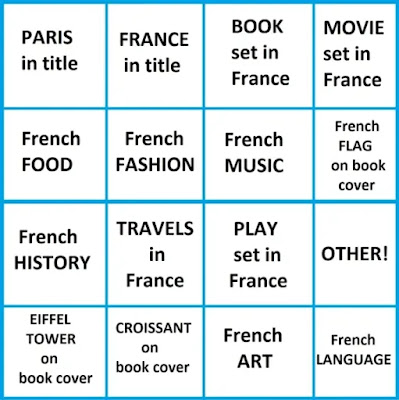
I don't have a lot of energy to participate this year by reading new books about Paris, but I tried to take part through the Paris Bingo. I will try to add books etc. I have not used in any of the Paris in July years before (though it is hard and therefore cannot be entirely avoided).
PARIS in title
Rutherfurd, Edward
"Paris" - 2013

FRANCE in title
Stein, Gertrude "Paris France" - 1940

BOOK set in France
Ernaux, Annie "The Years" (FR: Les années) - 2008

MOVIE set in France
Leroux, Gaston "The Phantom of the Opera" (French: Le Fantôme de l'Opéra) - 1910

French FOOD
Drinkwater, Carol "The Olive Farm" - 2001

French FASHION
Guiliano, Mireille "French Women Don’t Get Fat" - 2004

French MUSIC
Francis Cabrel "La Corrida"

French FLAG
Hugo, Victor "Les Misérables" (F: Les Misérables) - 1862

French HISTORY (not just French but funny)
Shaw, Karl "Royal Babylon: The Alarming History of European Royalty" - 1999

TRAVELS in France
Mayle, Peter "A Year in Provence" - 1989

PLAY set in France
Ionesco, Eugène "Rhinoceros" (French: Rhinocéros) - 1957

OTHER!
Voltaire "Candide, or Optimism" (F: Candide, ou l'Optimism) - 1757

EIFFEL TOWER
Dorling Kindersley "Eyewitness Guide Paris" and "Top 10 Paris" - 2020

CROISSANT
I haven't read a book that has a croissant on my edition but I found one that has a croissant on the Portuguese one:

Clarke, Stephen "A Year in the Merde" - 2004 - Um Ano Em França

French ART
Chevalier, Tracy "The Lady and the Unicorn" - 2003

French LANGUAGE
Némirovsky, Irène "La Proie" [The Prey] - 1938

I am looking forward to seeing many posts by other Paris enthusiasts.

🥐 Joyeux Juillet 🥐

Monday, 13 May 2024

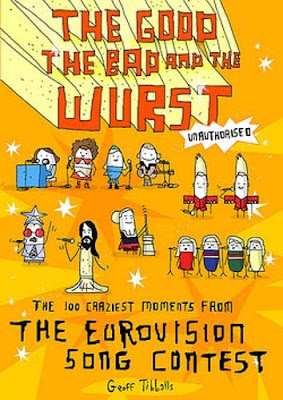
Tibballs, Geoff "The Good, the Bad and the Wurst"

Tibballs, Geoff "The Good, the Bad and the Wurst. The 100 Craziest Moments from the European Song Contest" - 2016

This book is about one of my favourite events of the year. I watch neither the Oscars nor the BAFTA or any of the other award programmes but I have been watching the ESC for a long long time, still back in the day when it was called "Grand Prix Eurovision de la Chanson" everywhere.

I thought the title was hilarious. And so was the book. Granted, at times, the author overdid it. Come to that … Who is Geoff Tibballs? I am sure it's a pseudonym of someone who doesn't even want to admit that he watches this every year. I couldn't find anything about him on the internet. And there is no description in the book like: He lives with his wife, two lovely daughters, a dog and a cat in the Cotswolds … or something to that effect. If anyone knows something about him, let me know.

Anyway, we hear about the different songs in different years, who was the worst (the wurst?), who had the most interesting costume, what stories happened before, during and after the performance, who votes for whom, what is the impact on politics and vice-versa.

There used to be a Dutch website, the Barbara Dex Award who selected the worst costume every year. Unfortunately, that went from 1997 to 2016 only. But, the Belgians have started a new one in 2022, for the most remarkable outfit. The winner 2022 was Australia, then Finland. It's called the "You're a Vision Award" (Wikipedia).

To the voting, I must say, of course people vote for their neighbour countries since the taste in music is often similar. Except for those who don't really like each other much.

There are some comments about politics and Eurovision but I have to share this one, not because it was a German commentator who gets the mention. Check out this video clip on YouTube, where German comedian Anke Engelke is telling Azerbaijan that Europe is watching them. And here it is in writing. Well said, Anke (who is a brilliant presenter, by the way). People should do that more often.

And last but not least: "… and Australia belongs to Europe …"

Of course it does. 😉 Would be nice if it was a little closer. But in all honesty, there are many countries participating who are not European. But it is called Eurovision and a lot of non-European countries are members of Eurovision i.e. the European Broadcasting Union. Australia was invited to participate because they are the biggest fans. I just would like to know what they'll do, if Australia wins one day. Not this year, they didn't make it to the final, unfortunately. Better luck next time, Australia.

I know there are a lot of controversies about the ESC. But, let us enjoy one (or three) nights a year. I'm not a fan of football. Do you know how often we non-football lovers have to endure changes in the TV programme because a game goes over?

From the back cover:

"All the highs and lows of over sixty years of Eurovision, from Céline Dion to Dustin the Turkey, and from ABBA to Conchita Wurst: plenty of silly constumes, truly terrible lyrics and all-round unbeatable entertainment.

Since 1956, the Eurovision Song Contest has existed in a parallel universe that continues to beguine and bemuse in equal measure. In this glittering, magical world, a song about the construction of a hydro-electric power station is cutting edge-pop, half a dozen warbling Russian grandmothers make up a band, a song that repeats the word 'la' 138 times is a winner, and Australia is part of Europe.

There has been scandal, too, in the form of an over-long kiss; national outrage in 1976 as a result of the Greek entry's savage indictment of Turkish foreign policy in Cyprus; and a night of near-death in Luxembourg when the floor manager warned the audience against standing up to applaud because they might be shot by security forces.
"

By the way, my favourites this year was France, followed by Norway. They made #4 and 25 respectively. Shows how much my taste goes with the majority. LOL

Wednesday, 20 March 2024

Dorling Kindersley "Brussels"

Dorling Kindersley (Hewetson, Zöe) "Brussels. Bruges, Ghent & Antwerp" - 2000
A Dorling Kindersley Travel Guide

One of the DK Travel Guides I have used frequently. Brussels is my favourite city. I have lived there. I have met my husband there. We have been going more than once every year since we moved away and now our youngest son lives there, right in the area where my husband and I met.

I love the Eyewitness Guides and also their little sister, The Travel Guides. Even if you are not able to visit a city (or a country), you can see exactly what it looks like and get a lot of information about the town, the people, the buildings, the parks, the museums, the food, just about everything you would like to know about a certain place.

The guide is divided into the areas of the city: the Lower Town, the Upper Town, Greater Brussels, Beyond Brussels, it gives you all the information a traveller needs: Where to stay, restaurants, cafés and bars, Shopping in Brussels, there is a survival guide with practical and travel information, everything you need to know.

Brussels is such a beautiful city with so many historic places, it's hard to know where to begin. A must is definitely the Grand Place with all its picturesque guild houses. You certainly can't miss this. It's beautiful to sit in one of the restaurants and observe the bustling life around you. But we usually just have a coffee there and go for dinner in one of the cheaper places just off the market or in another quarter, the food is so much better, as well.

In every even year, there is a flower carpet on the Grand Place, always around Assumption Day (of Mary, 15 August), a national holiday in Belgium.

One place we visit almost every time is the Cinquantenaire which is close by my old living place. There's a beautiful parc and a palace built by Leopold II on the occasion of the fiftieth anniversary (cinquantenaire) of Belgium. Him being German, he based the memorial arcade on the Brandenburg Gate but it also looks like the Arc de Triomphe in Paris.

Then there's the Quartier Royal with its Royal Palace and the Parc de Bruxelles, one of the most beautiful parcs you can imagine. And, of course, lots of wonderful museums for anyone interested in art and history. The palace is open to the public in the summer. Definitely worth another visit.

And there are places you should visit, if you happen to be in Brussels for longer or at a certain time. First of all, the symbol of Brussels, the Atomium, originally constructed as the centrepiece of the 1958 Brussels World's Fair (Expo 58). Definitely worth it, especially since its renovation about two decades ago. Six of the spheres are accessible to the public and they show permanent as well as temporary exhibitions on the 50s, the Expo, the construction as well as modern art or anything of current interest.

Then there are the Royal Greenhouses of Laeken which are open to the public once a year for two weeks in April/May.

You can also do tours around Brussels to admire the Art Nouveau houses, doors, windows, entrances (you can get a cheap map at the info centre at the Grand Place). There is also such a map for all the comic related street art. Tintin and his friends are all over the place. And if you arrive at the Gare Central (central station) and leave the place, don't forget to look up when you pass under the passage of the Putterie.

Brussels also has beautiful metro stations, a ride on the metro is always interesting.

There is so much more to see that it is impossible to write in just one post. You will have to go and see for yourself why I love this town so much.

Of course, all the other cities mentioned in the title and the book are also very much worth visiting.

Book description:

"Highlights Lower Town, Upper Town, Greater Brussels, as well as sited beyond the city.

Recognized the world over by frequent flyers and armchair travelers alike, Eyewitness Travel Guides are the most colorful and comprehensive guides on the market. With beautiful commissioned photographs and spectacular 3-D aerial views revealing the charm of each destination, these amazing travel guides show what others only tell.

'
DK Eyewitness Travel Guide: Brussels, Bruges, Ghent & Antwerp' is your indispensable guide to this beautiful part of the world. The fully updated guide includes unique cutaways, floor plans and reconstructions of the must-see sights, plus street-by-street maps. The also is packed with photographs and illustrations leading you straight to the best attractions these cities offer.

With insider tips and essential local information, this uniquely visual DK Eyewitness Travel guide highlights everything you'll need to know to make your vacation special, from local festivals and markets to day trips around the countryside. Detailed listings will guide you to the best hotels, restaurants, bars, and shops for all budgets, while practical information will help you to get around by train, bus, or car.


'DK Eyewitness Travel Guide: Brussels, Bruges, Ghent & Antwerp' will help you effortlessly explore every corner of Brussels, Bruges, Ghent & Antwerp."

Monday, 18 March 2024

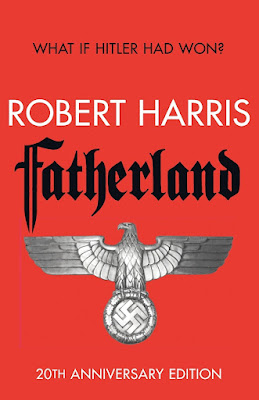
Harris, Robert "Fatherland"

Harris, Robert "Fatherland" - 1992

What an awful thought. Hitler resp. the Nazis had won the war. I always say, the Germans didn't lose the war, that were the Nazis. The Germans effectively won the war. In this book (and in various others, like my favourite "The Children's War") we can all see why.

The story itself concentrates on one particular case. A policemen who is not a fan of the Nazis but still has to wear their uniform for his job, tries to find the secret behind a murder. And with that, he could transform the whole world.

We need people like that everywhere, people who don't just blindly follow some dicatators, even if it is an advantage for them.

I think, right now is the right time to read this book again. Right now, where the Right is on the rise in many, many countries. Too many, if you ask me. How can people forget what it was? Even if you haven't lived during the war, most of us haven't, lets be honest. My parents would have been ninety had they still lived. And they were five when the Nazis were elected, so anyone responsible for the regime must be about a hundred. Not many of them alive anymore. But we have to remember what our parents or grandparents told us and see where we are heading if we elect those idiots that tell us the foreigners are our enemies. Nope, those who want to abolish our hard-earned democracy are.

We should all be happy that the war ended the way it did, this book shows us what could have been had it been different.

From the back cover:

"April 1964.

The naked body of an old man floats in a lake on the outskirts of Berlin. In one week it will be Adolf Hitler’s 75th birthday. A terrible conspiracy is starting to unravel…

What if Hitler had won?
"

Monday, 11 March 2024

Brontë, Charlotte "The Professor"

Brontë, Charlotte "The Professor" - 1857

This novel has been on my wishlist for quite a while. It was recommended to me by another blogger who, like me, has also lived in Brussels and from her I learned that they have a Brontë society there now. Unfortunately, I knew nothing about that when I lived there but they might have started this after my time.

Anyway, if you have not read anything by Charlotte Brontë, you definitely must have heard of Jane Eyre, her most popular book, probably the most popular one of all the books by any of the Brontë sisters.

I have yet to find a book by any of them that I don't like at all, they are all fascinating and gripping. Just as this one. I must admit, I might like it even more because it takes place in Brussels but it would have been just as interesting had the protagonist lived elsewhere.

What makes this book as interesting as her others, you have the feeling you are in the midst of the story, even though it took place almost two centuries ago. It is so lively. You can feel the problems of the protagonists, you understand how difficult it was for women in former times and how much as changed and how much hasn't.

Unfortunately, like Jane Austen, the Brontës all died far too early.

From the back cover:

"Charlotte Bronte's first novel, The Professor, is narrated from the viewpoint of an ambitious and self-made man.

Rejecting his aristocratic inheritance William Crimsworth goes to Brussels to find his fortune. He takes a job teaching at a boarding school for young ladies, where he begins a flirtation with Zoraide Reuter, who, out of jealousy, attempts to frustrate his courtship of Frances Henri, an attractive young woman determined to make her way in the world.

In
The Professor Charlotte Bronte holds up to scrutiny the Victorian ideals of self-help and individualism. The result is an unusual love story, and a novel profoundly critical of a society in which the relationships between men and women are reduced to power struggles."

Monday, 31 July 2023

🇫🇷 Paris in July 2023 - Summary 🇫🇷


Another Paris in July has passed. This year, Emma @ Words and Peace has kindly taken over as the host. She has given us the opportunity to link all our posts concerning the topic and you can find the results here. The picture  at the top is also created by her.

The books I read this month that concern Paris (or France in general) are:

Canetti, Elias "Die Blendung" (Auto-da-Fé) - 1935
Ernaux, Annie "The Years" (FR: Les années) - 2008
Guiliano, Mireille "French Women Don’t Get Fat" - 2004
Orwell, George "Down and Out in Paris and London" - 1933

Wickert, Ulrich "Frankreich muss man lieben, um es zu verstehen" [You have to love France to understand it] - 2017

Films
I haven't watched all of these this year but I thought I add a list of the movies I know that take place in Paris.
"Amélie" w. Audrey Tautou - 2001
"An American in Paris" w. Gene Kelly, Leslie Caron - 1951
"The Aristocats" - Disney - 1970
"Before Sunrise" w. Ethan Hawke, Julie Delpy - 1995
"Before Sunset"
w. Ethan Hawke, Julie Delpy -  2004
"La Boum" (The Party) and "La Boum 2" (The Party 2) w. Sophie Marceau, Claude Brasseur - 1980 + 1982
"Charade" w. Audrey Hepburn, Cary Grant - 1963
"The Da Vinci Code"
w. Tom Hanks, Audrey Tautou - 2006
"Un éléphant ça trompe énormément" (Pardon mon affaire) w. Jean Rochefort, Claude Brasseur - 1976
"L'Etudiante" (The Student) w. Sophie Marceau, Vincent Lindon - 1988
"Forget Paris" w. Billy Crystal, Debra Winger - 1995
"French Kiss" w. Meg Ryan, Kevin Kline - 1995
"Funny Face" w. Audrey Hepburn, Fred Astaire - 1957
"Gigi" w. Leslie Caron, Maurice Chevalier, Louis Jourdan - 1958
"Jules et Jim" from François Truffaut w. Jeanne Moreau - 1962
"Madeline" w. Frances McDormand, Nigel Hawthorne - 1998
"Maigret" w. Rowan Atkinson - 2016-17:
"Maigret Sets a Trap"
"Maigret's Dead Man"
"Maigret: Night at the Crossroads"
"Maigret in Montmartre"
"Maigret" w. Michael Gambon (internationally probably most widely known for his role as Professor Dumbledore in the Harrry Potter movies) - 1992-93
"Les Misérables" by Victor Hugo w. Hugh Jackman, Anne Hathaway - 2012
"Moulin Rouge" w. Nicole Kidman, Ewan McGregor - 2001
"Paris, je t'aime" w. Juliette Binoche - 2006
"Ratatouille" - Disney/Pixar - 2007
"Sabrina" w. Audrey Hepburn, Humphrey Bogart - 1954
"Sabrina" w. Julia Ormond, Harrison Ford - 1995

Friday, 28 July 2023

Canetti, Elias "Auto-da-Fé"

Canetti, Elias "Auto-da-Fé" (German: Die Blendung) - 1935

For the The Classics Spin #34, we were given #13, and this was my novel.

What a book! Did I like it? Hm, hard to tell. It is described as grotesk, obscure, weird, … And weird it is.

The book tells the story of Peter Kien, a sinologist and philologist who lives very reclusively in his apartment with his books. He marries his housekeeper but he slides more and more into madness.

Peter's brother Georg is a famous psychologist in Paris. Alerted by one of Peter's acquaintances, he comes to Vienna in order to help but, alas, is not successful.

This is a very complex book that cannot possibly be explained in a few words. Its a book of obsession and criticism, of society at the time but also a warning about what was to come. After all, this was two years after the nazis gained power in Germany and many people, like the author, feared for the future. And they were right, as it turned out.

The meaning of the English title is explained in Wikipedia:
An auto-da-fé (/ˌɔːtoʊdəˈfeɪ, ˌaʊt-/ AW-toh-də-FAY, OW-; from Portuguese auto da fé [ˈawtu ðɐ ˈfɛ], meaning 'act of faith'; Spanish: auto de fe [ˈawto ðe ˈfe]) was the ritual of public penance carried out between the 15th and 19th centuries of condemned heretics and apostates imposed by the Spanish, Portuguese, or Mexican Inquisition as punishment and enforced by civil authorities. Its most extreme form was death by burning.

The book was first published in English with the title "The Tower of Babel".
The translation of the original titel "Die Blendung" would be translated into "Blinding as a punishment", "Glare", "Deception", or even in the sense of "Verblendung" as "Infatuation". All these words could be used as the title of the book. In the German book description, it is said that "like Joyce's 'Ulysses', 'The Blinding' is a powerful metaphor for the lonely reflective mind's confrontation with reality." Sounds correct to me.

Book Description:

"'Auto-da-Fé' is the story of Peter Kien, a distinguished, reclusive sinologist living in Vienna between the wars. With masterly precision, Canetti reveals Kien's character, displaying the flawed personal relationships which ultimately lead to his destruction.

Manipulated by his illiterate and grasping housekeeper, Therese, who has tricked him into marriage, and Benedikt Pfaff, a brutish concierge, Kien is forced out of his apartment - which houses his great library and one true passion - and into the underworld of the city. In this purgatory he is guided by a chess-playing dwarf of evil propensities, until he is eventually restored to his home. But on his return he is visited by his brother, an eminent psychiatrist who, by an error of diagnosis, precipitates the final crisis...

'
Auto-da-Fé' was first published in Germany in 1935 as 'Die Blendung' ('The Blinding' or 'Bedazzlement') and later in Britain in 1947, where the publisher noted Canetti as a 'writer of strongly individual genius, which may prove influential', an observation borne out when the author was awarded the Nobel Prize for Literature in 1981. 'Auto-da-Fé' still towers as one of the greatest novels of the twentieth century, and Canetti's incisive vision of an insular man battling agianst the outside world is as fresh and rewarding today as when first it appeared in print."

Elias Canetti received the Nobel Prize for Literature in 1981 "for writings marked by a broad outlook, a wealth of ideas and artistic power".

I contribute to this page: Read the Nobels and you can find all my blogs about Nobel Prize winning authors and their books here.

Since this book takes partly place in Paris, it can also go with the project #parisinjuly2023.

Monday, 3 July 2023

🇫🇷 Paris in July 🇫🇷

July is with us again and so is Paris in July.

Welcome to another exciting month where we exchange reviews about books we read about Paris. Last year (2022), I posted the books I read where Paris is either the topic or at least part of the read and the books I read about France or the French language and the books I read last year for Paris in July.

I found the challenge at Lisbeth @ The Content Reader. Tamara @ Thyme for Tea has been hosting a Paris in July challenge for eleven years. Last year, she hosted together with Deb @ Readerbuzz. This year, Emma @ Words and Peace has kindly taken over as the host. The picture  at the top is also created by her.

In the end, I read two books this year:
Leroux, Gaston "The Phantom of the Opera" (F: Le Fantôme de l'Opéra) - 1910
Némirovsky, Irène
"La Proie" [The Prey] - 1938

The books about France and/or Paris I read or posted this year, so far, are:

Gray, Martin "For those I loved" (F: Au nom de tous les miens) - 1971
Illies, Florian "1913: The Year before the Storm" (GE: 1913: Der Sommer des Jahrhunderts) - 2012 (not just about France but it does take a big part in the non-fiction book)
Stein, Gertrude "Paris France" - 1940

For this month, my plan is to read:
Orwell, George "Down and Out in Paris and London: A Gritty Memoir on Life & Poverty in Two Cities" - 1933

Two years ago, I mentioned the Maigret series with Rowan Atkinson. Unfortunately, the four episodes they filmed seem to be the only ones, although, who knows, maybe someone convinces the makers that we need more of them.

But, do not despair, I found some older ones that are also quite good, The inspector is played by Michael Gambon here, and there are twelves episodes made in 1992 and 1993. See here. I think I might rewatch all of them, maybe not all in July but over the next couple of months.

If you are looking for more books about France, have a look here.
And for my other Paris in July years, see here.

Also, if you have read an interesting book about Paris or France or a book taking place there, please, let me know. If you have reviewed it, I'd be grateful for a link.

🇫🇷 Joyeux Juillet 🇫🇷