Showing posts with label Family. Show all posts

Monday, 8 June 2026

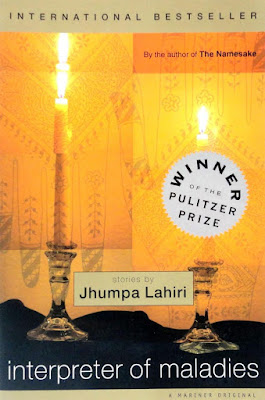
Lahiri, Jhumpa "Interpreter of Maladies"

Lahiri, Jhumpa "Interpreter of Maladies" - 1999

I have read this book in 2015. This was my review back then:

"As most of my friends know, I am not a big fan of short stories. However, I read 'The Namesake' by the same author and really loved it. And several of my friends had recommended 'Interpreter of Maladies' to me, one had even left a copy to me when she was moving, I just had to read it.

I was pleasantly surprised. What a lovely collection of short stories, some of them even interlink, so it doesn't seem like there are a hundred small stories that you forget right away. On the contrary, Jhumpa Lahiri has created some wonderful characters that you won't forget that easily. She incorporates all sorts of problems anyone might face who lives in a culture different from the one they or their parents grew up with. She describes some lovely people (and some not so lovely ones) who are all confronted with a life in two different parts of this world. Since the author is Indian herself and grew up in the United States, this is the background to almost all her stories. Having lived abroad (though not in such a different culture as the characters in the book) almost half of my life myself, I can certainly relate to a few of them.

Jhumpa Lahiri has a good, elegant style, her stories just flow, I will certainly read more of her writings."

A while ago, I joined an online group called Literary Wives and this was the next book on our list. So, I re-read the book because it was a while ago that I read it and we read it with a different topic in mind. What does the author say about the wives in his book?

Most of these stories take place in India and/or around Indian couples.

A Temporary Matter

We look at the end of a marriage. A couple suffers from the loss of a baby that was stillborn. They have nothing to say to each other even though they try hard.

When Mr. Pirzada Came to Dine

In this story, a woman remembes a man from East Pakistan/Bangladesh coming to visit her Indian family in the States while his family is back home. It is more a story about the man than about this particular wife but it still gives us an insight into the life of the Indian wives in the US.

Interpreter of Maladies

This is about an Indian American family visiting the country of their heritage. We learn even more about the life of such a wife, she is so lonely. I can relate because as a non-working wife abroad, you don't have the sort of social life your husband and children habe and it is hard work to try and find your place.

A Real Durwan (doorkeeper)

This story is about an eldery woman who is a stairsweeper and lives on the roof ot the building she works in.

While this is less about the situation of a wife, it tells us about poverty and how you can be even poorer than all the others around you.

Sexy

We're back in the US. Again, not the story of a wife but of a mistress. And of a husband who is leaving his wife. A good reflection about this kind of situation from every point of view, the wife and the mistress. 

Mrs. Sen's

Her we have the story of an Indian woman living in the States who doesn't drive and doesn't have any contact outside the house. She looks after an eleven year old boy after school and teaches him about their food. Probably one of my favourite stories. I really felt for the lady.

This Blessed House

A yound married Indian couple in Connecticat who moves into their new house and find many Christian relics. The wife puts them on the mantel of the fireplace. A good story about how different people can have different opinions about what to keep and what not and what to embrace. And how they have to work on your marriage.

The Treatment of Bibi Haldar

A woman suffers from seizures and a doctor recommends to marry her off. But it costs money to get married and you have to find a suitor. So, her relatives rather let her live on the roof. This story focuses on the treatment of illness and of prejudices.

The Third and Final Continent

This guy has moved from India to London and then to the States where he rents a room from a 103-year-old lady. They develop a good connection until he gets married and moves out. We follow his and his wife's life and how they get to know each other.

As I mentioned in the stories, they are not all about the wives, some of them don't relate to their status at all, they are just there. But where they are mentioned, we learn a lot about the differences between Indian and (mainly) American wives, their rights and their duties.

I think it also helps to understand why immigrants so often stay among themselves. It is not just about the language, though that doesn't help if nobody teaches them the host language, it is more about the culture and understanding each other. Especially the wives are invisible, they disappear in the crowd. Especially if it has been an arranged marriage, the husband often doesn't understand his wife.

From the back cover:

"Navigating between the Indian traditions they've inherited and the baffling new world, the characters in Jhumpa Lahiri's elegant, touching stories seek love beyond the barriers of culture and generations. In 'A Temporary Matter,' published in The New Yorker, a young Indian-American couple faces the heartbreak of a stillborn birth while their Boston neighborhood copes with a nightly blackout. In the title story, an interpreter guides an American family through the India of their ancestors and hears an astonishing confession. Lahiri writes with deft cultural insight reminiscent of Anita Desai and a nuanced depth that recalls Mavis Gallant."

Jhumpa Lahiri received the Pulitzer Prize for "Interpreter of Maladies" in 2000.

And here are the reviews of the other literary wives:

Becky from Sydney of Aidanvale

Kate from Melbourne of booksaremyfavoriteandbest

Rebecca from Maryland, USA of Bookish Beck

Kay from Washington State, USA of What? Me Read?

Monday, 27 April 2026

Kingsolver, Barbara "Animal, Vegetable, Miracle"

Kingsolver, Barbara, Steven L. Hopp, Camille Kingsolver "Animal, Vegetable, Miracle: A Year of Food Life" - 1990

Live the year with Barbara Kingsolver and her family on their farm.

I grew up like this. My parents didn't own a farm but they rented a house with a large garden, quite normal at the time in the countryside. We would grow everything, really everything the family need during the year. Except for the potatoes, the garden was not large enough, especially since we hardly ever had rice or pasta. But my uncle was a farmer and he would come by once a year and fill half of our little cellar room with potatoes. The other half would be harvested in a nearby apple orchard. We also had chickens, rabbits (which I still refuse to eat to this day) and even a pig from time to time. Fresh milk would be fetched from the next farmer, the one who also owned our house.

So, I read this book with a laughing and a crying eye. Too many memories of a hard childhood. But also so much that sounded familiar. Not just the planting and harvesting of the veggies, the washing of the preserving jars and then the processing and the cooking. A lot of work. In the end, I was happy I don't have to do that anymore.

What I liked about the book was the togetherness of the family, the will to stick together and live off the land for a whole year. Of course, not everyone would be able to do that. We all have to go out and earn a living, there is not that much time left to grow everything we want to eat. Also, most people don't have the money to have land so large that they can live from the proceeds any longer.

Mind you, a lot of her findings about food you can buy and probably shouldn't, are about the US American market but we all have to find what is good food and what isn't

So, I understand people who didn't like the book because of that. But we can all learn from the author and buy more local food, buy more stuff that is in season and didn't have to be shipped all over the world until we get it.

I also loved her remark to lactose intolerance. I belong to the (large) group of people inflicted with it and often have to hear snide remarks. I should take an excerpt from her book along with me in future:

"This is not an allergy or even, technically, a disorder. Physical anthropologists tell us that age four, when lactose intolerance typically starts, is about when nature intended for our kind to be wholly weaned onto solid food; in other words, a gradual cessation of milk digestions is norma. In all other mammals, the milk-digesting enzyme shuts down soon after weaning. So, when people refer to this as an illness, I'm inclined to point out we L.I's can very well digest the sugar in grown-up human foods like fruits and vegetables, thank, we just can't nurse. From a cow. Okay?"

As a big fan of gatherings by family and friends, I also loved her accounts of those. She obviously has more space than we do but even in our smaller apartments, we often had several dozens of visitors to our parties.

There are also contributions by her husband and her daughter Camille who includes a lot of recipes that you can download here: AnimalVegetableMiracle.

Does Barbara Kingsolver still belong to my favourite authors? But, of course. All her books are great!

Book Description:

"Author Barbara Kingsolver and her family abandoned the industrial-food pipeline to live a rural life—vowing that, for one year, they'd only buy food raised in their own neighbourhood, grow it themselves, or learn to live without it. Part memoir, part journalistic investigation, Animal, Vegetable, Miracle is an enthralling narrative that will open your eyes in a hundred new ways to an old truth: You are what you eat."

Thursday, 26 February 2026

Chevalier, Tracy "The Glassmaker"

Chevalier, Tracy "The Glassmaker" - 2024

I have read quite a few novels by Tracy Chevalier and they were all highly interesting, always about different people in different areas at different times.

But this was special. From the descriptions, I first thought this was a little like the stories by Edward Rutherfurd who guides us through centuries by introducing several people from several families. Well, this was a little different. The story starts in 1494 Orsola Rossa, the protagonist, lives in Murano with her family of glassmakers. After 500 years, she is in her sixties and has lived through a plague, several wars, many changes in the lives of people, especially women.

While I was first a little dismayed by this way of telling the story, I really loved the people in Murano and Venice. Not all, but most of them. And the story of the family and how they got through all the upheavals, was also fantastic. 

You can tell, that Tracy Chevalier put a lot of time and effort into the research. I especially loved to learn about all the details of glassmaking. Well done.

I doubt I will ever get to see Venice but this is a good substitute.

From the back cover:

"Across the lagoon lies Murano. Time flows differently here – like the glass the island’s maestros spend their lives perfecting.

In secret, Orsola Rosso learns to craft glass. As a woman, she must flout convention to save her family from ruin. We follow her through hundreds of years of war and plague, tragedy and triumph, love and loss.

Skipping like a stone across the centuries, The Glassmaker is a virtuoso portrait of a woman, a family and a city that are as everlasting as glass."

Monday, 22 December 2025

O'Farrell, Maggie "Hamnet"

O'Farrell, Maggie "Hamnet" - 2020

Somebody talked to me about this book. Someone who likes Maggie O'Farrell. I have a vague recollection of who it was but I can't find it again. So, maybe it was someone else. Sorry, whoever you are.

Anyway, it was nice to read about a part of Shakespeare's life that is not so well known. We know that his son died young. That his name was Hamnet and that his father wrote a play called Hamlet. As to the book, the spelling of the name is interchangeable, so it is more or less the same. I mean, Shakespeare himself had about 27 varieties of is last name. Or something like that.

The author mentions that this is a piece of fiction based on only the few facts I mentioned above. So, she lets us know her imagination and we can add to that.

But I still learned about Shakespeare and especially his wife, Anne Hathaway, who is called Agnes in the novel. Because I like to search for more information elsewhere whenever I read a book. Sometimes, you need a starter for that.

And what was also excellent is the description of the grief parents go through when losing a child. That was heartbreaking.

Maggie O'Farrell received several prizes for this book, i.a. the Women's Prize for Fiction 2020.

We discussed this book in our local book club in April 2026.

A few comments from our book club members:

  • Shakespeare's life in London wasn't given enough attention.
  • How is it that such a strong woman suffers so much from the death of her child?
  • We liked the way the transmission of the plague was described.

From the back cover:

"On a summer's day in 1596, a young girl in Stratford-upon-Avon takes to her bed with a fever. Her twin brother, Hamnet, searches everywhere for help. Why is nobody at home?

Their mother, Agnes, is over a mile away, in the garden where she grows medicinal herbs. Their father is working in London.

Neither parent knows that one of the children will not survive the week.

Hamnet is a novel inspired by the son of a famous playwright. It is a story of the bond between twins, and of a marriage pushed to the brink by grief. It is also the story of a kestrel and its mistress; flea that boards a ship in Alexandria; and a glovemaker's son who flouts convention in pursuit of the woman he loves. Above all, it is a tender and unforgettable reimagining of a boy whose life has been all but forgotten, but whose name was given to one of the most celebrated plays ever written."

Wednesday, 3 December 2025

Kivi, Alexis " Seven Brothers"


Kivi, Alexis " Seven Brothers" (Finnish: Seitsemän veljestä) - 1870

This is supposedly the most famous and best classic Finnish book. Well, I haven't read much Finnish literature, but this was definitely not the best. As the title and description suggest, it's about seven brothers. One expects, or at least I expected, the story of a "normal" Finnish family from that era. I would have liked to learn about the life of an average family.

Instead, we only hear about fights and drinking bouts; the language is described as "rustic" but "coarse" or "crude" is still too flattering even with the most charitable interpretation. The brothers' behaviour towards each other was more like that of  pre-school or young school children; they displayed manners that one should have outgrown by the 1920s.

Some readers might find this amusing, but I didn't. What a shame.

And here are some of the comments from the discussion:

The book didn’t lead to dramatic reactions, but it did give us plenty to think about regarding its themes, its style, and its place in Finnish literature.

Most of us found the novel demanding. The older language, long passages, and slow pacing required some adjusting to.
It took a while to get into, but once I accepted the rhythm, the brothers’ development started to feel clear and honest.
Overall, many appreciated how the novel shows growth—learning responsibility, patience, and how to live with others.

We also talked about some of the more chaotic and difficult scenes, which help define the book’s realism:
The early conflicts with the village and authorities underline how unprepared the brothers are for adult responsibilities.
Their retreat to the forest isn’t peaceful: they burn down their own sauna-house during a careless moment, leaving themselves without shelter.
They face real danger, including the well-known scene where they end up killing a herd of bulls in self-defense.
Their years in the forest are marked by hunger, failed attempts to farm, heavy drinking, and frequent arguments.
These moments show the harsher side of rural life, and the distance the brothers must travel—practically and personally—before they can return to society.

We also revisited why Seven Brothers is so central in Finnish literary history:
Published in 1870, it was among the first major works written in Finnish at a time when Finnish-language literature was still new and culturally fragile.
Many expected Finnish literature to focus on noble, heroic, or uplifting themes. Instead, Kivi wrote about ordinary rural men, their flaws, and the unembellished reality of their lives.
Early critics found the book too rough and thought it gave a poor image of the Finnish people.
Over time, it became recognized as a groundbreaking work of realism—depicting rural life without idealization.
The brothers’ gradual journey from isolation and impulsiveness toward responsibility and community echoes broader changes happening in Finland at the time.

Our overall view was that Seven Brothers isn’t an easy read, but understanding its historical context and the realism behind its scenes helped us appreciate its significance. The rough edges and difficult moments give weight to the brothers’ eventual maturity, and the novel remains an important milestone in Finnish literature precisely because it chose honesty over idealization.

This was our read in our international online book club in November 2025.

From the back cover:

"Along with The Kalevala, Aleksis Kivi's Seven Brothers is Finland's most celebrated literary treasure. The crowning accomplishment of Finland's first literary genius, Seven Brothers remains 'the greatest Finnish novel of all time', the classic among the classics in Finnish literature. Published in 1870, in the author's 36th year and two years before his untimely death, Seven Brothers laid the foundation for what Kai Laitinen later called 'The Great Tradition in Finnish Prose'. This tradition is characterized by realism, humor, respect for the common people, and depiction of nature as both friend and foe. Received at the time of publication by uncomprehending arbiters of literary taste, who still delighted in romantic approaches to literature, Seven Brothers fared poorly in early reviews. Posterity, however, has resurrected the reputation of Aleksis Kivi, and critics, scholars, and readers at large continue to praise the virtues of this trail-blazing, exceedingly rich novel. Richard Impola's superb English translation captures the brothers' rustic milieu and the exceptional dynamics of Kivi's creative style and artistic conception."

Monday, 17 November 2025

Faulkner, William "The Sound and the Fury"

Faulkner, William "The Sound and the Fury" - 1929

For the Classics Spin #42, we received #17 and this was my novel. When I revealed this to the other bloggers, I got a lot of comments that people did not like the book at all. But I was determined to like it. After all, I loved "Light in August" by the same author.

However, this is not comparable to the first of his books that I read. I think I agree with most of the other readers.

But let's get to the book.

In one of the reviews (see here), I read "I appreciated the writer's skill a lot more than I enjoyed reading the novel." I think that hits the nail on its head. Another one compared it with "Look Homeward, Angel" which I could also agree on. Another Southern US writer whom you might only want to follow, if you are a Southerner yourself.

I'm sure you guessed it, this wasn't my favourite book of the year. But I appreciated having read it.

They mention "Ulysses" in the description. As you can see, I read that and said at the time "this is the most difficult book I have ever read". It still belongs on that list but I understood that better than this one. I also said "the longer I distance myself from this novel, the more it makes sense and the bigger an impact does it have on me." I doubt this will ever happen here but one can always hope.

I did understand the actions in the book but really didn't like a single character and couldn't follow any of their decisions.

It is also says in the description that "... in the next two sections ... the novel begins to reveal itself."

Nope, not really, it was still as confusing as before. If you're not a huge fan of stream of consciousness books, I wouldn't recommend it.

From the back cover:

"Ever since the first furore was created on its publication in 1929, The Sound and the Fury has been considered one of the key novels of this century. Although it is difficult, in the same way that Ulysses is difficult, it is rewarding. Few readers can fail to become absorbed in this imaginative creation of the degenerate und disintegrating Compson family.

Faulkner does not use characters as pawns in a plot: he is interested in minds and emotions, in the interaction of characters and the way incidents and events affect individuals and their relationships. This is done by dividing the novel into four sections: the first is 'told by an idiot' - Benjy, for whom time does not exist. It is in the next two sections, when the reader hears the tale told by Benjy's two brothers, that the novel begins to reveal itself.

In essence this is a novel about lovelessness - 'only an idiot has no grief; only a fool would forget it. What else is there in this world sharp enough to stick to your guts?' It is a novel about intense and passionate family relationships wherein there is no love, only self-centredness.

The cover shows a detail from 'The Scarecrow' by Andrew Wyeth in the National Collection of Fine Arts, Washington."

William Faulkner received the Nobel Prize for Literature in 1949 "for his powerful and artistically unique contribution to the modern American novel."

I contribute to this page: Read the Nobels and you can find all my blogs about Nobel Prize winning authors and their books here.

Here are all the books on my original Classics Club list.
And here is a list of all the books I read with the Classics Spin.

Monday, 10 November 2025

Murrin, Alan "The Coast Road"

Murrin, Alan "The Coast Road" - 2024

A friend had read this book and lent it to me. It sounded quite interesting, stories about Ireland often are. But, this story really could have taken place almost everywhere. There are people like that in every village. I grew up in a Catholic village in the sixties and seventies, and life there was almost like that. Actually, there are still people around who act similar. However, these characters didn't come across very likely and likeable.

So, an easy read for anyone who is looking for that. Since I usually don't, I didn't enjoy this book that much. Not my thing.

From the back cover:

"It's 1994 in County Donegal, Ireland, and everyone is talking about Colette Crowley - the writer, the bohemian, the woman who left her husband and sons to pursue a relationship with a married man in Dublin. But now Colette is back, and nobody knows why.

Returning to the community to try and reclaim her old life, Colette quickly learns that they are unwilling to give it back to her. The man to whom she is still married is denying her access to her children, and while the legalisation of divorce might be just around the corner, Colette finds herself caught between her old life and the freedom for which she risked everything. Desperate to see her children, she enlists the help of Izzy, a housewife and mother of two, and the women forge a friendship that will send them on a spiralling journey - one toward a path of self-discovery, and the other toward tragedy."

Monday, 22 September 2025

Benedetti, Mario "The Truce"

Benedetti, Mario "The Truce" (Spanish: La Tregua) - 1960

Diana from Thoughts on Papyrus recommended this book to me. It's not very long, so I read it in between other things. Despite its brevity, it contains a lot, practically everything you need for a long life.

It's about a man nearing retirement. Well, much earlier than most people retire, but the situation is still realistic. He's wondering what he's going to do with the rest of his life. Then he falls in love with a co-worker, and she falls in love with him. After raising his three children alone after the untimely death of his wife, this is a new beginning for him.

In his diary, we can follow his thoughts. It also deals with religion; among other things, he says: "Frankly, I don't know if I believe in God. Sometimes I think that if God really existed, such doubts shouldn't upset him." I think this quote alone says a lot about the book, which I really enjoyed. It's a calm narrative that nevertheless has a lot to say.

From the back cover:

"'Perhaps that moment had been exceptional, but still, I felt alive. That pressure on my chest means being alive.' Forty-nine, with a kind face, no serious ailments (apart from varicose veins on his ankles), a good salary, and three moody children, widowed accountant Martín Santomé is about to retire. He assumes he'll take up gardening, or the guitar, or whatever retired people generally do. What he least expects is to fall passionately in love with his shy young employee Laura Avellaneda. As they embark upon an affair, happy and irresponsible, Martín begins to feel the weight of his quiet existence lift - until, out of nowhere, their joy is cut short. The intimate, heartbreaking diary of an ordinary man who is reborn when he falls in love one final time, this beloved Latin American novel has been translated into twenty languages and sold millions of copies worldwide."

Tuesday, 10 June 2025

Hornby, Gill "Miss Austen"

Hornby, Gill "Miss Austen" - 2020

As I mentioned before, as part of the commemoration of Jane Austen's 250th birthday, the Classics Club has started a #Reading Austen project. We are reading a book by her every other month, and I want to do read something Austen-related by her in between.

In April, I read a German book by Catherine Bell, "Jane Austen und die Kunst der Worte" [Jane Austen and the Art of Words].  I was not impressed, I probably read too much about Jane Austen before and this one could have been written by any Jane Austen fan without doing any more research. Such a pity.

Mind you, "Miss Austen" wasn't all that much better, only a little. The Miss Austen mentioned in the title is not Jane but her sister Cassandra. We hear about her last self-given task, the intention to destroy the letters her sister had written that contained something Cassandra didn't want anyone to know, that would look bad on her sister's legacy. But, since those letters were destroyed, we don't know what it contained and the author just invented them.

I don't like people writing a sequel to a book where the original author died. I never did and I doubt I ever will. So, I guess my next book about Jane Austen (in August) will be a non-fiction again.

From the back cover:

"1840 : Cassandra Austen returns to the village of Kintbury.

She knows that, in some corner of the vicarage where she is staying, there is a cache of letters written by her sister Jane.

As Cassandra recalls her youth, she pieces together buried truths about Jane's history - and her own ; secrets which should not be revealed.

And she faces a stark choice : should she act to protect Jane's reputation?

Or leave the letters unguarded to shape her legacy..."

Friday, 18 April 2025

Hislop, Victoria "The Figurine"

Hislop, Victoria "The Figurine" - 2023

I have been a fan of Victoria Hislop since I read her first book "The Island". I have only been to Greece once, and not even to the mainland but to Crete. But through this author, I have come to love the country and this one is one of her best.

The heroine of the book, Helena, has a Scottish father and a Greek mother. And her family does the best thing one can do to a bi-cultural child, they send her to her grandparents for the holidays so that she becomes a fully bilingual child.

The story is so exciting, not just from the language or the Greek point of view, there is so much going on and we can follow Greek history recent and ancient in this one novel. Fantastic.

I don't know which one is my favourite, "The Island" or this one but it certainly is one of the two. Such a beautiful story.

From the back cover:

"'Her love for Greece shines through and transports readers to a brilliantly drawn world' Independent

'Family turmoil, unanswered questions, romance and betrayal, all served up against the backdrop of Greece and its enchanting history' Daily Express

An unputdownable read with a family's dark history giving a unique glimpse into Greece's troubled past. Athens sparkles in Victoria Hislop's imagination. Concealed beneath the dust sheets in the Athens apartment she has inherited from her grandparents, Helena McCloud discovers a hidden hoard of rare antiquities, amassed during a dark period in Greek history when the city and its people were gripped by a brutal military dictatorship. Helena's fascination for archaeology, ignited by a summer spent on a dig on an Aegean island, tells her that she must return these precious artefacts to their rightful place. Only then will she be able to allay the darkness of the past and find the true meaning of home - for cultural treasures and for herself."

Friday, 7 March 2025

Backman, Fredrik "Britt-Marie was here"

Backman, Fredrik "Britt-Marie was here" (Swedish: Britt-Marie var här) - 2014

This was my second book by Fredrik Backman. And my last. The first one was quite nice, funny, but I couldn't care for this one. I didn't like the protagonist, Britt-Marie because I'm not OCD even though I like order, I don't like football, so that didn't allure me, either. The story is described as "funny and moving", I couldn't find either.

This was a book club book, otherwise I might not have finished it.

We read this in our international online book club in February 2025.

Some comments from the other members:

"It scored pretty low by most others in the discussion.

Some commented that it felt more like a movie script than a real novel. Which makes sense as Backman's books have many of them been filmed both in Sweden and internationally. For me it was a nice light humorous read, maybe more like a fun summer read than real thought raising literature. This despite me hating the main character from the very start. I guess much of Backman's stories are like that, with quite stereotypical characters, and predictable plot and then an uplifting twist at the end. The timeline of the book felt familiar in terms of what was happening in small towns here in the Nordics in maybe 90-s or early 00s. Services being closed down and some neighbourhoods being quite poor. Not really something I believe can be saved by one determined lady and the community. But a nice thought."

From the back cover:

"Britt-Marie can’t stand mess. A disorganized cutlery drawer ranks high on her list of unforgivable sins. She is not one to judge others—no matter how ill-mannered, unkempt, or morally suspect they might be. It’s just that sometimes people interpret her helpful suggestions as criticisms, which is certainly not her intention.

But hidden inside the socially awkward, fussy busybody is a woman who has more imagination, bigger dreams, and a warmer heart that anyone around her realizes.

When Britt-Marie walks out on her cheating husband and has to fend for herself in the miserable backwater town of Borg—of which the kindest thing one can say is that it has a road going through it—she finds work as the caretaker of a soon-to-be demolished recreation center. The fastidious Britt-Marie soon finds herself being drawn into the daily doings of her fellow citizens, an odd assortment of miscreants, drunkards, layabouts. Most alarming of all, she’s given the impossible task of leading the supremely untalented children’s soccer team to victory. In this small town of misfits, can Britt-Marie find a place where she truly belongs?

Funny and moving, sweet and inspiring, Britt-Marie Was Here celebrates the importance of community and connection in a world that can feel isolating."

Monday, 9 September 2024

Stedman, M L "The Light Between Oceans"

Stedman, M L "The Light Between Oceans" - 2012

I must say, I expected more from this novel. But I don't want to spoil it for anyone who still wants to read this. I really would welcome comments from those who have.

Spoiler:
As you can see from the book description, a couple who cannot have a child "finds" one and decides to keep it. Even when they know where it belongs, they don't tell the truth. An interesting topic. Is it correct to keep a baby if you think it might have been abandoned? Is it correct to keep it even if you know it isn't? I would say no in both cases. Someone who is not able to have children but would love to have them, might think different but I think about the mother whose baby is stolen. Yes, stolen. I would have killed anyone who would have done that to me.

An interesting subject but the writing has not enticed me to read anything else by this author. It was a little to "chick-litty" for me.

From the back cover:

"Tom Sherbourne, released from the horrors of the First World War, is now a lighthouse keeper, cocooned on a remote island with his young wife Izzy, who is content in everything but her failure to have a child.

One April morning, a boat washes ashore carrying a dead man - and a crying baby. Safe from the real world, Tom and Izzy break the rules and follow their hearts.

It is a decision with devastating consequences."

Monday, 27 May 2024

Hamsun, Knut "Growth of the Soil"

Hamsun, Knut "Growth of the Soil" (Norwegian: Markens Grøde) - 1917

For the Classics Spin #37, we received #8 and this was my novel.

So far, I have only read one book by Knut Hamsun, "Pan". That was part of our international book club. One of our members was from Norway, and Knut Hamsun was her favourite author. I liked "Pan", it's a great novel and probably a good one for a book club since it's not too large.

"Growth of the Soil" was just as great. Apparently, this gained him the Nobel Prize for Literature. You can tell that the author loves nature and what it does for us. In this case, Isak, the protagonist, comes to an area where nobody lives and which seems hard to farm. He makes something of it and becomes one of the richest man in the area after some others follow.

It's not just the story, it's the way the people are described, their hard work, their love of nature, their will to become more, also those who don't agree with that style of life.

It's a quiet story, a calming story. An epic story about a time long gone.

From the back cover:

"The epic novel of man and nature that won its author the Nobel Prize in Literature, in the first new English translation in more than ninety years

When it was first published in 1917,
Growth of the Soil was immediately recognized as a masterpiece. More than one-hundred years later it still remains a transporting literary experience. In the story of Isak, who leaves his village to clear a homestead and raise a family amid the untilled tracts of the Norwegian back country, Knut Hamsun evokes the elemental bond between humans and the land. Newly translated by the acclaimed Hamsun scholar Sverre Lyngstad, Hamsun's novel is a work of preternatural calm, stern beauty, and biblical power - and the crowning achievement of one of the greatest writers of the twentieth century."

Knut Hamsun received the Nobel Prize for Literature in 1920 "for his monumental work, 'Growth of the Soil'"

I contribute to this page: Read the Nobels and you can find all my blogs about Nobel Prize winning authors and their books here.

Monday, 22 April 2024

Hyde, Catherine Ryan "When I found you"


Hyde, Catherine Ryan "When I found you" - 2009

A member of my book club mentioned she really liked the books by Catherine Ryan Hyde. I had never heard of her before, so she lent me one of her titles.

It looks like Mrs. Hyde is a very diligent writer because she has published 24 books sind 1997, this being her eleventh.

A lot of topics are touched in this book. Not that it makes it superficial or anything, the whole story is very touching and the different topics float into each other perfectly. Abandonment, foster care, professional sports, early love, late love, poverty. You would think with all those subjects, it is more a chick lit type of book but it was not. I quite liked it.

From the back cover:

"When Nathan McCann discovers a newborn baby boy half buried in the woods, he assumes he's found a tiny dead body. But then the baby moves and in one remarkable moment, Nathan's life is changed forever.

The baby is sent to grow up with his grandmother, but Nathan can't forget him and is compelled to pay her a visit. He asks for one simple promise - that one day she will introduce the boy to Nathan and tell him, '
This is the man who found you in the woods.'

Years pass and Nathan assumes that the old lady has not kept her promise, until one day an angry, troubled boy arrives on his doorstep with a suitcase . . .
"

Wednesday, 17 January 2024

Wells, Benedict "The End of Loneliness"

Wells, Benedict "The End of Loneliness" (German: Vom Ende der Einsamkeit) - 2016


A quiet book about a family that suddenly isn't a family anymore. How do children cope with the death of their parents, how do they get on?

In this story we can see what happens next.
Or not. How this loss accompanies a child throughout their entire life, how it shapes their life.

After the death of their parents, the children grow up in a boarding school, which is also described very impressively.
Here the author probably drew on his own experiences, as he too was at boarding school at the age of six.

This is a fabulous book that captures all facets of an entire life (or several).
Wonderfully written, a fascinating family story that is so comprehensive despite only being just over 350 pages long. Terrific. 

I think I will read more from this young author.

From the back cover:

"Jules Moreau’s childhood is shattered after the sudden death of his parents. Enrolled in boarding school where he and his siblings, Marty and Liz, are forced to live apart, the once vivacious and fearless Jules retreats inward, preferring to live within his memories - until he meets Alva, a kindred soul caught in her own grief. Fifteen years pass and the siblings remain strangers to one another, bound by tragedy and struggling to recover the family they once were. Jules, still adrift, is anchored only by his desires to be a writer and to reunite with Alva, who turned her back on their friendship on the precipice of it becoming more, but just as it seems they can make amends for time wasted, invisible forces - whether fate or chance - intervene.

A kaleidoscopic family saga told through the fractured lives of the three Moreau siblings alongside a faltering, recovering love story, The End of Loneliness is a stunning meditation on the power of our memories, of what can be lost and what can never be let go. With inimitable compassion and luminous, affecting prose, Benedict Wells contends with what it means to find a way through life, while never giving up hope you will find someone to go with you
."

"The End of Loneliness" has been chosen favourite book of the year 2016 by the German Indepent Book Shops and received the European Union Prize for Literature.

Monday, 11 September 2023

Moggach, Deborah "The Carer"

Moggach, Deborah "The Carer" - 2019

I have read "Tulip Fever" by the same author and thought it was very good. So, when a friend offered to lend me this one, I took the opportunity.

This was not the same at all. Not just because it was a different topic. It just read more like chick-lit disguised as a serious novel.

While this could be a great novel about old age and how the care of a senile father can take up everyone's resources, the story turned more and more into a soap opera with family secrets everywhere. I could have done without all that and it might have been a brilliant novel. This is just very unreal. The only thing missing is a murder and the landing of an alien ship, then all genres would have been covered.

According to Goodreads, the novel is humourous. I couldn't detect that.

From the back cover:

"From the bestselling author of The Best Exotic Marigold Hotel and Tulip Fever, a deliciously funny, poignant and wry novel, full of surprising twists and turns.

James is getting on a bit and needs full-time help. So Phoebe and Robert, his middle-aged offspring, employ Mandy, who seems willing to take him off their hands. But as James regales his family with tales of Mandy's virtues, their shopping trips, and the shared pleasure of their journeys to garden centres, Phoebe and Robert sense something is amiss. Is this really their father, the distant figure who never once turned up for a sports day, now happily chortling over cuckoo clocks and television soaps?

Then something happens that throws everything into new relief, and Phoebe and Robert discover that life most definitely does not stop for the elderly. It just moves onto a very different plane - changing all the stories they thought they knew so well.
"

Wednesday, 21 June 2023

Handke, Peter "Storm Still"

Handke, Peter "Storm Still" (German: Immer noch Sturm) - 2010

A book about the Slovenian minority in Carinthia. We all know that there are areas everywhere with immigrants from all kinds of other countries, but my knowledge of Austria and its foreigners is quite limited. This novel is described as a play, which I can not quite understand. Admittedly, the story is told by different family members, but there is hardly any exchange.

Either way, this is not an easy book to just follow and then get the hang of.
You have to strain your gray brain cells to be able to follow the author at all. Handke is a very controversial author, and not everyone welcomed his award of the Nobel Prize for Literature. But he has a certain something. You just want to keep reading. And in the decade that has passed since the book was published, not much has changed, in Austria or elsewhere, it rather got rather worse.


From the back cover:

"Peter Handke, a giant of Austrian literature, has produced decades of fiction, poetry, and drama informed by some of the most tumultuous events in modern history. But even as these events shaped his work, the presence of his mother - a woman whose life spanned the Weimar Republic, both world wars, and the postwar consumer economy - loomed even larger.

In Storm Still, Handke’s most recent work, he returns to the land of his birth, the Austrian province of Carinthia. There on the Jaunfeld, the plain at the center of Austria’s Slovenian settlement, the dead and the living of a family meet and talk. Composed as a series of monologues, Storm Still chronicles both the battle of the Slovene minority against Nazism and their love of the land. Presenting a panorama that extends back to the author’s bitter roots in the region, Storm Still blends penetrating prose and poetic drama to explore Handke’s personal history, taking up themes from his earlier books and revisiting some of their characters. In this book, the times of conflict and peace, war and prewar, and even the seasons themselves shift and overlap. And the fate of an orchard comes to stand for the fate of a people."

Peter Handke received the Nobel Prize for Literature in 2019 "for an influential work that with linguistic ingenuity has explored the periphery and the specificity of human experience".

I contribute to this page: Read the Nobels and you can find all my blogs about Nobel Prize winning authors and their books here.

Monday, 12 June 2023

Ansay, A. Manette "Blue Water"

Ansay, A. Manette "Blue Water" - 2006

I read a book by Manette Ansay (Vinegar Hill) a couple of years ago and really liked it. Talking about it a while ago, I felt I really needed to read another one of her books. And I didn't regret it.

The story was captivating and suspenseful. You couldn't wait to turn the page. The author has a great writing style. The protagonists are well described, the plot good to follow and you can feel with the characters.

As in her other book, we ask ourselves how much a person can endure but also, how can we forgive someone. You find all kinds of emotions in the novel, love and hate, anger and hope, grief and forgiveness. There are solutions but also problems that cannot be solved. An interesting story.

Certainly not my last book by Manette Ansay.

From the back cover:

"Aboard their sailboat, Chelone, Megan and Rex Van Dorn look like a couple living their dream. But when people ask, 'Do you have children?' Meg doesn't know how to answer. For their only child, Evan, was killed in a car accident, and behind the wheel was Cindy Ann Kreisler, Meg's one-time best friend.

The couple's only plan, as they set sail, is to put as much distance between themselves and Cindy Ann as possible. But when Meg returns to shore for her brother's wedding, she is forced to face the ties that bind her to the woman who has wounded her so badly. As Meg well knows, Cindy Ann has secrets and sorrows of her own - which date back to the summer of their brief friendship.
"

Tuesday, 9 May 2023

Hajaj, Claire "Ishmael's Oranges"

Hajaj, Claire "Ishmael's Oranges" - 2014

I had just finished another book on the Israeli-Palestinian conflict (Against the Loveless World by Susan Abulhawa) when this was suggested as the next one for our book club.

There is not much to be found about the author (she doesn't even have an entry on Wikipedia) except this on Goodreads:

"Claire Hajaj has spent her life building bridges between two worlds, sharing both Palestinian and Jewish heritage. She has lived on four continents and worked for the United Nations in war zones from Burma to Baghdad. A former contributor to the BBC World Service, Claire's writing has also appeared in Time Out and Literary Review. She lives in Beirut, Lebanon."

And this on the German site Lovelybooks:
"Claire Hajaj was born in London in 1973 and feels part of two cultures, Jewish and Palestinian, which she tries to reconcile..."

I would have liked to know how much this book is based on her own life or that of her parents. It always helps to understand a book if you know about the author's background.

I visited Israel in 1986 and remember a lovely time in Jaffa. So, reading about the Palestinian family who had lived there for generations and was expelled, made me incredibly sad. I don't think we can possibly imagine how that must have felt.

Like so many other books about the people of Palestine, the Jews that came to occupy their country, the British that helped them, it can only touch the surface of what is going on. Therefore, we need to read as many books about this as possible and pass them on. This is certainly not the best book I have read about the subject but it was interesting nevertheless. And is probably easier to read for people who don't want to get too many details. If you are interested, check out more of the books I read about this subject under my link Israel/Palestine.

In her acknowledgements, she mentions Adam LeBor and "the wonderful Jaffa, City of Oranges" which I also love.

We read this in our German Book Club in April 2023.

From the back cover:

"It's April 1948, and war hangs over Jaffa. One minute seven-year-old Salim is dreaming of taking his first harvest from the family’s orange tree; the next he is swept away into a life of exile and rage.

Seeking a new beginning in swinging-Sixties London, Salim finds an unexpected love with Jude, a troubled Jewish girl struggling with her own devastating family legacy. The bond between them flourishes in the freedom of the age, bringing the promise of thrilling new worlds. But before long, childhood conflicts and prejudices reawaken to infringe upon their life together, pulling them and their children inexorably back towards the Middle East and its battlegrounds.

From Russia's pogroms, to the Summer of Love and the Middle East’s restless cities,
'Ishmael’s Oranges' follows the journeys of men and women cast adrift by war - to tell the story of two families spanning the crossroad events of modern times, and of the legacy of hatred their children inherit."

Monday, 27 February 2023

Gulbranssen, Trygve - Bjørndal Trilogy (Bjørndaltrilogien)

Gulbranssen, Trygve "Beyond Sing the Woods" (Norwegian: Og bakom synger skogene) - 1933
Gulbranssen, Trygve "The Wind from the Mountains" (Norwegian: Det blåser fra Dauingfjell and Ingen vei går utenom) - 1934/35

These books were among the few hardcovers my parents owned and were therefore among the first ones I read. That was more than half a century ago now. When my parents died and we liquidated their house, my brothers decided that the books should be mine. I was very happy about them, because they are a nice memento of my parents and my love of reading, which I discovered early on.

The novels are considered a development, peasant, generational and gothic novel.
Let's say it could pass as a tragedy. We also liked to watch the movies when they came on TV.

From the back covers:

Gulbranssen, Trygve "Beyond Sing the Woods" (Norwegian: Og bakom synger skogene)
"The story of three generations of an old-lineage Norwegian family making their life in the northern woods (circa 1750's.) Main themes are the struggle between tradition and innovation, the prejudices of pastoral society, and a study in human nature and man's ability to make peace with it."

Gulbranssen, Trygve "The Wind from the Mountains" (Norwegian: Det blåser fra Dauingfjell and Ingen vei går utenom) - 1934/35
"In this second volume of the trilogy, we meet Dag again, who is now slightly older. He is now Old-Dag. His son, Young-Dag, is married off to Adelheid Barre, an officer's daughter, something her urban office-holding family is not immediately thrilled about. But Old-Dag makes a grand impression on them at the wedding, and the objectors fall silent. Adelheid's life at the farm is different than she expected. Her marriage is especially difficult to comprehend. She grows close to Old-Dag, and finds much joy in his company and in long and deep conversations with him. Young-Dag is in many ways a stranger both to her and the family. A tragedy prompts him to run away from the farm, into the woods - all the way to Death Mountain. From there, nobody returns. But he does anyway, and the experiences become a turning point in the relationship between Young-Dag and Adelheid."

"Det blåser fra Dauingfjell" and "Ingen vei går utenom" was collectively translated under the English title The Wind from the Mountains.