Showing posts with label Author: Geert Mak. Show all posts

Tuesday, 24 February 2026

Lanschot, Reinier van "We are Europe"

Lanschot, Reinier van "We are Europe" (Dutch: Wij zijn Europa: een nieuw Europees verhaal) - 2024

A Christmas present from one of my sons. One of his bosses had written a book about Europe. History. Present. Problems. Future.

I grew up in the middle of Europe with the European Economic Community. We had the same age. I saw a lot of controversy. Many people who were against it. Especially the farmers in our area though a lot of them benefitted from the butter mountain and other agricultural grants. I also lived in England while they were members of the EU and heard a lot of negativity there, they take away our measurements etc. The same moaning in both countries, we pay more into the community than we get out.

But do we really? I never believed that story because I know how much our market grew, I could see how we all participated in the prosperity.

Reinier van Lanschot observes this very well. He is the next generation and he gives us hope. As long as there are people like him who work toward a better future, who understand the problems and try to find solutions, so long we can have hope. The right wingers shout louder but I grew up with the conviction "He who shouts the loudest is in the wrong". And that's always right.

The EU is our biggest hope against nationalism, racism and all the other -isms who think they are better than others because … usually no reason at all, they just made one up.

There are a lot of facts in this book that tell us what has led to some events like Brexit but many stories that have to convince us that Europe is the only hope for the future.

I can only recommend this book to anyone who has the slightest interest in Europe and needs good points to convince others.

P.S. In his acknowledgements, the author also mentions Geert Mak, one of my favourite Dutch authors who has written a lot of great non-fiction books about our century, his country and Europe. And quite a few of his books have been translated into English. Try them, he is great.

Some quotes:

"When death and decline are all around and there appears to be no light left, this is frequently when the most brilliant plans emerge. And it is also when the strength to carry them out becomes possible." Mathieu Segers
The author says: "This was exactly the context in which European cooperation was born. After the devastation of the Second World War, Europe found itself in a precarious position."

On the Peace of Augsburg in 1555:
"This treaty introduced the principle of cuius regio, euius religion ('whose realm, his religion') granting rulters the authority to determine the official faith of their territories."

In German, we have a saying "Wes Brot ich ess, des Lied ich sing". (He whose bread I eat, his song I sing.) The Dutch say the same "Wiens brood men eet, diens woord men spreekt". That's about the same as "He who pays the piper calls the tune."

To explore how the EU affects your daily life, region, or interests, it is well worth visiting the webiste called What Europe Does For Me.
This is a good site that especially anyone who is against the EU should read.

From the back cover:

"We are living in a time of profound change. In Brussels, decisions are made every day that affect the lives of 450 million Europeans and shape the wider world. European cooperation is unique, far-reaching, and remarkably successful. Yet that story is rarely told in our national media or in everyday conversations.

In 'We Are Europe', Reinier van Lanschot takes readerson a journey across the continent. With historical perspective and vivid anecdotes, he reveals the real story behind European cooperation, its bold achievements and its serious shortcomings.

Van Lanschot does not shy away from Europe’s flaws. By examining today’s greatest challenges, he exposes the weaknesses of the current system and argues for the fundamental changes needed to safeguard our future. What emerges is a clear and hopeful vision for a renewed European project.

This book is both a wake-up call and an invitation: to recognise that Europe is not something distant, but something we all shape. Because the truth is simple – we are Europe."

Monday, 28 April 2025

Mak, Geert "The Dream of Europe"

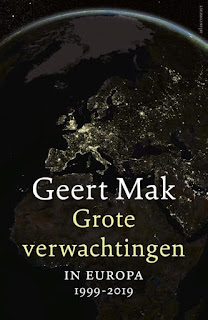
Mak, Geert "The Dream of Europe. Travels in a Troubled Continent" (Dutch: Grote verwachtingen. In Europa 1999-2019) - 2019

This book was a present by my son for Christmas. While I usually try to read Dutch books in Dutch, this was an English edition. In the end, I was not unhappy about that because now I can pass it on to my sons. They both speak Dutch but wouldn't read such a large book in that language.

I have read a few book by this fantastic journalist and author. All of them having to do with the changes of our continent in modern times. Totally interesting and very well examined and described.

He wrote this book six years ago and he predicted many events that are true today. That shows how well he observes. This can be seen as a follow-up to "In Europe. Travels through the Twentieth Century". A very-well deserved and very well executed follow-up. His observations about the first twenty years of our century are shocking and frightening. We should listen what he has to say about the future.

And here are some important quotes (from many):

"I wrote Enraged Citizens to show how it ought to be. The Capital (Die Hauptstadt)  is what it actually is." Robert Menasse

"But let all those idiots gather together in politics without sufficient resistance of any kind and you get a dictatorship of idiocy". Jacques de Kadt, Dutch essayist, in 1936

"He [one of the Republican candidates in 2015] lacked even the most basic respect for facts, institutions and democratic principles. To him, political opponents were enemies, a compromise was not a dignified agreement but a capitulation …" Doesn’t that apply to all of them???

From the back cover:

'Mak is the history teacher everyone should have had' Financial Times

How did the great European dream turn sour? And where do we go from here? From the author of the internationally acclaimed In Europe, a stunning history of our present,examining the first two decades of this most fragile and fraught new millennium. The great European project was built out of a common desire for peace, prosperity and freedom; a wish for a united Europe striving towards a common goal. The EU was to set an an arena for close cooperation, tackling crucial shared concerns from climate change to organized crime, promoting open borders and social security. But the first two turbulent decades of this century have been times of rapid and profound change. From the shores of Lampedusa to Putin's Moscow, the continent threatens to tear itself apart. What's happened to Europe's optimism and euphoria? How has it given way to nostalgia, frustration and fear, the fragile European dream in danger of turning into a nightmare?

In The Dream of Europe, Geert Mak, one of Europe's best-loved commentators, charts the seismic events that have shaped people's lives over the past twenty years. Mak's monumental book In Europe defined the continent on the verge of a new millennium. The Dream of Europe brings us up to the present day, through the rocky expansion of the EU, the aftermath of 9/11 and terrorist attacks across Europe, the 2008 financial crash and the euro crisis, the tragedy of the migrant crisis in the Mediterranean, the rise of right-wing populism and Brexit.

Like no other, Mak blends history, politics and culture with the stories and experiences of the many Europeans he meets on his travels. He brings this continent to life, and asks what role does Europe play now, and how might we face our challenges together, in the spirit of solidarity and connection.

'A powerful, humane and serious mind' Guardian

'Mak is a truly cosmopolitan chronicler' Independent"

Thursday, 4 June 2015

Mak, Geert "In Europe. Travels through the twentieth century"

Mak, Geert "In Europe. Travels through the twentieth century" (Dutch: In Europa: Reizen door de twintigste eeuw) - 2004

The 20th century. What a century it was. If we are older than 20 years, we might remember part of it. I remember the last half. The better half I would think, the peaceful half, the one where war only loomed around the corner but was never present. At least not in the part of the world where I lived.

Geert Mak is an excellent Dutch journalist who has written several non-fiction books about life in general and in particular in this part of the world (I reviewed "Jorwerd: The Death of the Village in late 20th Century" here.)

With this work he has excelled himself. He travels through Europe (not just in the book but also in real life) and describes every decade through the country he is just visiting. Some of them he has to visit several times, of course.

In any case, he gives a brilliant overview about the century that changed everyone's life (and not just that of the Europeans) forever. Let us learn from the mistakes made in the past. Reading a book like this one could help us all understanding those mistakes better and trying to avoid them for a better and more peaceful world.

See more comments on my ThrowbackThursday post in 2025.

From the back cover:

"From the First World War to the waning days of the Cold War, a poignant exploration on what it means to be European at the end of the twentieth-century. Geert Mak criss-crosses Europe from Verdun to Berlin, Saint Petersburg to Srebrenica in search of evidence and witnesses of the last hundred years of Europe. Using his skills as an acclaimed journalist, Mak locates the smaller, personal stories within the epic arc of history-talking to a former ticket-taker at the gates of the Birkenau concentration camp or noting the neat rows of tiny shoes in the abandoned nursery school in the shadow of Chernobyl. His unique approach makes the reader an eyewitness to a half-forgotten past, full of unknown peculiarities, sudden insights and touching encounters. Sweeping in scale, but intimate in detail 'In Europe' is a masterpiece."

In the meantime, the author has written a follow-up:
"The Dream of Europe" - 2019

Saturday, 14 April 2012

Mak, Geert "Jorwerd"

Mak, Geert "Jorwerd: The Death of the Village in late 20th Century" (Dutch: Hoe God verdween uit Jorwerd. Een Nederlands Dorp In De Twintigste Eeuw) - 1996

The original Dutch title is (translated) "How God disappeared from Jorwerd". The story is about a small village in Friesland and the changes it underwent in the first half of the 20th century, changing from farming to a commuting place, the influence of modern technology on a people that had lived off the land for centuries. But it is not just the story of Jorwerd, overall in Europe, the countryside changed. This little place with a population of just 700 became even smaller through the "Silent Revolution". After  more industrialization and mechanization of the farming, only about half of those people still live there, and they are getting older and older.

Geert Mak lived in the village for half a year to explore all the history and the changes. One remark I will never forget, life in a village in the Netherlands was closer to life in a village in Russia than to life in a town in the Netherlands. I think this was true overall, especially when comparing this book to that of Russian authors. "Anna Karenina" comes to mind where village and town life are described very well.

A very interesting book showing us what development and improvement has done to our lives. And the title, the more the people can rely on help from outside, the less they depend on changes of weather, etc., the fewer of them go to church and the believers attending the services are getting less and less.

This book is very interesting, no matter from which country you come, it’s a great account of the lives our grandparents still lived.

Geert Mak has carried on writing about the life of ordinary people in Europe. "My father’s century" and "In Europe. Travels through the twentieth century", both are on my reading list.

I read this in the original Dutch.

See more comments on my ThrowbackThursday post in 2025.

From the back cover:

"Born in Friesland himself, Geert Mak has returned to his roots to explore the silent revolution that took place in the small village of Jorwerd, Friesland, after World War II. He lived in Jorwerd for six months, gathering the personal stories of Jorwerters past and present, many of whom were born, lived and died there. By interweaving their colourful stories with the wider history of Europe, Mak provides an unsentimental portrayal of the pleasures and the hardships of living in the country, while illustrating at the same time how rural life everywhere is under threat from the modern world."