Showing posts with label Aliens. Show all posts

Monday, 6 September 2021

Le Guin, Ursula K. "The Left Hand of Darkness"

Le Guin, Ursula K. "The Left Hand of Darkness" - 1969

I'm not the biggest fan of science fiction but my book club seems to select one every couple of months. What can I say, some of them are quite interesting, others not so much.

"The Left Hand of Darkness" can be fascinating in many ways. There is a different kind of life on planet Winter, it is a cold life, as the name of the planet already suggests. But it's also different to our kind of life as in all its inhabitants are ambisexual. They call it differently and anyone who is just one gender (like the inhabitants of our planet, Terra) is a pervert. Maybe this would help people who consider anyone who is not straight a weirdo. Though I doubt they would read a book like this.

So, other than making us understand the LGBTQ community better, what else is there to learn from this book. Well, the Ekumen reminded me a little of the United Nations or the European Union which have the same kind of problems because everyone wants a communion but it should, please, be moulded on their own culture.

Apparently, this book belongs to a series of novels called "The Hainish Cycle" but you are not supposed to read them all in order, they are published as single novels without any follow-up of one of the stories.

And it definitely gives us food for thought about our world and all the people living in it.

Some comments from our members:

  • It gave much topics for discussion. Beside topics of what is Sci-fi, space travel, Mindspeak, gender difference, habitable ice planet, its people, politics and customs.
  • I especially found the attitude towards time and societal progress interesting.
  • IMO, her best book (not that I've read all of them) is The Lathe of Heaven. It's very different to her usual style. Highly recommend.
  • While reading "The Left Hand of Darkness" I also reviewed Ursula Le Guin's rendition of Lao Tzu's "Tao Te Ching". It made for an enriched experience to consider the plot and characters of The Left Hand of Darkness through a Taoist lens. The shifting of Gethenian power and ways has a yin-yang quality that is very true to life.

We read this in our international online book club in August 2021.

From the back cover:

"A lone human ambassador is sent to the icebound planet of Winter, a world without sexual prejudice, where the inhabitants’ gender is fluid. His goal is to facilitate Winter’s inclusion in a growing intergalactic civilization. But to do so he must bridge the gulf between his own views and those of the strange, intriguing culture he encounters...

Embracing the aspects of psychology, society, and human emotion on an alien world,
The Left Hand of Darkness stands as a landmark achievement in the annals of intellectual science fiction."

Urusla K. Le Guin has received many prizes for her works, i.a. the Hugo Award and the Nebula Award.

Thursday, 3 September 2020

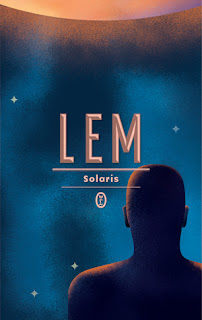
Lem, Stanisław "Solaris"

Lem, Stanisław "Solaris" (Polish: Solaris (powieść)) - 1961

If you research the author, it sounds like Stanisław Lem is one of the greatest science fiction writers ever. And I fully understand after having read this book. It is quite extraordinary and not at all like what you often find in science fiction stories.

First of all, you don't find the usual "aliens" in the book that are just humans in disguise. No, it's a completely different kind of species that Stanisław Lem comes up with. So unreal that it sounds more real than all the other science fiction stories.

There is a lot of psychology in this book, the memories of earthlings are sometimes more alien than any Babel Fish, Borg, Cat, Dalek, Droid, Ewok, Klingon, Vulcan or whatever the names of those extra-terrestrials in the popular sci-fi series are.

I'm not a huge fan of science fiction though I have read a few books that were not too bad. But this one I found fantastic, exciting, gripping, captivating, intriguing, riveting. I couldn't find enough words to express my feelings.

I totally liked this quote:

"We have no need of other worlds. We need mirrors. We don't know what to do with other worlds. A single world, our own, suffices us; but we can't accept it for what it is."

I think the author managed this very well. I am very glad that my book club chose this novel because I doubt I would have ever found or read it otherwise.

Comments from other members:

  • There was one chapter that I thought was a bit too wordy, but it's mostly an easy read.
  • I really liked the book, especially how the author talentfully built up the feeling in the story and characters and the futility and frustration of understanding an alien being.
  • We also had a good laugh about the faulty logic in the test of sanity made by Kelvin. And the possibility that the characters in the story were suffering from space-madness and possibly were a representation of high-IQ people.
  • I hadn't read it before, but had read another book by Lem called Fiasco, which I am now going to reread (I own a copy). I really liked the book, and it's also interesting for me reading a book by a Polish author, as I lived there for a little while.
  • When looking up books to read for us I always get side-tracked by a lot of articles about the book and authors. I especially thought it was interesting to learn about the different translations of the book. I read a Swedish translation made in the 70-s from French, while the Finnish translation was made from German.
    I feel the same, would love to know which translation is closer to the original.
  • Our library was unable to obtain this book for me so eventually I reluctantly read it online. I like to hold a book to get into it. I got into this book in spite of myself. It triggered reflections on our elaborate defenses against understanding reality, and against reading novels on a screen.

This was our international online book club novel in August 2020.

From the back cover:

"A classic work of science fiction by renowned Polish novelist and satirist Stanislaw Lem.

When Kris Kelvin arrives at the planet Solaris to study the ocean that covers its surface, he finds a painful, hitherto unconscious memory embodied in the living physical likeness of a long-dead lover. Others examining the planet, Kelvin learns, are plagued with their own repressed and newly corporeal memories. The Solaris ocean may be a massive brain that creates these incarnate memories, though its purpose in doing so is unknown, forcing the scientists to shift the focus of their quest and wonder if they can truly understand the universe without first understanding what lies within their hearts.
"

Monday, 3 August 2020

Stephenson, Neal "Anathem"

Stephenson, Neal "Anathem" - 2008

"The expression anathema
(ancient Greek ἀνάθημα or ἀνάθεμα "the devotee, cursing"),
also anathema, spell ray, spell of the church or
- in connection with a curse - spell curse,
denotes a condemnation by a church
that is associated with the exclusion from the ecclesial community
and canon law is to be equated with excommunication
."

I'm not a big fan of science fiction and this is certainly a book that falls under that category. However, I love dystopian literature end I think, we can easily put it into that category, as well.

It is the year 3,000 or so on the planet Arbre. All the names they use come from some earthly words, this one meaning tree, of course. People have split up into two different kind of societies, the "avout" (probably from French "avouer", to confess) who live in monastery-like world, but definitely rational, atheist, and the Sæcular, the more worldly people. The avout are the scientists who study all sorts of different things, any science we know about - and probably more.

We get to meet one of them, Erasmas, also called Raz, after having spent a year in the "concent" when they get to meet the sæcular and we can see how they usually live. After that, everything goes pear-shaped and Raz goes on the trip of a lifetime, to different planets

I loved this book. It's not about science. Or fiction. Although, if that's your preference, you might want to read this, as well. It's about philosophy, about imagination. Arbre is similar to the Earth but has taken different steps. So, you can fantasize about how we could live, how our society might look like. I also really liked digging out all the meanings of the "foreign" words.

A lot of these kind of books have it but I really appreciated the glossary in the back of the book because I could always go back to a word I didn't remember rather than having to flip to a page before where it might have been explained. Of course, it meant I read many more than those 1,024 pages because I must have read the annex about twenty times. At least!

There's even a Wiki Fandom page that explains the correlation between Earth and Arbre, links their people to famous people in our world, their languages to ours etc. and a video/trailer on YouTube.

An interesting book. I'll read more by Neal Stephenson.

From the back cover:

"Erasmas - Raz - is a young avout living in the Concent, a sanctuary for mathematicians, scientists, and philosophers, protected from the corrupting influences of the outside world by ancient stone, honoured traditions, and complex rituals. Three times during history's darkest epochs, the cloistered community has been devastated by violence. Yet the avout have always managed to adapt in the wake of catastrophe.

Now, in celebration of a week-long, once-in-a-decade rite, the avout prepare to open the concent's gates. Before the week is out, both worlds - the inner and the outer - will stand poised on the brink of cataclysmic change. Suddenly Erasmas finds himself a major player in a drama that will determine the future of his world - as he sets out on an extraordinary odyssey that will carry him to the most dangerous, inhospitable corners of the planet... and beyond."

Thursday, 6 October 2016

Adams, Douglas "The Hitch Hiker's Guide to the Galaxy"

Adams, Douglas "The Hitch Hiker's Guide to the Galaxy" - 1979

As everybody knows, I am not a huge fan of science fiction, neither on paper nor on the screen. But I thought that "The Hitch Hiker's Guide to the Galaxy" belongs to the classics and should be read by anyone who is interested in literature.

Yes, a nice little story about the "Ultimate Question of Life, the Universe, and Everything", certainly a brilliant story if you like this genre but not enough to tempt me to read the four other parts of this "trilogy". Mind you, I love Martin Freeman, so I might even watch the movie.

From the back cover:

"One Thursday lunchtime, the Earth gets unexpectedly demolished to make way for a new hyperspace bypass. It's the final straw for Arthur Dent, who has already had his house bulldozed that morning. But for Arthur, that is only the beginning .In the seconds before global obliteration, Arthur is plucked from the planet by his friend Ford Prefect - and together the pair venture out across the galaxy on the craziest, strangest road trip of all time. book."

Thursday, 20 November 2014

Bradbury, Ray "The Martian Chronicles"

Bradbury, Ray "The Martian Chronicles" - 1950

"The Martian Chronicles", a highly interesting novel about the human invasion on another planet. A dystopian novel that couldn't envisage anything better. Or worse.

The whole story is separated into several different short stories, each of which could be read separately but only together do they form a full picture of the extent what the human race can do. That doesn't mean they should necessarily do it.

I think the Martian Chronicles should be seen, as any dystopian literature, as a warning to us. The author doesn't necessarily talk about what we could be doing to the planet Mars but also about what we are doing to our own planet. If we don't stop what we are doing, we will end up like the Martians, non-existent. We should see this book as a parable and learn from it.

I loved Ray Bradbury's "Fahrenheit 451" but I think I liked "The Martian Chronicles" even better. His style is agreeable, easy to get, yet full of allusions and side remarks. Anyone who likes this sort of genre should read his books.

See more comments on my ThrowbackThursday post in 2025.

From the back cover:

"Leaving behind a world on the brink of destruction, man came to the Red Planet and found the Martians waiting, dreamlike. Seeking the promise of a new beginning, man brought with him his oldest fears and his deepest desires. Man conquered Mars - and in that instant, Mars conquered him. The strange new world with its ancient, dying race and vast, red-gold deserts cast a spell on him, settled into his dreams, and changed him forever. Here are the captivating chronicles of man and Mars - the modern classic by the peerless Ray Bradbury."

Ray Bradbury received a special Pulitzer Prize citation in 2007 for "his distinguished, prolific and deeply influential career as an unmatched author of science fiction and fantasy."