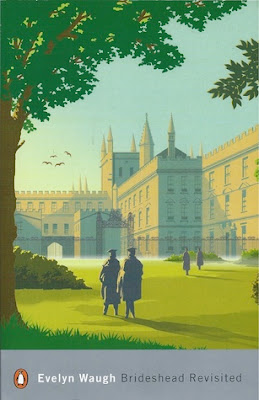
Waugh, Evelyn "Brideshead Revisited: The Sacred and Profane Memories of Captain Charles Ryder" - 1945
This was our international online book club novel for March 2022.
I don't know for how long I wanted to read this book. I never watched the TV series with Jeremy Irons and Anthony Andrews, either, even though I like most of the actors that play in it.
So, I wasn't unhappy that our book club chose it for this month.
The story reminds a little bit of the life of "The Great Gatsby", people with nothing to do than spending money. So, I couldn't say that I warmed to any of the characters, they were just spoiled brats.
However, the novel itself is beautifully written, it accentuates all the facts of life for a generation long gone and a lifestyle so out of fashion that whoever lives like that nowadays can only be ashamed. Well, with some exceptions who populate the social media, of course, and I can't warm to them, either. The names, however, could have been picked from a Dickens novel, Ryder, Flyte, Marchmain, they only had "regular" first names.
I especially like the portrayal of the change in society. Some people get there slowly but those that are kicked from their high horse have a rather hard landing to deal with.
A good modern classic that will become a good mirror of the times.
Comment from a book club member:
"The book really surprised me, in a positive way. The story was much more entertaining and interesting than I expected. I agree it really brought out the old culture and country vs. the new generation. Like you said like the Great Gatsby. I was fascinated by the difference in attitude between the upbringing styles of Charles and the aristocratic Brideshead and how the characters developed along with the story, but I also didnt get so attached to the main characters either."
From the back cover:
"The most nostalgic and reflective of Evelyn Waugh's novels, Brideshead Revisited looks back to the golden age before the Second World War. It tells the story of Charles Ryder's infatuation with the Marchmains and the rapidly-disappearing world of privilege they inhabit. Enchanted first by Sebastian at Oxford, then by his doomed Catholic family, in particular his remote sister, Julia, Charles comes finally to recognize only his spiritual and social distance from them."
Wednesday, 6 April 2022
Waugh, Evelyn "Brideshead Revisited"
Monday, 14 February 2022
Cather, Willa "Shadows on the Rock"
Cather, Willa "Shadows on the Rock" - 1931
A couple of years ago, I read "My Ántonia" with my book club and loved it. It was a great description about new settlers in America. So, when I came across "Shadows on the Rock" which was about Quebec in the 17th century, I thought this will certainly be a great book to add to my list, something like her former book, just about Canada.
I suppose the author must not have had as much experience with Canada, not known as many settlers from there or whatever but this book didn't ring as true as her other one. It was an alright read but it didn't catch my interest in the story as did her other one.
What it did, though, it made me want to know more about the real-life people she mentions and I found a lot of information about them on the internet, so that was something.
I usually love historical fiction but this one was not for me.
From the back cover:
"Willa Cather wrote Shadows on the Rock immediately after her historical masterpiece, Death Comes for the Archbishop. Like its predecessor, this novel of seventeenth-century Quebec is a luminous evocation of North American origins, and of the men and women who struggled to adapt to that new world even as they clung to the artifacts and manners of one they left behind.
In 1697, Quebec is an island of French civilization perched on a bare gray rock amid a wilderness of trackless forests. For many of its settlers, Quebec is a place of exile, so remote that an entire winter passes without a word from home. But to twelve-year-old Cécile Auclair, the rock is home, where even the formidable Governor Frontenac entertains children in his palace and beavers lie beside the lambs in a Christmas créche. As Cather follows this devout and resourceful child over the course of a year, she re-creates the continent as it must have appeared to its first European inhabitants. And she gives us a spellbinding work of historical fiction in which great events occur first as rumors and then as legends - and in which even the most intimate domestic scenes are suffused with a sense of wonder."
Monday, 29 March 2021
Rhoides, Emmanuel "The Curious History of Pope Joan"
Rhoides, Emmanuel (Emmanuel Roidis) "The Curious History of Pope Joan" (Greek: Πάπισσα Ιωάννα/Papissa Ioanna) - 1866
With my book club, I read "Pope Joan" by Donna Woolfolk Cross twenty years ago (my, how time flies!) At some point, I bought this older book about the same subject because it was on a reduced shelf in my bookshop.
Same as the first book I read, this didn't really impress me that much. Granted, there might have been a female pope, I can well believe that but the story itself wasn't too exciting. Also, I couldn't detect the humour that some people loved so much.
However, there is some information about life in the 9th century. That's always nice.
Since this was a Greek book, I read it in German. "Die Päpstin Johanna von Ingelheim"
From the back cover:
"'Pope Joan' or 'Papissa Joanna' was originally published in 1886 by the Greek author Emmanuel Royidis. It tells the story of Pope John VIII, the purported ruler of Xendom for a period of two years, five months & four days in the middle of the 9th century. 'Pope Joan' is a comic masterpiece of irreverence towards the medieval Church & the accepted pieties of its revisionist historians. Indeed, insofar as Royidis continued to propagate the legend of Pope Joan, to claim that the work contained only 'facts & events proved beyond discussion', the text itself ingeniously combines history, legend & wit to subvert claims of authority. As Durrell notes in his Preface to his English translation & adaptation, 'the authorities of the Orthodox Church were horrified by what seemed to them to be the impious irony of its author - & no less by the gallery of maggot-ridden church fathers which he described so lovingly.' Not suprisingly, Royidis was excommunicated from the Orthodox Church, his book banned in Greece.
The first three parts of 'Pope Joan' tell of Joanna prior to her arrival in Rome, before she became an historical personage. Set in the 9th century, the narrative captures Europe after the death of Charlemagne, a time when civilization was tenuous & the Church provided one of the few viable social structures. This part is the imagined story of Joanna's life in Germany & then in Greece. After her parents die, Joanna clandestinely enters a monastery where she meets the monk Frumentius & develops a romantic relationship with him. When her gender is surmised, Joanna & Frumentius flee one monastery & then another, eventually ending up in Greece. Joanna soon becomes tired of romance & her intellectual brilliance attracts the attention of Church leaders thruout Greece. She leaves Frumentius & departs alone for Rome, where the legend, some say the history, of Pope Joan begins. She becomes a papal secretary renowned for her intellect &, when Pope Leo IV dies, she ascends to the papacy. Pope Joan becomes pregnant & dies after giving birth during a procession thru Rome.
While the general outline of the narrative may seem only mildly interesting, the translation of Lawrence Durrell, together with the biting, irreverent wit of Royidis, make 'Pope Joan' a work of comic genius. A flavor for this wit & style can be found in a passage describing what ensued after Joan gave birth: 'Great was the consternation when a premature infant was produced from among the voluminous folds of the papal vestments...Some hierarchs who were profoundly devoted to the Holy See sought to save the situation & change horror & disgust to amazement by crying out A miracle! A miracle! They bellowed loudly calling the faithful to kneel & worship. But in vain. Such a miracle was unheard of; & indeed would have been a singular contribution to the annals of Xian thaumaturgy which, while it borrowed many a prodigy from the pagans, had not yet reached the point where it could represent any male saint as pregnant & bringing forth a child.'
While the apologist position has denied the historicity of Pope Joan, there is some suggestion that the legend is factual. As Durrell suggests in his Preface, one telling point is that Platina includes a biography of Pope John VIII in his 'Lives of the Popes'. The Catholic Encyclopedia states: 'Platina's Lives of the Popes is a work of no small merit, for it is the first systematic handbook of papal history. ' Historical disputation aside, however, 'Pope Joan' stands as a brilliant work of comic writing & translation."
Monday, 10 August 2020
Booth, Cathleen "Mercy & Grace on the Camino de Santiago"
"Sometimes it’s doing the thing that terrifies you that really helps you grow."
Before I begin with the review and you wonder why I'm so fascinated by this story, the author is a friend of mine. (Although, having said that, you probably won't wonder because she is a great storyteller.) For years, we've been attending the same church and since our birthdays are only a couple of days apart, we've been enjoying a coffee or lunch together in between. I have taught not just her daughter Madeleine in RE but also the other girls that walked the Camino with them. And my whole family knows all of the "Eleven Amigos", as the group called themselves (great name, by the way) and their families. They are some of the loveliest people I have ever met in my life and reading about their experience was so wonderful for me. Thank you, Cathleen, for including me in this trip in this unique way. I know I can't give you enough credit with my humble review but I hope it will instigate a few people to read the book.
And here I am right in the middle of it. I am sure anyone who reads this book must feel the same, whether you know the pilgrims or not. I knew Cathleen could write since she had written a personal blog for years (much more personal than my book blog).
In her prologue, she tells us how the idea started, how she wanted to go but was too afraid. I totally understand, I would have been, as well. Actually, I am, that's why I never went even though I know a lot of people who did. But with my back problems, I couldn't even do a quarter let alone half the walks they did, even without a backpack or "mochila". No, that train has left.
But here I am with Cathleen and her friends, listening to (or rather reading about) them as they plan and prepare their trip, as they meet to drive to the airport, as they join the next members somewhere between here and Santander. We hear about the first dinner, the first night in one of the albergues, the first breakfast. They leave the hostel every morning and walk for a while before settling down for breakfast in one of the many cafés along the way.
Their walks tend to be between twenty and thirty kilometres. Hats off, Cathleen and friends. Even though you seem to be at the end of your tether from time to time, you soldier on and don't lose sight of your goal. Together you are strong. I am also grateful that Cathleen belongs to the slower part of the group because that's where I always end up. Makes it more authentic for me.
They meet a lot of lovely people along the way. I have always heard that from anyone who walked the Camino. If you're on that way, everyone is your friend. How lovely to tackle this in such a wonderful community.
There are many wonderful stories in the book about companionship, soul-searching, finding your way to yourself and to God but there are also some hilarious stories, as well. No wonder, when Cathleen and Lila (the friend who invited her to the trip) are together. I remember having been told many of them eye-to-eye, so reading about them makes it almost as if they were here.
I know all the kids have made it into adulthood and listening to their parents they have become just as wonderful adults as they were children. Well done, everyone.
But thank you, Cathleen, for this wonderful report about your Camino. We all can learn from your big heart.
You can find more information (and more pictures) on her website.
I always enjoy reading about other parts of the world and get to know them but I also love reading about the parts that I know. And here, not only did I know all the members of the group, I also know the area where Cathleen lived (as we can see in her pictures in "Training Days", I was also there when our friend Maria showed her pictures in church which was when many of us heard from someone who had experienced the pilgrim themselves.
I also loved that Jim Forrest, another author I highly admire, wrote the introduction.
I have read another book about someone on the Camino de Santiago, German humourist Hape Kerkeling. Also, a great story about someone whose life changed after doing this spiritual journey.
Kerkeling, Hape "I'm off then: Losing and Finding Myself on the Camino de Santiago" (German: Ich bin dann mal weg. Meine Reise auf dem Jakobsweg). I think, the fact that his account has been translated into English says it all.
From the back cover:
"'Sometimes it’s doing the thing that terrifies you that really helps you grow.'
These words, spoken in love by a friend, motivated 300-pound Cathleen Booth off her couch and onto the Camino de Santiago. Cathleen’s physical limitations quickly shattered any illusions of self-sufficiency and pride. On a muddy mountainside in Spain - at her most vulnerable - Cathleen would experience from her friend a self-sacrificial love that would ultimately change her from the inside out. Equal parts humor, humility, and heart, Mercy & Grace on the Camino de Santiago invites the reader on a deeply intimate and human spiritual journey."
And if you want to know about Cathleen's sense of humour, Mercy and Grace is what she called her walking boots.
Monday, 10 April 2017
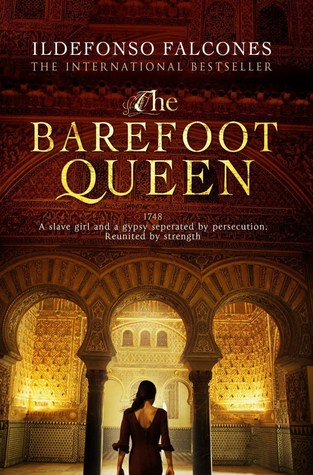
Falcones, Ildefonso "The Barefoot Queen"
As with his former books "Cathedral of the Sea" and "The Hand of Fatima", Ildefonso Falcones does not disappoint with his newest novel. Whether he talks about Barcelona in the 14th century, Muslims in the 16th century or gypsies in the 18th, he seems to know all the characters personally and introduces us to their lives and struggles. This time, it's the gypsies and their problems in a country where they are not welcome, well, where are they ever? They can't make a living by staying somewhere because they are not allowed to work in many many jobs but they also can't travel. And when the Spanish crown decides to lock them all up in order to conduct the perfect genocide. Well, luckily, there is no perfect genocide, there are always members of a race that are willing to fight until the very end.
Ildefonso Falcones is a great storyteller, he can make you love the characters and feel with them through their dramatic lives. And in addition to that, it's also a fantastic history lesson. We don't just learn about Spain in the 18th century, we also learn about slaves in Cuba, tobacco planting and and working, trading and smuggling. There is so much in this story. Even though Caridad, a former slave, is supposed to be the protagonist, her friend Milagros with her grandfather Melchor and their family are also quite important to the story.
Can't wait until his newest book "Los herederos de la tierra" (2016), the follow-up to "Cathedral of the Sea" is translated.
From the back cover:
"A historical epic full of bravery and romance that follows two women as they make a life for themselves in 18th-century Spain.
It's January of 1748. Caridad is a recently freed Cuban slave wondering the streets of Seville. Her master is dead and she has nowhere to go. When her path crosses with Milagros Carmona's-a young, rebellious gypsy-the two women are instantly inseparable. Milagros introduces Caridad to the gypsy community, an exotic fringe society that will soon change her life forever. Over time they each fall in love with men who are fiercely loyal and ready to fight to the death for their rights as a free people. When all gypsies are declared outlaws by royal mandate, life in their community becomes perilous. They soon find themselves in Madrid-a city of passion and dancing, but also a treacherous one full of smugglers and thieves. Caridad and Milagros must help in the gypsy's struggle against society and its laws in order to stay together; it's a dangerous battle that cannot, and will not, be easily won. From the tumultuous bustle of Seville to the theatres of Madrid, The Barefoot Queen is a historical fresco filled with characters that live, love, suffer, and fight for what they believe."
Wednesday, 8 June 2016
Joyce, James "A Portrait of the Artist as a Young Man"
The story of a young man trying to find himself, a story about James Joyce himself, his character Stephen Dedalus is partly autobiographical. Stephen comes from a poor Irish family who goes to a religious boarding school which he has to leave for financial reasons. He then enters another religious school where they try to convince him to become a priest. This question is very important to the author and he tries to imagine himself as a priest. But he decides that life as it is is far more interesting for him and that he wants to live it in freedom. Between all this, he goes from all sorts of religious and social questions to the meaning of life and his first attempts of becoming a writer.
The book itself is highly philosophical and one could write a whole new book about Stephen Dedalus ... well, James Joyce did. "Ulysses" was first intended to be just a short story for the collection "Dubliners" but then was written as a sequel to "A Portrait of the Artist as a Young Man".
From the back cover:
"Published in 1916, James Joyce's semiautobiographical tale of his alter ego, Stephen Dedalus, is a coming-of-age story like no other. A bold, innovative experiment with both language and structure, the work has exerted a lasting influence on the contemporary novel.
'Joyce dissolved mechanism in literature as effectively as Einstein destroyed it in physics,' wrote Alfred Kazin. 'He showed that the material of fiction could rest upon as tense a distribution and as delicate a balance of its parts as any poem. Joyce's passion for form, in fact, is the secret of his progress as a novelist. He sought to bring the largest possible quantity of human life under the discipline of the observing mind, and the mark of his success is that he gave an epic form to what remains invisible to most novelists.... Joyce means many things to different people; for me his importance has always been primarily a moral one. He was, perhaps, the last man in Europe who wrote as if art were worth a human life.... By living for his art he may yet have given others a belief in art worth living for."
See more comments on my ThrowbackThursday post in 2026.
Tuesday, 29 December 2015
Kerkeling, Hape "I'm off then"
I am Catholic. But I would have never even thought about doing a pilgrimage and certainly not one like this one, described by a German comedian. Yes, true, a comedian who makes the Camino de Santiago. And not just the last 100 kilometres but the whole way from the French border, 800 kilometres entirely.
Why did I pick up this book? It is a very popular book in Germany and a lot of people have been talking about it. But mainly, I love the author, he is one of the funniest guys alive, one of the best German comedians. I know, a lot of my foreign friends will say "German comedian?" Isn't that a contradiction in terms? But believe me, if only you would understand him, you'd laugh just as much as all his fans.
Personally, I know quite a few people who have undertaken the pilgrimage after reading the book, or after seeing other people who had read the book doing it. So, on the whole, he did a great job, is probably one of their best promoters.
But even if you're not Catholic or German, this is a fantastic book. It tells us about what we can achieve. I know I would never be able to achieve what Hape (Hans-Peter) Kerkeling did, wouldn't have the time to do it all in one go, for example, but he gives us hope, he describes a fantastic journey through a very interesting part of our continent, tells us about friendships he made along the way and how he had to fight with a big enemy - himself.
And since the book has been translated into several languages in the meantime, there is no reason why you shouldn't start it. (I just hope the translations are good.) I will certainly look out for more books by one of my favourite comedians.
See more comments on my ThrowbackThursday post in 2025.
From the back cover:
"I'm Off Then has sold more than three million copies in Germany and has been translated into eleven languages. The number of pilgrims along the Camino has increased by 20 percent since the book was published. Hape Kerkeling's spiritual journey has struck a chord.
Overweight, overworked, and disenchanted, Kerkeling was an unlikely candidate to make the arduous pilgrimage across the Pyrenees to the Spanish shrine of St. James, a 1,200-year-old journey undertaken by nearly 100,000 people every year. But he decided to get off the couch and do it anyway. Lonely and searching for meaning along the way, he began the journal that turned into this utterly frank, engaging book. Filled with unforgettable characters, historic landscapes, and Kerkeling's self-deprecating humour, I'm Off Then is an inspiring travelogue, a publishing phenomenon, and a spiritual journey unlike any other."
Wednesday, 5 August 2015
Schoemperlen, Diane "Our Lady of the Lost and Found"
This was one of the books a friend left behind when she moved and said she thought I might like it. I don't think I would have picked it myself because it seemed to me like chick lit crossed with a religious theme. Breakfast with Mother Mary. Or something like that.
And it reads a little like that. I still couldn't say this was one of my favourite books but it had something. The information about the Virgin Mary, for example, the author puts together a list of Marian apparitions and other stories around her. That I found quite interesting.
From the back cover:
"On a Monday morning in April, a middle-aged writer finds a woman standing in front of the fig tree in her living room. The woman is wearing a navy blue trench coat and white Nikes, and is carrying a small black suitcase. She is the Virgin Mary and, she explains, after 2,000 years of petition, adoration and travel, she is in need of some R&R.
In Our Lady of the Lost and Found, Diane Schoemperlen has created a profound and original novel that captures the hearts and imagination of readers. Now available with a P.S. section featuring insightful background material, this captivating story is an exploration of our capacity for faith and of the miracles of daily life."
Two books are mentioned in the book, books the author supposedly reads before and during Mary's visit:
Allende, Isabel "The House of the Spirits"
Grunwald, Lisa "The Theory of Everything"
And there was an interesting passage I would like to quote: "For those with a bookish bent, reading is a reflexive response to everything. This is how we deal with the world and anything new that comes our way. We have always known that there is a book for every occasion and every obsession. When in doubt, we are always looking things up."
I couldn't agree more!
Wednesday, 1 October 2014
McCullough, Colleen "The Thorn Birds"
I read this book years ago, shortly after the mini series came out in 1983. However, I am sure that I read it in German at the time because I wasn't able to get English books that easily back then. Or at all.
I wanted to reread the novel for ages and now I finally achieved that.
I think we can easily call this book an epic saga. The story of the Cleary family over two generations coming from New Zealand to Australia in the early Twenties of the last century and also moves to London and Rome. But the main story is told in New Zealand, how a family settles in a strange country and goes through all the hardships you can imagine.
The story touches almost every topic you can imagine, well, there are over 700 pages, so there is space for a lot of drama. It is so well written. The characters come alive in a way that makes you feel you know them personally. You fear with them, you rejoice with them. You feel sorry for them when something bad happens. And there is plenty of bad stuff to happen to a family like that but there are also some quite unexpected parts, roads this story takes that you don't think it would.
I especially loved it because it shows the hardships people went through when settling in a new continent. Even though the Clearys were not the first settlers, there was still a lot to overcome, both in New Zealand as well as in Australia. Some things we should not forget nowadays where all these countries have all the modern facilities imaginable.
Anyway, if you love chunky books and would like to read about Australia, this is a wonderful book, whether you have seen the series or not. Read it. You won't regret it. Maybe it's time to get the DVD out again, as well.
As powerful, moving, and unforgettable as when it originally appeared, THE THORN BIRDS remains a novel to be read…and read again."
Monday, 25 February 2013
Ansay, A. Manette Vinegar Hill"
It is always amazing to see how much a person can endure. And how long they can watch to see how their loved ones, their children, can go through hard times.
The story of Ellen and her husband who move in with his parents is that of a lot of women in the seventies, not enough money to raise their family, so moving in with the parents seems like a good idea. Well, not exactly but it seems like the only idea.
The story is told with a lot of detail, yet very flowing. The language is beautiful, the author manages to build anticipation, to make the book exciting from the first line to the last. No wonder Oprah chose this for her list.
See more comments on my ThrowbackThursday post in 2025.
From the back cover:
"In a stark, troubling, yet ultimately triumphant celebration of self-determination, award-winning author A. Manette Ansay re-creates a stifling world of guilty and pain, and the tormented souls who inhabit it. It is 1972 when circumstance carries Ellen Grier and her family back to Holly's Field, Wisconsin. Dutifully accompanying her newly unemployed husband, Ellen has brought her two children into the home of her in-laws on Vinegar Hill -- a loveless house suffused with the settling dust of bitterness and routine -- where calculated cruelty is a way of life preserved and perpetuated in the service of a rigid, exacting and angry God. Behind a facade of false piety, there are sins and secrets in this place that could crush a vibrant young woman's passionate spirit. And here Ellen must find the straight to endure, change, and grow in the all-pervading darkness that threatens to destroy everything she is and everyone she loves."
Sunday, 18 November 2012
Lukefahr, Oscar, C.M. "We Worship"
Oscar Lukefahr is a well known Catholic priest and theologian in the United States. He has written several books about the Catholic faith, including "We Believe... A Survey of the Catholic Faith". In this book, he doesn't just explain how a Mass is set up but also what it means and why every Catholic should attend it. He answers a lot of questions people have about the set-up of Mass and also its spiritual meaning. It can also be used for teaching anyone who wants to know more about the Catholic Mass.
From the back cover:
"This edition is newly updated with the Roman Missal, Third Edition
What is the Mass? The one thing Jesus asked us to do for him! In a warm and down-to-earth manner, Father Oscar Lukefahr presents a positive and enriching look at the Mass and its significance. Using examples from the lives of real people, he provides
- Solid reasons for attending Mass
- A look at the fascinating history of the Mass through the centuries
- A step-by-step guide to the Mass according to the NEW General Instruction of the Roman Missal, Third Edition
- Suggestions for participation that open mind and heart to the full meaning of the Mass
- What Jesus really meant by "this is my body...this is my blood"
- Frequently asked questions about the Mass
- Practical steps for building a solid Catholic spirituality on the foundation of the Eucharist
Each chapter concludes with questions for discussion and refl ection (useful for group participation or personal study) and with activities to help readers apply what they learn to everyday living.
Readers of this book will learn to experience and love the Mass. We Worship will be welcomed by all who want to deepen their appreciation of Mass and by those looking for reasons to return to the Eucharist. Catechists will find in it a complete, easily understandable tool that will appeal to teens and adults."
Lukefahr, Oscar, C.M. "We Believe"
Oscar Lukefahr is a Catholic priest and a very well known theologian in the United States. In this book, he gives a good overview about what Catholicism means, a good information for Catholics and non-Catholics who want to know more about the belief. He refers to the Catechism of the Catholic Church and gives on overview about the Bible, the history of Catholicism and how it can be incorporated into modern day life.
A very helpful book, 200 pages of theology for lay people. Easy to understand, it answers a lot of questions you always had about "God, the Bible, the life and teaching of Jesus, the Church, Mary, the saints, life after death, the Sacraments, moral living, and Catholic prayer".
From the back cover:
"This bestselling guide to the Catholic faith has been revised and cross-referenced to the Catechism of the Catholic Church and to follow the four main divisions of the Catechism (Belief, Worship, Christian Life, and Prayer).
Father Lukefahr, an expert on Catholic theology, provides an overview of the Catholic faith in an easy-to-understand format that touches on the important elements of belief and practice.
Catholics and non-Catholics alike can learn how to be more faithful to Christ: in thinking about the meaning of life, in loving God and neighbor, and in experiencing life as a precious and wonderful gift from God. Each chapter touches on contemporary Catholic teaching - -faithful to Scripture and Tradition - and discusses such topics as
The Bible as a Faith
History How Catholics Interpret the Bible
The Life and Teachings of Jesus
The Christian Life
Heaven, Hell, and Purgatory
Church History/Tradition
Salvation Prayer
Mary and the Saints
The Sacraments
Thought-provoking activities and questions are included at the end of each chapter for both individual and group discussion."
The author has also written a good book about the Catholic Mass "We Worship: A Guide to the Catholic Mass".
Thursday, 9 August 2012
Carroll, James "Practicing Catholic"
Carroll, James "Practicing Catholic" - 2009
An interesting perspective of an ex-priest but still very much practicing catholic who has a great knowledge about Catholicism. I learned a lot from this book both about the spiritual as well as the practical and historical side of my belief.
From the back cover:
"James Carroll turns to the notion of practice - both as a way to learn and a means of improvement - as a lens for this thoughtful and frank look at what it means to be Catholic. He acknowledges the slow and steady transformation of the Church from its darker, medieval roots to a more pluralist and inclusive institution, charting along the way stories of powerful Catholic leaders (Pope John XXIII, Thomas Merton, John F. Kennedy) and historical milestones like Vatican II. These individuals and events represent progress for Carroll, a former priest, and as he considers the new meaning of belief in a world that is increasingly as secular as it is fundamentalist, he shows why the world needs a Church that is committed to faith and renewal."
Sunday, 22 April 2012
Forest, Jim "The Ladder of the Beatitudes"
Forest, Jim "The Ladder of the Beatitudes" - 1999
Another great book by Jim Forest. If you want to explore Christianity, if you want to get closer to your religion, these are the books you should read. Jim has a great way of describing any part of our belief in giving real life examples and explaining scripture drawing from his own experiences and/or those of friends. His books are easy to read but not an easy read.
In this work, he describes the Beatitudes. For those who don’t know what that means, I am sure you have heard the words "Blessed are the poor in spirit".
A lot of topics in this book speak to me. I just want to quote and comment on one issue I found on page 49: "Few aspire to humility; we prefer being proud. 'I'm proud to be .... (fill in the blank).' We’re proud of who we are, what we’ve done, the national or ethnic group to which we happen to belong. Coming from 'humble origins' means not being born with a silver spoon in your mouth but, through perseverance and hard work, leaving poverty behind and achieving things to be 'proud of'."
I have a huge problem with racism and I believe that patriotism is the first step towards it, same as being proud of anything we haven't done ourselves. Jim Forest just knows how to express this in much a better way than I ever will be able to.
How can you not admire this guy?
From the back cover:
"Drawing on stories from the lives of the saints, scripture, and everyday life, Jim Forest opens up the mysteries of the beatitudes. These ancient blessings, with which Christ began his Sermon on the Mount, are all aspects of communion with God. As Forest shows, they are like rungs on a ladder, each one leading to the next. They appear at the doorway of the New Testament to provide an easily memorized summary of everything that follows, right down to the crucifixion ('Blessed are you who are persecuted') and the resurrection ('Rejoice and be glad')"
Also read: "Praying with Icons", "The Road to Emmaus. Pilgrimage as a Way of Life" and "Confession. Doorway to Forgiveness".
Thursday, 5 January 2012
Löwenstein, Anna "The Stone City"
I love historical novels, this book appeared in Esperanto, I even know the author, so, of course, I had to read this book. Granted, I usually prefer to read books in the original but since this one has been translated by the author herself and I know how perfect her Esperanto is, I gave it a try. And have not been disappointed.
A gripping story that exists in three parts and every single one is just as exciting as the other ones. A young girl, Bivana, grows up in Britain in the first century. We learn a lot about the lifestyle of this Celtic people. The Romans arrive and capture her. She is transported to a place outside of Rome and has to work as a slave. Again, a great description of life in a Roman villa and the fate of Barbara, how the Romans call our heroine, and various other slaves. The last part is in Rome itself where we see the first steps of Europe into Christianity. Incredible how much the author managed to put into one book, there is so much material, it certainly could have been three books. But I am glad this was all united in one.
If you can get a hold of this book, it is definitely worth reading.
See more comments on my ThrowbackThursday post in 2024.
From the back cover:
"Snatched from her peaceful homestead in Celtic Britain, Bivana is transported to the legendary city of Rome. Struggling to come to terms with the loss of everyone and everything she has ever known, but determined to survive, she slowly adapts to a life of slavery and to the alien culture which surrounds her. Her relationship with the slave Philon seems to promise a fresh start, but it also brings her into contact with the Nazarenes, activists in a fanatical new religious movement. When her own family is drawn into a clash with the authorities, she is forced to draw on all her resources to save them. --- Since its first publication in 1999, 'The Stone City' has become well known and loved in its Esperanto translation, and has been translated by fans into French and Hungarian. This revised edition of the original English version includes several additional scenes."
Visit the author's website here.
Friday, 9 December 2011
Ilibagiza, Immaculée "Our Lady of Kibeho"
I read Immaculée Ilibagiza's harrowing tale of the genocide in Rwanda "Left to Tell: Discovering God Amidst the Rwandan Holocaust" which was written before this one but happened later. During the first book I was always amazed about her faith, her indistructible faith in God that he would spare her. How could someone so young be so faithful?
After reading this book, I am not surprised. She was born like that, her family was very religious and then she saw the visionaries.
A remarkable book by a remarkable young woman.
See more comments on my ThrowbackThursday post in 2023.
From the back cover:
"Thirteen years before the bloody 1994 genocide that swept across Rwanda and left more than a million people dead, the Virgin Mary and Jesus Christ appeared to eight young people in the remote village of Kibeho. Through these visionaries, Mary and Jesus warned of the looming holocaust, which (they assured) could be averted if Rwandans opened their hearts to God and embraced His love.
Mary also sent messages to government and church leaders to instruct them how to end the ethnic hatred simmering in their country. She warned them that Rwanda would become "a river of blood"-a land of unspeakable carnage-if the hatred of the people was not quickly quelled by love. Some leaders listened, but very few believed. The prophetic and apocalyptic warnings tragically came true during 100 horrifying days of savage bloodletting and mass murder.
Much like what happened at similar sites such as Fátima and Lourdes, the messengers of Kibeho were at first mocked and disbelieved. But as miracle after miracle occurred in the tiny village, tens of thousands of Rwandans journeyed to Kibeho to behold the apparitions. After the genocide, and two decades of rigorous investigation, Our Lady of Kibeho became the first and only Vatican-approved Marian (related to the Virgin Mary) site in all of Africa. But the story still remained largely unknown.
Now, however, Immaculée Ilibagiza has changed all that. She has made many pilgrimages to Kibeho, both before and after the holocaust, has personally witnessed true miracles, and has spoken with a number of the visionaries themselves. What she has discovered will deeply touch your heart!"
Friday, 25 November 2011
Harris, Joanne "Chocolat"
I read this book quite a while ago when everyone was raving about it. Actually, it was one of my former book club reads. I liked it all right but couldn't possibly think why everyone was just praising it so much. The story itself was not so absolutely new or interesting, the writing was alright but nothing of the ordinary. As I said, it was alright but that was it.
Then I happened to watch the movie. Don't remember why because usually I wouldn't necessarily watch a movie after I didn't like the book in the first place. But I watched it and I loved it. Probably due to the actors, they were all great. This is the only story I can think of where I liked the move better than the book.
See more comments on my ThrowbackThursday post in 2024.
From the back cover:
"Chocolat begins with the arrival in a tiny French village of Vianne Rocher, a single mother with a young daughter, on Shrove Tuesday. As the inhabitants of Lansquenet-sous-Tannes clear away the remains of the carnival which heralds the beginning of Lent, Vianne moves with her daughter into a disused bakery facing the church, where Francis Reynaud, the young and opinionated curé of the parish, watches her arrival with disapproval and suspicion."
We read this in our Dutch International Women's Book Club in 2000/2001.
I also read "Five Quarters of the Orange", "Coastliners", and "Blackberry Wine".
Read more about her other books here.
Brecht, Bertolt "Life of Galileo"
An epic play about the life of Galileo Galilei, his discoveries, his conflicts with the Catholic Church, his conflicts with himself and the rest of the world. Brecht wrote this in exile in Denmark and later translated it into English himself.
I am not a big fan of reading plays, they should be played rather than read, in my opinion. However, I think this play is a lot more, Brecht doesn't' just write about the conflicts of Galileo, he writes about his own conflicts with his home country, with the evil that was going through it at the time, so it is a very interesting story and a very worthy book to read.
See more comments on my ThrowbackThursday post in 2024.
From the back cover:
"Along with Mother Courage, the character of Galileo is one of Brecht's greatest creations, immensely live, human and complex. Unable to resist his appetite for scientific investigation, Galileo's heretical discoveries about the solar system bring him to the attention of the Inquisition. He is scared into publicly abjuring his theories but, despite his self-contempt, goes on working in private, eventually helping to smuggle his writings out of the country.
As an examination of the problems that face not only the scientist but also the whole spirit of free inquiry when brought into conflict with the requirements of government or official ideology, Life of Galileo has few equals.
Written in exile in 1937-9 and first performed in Zurich in 1943, Galileo was first staged in English in 1947 by Joseph Losey in a version jointly prepared by Brecht and Charles Laughton, who played the title role. "
Thursday, 17 November 2011
Schmitt, Éric-Emmanuel "Oscar and the Lady in Pink"
Same as in "Monsieur Ibrahim and the Flowers of the Koran" (Monsieur Ibrahim et les fleurs du Coran), Éric-Emmanuel Schmitt introduces his readers to a religion through the eyes of a child. This time, he talks about Christianity. Oscar is a ten-year old boy who suffers from cancer. The Lady in Pink is one of the nurses in a pink uniform who visits him every day. She suggests he write letters to God. It is interesting to follow Oscar's thoughts through his illness, perhaps his last days on earth. I read somewhere that this is a story about acceptance. True.
My favourite quote from the book: "My illness is part of me. They shouldn't behave differently because I'm ill. Or can they only love me when I'm well?" Good question, Oscar.
See more comments on my ThrowbackThursday post in 2024.
From the back cover:
"Oscar is dying. One of the 'ladies in pink' who come to visit the patients, makes friends with him. She suggests that he should pretend that each of the following 12 days is a decade of his imaginary life. Oscar writes ten letters to God that are sensitive, funny, heartbreaking and, ultimately, life-affirming."
We discussed this in our international book club in May 2016.
Friday, 11 November 2011
Forest, Jim "Confession"
I have read a couple of Jim Forest's books in my church group. I have also had the pleasure to meet this wonderful man and interesting writer.
Jim Forest is Orthodox and has written a lot of books on parts of the liturgy that is dear to any Catholic as well.
In this book, he writes about one of our sacraments that is often forgotten nowadays, confession. He gives examples through the bible and other literature, the saints and a lot of related stories, almost like parables. His writing is in such a way that it makes you think, no, reflect on every little part he says, a lot of it stays with you for a long time.
From the back cover:
"Once a defining feature of Christian life, the practice of Confession has largely faded in recent years. And yet, without an acknowledgment of sin and the longing for forgiveness and reconciliation the Gospel makes little sense. In Confession Jim Forest offers a moving reappraisal of this neglected sacrament, drawing on scripture, the lives of the saints, and a wealth of personal stories. From St. Augustine and St. Paul, to Dorothy Day, Thomas Merton, and Dostoevsky, Forest shows how the practice of confession draws us deeper into a loving relationship with God, the body of Christ, and our fellow sinners."
Jim Forest and his wife Nancy have also a very good website about all their works:
If you want to know more about Christianity, this is the guy to read. We also read and discussed "The Road to Emmaus. Pilgrimage as a Way of Life". I also read and loved "Praying with Icons" and "The Ladder of the Beatitudes".