Showing posts with label Love. Show all posts

Monday, 8 June 2026

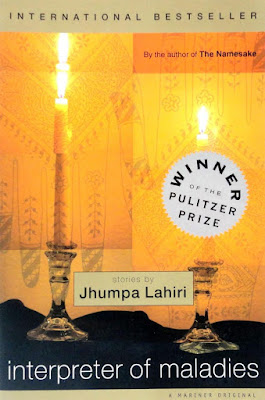
Lahiri, Jhumpa "Interpreter of Maladies"

Lahiri, Jhumpa "Interpreter of Maladies" - 1999

I have read this book in 2015. This was my review back then:

"As most of my friends know, I am not a big fan of short stories. However, I read 'The Namesake' by the same author and really loved it. And several of my friends had recommended 'Interpreter of Maladies' to me, one had even left a copy to me when she was moving, I just had to read it.

I was pleasantly surprised. What a lovely collection of short stories, some of them even interlink, so it doesn't seem like there are a hundred small stories that you forget right away. On the contrary, Jhumpa Lahiri has created some wonderful characters that you won't forget that easily. She incorporates all sorts of problems anyone might face who lives in a culture different from the one they or their parents grew up with. She describes some lovely people (and some not so lovely ones) who are all confronted with a life in two different parts of this world. Since the author is Indian herself and grew up in the United States, this is the background to almost all her stories. Having lived abroad (though not in such a different culture as the characters in the book) almost half of my life myself, I can certainly relate to a few of them.

Jhumpa Lahiri has a good, elegant style, her stories just flow, I will certainly read more of her writings."

A while ago, I joined an online group called Literary Wives/Marriage Plot and this was the next book on our list. So, I re-read the book because it was a while ago that I read it and we read it with a different topic in mind. What does the author say about the wives in his book?

Most of these stories take place in India and/or around Indian couples.

A Temporary Matter

We look at the end of a marriage. A couple suffers from the loss of a baby that was stillborn. They have nothing to say to each other even though they try hard.

When Mr. Pirzada Came to Dine

In this story, a woman remembes a man from East Pakistan/Bangladesh coming to visit her Indian family in the States while his family is back home. It is more a story about the man than about this particular wife but it still gives us an insight into the life of the Indian wives in the US.

Interpreter of Maladies

This is about an Indian American family visiting the country of their heritage. We learn even more about the life of such a wife, she is so lonely. I can relate because as a non-working wife abroad, you don't have the sort of social life your husband and children have and it is hard work to try and find your place.

A Real Durwan (doorkeeper)

This story is about an elderly woman who is a stairsweeper and lives on the roof ot the building she works in.

While this is less about the situation of a wife, it tells us about poverty and how you can be even poorer than all the others around you.

Sexy

We're back in the US. Again, not the story of a wife but of a mistress. And of a husband who is leaving his wife. A good reflection about this kind of situation from every point of view, the wife and the mistress. 

Mrs. Sen's

Her we have the story of an Indian woman living in the States who doesn't drive and doesn't have any contact outside the house. She looks after an eleven year old boy after school and teaches him about their food. Probably one of my favourite stories. I really felt for the lady.

This Blessed House

A yound married Indian couple in Connecticut who moves into their new house and find many Christian relics. The wife puts them on the mantel of the fireplace. A good story about how different people can have different opinions about what to keep and what not and what to embrace. And how they have to work on your marriage.

The Treatment of Bibi Haldar

A woman suffers from seizures and a doctor recommends to marry her off. But it costs money to get married and you have to find a suitor. So, her relatives rather let her live on the roof. This story focuses on the treatment of illness and of prejudices.

The Third and Final Continent

This guy has moved from India to London and then to the States where he rents a room from a 103-year-old lady. They develop a good connection until he gets married and moves out. We follow his and his wife's life and how they get to know each other.

As I mentioned in the stories, they are not all about the wives, some of them don't relate to their status at all, they are just there. But where they are mentioned, we learn a lot about the differences between Indian and (mainly) American wives, their rights and their duties.

I think it also helps to understand why immigrants so often stay among themselves. It is not just about the language, though that doesn't help if nobody teaches them the host language, it is more about the culture and understanding each other. Especially the wives are invisible, they disappear in the crowd. Especially if it has been an arranged marriage, the husband often doesn't understand his wife.

From the back cover:

"Navigating between the Indian traditions they've inherited and the baffling new world, the characters in Jhumpa Lahiri's elegant, touching stories seek love beyond the barriers of culture and generations. In 'A Temporary Matter,' published in The New Yorker, a young Indian-American couple faces the heartbreak of a stillborn birth while their Boston neighborhood copes with a nightly blackout. In the title story, an interpreter guides an American family through the India of their ancestors and hears an astonishing confession. Lahiri writes with deft cultural insight reminiscent of Anita Desai and a nuanced depth that recalls Mavis Gallant."

Jhumpa Lahiri received the Pulitzer Prize for "Interpreter of Maladies" in 2000.

And here are the reviews of the other literary wives:

Becky from Sydney of Aidanvale

Kate from Melbourne of booksaremyfavoriteandbest

Rebecca from Maryland, USA of Bookish Beck

Kay from Washington State, USA of What? Me Read?

Wednesday, 11 March 2026

Turgenev, Ivan "Fathers and Sons"

Turgenev, Ivan "Fathers and Sons" (Russian: Отцы и дети/Otzy i deti) - 1862
I love Russian authors, as all my friends know. But I had never read a book by Turgenjew. So, I was happy that #2 was chosen for our classic spin this term.

Was it as good as most of the other Russian authors I read? Yes, it was. I loved reading about life in Russia in the middle of the nineteenth century, when times started to change, farmers got more freedom, serfdom started to be abolished and the whole order of society was questioned.

Almost any kind of character was described in this book, diffferent ages, different social status, different education, different housholds, town and countryside, students and farmers, parents and children, women and men (which doesn't happen often in those books).

According to Wikipedia, this is considered the first modern Russian novel. I can well believe that. Changes were coming and the author managed to put that situation to paper.

In any case, I can highly recommend this book. And not just to those who love classics and/or Russian literature.

From the back cover:

"Bazarov—a gifted, impatient, and caustic young man—has journeyed from school to the home of his friend Arkady Kirsanov. But soon Bazarov’s outspoken rejection of authority and social conventions touches off quarrels, misunderstandings, and romantic entanglements that will utterly transform the Kirsanov household and reflect the changes taking place across all of nineteenth-century Russia.

Fathers and Sons enraged the old and the young, reactionaries, romantics, and radicals alike when it was first published. At the same time, Turgenev won the acclaim of Flaubert, Maupassant, and Henry James for his craftsmanship as a writer and his psychological insight. Fathers and Sons is now considered one of the greatest novels of the nineteenth century.

A timeless depiction of generational conflict during social upheaval, it vividly portrays the clash between the older Russian aristocracy and the youthful radicalism that foreshadowed the revolution to come—and offers modern-day readers much to reflect upon as they look around at their own tumultuous, ever changing world."

Here are all the books on my original Classics Club list.
And here is a list of all the books I read with the Classics Spin.

Wednesday, 18 February 2026

Garmus, Bonnie "Lessons in Chemistry"

Garmus, Bonnie "Lessons in Chemistry" - 2022

A member of my German book club had suggested this book  but despite everyone agreeing to it at first, it wasn't chosen in the end. But I had already ordered the book, so I wanted to read it.

It certainly would have been a good choice to discuss. I doubt I would have chosen it, had I only seen the cover. On the other hand, I suppose those people who are looking for a romantic chick lit, might be disappointed.

It's hard to describe this book. I would probably declare it as chick-lit though it has some deeper meanings. However, I did like the protagonist a lot, I wish I would have had an Elizabeth Zott in my life when growing up. Even though I am certainly about a decade younger than her, all those obstacles that were placed in the way of women were still around. And there was nobody, absolutely nobody who supported me in my education, not my parents and definitely not my teachers (except for the one in elementary school but he wasn't there anymore later). On the contrary, all I heard was "you will get married and don't need a job". And my boss got a guy in from outside instead of promoting me. For the same reason.

Same as Elizabeth, I had the feeling my whole life that I worked for men less intelligent than me.

The books is described as humorous and there are certain aspects of humour in it, but overal, the sadness is more important and stays more in our memories.

Maybe this story speaks more to a younger audience, it just brought too many bad memories for me. (Although that speaks in favour of the book.) I wouldn't say I disliked the book completly, but it brought me back to a time I'd rather forget. I would have loved to discuss it with my book club and hear what the other women have to say about it.

And last, but not least, some things have changed but not enough. What do you think???

From the back cover:

"Chemist Elizabeth Zott is not your average woman. In fact, Elizabeth Zott would be the first to point out that there is no such thing.

But it's the early 1960s and her all-male team at Hastings Research Institute take a very unscientific view of equality. Forced to resign, she reluctantly signs on as the host of a cooking show, Supper at Six. But her revolutionary approach to cooking, fuelled by scientific and rational commentary, grabs the attention of a nation. Soon, a legion of overlooked housewives find themselves daring to change the status quo. One molecule at a time."

"Lessons in Chemistry" has been chosen favourite book of the year 2022 by the German Indepent Book Shops.

Monday, 22 September 2025

Benedetti, Mario "The Truce"

Benedetti, Mario "The Truce" (Spanish: La Tregua) - 1960

Diana from Thoughts on Papyrus recommended this book to me. It's not very long, so I read it in between other things. Despite its brevity, it contains a lot, practically everything you need for a long life.

It's about a man nearing retirement. Well, much earlier than most people retire, but the situation is still realistic. He's wondering what he's going to do with the rest of his life. Then he falls in love with a co-worker, and she falls in love with him. After raising his three children alone after the untimely death of his wife, this is a new beginning for him.

In his diary, we can follow his thoughts. It also deals with religion; among other things, he says: "Frankly, I don't know if I believe in God. Sometimes I think that if God really existed, such doubts shouldn't upset him." I think this quote alone says a lot about the book, which I really enjoyed. It's a calm narrative that nevertheless has a lot to say.

From the back cover:

"'Perhaps that moment had been exceptional, but still, I felt alive. That pressure on my chest means being alive.' Forty-nine, with a kind face, no serious ailments (apart from varicose veins on his ankles), a good salary, and three moody children, widowed accountant Martín Santomé is about to retire. He assumes he'll take up gardening, or the guitar, or whatever retired people generally do. What he least expects is to fall passionately in love with his shy young employee Laura Avellaneda. As they embark upon an affair, happy and irresponsible, Martín begins to feel the weight of his quiet existence lift - until, out of nowhere, their joy is cut short. The intimate, heartbreaking diary of an ordinary man who is reborn when he falls in love one final time, this beloved Latin American novel has been translated into twenty languages and sold millions of copies worldwide."

Monday, 15 September 2025

Dostoevsky, Fyodor "A Little Hero"

Dostoevsky, Fyodor "A Little Hero" (Russian: Маленький герой/Malen'kiy geroy) - 1857

Novel in Nine Letters - 1847
A Gentle Creature - 1876
A Little Hero - 1849

This booklet consists of three short stories, but I liked the "Novel in Nine Letters" the best. It's the correspondence between two men who somehow always manage to miss each other. 

Dostoevsky said of this: "When I was penniless the other day, I visited Nekrasov. While I was sitting with him, the idea came to me to write a novel in nine letters. When I returned home, I finished the novel in one night. In the morning, I brought the manuscript to Nekrasov and received 125 rubles for it."

In this story, you can tell that Pyotr Ivanych wants something from Ivan Petrovich and vice versa. One excuse for why the meeting doesn't take place follows another. Very funny.

I had already read "The Gentle One" in another collection. (see here) Also an interesting story about the beginning and end of a relationship and how it all came about.

I found the actual story, or rather the one that adorns the title, rather boring. An eleven-year-old falls in love with his cousin, and the "gentlewomen" of society make this the subject of their amusement, making fun of him, and embarrassing him. Nevertheless, it's a Dostoyevsky story and therefore worth reading in its own right.

From the back cover:

"At that time I was nearly eleven, I had been sent in July to spend the holiday in a village near Moscow with a relation of mine called T., whose house was full of guests, fifty, or perhaps more.... I don't remember, I didn't count. The house was full of noise and gaiety. It seemed as though it were a continual holiday, which would never end. It seemed as though our host had taken a vow to squander all his vast fortune as rapidly as possible, and he did indeed succeed, not long ago, in justifying this surmise, that is, in making a clean sweep of it all to the last stick."

Wednesday, 10 September 2025

Dickens, Charles "Martin Chuzzlewit"

Dickens, Charles "Martin Chuzzlewit. The Life and Adventures of Martin Chuzzlewit" - 1843-44 

I'm a huge fan of Charles Dickens and am glad I read this novel. But I wouldn't recommend it if you haven't read anything else by him. For me, this was one of his worst novels.

Too many characters, even though he was able to include many interesting names. This also meant that some things got lost, such as the main love story, which is what everything supposedly revolves around. But it's barely portrayed. We hardly see the couple together. Otherwise, too much confusion, chaos, one catastrophe after another.

I read somewhere that this is Dickens' most underrated book. I wouldn't say that; I think it landed exactly where it belongs, somewhere at the very bottom of all his fantastic books.

I recommend "David Copperfield" for starters.

From the back cover:

"Old Martin Chuzzlewit believes that greed is so endemic in his family that he disinherits his grandson and hinders his courtship of Mary Graham. As the intricacies of he plot develop the story passes from sunny comedy to the grimmest depths of criminal psychology. Domestic tyranny is tellingly depicted through the household of Mr Pecksniff and public villainy - leading to blackmail and  murder - revealed in the activities of the Anglo-Bengalee Disinterested Loan and Life Assurance Company...

A brilliant satire on selfishness and hypocrisy revolving around a stubborn young protagonist. Martin Chuzzlewit is also one of Dickens's comic masterpieces. Peopled with a cast of characters - including Mrs. Gamp, Poll Sweedlepipe, Montague Tigg and Chevy Slyme - unequalled elsewhere in his novels."

Friday, 18 April 2025

Hislop, Victoria "The Figurine"

Hislop, Victoria "The Figurine" - 2023

I have been a fan of Victoria Hislop since I read her first book "The Island". I have only been to Greece once, and not even to the mainland but to Crete. But through this author, I have come to love the country and this one is one of her best.

The heroine of the book, Helena, has a Scottish father and a Greek mother. And her family does the best thing one can do to a bi-cultural child, they send her to her grandparents for the holidays so that she becomes a fully bilingual child.

The story is so exciting, not just from the language or the Greek point of view, there is so much going on and we can follow Greek history recent and ancient in this one novel. Fantastic.

I don't know which one is my favourite, "The Island" or this one but it certainly is one of the two. Such a beautiful story.

From the back cover:

"'Her love for Greece shines through and transports readers to a brilliantly drawn world' Independent

'Family turmoil, unanswered questions, romance and betrayal, all served up against the backdrop of Greece and its enchanting history' Daily Express

An unputdownable read with a family's dark history giving a unique glimpse into Greece's troubled past. Athens sparkles in Victoria Hislop's imagination. Concealed beneath the dust sheets in the Athens apartment she has inherited from her grandparents, Helena McCloud discovers a hidden hoard of rare antiquities, amassed during a dark period in Greek history when the city and its people were gripped by a brutal military dictatorship. Helena's fascination for archaeology, ignited by a summer spent on a dig on an Aegean island, tells her that she must return these precious artefacts to their rightful place. Only then will she be able to allay the darkness of the past and find the true meaning of home - for cultural treasures and for herself."

Monday, 7 April 2025

Flaubert, Gustave "Madame Bovary"

Flaubert, Gustave "Madame Bovary" (French: Madame Bovary) - 1857

For the Classics Spin #40, we received #4 and this was my novel.

I have a love-hate relationship with French books. I love the French language. I absolutely love the books by Albert Camus, there are a few others I don't exactly dislike but, in general, they are not for me.

I had hoped that this one would be for me like my beloved English classics by Jane Austen, Charles Dickens, the Brontës, etc. etc. But it was not to be.

What did I dislike about the novel? Not the story itself, it was quite interesting to follow the story of Emma, a young girl who marries a doctor but finds her life beside him completely boring so looks for excitement in other men. Or maybe it was the story. It was as boring as the life of the protagonist. So, maybe that's exactly what he was trying to show. Then he succeded. But not with me.

From the back cover:

"Madame Bovary is the debut novel of French writer Gustave Flaubert, published in 1856. The character lives beyond her means in order to escape the banalities and emptiness of provincial life. When the novel was first serialized in La Revue de Paris between 1 October 1856 and 15 December 1856, public prosecutors attacked the novel for obscenity. The resulting trial in January 1857 made the story notorious. After Flaubert's acquittal on 7 February 1857, Madame Bovary became a bestseller in April 1857 when it was published in two volumes. A seminal work of literary realism, the novel is now considered Flaubert's masterpiece, and one of the most influential literary works in history."

Here are all the books on my original Classics Club list.
And here is a list of all the books I read with the Classics Spin.

Monday, 31 March 2025

Weir, Alison "Katharine Parr. The Sixth Wife"

Weir, Alison "Katharine Parr. The Sixth Wife" (Six Tudor Queens #6) - 2021

The sixth wife of Henry VIII. And the sixth book in the Tudor Queens series by Alison Weir.

I think I knew far too little about Katharine Parr. She was Henry's last wife. She survived him. She had two husbands before him. She married again when he died only to die herself in childbed. That's about all I knew.

Of course, this is a novel based on the life of the queens. However, there is a lot in it that is history and where we can learn about that time in England.

We see through the eyes of Katharine Parr that women were just a commodity, and not worth a lot for that. At her first marriage, she doesn't even know the husband. Then she has to look for another one because otherwise a woman has no means to live. When she falls in love with Thomas Seymour, she has to marry the king who also wants her. What a life!

In any case, Alison Weir has brought the Tudor queens to life in a way no history book could ever have done. For that, I thank her profoundly.

From the back cover:

"Two husbands dead; a life marred by sadness. And now Katharine is in love for the first time in her life.

The eye of an ageing and dangerous king falls upon her. She cannot refuse him. She must stifle her feelings and never betray that she wanted another.

And now she is the sixth wife. Her queenship is a holy mission yet, fearfully, she dreams of the tragic parade of women who went before her. She cherishes the secret beliefs that could send her to the fire. And still the King loves and trusts her.

Now her enemies are closing in. She must fight for her very life.

KATHARINE PARR – the last of Henry’s queens.

Alison Weir recounts the extraordinary story of a woman forced into a perilous situation and rising heroically to the challenge. Katharine is a delightful woman, a warm and kindly heroine – and yet she will be betrayed by those she loves and trusts most.

Too late, the truth will dawn on her."

Tuesday, 3 December 2024

Dickens, Charles "Nicholas Nickleby"

Dickens, Charles "Nicholas Nickleby. The Life and Adventures of Nicholas Nickleby" - 1838/39

For the Classics Spin #39, we received #3 and this was my novel.

I have read most of the books by Charles Dickens by now but there are still a few left. So, I was happy that this number got drawn. So, here was the chance to devour one more of his fabulous books.

And fabulous it was. It had everything a Dickens novel needs: villains and virtues, rogues and good people, a helicopter mother from the Georgian era, just a caleidoscope of people from his time with lots of intrigues. Not to forget the great names he gives his characters: The Cheerybles, The Crummles, Sir Mulberry Hawk, Newman Noggs, Peg Sliderskew, Wackford Squeers, one of them funnier than the last.

Of course, this is a novel against social injustice. And while we might think that is better today, some things never change.

Obviously, a lot happens in the story, much of it is already given in the synopsis, so I wouldn't want to add to that in order not to spoil it for the first-time readers. Therefore, I finish with a quote from Oscar Wilde (in "The Importance of Being Earnest"): "The good ended happily, and the bad unhappily. That is what fiction means".

From the back cover:

"When Nicholas Nickleby is left penniless after his father's death, he appeals to his wealthy uncle to help him find work and to protect his mother and sister. But Ralph Nickleby proves both hard-hearted and unscrupulous, and Nicholas finds himself forced to make his own way in the world. His adventures gave Dickens the opportunity to portray an extraordinary gallery of rogues and eccentrics, such as Wackford Squeers, the tyrannical headmaster of Dotheboys Hall, a school for unwanted boys; the slow-witted orphan Smike, rescued by Nicholas; and the gloriously theatrical Mr. and Mrs. Crummles and their daughter, the 'infant phenomenon'. Like many of Dickens's novels, Nicholas Nickleby is characterised by his outrage at cruelty and social injustice, but it is also a flamboyantly exuberant work, revealing his comic genius at its most unerring."

Here are all the books on my original Classics Club list.
And here is a list of all the books I read with the Classics Spin.

Monday, 18 November 2024

Towles, Amor "Rules of Civility"

Towles, Amor "Rules of Civility" - 2011

After reading "A Gentleman in Moscow", I definitely wanted to read more of this author and when one of my book club members offered to lend me her copy of this one, I happily said yes.

It is not the same as the aforementioned novel but it is also a good one. A completely different area, a different situation, but you get a similar feeling. This one takes place in New York around the life of a young girl who comes to New York.

We don't hear much about the parents who immigrated from Russia but it is her background that get her into her jobs, as she is able to speak Russian.

We get to know her friends, the circles she moves in. A well-written account of life in the first half of the last century. Amor Towles is certainly an author who knows how to capture an audience.

In the epilogue we find what is probably one of the most important lines from the whole book:

"The thing of it is - 1939 may have brought the beginning of the war in Europe, but in America it brought the end of the Depression. While they were annexing and appeasing, we were stoking the steel plants, reassembling the assembly lines, and readying ourselves to meet a world-wide demand for arms and ammunition. In December 1940, with France already fallen and the Luftwaffe bombarding London, back in America Irving Berlin was observing how the treetops glistened and children listened to hear those sleigh bells in the snow. That's how far we were from the Second World War."

The title is based on George Washington's "Rules of Civility" and you can find them here.

From the back cover:

"In a New York City jazz bar on the last night of 1937, watching a quartet because she couldn't afford to see the whole ensemble, there were certain things Katey Kontent knew:

· like how to sneak into the cinema, and steal silk stockings from Bendel's

· how to type eighty words a minute, five thousand an hour, and nine million a year

· that if you can still lose yourself in a Dickens novel then everything is going to be fine

By the end of the year she'll have learned:

· how to live like a redhead and insist upon the very best

· that chance encounters can be fated, and the word 'yes' can be a poison

· that riches can turn to rags in the trip of a heartbeat ..."

Tuesday, 15 October 2024

Follett, Ken "The Armour of Light"

Follett, Ken "The Armour of Light" - 2023

"The grand master of gripping fiction is back. International No.1 bestseller Ken Follett returns to Kingsbridge with an epic tale of revolution and a cast of unforgettable characters."

Yes, he is a grand master indeed. After having written four books about Kingsbridge, their cathedral and the inhabitants, rich and poor from 997 until the 16th century, here is the follow-up for the Industrial Revolution.

With the story of  Kingsbridge, we also learn the story of England and the United Kingdom. Anytime we read about history and how people lived, we must be thankful to live today. Even though we also have political problems, we as "the little people" have a lot more rights than people ever had. And we owe this to people like those described here.

I hope the story of Kingsbridge will continue into modern times. Then we could just go on with the century trilogy.

In any case, this is THE series for lovers of historical fiction.

I missed a list of all the characters before and during the book. And, like I said before, I would have enjoyed a timeline of what happened at the time. Yes, I have the internet and plenty of other books where I can look this up but I find having it in the actual book I'm reading is actually very helpful.

From the back cover:

"Revolution is in the air

1792. A tyrannical government is determined to make England a mighty commercial empire. In France, Napoleon Bonaparte begins his rise to power, and with dissent rife, France’s neighbours are on high alert.

Kingsbridge is on the edge

Unprecedented industrial change sweeps the land, making the lives of the workers in Kingbridge’s prosperous cloth mills a misery. Rampant modernization and dangerous new machinery are rendering jobs obsolete and tearing families apart.

Tyranny is on the horizon

Now, as international conflict nears, a story of a small group of Kingsbridge people - including spinner Sal Clitheroe, weaver David Shoveller and Kit, Sal’s inventive and headstrong son - will come to define the struggle of a generation as they seek enlightenment and fight for a future free from oppression. . .

Taking the reader straight into the heart of history with the fifth novel in the ground-breaking Kingsbridge series, The Armour of Light is master storyteller Ken Follett’s most ambitious novel to date."

Monday, 15 July 2024

Du Maurier, Daphne "Rebecca" - 1938

Du Maurier, Daphne "Rebecca" - 1938

"Last night I dreamt I went to Manderley again." Besides "Happy families are all alike; every unhappy family is unhappy in its own way" from Anna Karenina and "It was the best of times, it was the worst of times ..." from "A Tale of Two Cities" probably one of the best known first lines of any novel. Even people who never read the books have heard them.

I have wanted to read this novel for a long, long time. I don't know why it took me so long to start it but I am glad I finally did. What a story! Definitely one of my favourites of all time.

I remember watching the film at least forty years ago, I have never forgotten it. Sometimes you don't want to spoil a book by watching the movie, sometimes it is the other way around.

This has not disappointed me. On the contrary. I am glad I watched the film first because I might have not liked it as much. But his way it was good.

The writing of this book is just superb. Whether it's a conversation or the description of a situation or a landscape, it couldn't have been done any better.

The description of the book says it all, I don't want to add more to spoil it for those who have not read it.

Just one last question: Any ideas on the name of the narrator. My thought was Kirstin or Kristin or Christine or Kerstin or whatever variations of that name, I've seen so many of them. However, I guess there is a reason why the author decided not to give her a name, it goes well with her status in the book, with her self-confidence - or lack of it.

From the back cover:

"'Last night I dreamt I went to Manderley again.'

So the second Mrs. Maxim de Winter remembered the chilling events that led her down the turning drive past the beeches, white and naked, to the isolated gray stone manse on the windswept Cornish coast. With a husband she barely knew, the young bride arrived at this immense estate, only to be inexorably drawn into the life of the first Mrs. de Winter, the beautiful Rebecca, dead but never forgotten...her suite of rooms never touched, her clothes ready to be worn, her servant - the sinister Mrs. Danvers - still loyal. And as an eerie presentiment of the evil tightened around her heart, the second Mrs. de Winter began her search for the real fate of Rebecca...for the secrets of Manderley."

Wednesday, 3 July 2024

Erpenbeck, Jenny "Kairos"

Erpenbeck, Jenny "Kairos" (German: Kairos.) - 2021

This was the starter book for this month's Six Degrees of Separation. I haven't read the starter book very often but this was a new acclaimed book by an author I'd read and liked before, so I gave it a go.

I quite liked "The End of Days" (Aller Tage Abend) and hope this one would be just as good.

Jenny Erpenbeck was the first German author to receive the 2024 International Booker Prize.

This was an okay read but I was a little disappointed. The writing was not as fluent as expected. I think the love story should reflect the relationship between the two countries. And that was not a bad attempt. But, I didn't care for either of the protagonists, I couldn't feel sorry for them.

For those who don't know much about the former GDR or how the fall of the fall came about it probably isn't a bad book, though there are better ones that will tell you about this (The Tower/Der Turm, for instance)

All in all, I found the book, boring, tedious and tiresome. Yet another Booker prize award that I didn't like.

The title comes from an ancient Greek term for the right time.

From the back cover:

"Jenny Erpenbeck’s much anticipated new novel Kairos is a complicated love story set amidst swirling, cataclysmic events as the GDR collapses and an old world evaporates Jenny Erpenbeck (the author of Go, Went, Gone and Visitation ) is an epic storyteller and arguably the most powerful voice in contemporary German literature. Erpenbeck’s new novel Kairos - an unforgettably compelling masterpiece - tells the story of the romance begun in East Berlin at the end of the 1980s when nineteen-year-old Katharina meets by chance a married writer in his fifties named Hans. Their passionate yet difficult long-running affair takes place against the background of the declining GDR, through the upheavals wrought by its dissolution in 1989 and then what comes after. In her unmistakable style and with enormous sweep, Erpenbeck describes the path of two lovers, as Katharina grows up and tries to come to terms with a not always ideal romance, even as a whole world with its own ideology disappears."

Monday, 17 June 2024

Paretti, Sandra "The Wishing Tree"

Paretti, Sandra "The Wishing Tree" (German: Der Wunschbaum) - 1975

Actually nothing more than a love story that I read many years ago. Could also have been a threepenny novel.

The English subtitle actually says it all: "The Saga of a Woman and her Family and a Dream That Wouldn't Die". The cover photo on the English edition does the rest.

But I know that there are readers who like this type of literature. Because, otherwise, it was well written.

From the back cover:

"In 1900 Camilla Hofmann is seventeen. The home of her parents is in Berlin's Steglitz. It's a big house with a park around it. Her father goes bankrupt, the family business is lifted, the main house is sold and the family falls apart. Camilla, the youngest, is nothing else but the memory ... and the desire ever to get back in that house in Steglitz and be able to sit under the big lime tree which is told that he wishes come true can let go."

Monday, 22 April 2024

Hyde, Catherine Ryan "When I found you"


Hyde, Catherine Ryan "When I found you" - 2009

A member of my book club mentioned she really liked the books by Catherine Ryan Hyde. I had never heard of her before, so she lent me one of her titles.

It looks like Mrs. Hyde is a very diligent writer because she has published 24 books sind 1997, this being her eleventh.

A lot of topics are touched in this book. Not that it makes it superficial or anything, the whole story is very touching and the different topics float into each other perfectly. Abandonment, foster care, professional sports, early love, late love, poverty. You would think with all those subjects, it is more a chick lit type of book but it was not. I quite liked it.

From the back cover:

"When Nathan McCann discovers a newborn baby boy half buried in the woods, he assumes he's found a tiny dead body. But then the baby moves and in one remarkable moment, Nathan's life is changed forever.

The baby is sent to grow up with his grandmother, but Nathan can't forget him and is compelled to pay her a visit. He asks for one simple promise - that one day she will introduce the boy to Nathan and tell him, '
This is the man who found you in the woods.'

Years pass and Nathan assumes that the old lady has not kept her promise, until one day an angry, troubled boy arrives on his doorstep with a suitcase . . .
"

Monday, 11 March 2024

Brontë, Charlotte "The Professor"

Brontë, Charlotte "The Professor" - 1857

This novel has been on my wishlist for quite a while. It was recommended to me by another blogger who, like me, has also lived in Brussels and from her I learned that they have a Brontë society there now. Unfortunately, I knew nothing about that when I lived there but they might have started this after my time.

Anyway, if you have not read anything by Charlotte Brontë, you definitely must have heard of Jane Eyre, her most popular book, probably the most popular one of all the books by any of the Brontë sisters.

I have yet to find a book by any of them that I don't like at all, they are all fascinating and gripping. Just as this one. I must admit, I might like it even more because it takes place in Brussels but it would have been just as interesting had the protagonist lived elsewhere.

What makes this book as interesting as her others, you have the feeling you are in the midst of the story, even though it took place almost two centuries ago. It is so lively. You can feel the problems of the protagonists, you understand how difficult it was for women in former times and how much as changed and how much hasn't.

Unfortunately, like Jane Austen, the Brontës all died far too early.

From the back cover:

"Charlotte Bronte's first novel, The Professor, is narrated from the viewpoint of an ambitious and self-made man.

Rejecting his aristocratic inheritance William Crimsworth goes to Brussels to find his fortune. He takes a job teaching at a boarding school for young ladies, where he begins a flirtation with Zoraide Reuter, who, out of jealousy, attempts to frustrate his courtship of Frances Henri, an attractive young woman determined to make her way in the world.

In
The Professor Charlotte Bronte holds up to scrutiny the Victorian ideals of self-help and individualism. The result is an unusual love story, and a novel profoundly critical of a society in which the relationships between men and women are reduced to power struggles."

Monday, 5 February 2024

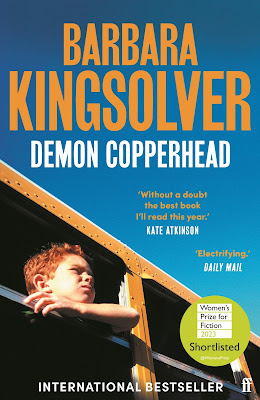
Kingsolver, Barbara "Demon Copperhead"

Kingsolver, Barbara "Demon Copperhead" - 2022

I must have mentioned this a hundred times. I'm a huge Charles Dickens fan. I really love Barbara Kingsolver's books, so this was just the book for me, a modern version of my favourite Dickens book, "David Copperfield".

I am not necessarily a fan of rewritten classics. I always say, authors should have their own idea for a story and not pick up that of another one. However, this is just a story that deserves to be picked up and looked upon with fresh eyes. It's easy to say that was so long ago and isn't part of our lives anymore. But what if it is?

Barbara Kingsolver managed it perfectly to transform the story into the 21st century. We follow Demon aka David through his sad life where he slides from one problematic situation to the next - or is pushed.

So, even if you know "David Copperfield" inside out and know exactly what must be coming next, it still is a highly suspenseful novel, or maybe even because of that. You know what is coming but you wonder how she transformed the story. Brilliant.

I think this gives us a good view about today's problems, even in so-called first world countries, and a lot to think about. Something that Barbara Kingsolver does so well.

This might even become my favourite book of the year.

From the back cover:

"Demon's story begins with his traumatic birth to a single mother in a single-wide trailer, looking 'like a little blue prizefighter.' For the life ahead of him he would need all of that fighting spirit, along with buckets of charm, a quick wit, and some unexpected talents, legal and otherwise.

In the southern Appalachian Mountains of Virginia, poverty isn't an idea, it's as natural as the grass grows. For a generation growing up in this world, at the heart of the modern opioid crisis, addiction isn't an abstraction, it's neighbours, parents, and friends. 'Family' could mean love, or reluctant foster care. For Demon, born on the wrong side of luck, the affection and safety he craves is as remote as the ocean he dreams of seeing one day. The wonder is in how far he's willing to travel to try and get there.

Suffused with truth, anger and compassion,
Demon Copperhead is an epic tale of love, loss and everything in between."

Friday, 26 January 2024

Dickens, Charles "Barnaby Rudge"

Dickens, Charles "Barnaby Rudge: A Tale of the Riots of Eighty" - 1841

I'm a huge Charles Dickens fan. I have never read a book by him that wasn't fascinating. This was so great, as well.

I didn't know that this was another historical novel (next to "A Tale of Two Cities").

What I loved about this book was just what I normally love about Dickens. His description of the little man, the life of people at the time he writes about. How did they live? What were their problem? Why did they revolt in this case?

We get a good view about the lives and the problems of the people in the 18th century even though it wasn't the time Dickens lived in.

I can see why this is the least read of his books though it doesn't really deserve it. The topic might not seem as interesting to readers or maybe they are missing a really feel-good romance. No matter the reason, this is a great book and if you are a fan of classic literature, you should consider reading at least one of Dickens' books. And if you don't want to carry on then, it is your loss.

I would love to read this with a book club since there is so much to talk about. But I don't want to give spoilers on my blog, so I will not go into details.

From the back cover:

"Dickens's first historical novel is set against the infamous 'No Popery' riots that were instigated by Lord George Gordon in 1780, and terrorised London for days. Prejudice, intolerance, misplaced religious and nationalistic fervour, together with the villains who would exploit these for political ends, are Dickens's targets. His vivid account of the riots at the heart of the novel is interwoven with the mysterious tale of a long unsolved murder, and a romance that combines forbidden love, passion, treachery and heroism.

A typically rich cast of comic characters, from the snivelling Miss Miggs and the posturing Simon Tappertit to the half-witted
Barnaby Rudge of the title, ensures high entertainment."

Wednesday, 17 January 2024

Wells, Benedict "The End of Loneliness"

Wells, Benedict "The End of Loneliness" (German: Vom Ende der Einsamkeit) - 2016


A quiet book about a family that suddenly isn't a family anymore. How do children cope with the death of their parents, how do they get on?

In this story we can see what happens next.
Or not. How this loss accompanies a child throughout their entire life, how it shapes their life.

After the death of their parents, the children grow up in a boarding school, which is also described very impressively.
Here the author probably drew on his own experiences, as he too was at boarding school at the age of six.

This is a fabulous book that captures all facets of an entire life (or several).
Wonderfully written, a fascinating family story that is so comprehensive despite only being just over 350 pages long. Terrific. 

I think I will read more from this young author.

From the back cover:

"Jules Moreau’s childhood is shattered after the sudden death of his parents. Enrolled in boarding school where he and his siblings, Marty and Liz, are forced to live apart, the once vivacious and fearless Jules retreats inward, preferring to live within his memories - until he meets Alva, a kindred soul caught in her own grief. Fifteen years pass and the siblings remain strangers to one another, bound by tragedy and struggling to recover the family they once were. Jules, still adrift, is anchored only by his desires to be a writer and to reunite with Alva, who turned her back on their friendship on the precipice of it becoming more, but just as it seems they can make amends for time wasted, invisible forces - whether fate or chance - intervene.

A kaleidoscopic family saga told through the fractured lives of the three Moreau siblings alongside a faltering, recovering love story, The End of Loneliness is a stunning meditation on the power of our memories, of what can be lost and what can never be let go. With inimitable compassion and luminous, affecting prose, Benedict Wells contends with what it means to find a way through life, while never giving up hope you will find someone to go with you
."

"The End of Loneliness" has been chosen favourite book of the year 2016 by the German Indepent Book Shops and received the European Union Prize for Literature.