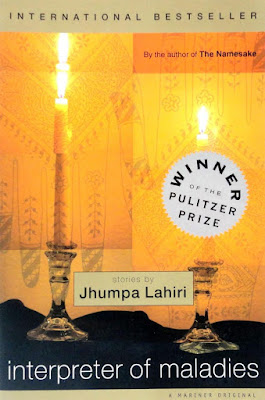
I have read this book in 2015. This was my review back then:
"As most of my friends know, I am not a big fan of short stories. However, I read 'The Namesake' by the same author and really loved it. And several of my friends had recommended 'Interpreter of Maladies' to me, one had even left a copy to me when she was moving, I just had to read it.
I was pleasantly surprised. What a lovely collection of short stories, some of them even interlink, so it doesn't seem like there are a hundred small stories that you forget right away. On the contrary, Jhumpa Lahiri has created some wonderful characters that you won't forget that easily. She incorporates all sorts of problems anyone might face who lives in a culture different from the one they or their parents grew up with. She describes some lovely people (and some not so lovely ones) who are all confronted with a life in two different parts of this world. Since the author is Indian herself and grew up in the United States, this is the background to almost all her stories. Having lived abroad (though not in such a different culture as the characters in the book) almost half of my life myself, I can certainly relate to a few of them.
Jhumpa Lahiri has a good, elegant style, her stories just flow, I will certainly read more of her writings."
A while ago, I joined an online group called Literary Wives/Marriage Plot and this was the next book on our list. So, I re-read the book because it was a while ago that I read it and we read it with a different topic in mind. What does the author say about the wives in his book?
A Temporary Matter
We look at the end of a marriage. A couple suffers from the loss of a baby that was stillborn. They have nothing to say to each other even though they try hard.
When Mr. Pirzada Came to Dine
In this story, a woman remembes a man from East Pakistan/Bangladesh coming to visit her Indian family in the States while his family is back home. It is more a story about the man than about this particular wife but it still gives us an insight into the life of the Indian wives in the US.
Interpreter of Maladies
This is about an Indian American family visiting the country of their heritage. We learn even more about the life of such a wife, she is so lonely. I can relate because as a non-working wife abroad, you don't have the sort of social life your husband and children have and it is hard work to try and find your place.
A Real Durwan (doorkeeper)
This story is about an elderly woman who is a stairsweeper and lives on the roof ot the building she works in.
While this is less about the situation of a wife, it tells us about poverty and how you can be even poorer than all the others around you.
Sexy
We're back in the US. Again, not the story of a wife but of a mistress. And of a husband who is leaving his wife. A good reflection about this kind of situation from every point of view, the wife and the mistress.
Mrs. Sen's
Her we have the story of an Indian woman living in the States who doesn't drive and doesn't have any contact outside the house. She looks after an eleven year old boy after school and teaches him about their food. Probably one of my favourite stories. I really felt for the lady.
This Blessed House
A yound married Indian couple in Connecticut who moves into their new house and find many Christian relics. The wife puts them on the mantel of the fireplace. A good story about how different people can have different opinions about what to keep and what not and what to embrace. And how they have to work on your marriage.
The Treatment of Bibi Haldar
A woman suffers from seizures and a doctor recommends to marry her off. But it costs money to get married and you have to find a suitor. So, her relatives rather let her live on the roof. This story focuses on the treatment of illness and of prejudices.
The Third and Final Continent
This guy has moved from India to London and then to the States where he rents a room from a 103-year-old lady. They develop a good connection until he gets married and moves out. We follow his and his wife's life and how they get to know each other.
As I mentioned in the stories, they are not all about the wives, some of them don't relate to their status at all, they are just there. But where they are mentioned, we learn a lot about the differences between Indian and (mainly) American wives, their rights and their duties.
I think it also helps to understand why immigrants so often stay among themselves. It is not just about the language, though that doesn't help if nobody teaches them the host language, it is more about the culture and understanding each other. Especially the wives are invisible, they disappear in the crowd. Especially if it has been an arranged marriage, the husband often doesn't understand his wife.
From the back cover:
"Navigating between the Indian traditions they've inherited and the baffling new world, the characters in Jhumpa Lahiri's elegant, touching stories seek love beyond the barriers of culture and generations. In 'A Temporary Matter,' published in The New Yorker, a young Indian-American couple faces the heartbreak of a stillborn birth while their Boston neighborhood copes with a nightly blackout. In the title story, an interpreter guides an American family through the India of their ancestors and hears an astonishing confession. Lahiri writes with deft cultural insight reminiscent of Anita Desai and a nuanced depth that recalls Mavis Gallant."
Jhumpa Lahiri received the Pulitzer Prize for "Interpreter of Maladies" in 2000.
And here are the reviews of the other literary wives:
Becky from Sydney of Aidanvale
Kate from Melbourne of booksaremyfavoriteandbest
Rebecca from Maryland, USA of Bookish Beck
Kay from Washington State, USA of What? Me Read?

Good on you for re-reading for Literary Wives! I very, very rarely re-read a book, mostly because second time around I'm disappointed by it! I'm curious, did you end up reading more by this author?
ReplyDeleteThanks, Kate. I don't re-read much but usually, when I am about to talk about it again with a book club, I try. If I still have the book, I don't buy it twice. LOL
DeleteI had read The Namesake before reading this for the first time and read The Lowland afterwards. All lgreat reads.
I think this book was difficult for a first time in the club, because of the short stories. You seem to agree with me about the isolation of especially the wives, though.
ReplyDeleteYou are right, Kay. I am not a huge fan of short stories but I did like the writing. Must read more by the author.
DeleteI thought it was rewarding to trace the differences between the 'Westernized' marriages and the ones that still adhered to a traditional model. I'm looking forward to reading more by Lahiri.
ReplyDeleteIn your original review, you noted links between some of the stories. I was curious as to what you noticed?
Great comment, Rebecca. I must say, since the others were novels and not short stories, I enjoyed them even more.
DeleteAnd a good question about the links. It's been over a decade since I wrote that but I think I meant that the lives of some of the wives were similar. But I'll think about it and will try to find a better answer.