Showing posts with label Historical Fiction. Show all posts

Thursday, 18 June 2026

Frazier, Charles "The Trackers" - 2023

Frazier, Charles "The Trackers" - 2023

I love Charles Frazier. I have read four of his books, "Cold Mountain" is still one of my favourite books ever, I've read it several times. But if I had to list his stories, this one would come last. It was an alright read because he is a good writer but the story is nothing compared to his other books. You can always imagine being right there with the characters. Only, I didn't really like any of them. That makes it harder to connect to them, harder to like the book. And it didn't really grab my attention, the story was too slow.

Just one quote that I really liked and by which I live (my friends will certainly back me up there): "First rule of hosting, excess is always preferable to shortage."

From the back cover:

"Hurtling past the downtrodden communities of Depression-era America, painter Val Welch travels westward to the rural town of Dawes, Wyoming. Through a stroke of luck, he's landed a New Deal assignment to create a mural representing the region for their new Post Office.

A wealthy art lover named John Long and his wife Eve have agreed to host Val at their sprawling ranch. Rumors and intrigue surround the couple: Eve left behind an itinerant life riding the rails and singing in a western swing band. Long holds shady political aspirations, but was once a WWI sniper--and his right hand is a mysterious elder cowboy, a vestige of the violent old west. Val quickly finds himself entranced by their lives.

One day, Eve flees home with a valuable painting in tow, and Long recruits Val to hit the road with a mission of tracking her down. Journeying from ramshackle Hoovervilles to San Francisco nightclubs to the swamps of Florida, Val's search for Eve narrows, and he soon turns up secrets that could spark formidable changes for all of them.

In The Trackers, singular American writer Charles Frazier conjures up the lives of everyday people during an extraordinary period of history that bears uncanny resemblance to our own. With the keen perceptions of humanity and transcendent storytelling that have made him beloved for decades, Frazier has created a powerful and timeless new classic."

Monday, 15 June 2026

Jeffers, Honorée Fanonne "The Love Songs of W.E.B. Du Bois"

Jeffers, Honorée Fanonne "The Love Songs of W.E.B. Du Bois" - 2021

This is such a beautiful book. Don't let yourself get scared by the 800+ pages, they are totally worth it. Barack Obama has it on his reading list. It's an Oprah book and it has been chosen by various other reading lists/awards. Definitely a good recommendation on all accounts.

W.E.B. Du Bois, the guy in the tile, was an American sociologist, writer, historian, and Pan-Africanist civil rights activist who lived from 1868 to 1963 and was the first African American to earn a doctorate at Harvard University. This book mentions him a lot. I have read his book "The Souls of Black Folk" which is a very thorough study of black culture in the United States. This novel adds to that subject.

The story circles around Ailey Pearl Garfield, a black girl born in 1973, and all her ancestors, going back to the first known ones in the 1740s. She has both black and Native American ancestors and there is a lot about their history. She has to struggle through all the problems many women but especially black women have to overcome. She is a strong woman but many obstacles are thrown in her way. And we learn how her ancestors, especially the women managed.

The only criticism I have has nothing to do with the story or the book. There is a family tree at the beginning but it is sometimes quite confusing. Either a diagram or some numbers as to who belongs to whom would have been helpful. The way it is presented, there is too much searching involved if you want to know more. If you are still reading it, there is a diagram on Wikipedia.

But other than that, book was just fantastic, epic.

From the back cover:

"A magisterial epic—an intimate yet sweeping novel with all the luminescence and force of Homegoing; Sing, Unburied, Sing; and The Water Dancer—that chronicles the journey of one American family, from the centuries of the colonial slave trade through the Civil War to our own tumultuous era.

The great scholar, W. E. B. Du Bois, once wrote about the Problem of race in America, and what he called 'Double Consciousness,' a sensitivity that every African American possesses in order to survive. Since childhood, Ailey Pearl Garfield has understood Du Bois’s words all too well. Bearing the names of two formidable Black Americans—the revered choreographer Alvin Ailey and her great grandmother Pearl, the descendant of enslaved Georgians and tenant farmers—Ailey carries Du Bois’s Problem on her shoulders.

Ailey is reared in the north in the City but spends summers in the small Georgia town of Chicasetta, where her mother’s family has lived since their ancestors arrived from Africa in bondage. From an early age, Ailey fights a battle for belonging that’s made all the more difficult by a hovering trauma, as well as the whispers of women—her mother, Belle, her sister, Lydia, and a maternal line reaching back two centuries—that urge Ailey to succeed in their stead.

To come to terms with her own identity, Ailey embarks on a journey through her family’s past, uncovering the shocking tales of generations of ancestors—Indigenous, Black, and white—in the deep South. In doing so Ailey must learn to embrace her full heritage, a legacy of oppression and resistance, bondage and independence, cruelty and resilience that is the story—and the song—of America itself."

Monday, 11 May 2026

McEwan, Ian "Lessons"

McEwan, Ian "Lessons" - 2022

This is the second book by Ian McEwan that I've started. I finished the first one, but I didn't like it at all. I stopped reading this one after a third of the way (150 pages); it was simply too boring, bloated, rambling, and tedious. I just can't find the right word to express how much this book bored me.

It could have been a good book in principle. But the author simply fails to engage the reader. The writing style is incredibly stiff, the whole approach utterly bland and outdated. The protagonist's life isn't just boring; you want to shake him. The eternal victim—what have others always done to me…

And this is supposed to be his masterpiece?

This will definitely be my last book by Ian McEwan. No matter what anyone else tells me, I won't touch another one. There are so many good books and outstanding writers out there.

Book Description:

"When the world is still counting the cost of the Second World War and the Iron Curtain has closed, eleven-year-old Roland Baines's life is turned upside down. 2,000 miles from his mother's protective love, stranded at an unusual boarding school, his vulnerability attracts piano teacher Miss Miriam Cornell, leaving scars as well as a memory of love that will never fade.

Now, when his wife vanishes, leaving him alone with his tiny son, Roland is forced to confront the reality of his restless existence. As the radiation from Chernobyl spreads across Europe, he begins a search for answers that looks deep into his family history and will last for the rest of his life.

From the Suez Crisis to the Cuban Missile Crisis, the fall of the Berlin Wall to the current pandemic and climate change, Roland sometimes rides with the tide of history, but more often struggles against it. Haunted by lost opportunities, he seeks solace through every possible means - music, literature, friends, sex, politics and, finally, love cut tragically short, then love ultimately redeemed. His journey raises important questions for us all. Can we take full charge of the course of our lives without damage to others? How do global events beyond our control shape our lives and our memories? And what can we really learn from the traumas of the past?

Epic, mesmerising and deeply humane, Lessons is a chronicle for our times - a powerful meditation on history and humanity through the prism of one man's lifetime."

Thursday, 26 February 2026

Chevalier, Tracy "The Glassmaker"

Chevalier, Tracy "The Glassmaker" - 2024

I have read quite a few novels by Tracy Chevalier and they were all highly interesting, always about different people in different areas at different times.

But this was special. From the descriptions, I first thought this was a little like the stories by Edward Rutherfurd who guides us through centuries by introducing several people from several families. Well, this was a little different. The story starts in 1494 Orsola Rossa, the protagonist, lives in Murano with her family of glassmakers. After 500 years, she is in her sixties and has lived through a plague, several wars, many changes in the lives of people, especially women.

While I was first a little dismayed by this way of telling the story, I really loved the people in Murano and Venice. Not all, but most of them. And the story of the family and how they got through all the upheavals, was also fantastic. 

You can tell, that Tracy Chevalier put a lot of time and effort into the research. I especially loved to learn about all the details of glassmaking. Well done.

I doubt I will ever get to see Venice but this is a good substitute.

From the back cover:

"Across the lagoon lies Murano. Time flows differently here – like the glass the island’s maestros spend their lives perfecting.

In secret, Orsola Rosso learns to craft glass. As a woman, she must flout convention to save her family from ruin. We follow her through hundreds of years of war and plague, tragedy and triumph, love and loss.

Skipping like a stone across the centuries, The Glassmaker is a virtuoso portrait of a woman, a family and a city that are as everlasting as glass."

Tuesday, 27 January 2026

Larsen, Nella "Passing"

Larsen, Nella "Passing" - 1929

I had never heard the expression "passing" in this sense. A "black" woman who is white enough to be considered "white" and "passes" as "white". While I totally understand that in such a racist world, a women (or a man) would do that, I don't see the need why they should have to. First of all, to me it really shouldn't matter what skin colour someone has. But, if you distinguish between "black" and "white", shouldn't someone who looks "white" be considered "white". There is something I don't get. Or rather, that I really don't want to get. In what kind of world are we living???

Anyway, I found this book because it was mentioned in "The Vanishing Half" by Britt Bennett where a similar situation is described.

As we can read in the book description, the novel is about two different women, both light-skinned, both considered "black". But, whereas one of the women lives officially as a black woman, the other one didn't even tell her husband about her ancestry. He is extremely racist. Which is another thing, why do you marry someone like that? Oh, right, some people marry for money. And, as most characters, who do that, they have to pay the price at some point.

The author has used a lot of material from her own life, apparently.

This rather short novella could have been longer for my taste but we have been given a lot of food for thought here. Great book.

From the book cover:

"This Signet Classics edition of Passing includes an Introduction by Brit Bennett, the bestselling author of The Vanishing Half.

Irene Redfield is a Black woman living an affluent, comfortable life with her husband and children in the thriving neighborhood of Harlem in the 1920s. When she reconnects with her childhood friend Clare Kendry, who is similarly light-skinned, Irene discovers that Clare has been passing for a white woman after severing ties to her past--even hiding the truth from her racist husband.

Clare finds herself drawn to Irene's sense of ease and security with her Black identity and longs for the community (and, increasingly, the woman) she lost. Irene is both riveted and repulsed by Clare and her dangerous secret, as Clare begins to insert herself--and her deception--into every part of Irene's stable existence. First published in 1929, Larsen's brilliant examination of the various ways in which we all seek to 'pass,' is as timely as ever."

Monday, 22 December 2025

O'Farrell, Maggie "Hamnet"

O'Farrell, Maggie "Hamnet" - 2020

Somebody talked to me about this book. Someone who likes Maggie O'Farrell. I have a vague recollection of who it was but I can't find it again. So, maybe it was someone else. Sorry, whoever you are.

Anyway, it was nice to read about a part of Shakespeare's life that is not so well known. We know that his son died young. That his name was Hamnet and that his father wrote a play called Hamlet. As to the book, the spelling of the name is interchangeable, so it is more or less the same. I mean, Shakespeare himself had about 27 varieties of is last name. Or something like that.

The author mentions that this is a piece of fiction based on only the few facts I mentioned above. So, she lets us know her imagination and we can add to that.

But I still learned about Shakespeare and especially his wife, Anne Hathaway, who is called Agnes in the novel. Because I like to search for more information elsewhere whenever I read a book. Sometimes, you need a starter for that.

And what was also excellent is the description of the grief parents go through when losing a child. That was heartbreaking.

Maggie O'Farrell received several prizes for this book, i.a. the Women's Prize for Fiction 2020.

We discussed this book in our local book club in April 2026.

A few comments from our book club members:

  • Shakespeare's life in London wasn't given enough attention.
  • How is it that such a strong woman suffers so much from the death of her child?
  • We liked the way the transmission of the plague was described.

From the back cover:

"On a summer's day in 1596, a young girl in Stratford-upon-Avon takes to her bed with a fever. Her twin brother, Hamnet, searches everywhere for help. Why is nobody at home?

Their mother, Agnes, is over a mile away, in the garden where she grows medicinal herbs. Their father is working in London.

Neither parent knows that one of the children will not survive the week.

Hamnet is a novel inspired by the son of a famous playwright. It is a story of the bond between twins, and of a marriage pushed to the brink by grief. It is also the story of a kestrel and its mistress; flea that boards a ship in Alexandria; and a glovemaker's son who flouts convention in pursuit of the woman he loves. Above all, it is a tender and unforgettable reimagining of a boy whose life has been all but forgotten, but whose name was given to one of the most celebrated plays ever written."

Wednesday, 17 December 2025

Mason, Daniel "North Woods"

Mason, Daniel "North Woods" - 2023

A book found by a friend who was nice enough to lend it to me. She wasn't a hundred percent sure whether I would love it but she thought I might like it. And she was right, a great and interesting book.

What I didn't realize at first was that I read a book by the same author years ago and I really liked that one: "The Piano Tuner".

The description on the back of this book was useless as it was interspersed with critics' laudations. But here it is (better version from Goodreads at the end):

"Over four centuries,
A single house dep in the woods of New England
Is the Home to runaways and visionairies, inseparable twins, a lovelorn painer, a desperat mother and a ruthless con man.
Each of them has a story to tell.
Prepare to be changed."

The set-up reminded me of another book I really loved where the author describes the life or a painting:
Vreeland, Susan "Girl in Hyacinth Blue" - 1999

And that again had reminded me of a film about the life of a violin: "The Red Violin" - 1998

All these stories go over centuries and we get to know the owners or, in this case, inhabitants of the house. Here, we see all kinds of different people (or, in one case, even an animal) live in the house in the woods. For a long time, they grow the best apples that ever exist. How would I have loved to taste one of those Wonder apples. 

In any case, I can highly recommend this novel.

The book received the JCO Award in 2020. I had not heard about this prize even though I am a huge Joyce Carol Oates fan. They have given out awards since 2017. I might have to read more of the winners.

Book Description:

"When two young lovers abscond from a Puritan colony, little do they know that their humble cabin in the woods will become the home of an extraordinary succession of human and nonhuman characters alike. An English soldier, destined for glory, abandons the battlefields of the New World to devote himself to growing apples. A pair of spinster twins navigate war and famine, envy and desire. A crime reporter unearths an ancient mass grave—only to discover that the earth refuse to give up their secrets. A lovelorn painter, a sinister con man, a stalking panther, a lusty beetle: As the inhabitants confront the wonder and mystery around them, they begin to realize that the dark, raucous, beautiful past is very much alive.

This magisterial and highly inventive novel from Pulitzer Prize finalist Daniel Mason brims with love and madness, humor and hope. Following the cycles of history, nature, and even language, North Woods shows the myriad, magical ways in which we’re connected to our environment, to history, and to one another. It is not just an unforgettable novel about secrets and destinies, but a way of looking at the world that asks the timeless question: How do we live on, even after we’re gone?"

Monday, 6 October 2025

Vreeland, Susan "The Passion of Artemisia"

Vreeland, Susan "The Passion of Artemisia" - 2002

I read "Girl in Hyacinth Blue" by this author a couple of years ago and really loved it. I always wanted to read something else by her. Now, I came across this book and it's about a female paper from the Baroque period. I had never heard of Artemisia Gentileschi even though I love art. Typical, women are never acknowledged much.

To start, I really like the note by the author. She mentioned that any work of fiction about history or a historical character ist still a work of imagination, not of reality. Based on known evidence, she spins her story. She used actual works of the artist and actual occurrences. I loved that.

Her style or writing is very vivid. Her descriptions are very detailed. We could see how people at the time lived, what were their hopes and fears. How did the church impact their lives?

Through this novel, I got to know a wonderful woman, a keen and gifted painter who struggled with the constrictions of the time but who nonetheless created some beautiful art.

I will look for more books by Susan Vreeland. Let me know if you've read one.

From the back cover:

"From extraordinary highs - patronage by the Medicis, friendship with Galileo and, most importantly of all, beautiful and outstandingly original paintings - to rape by her father's colleague, torture by the Inquisition, life-long struggles for acceptance by the artistic Establishment, and betrayal by the men she loved, Artemisia was a bold and brilliant woman who lived as she wanted, and paid a high price."

Monday, 28 July 2025

Gappah, Petina "Out of Darkness, Shining Light"

Gappah, Petina "Out of Darkness, Shining Light" - 2019

Of course, we all know about David Livingstone's search for the source of the river Nile. It is also widely known that his heart was buried in Africa and his body in Europe. This is the story, told by two slaves, how the body got from the middle of Africa to the sea so that he could be transferred to Great Britain.

Two different people tell the story, a women who is employed as a cook. Her story is pretty African, she uses far too many words that the average Europen will not understand. Granted, there is a small annex with explanations but you have to use that far too often and it destroys the enjoyment of any story. Then there is a guy who wants to become a priest. He is preaching already. All the time. Almost every second sentence starts or ends with "dear Lord" or something similar. He comes across as a religious fanatic. Reading the Bible is more wordly.

Have you guessed it already? I didn't like the book.

There was only about one sentence that made me smile. When someone told the other slaves about the meeting between Henry Morton Stanley and David Livingstone, he translated the first sentence (Dr. Livingstone, I presume?) into: "It can only be that you are Bwana Daudi."

We discussed this in our international online book club in July 2025.

Comments from the members:

The start of the book felt slow, and didn't feel pulled into it for the story so much until the murder plot unwound. It was a really nice read though in terms or history and culture. The discussion we had resulted into talking and thinking about African history, slavery, imperialist influences, death rites... The characters in the story were also really distinct. I feel a bit smarter about African history for having read it.

Many in the book club agreed that the language, particularly the religious tone and African dialects, made the beginning difficult to follow. However, as the story progresses, the plot becomes more engaging, especially with the focus on the African slaves who carried Livingstone’s body. Their journey is central to the book, and the contrast between their lives and Livingstone’s European legacy opens up important discussions about colonialism and the erasure of African voices in history. Some felt the religious elements were repetitive, but they were seen as integral to understanding the mindset of the time. Despite the slow start and challenging style, many found the novel’s exploration of historical and cultural themes thought-provoking.

Overall it was a really good discussion book, because we have read some books about African history and by African authors before, it always becomes an interesting part, looking at the books we have read, and how the new books align in with those. In that sense this felt like quite a good book to add to the list.

From the back cover:

"This is the story of the body of Bwana Daudi, the Doctor, the explorer David Livingstone - and the sixty-nine men and women who carried his remains for 1,500 miles so that he could be borne across the sea and buried in his own country.

This is the story of those in the shadows of history: the  dark companions who saved a white man's bones on an epic funeral march - little knowing his corps carried the maps that sowed the seeds of their continent's colonisation and enslavement.

This is the story of how human bravery, loyalty and love can triumph over darkness - and the result is Petina Gappah's radical masterpiece."

Monday, 30 June 2025

Groff, Lauren "Matrix"

Groff, Lauren "Matrix" - 2021

A member of our book club tried to convince us that this would be the best novel for our next book choice. But some members were not really convinced that they wanted to read it. So I "took pity" (LOL) and volunteered to be a guinea pig.

I love reading historical novels, especially about women and their fights against the prejudices of their times. So, I expected something really interesting. Many girls were sent to nunneries against their wishes and a few were quite successful in that world.

I tried to read more about the protagonist and found that the book is not really based on anything known from reality. It is what it says: pure fiction.

I thought I could learn more about the history of a person that was important in her lifetime. Unfortunately, I didn't. If you are looking for a novel without being interested in the background or whether that person existed, you might like this better. I was disappointed.

Overall, the novel was too superficial for me.

There are no footnotes or links to research pages that might support at least some of the stories.

From the back cover:

"Seventeen-year-old Marie, too wild for courtly life, is thrown to the dogs one winter morning, expelled from the royal court to become the prioress of an abbey. Marie is strange - tall, a giantess, her elbows and knees stick out, ungainly.

At first taken aback by life at the abbey, Marie finds purpose and passion among her mercurial sisters. Yet she deeply misses her secret lover Cecily and queen Eleanor.

Born last in a long line of women warriors and crusaders, women who flew across the countryside with their sword fighting and dagger work, Marie decides to chart a bold new course for the women she now leads and protects. She will bring herself, and her sisters, out of the darkness, into riches and power.

MATRIX is a bold vision of female love, devotion and desire from one of the most adventurous writers at work today."

Tuesday, 10 June 2025

Hornby, Gill "Miss Austen"

Hornby, Gill "Miss Austen" - 2020

As I mentioned before, as part of the commemoration of Jane Austen's 250th birthday, the Classics Club has started a #Reading Austen project. We are reading a book by her every other month, and I want to do read something Austen-related by her in between.

In April, I read a German book by Catherine Bell, "Jane Austen und die Kunst der Worte" [Jane Austen and the Art of Words].  I was not impressed, I probably read too much about Jane Austen before and this one could have been written by any Jane Austen fan without doing any more research. Such a pity.

Mind you, "Miss Austen" wasn't all that much better, only a little. The Miss Austen mentioned in the title is not Jane but her sister Cassandra. We hear about her last self-given task, the intention to destroy the letters her sister had written that contained something Cassandra didn't want anyone to know, that would look bad on her sister's legacy. But, since those letters were destroyed, we don't know what it contained and the author just invented them.

I don't like people writing a sequel to a book where the original author died. I never did and I doubt I ever will. So, I guess my next book about Jane Austen (in August) will be a non-fiction again.

From the back cover:

"1840 : Cassandra Austen returns to the village of Kintbury.

She knows that, in some corner of the vicarage where she is staying, there is a cache of letters written by her sister Jane.

As Cassandra recalls her youth, she pieces together buried truths about Jane's history - and her own ; secrets which should not be revealed.

And she faces a stark choice : should she act to protect Jane's reputation?

Or leave the letters unguarded to shape her legacy..."

Friday, 30 May 2025

Nguyễn, Phan Quế Mai "Dust Child"

Nguyễn, Phan Quế Mai "Dust Child" - 2023

An interesting topic. I've read books about soldiers' children before, and they weren't welcomed anywhere. In Germany, these were mostly children of black fathers during World War II; with the others, it wasn't so noticeable unless you lived in a village and everyone knew about it.

This is about the children of Vietnamese women and American soldiers. Regardless of whether the fathers were black or white, it was immediately noticeable. And the children suffered greatly. In this book, they not only grew up with the certainty of having a foreign father but also that their mother didn't want them and they had to grow up in an orphanage with no family to support them.

It was good to learn more about the topic, but I wasn't entirely thrilled with the book and the writing style. Again and again, she switches to Vietnamese, often translating it afterwards, but not always. And even in the former case, it disrupts the flow. Overall, the writing isn't very fluid; many things remain completely unclear. Sometimes you don't know what she's even talking about. It's nice to learn something about Vietnamese culture, but she assumes too much. Perhaps it's clear to people who speak Vietnamese or know Vietnam, but for others, it's still very confusing.

There are also several errors in the book that a native English speaker should have filtered out. A shame.

On Goodreads, someone recommends also reading Bao Ninh's book "The Sorrow of War" (Goodreads), the story of the war from the perspective of a Vietnamese soldier. And the author's first book "The Mountains Sing" (Goodreads) which takes place during the war.

Although I've often read that the first book is much better than this one, I'm not sure if I want to read another book by Phan Quế Mai Nguyễn anytime soon.

The quote she gives on page 267 is also not exactly correct:

"We are the unwilling
Led by the unqualified
Doing the unnecessary
For the ungrateful."

This is the correct one:

"We the unwilling 
Led by the unknowing
Are doing the impossible
For the ungrateful
We have done so much
For so long, with so little
We are now qualified to do
Anything with nothing,
Forever."
Konstantin Josef Jireček

However, most members of our book club enjoyed the book quite a bit, especially because they learned something about the people of Vietnam and the impact of the war on their lives. We also discussed the different perspectives held by people in Asia and Western Europe.

I read this with my German book club in May 2025

From the back cover:

"It is 1969, and sisters Trang and Quynh watch helplessly as their rural village is transformed by the outbreak of war. Desperate to help their impoverished parents, they head to the thronging city of Sai Gon and join the women working as 'bar girls', paid to flirt with American GIs. What follows will test their sisterhood in ways they could never have foreseen.

Decades later Viet Nam is thriving, successfully emerging out of the shadow of war. But Dan and Phong, two men whose lives were transformed by their experiences on different sides of the conflict, are struggling to leave the past behind.

But what happens when these four characters unexpectedly come together once more, and each is forced to grapple with the legacy of decisions made in the past – decisions that continue to reverberate through all their lives

Dust Child is their unforgettable story."

Monday, 19 May 2025

Cornwell, Bernard "The Last Kingdom"

Cornwell, Bernard "The Last Kingdom" (The Saxon Stories #1) - 2004

I love historical fiction. And this one is based on the real history of England. So, someone suggested I should read a book by this author. My husband loves him and we had this book at home, so I gave it a try.

While I liked the story of Uthred and his contemporaries, there was too much about fighting in the story and less about the "real life". Maybe, because there were few women - and even fewer stories about them - in the book. But this was not for me. I doubt I will read more about "The Last Kingdom", at least not in this series.

From the back cover:

"Uhtred is an English boy, born into the aristocracy of ninth-century Northumbria. Orphaned at ten, he is captured and adopted by a Dane and taught the Viking ways. Yet Uhtred's fate is indissolubly bound up with Alfred, King of Wessex, who rules over the only English kingdom to survive the Danish assault.

The struggle between the English and the Danes and the strife between christianity and paganism is the background to Uhtred's growing up. He is left uncertain of his loyalties but a slaughter in a winter dawn propels him to the English side and he will become a man just as the Danes launch their fiercest attack yet on Alfred's kingdom. Marriage ties him further still to the West Saxon cause but when his wife and child vanish in the chaos of the Danish invasion, Uhtred is driven to face the greatest of the Viking chieftains in a battle beside the sea. There, in the horror of the shield-wall, he discovers his true allegiance."

Monday, 21 April 2025

Brooks, Geraldine "Year of Wonders"

Brooks, Geraldine "Year of Wonders" - 2001

My goodness, what a story! I have read several books about the plague before or novels that had the plague in their book. But this one was one just about the plague. Well, up until the last couple of pages where another book was more or less forced into just one chapter.

Still, I loved this book about a village that struggled during the plague, that had the idea to shut themselves off from the rest of the world in order not to bring this horrible disease to others. The village existed, the people in the book were based on real people from that time. But it was still a novel.

Apparently, this was Geraldine Brooks' first book. I think she learned not to add such a quick end but I still loved it very much. The author is such a great writer. And I think the Covid-19 pandemic brought the story even closer to us.

From the back cover:

"Spring 1666: when the Great Plague reaches the quiet Derbyshire village of Eyam, the villagers make an extraordinary decision. They elect to isolate themselves in a fateful quarantine. So begins the Year of Wonders, seen through eighteen-year-old Anna Frith’s eyes as she confronts the loss of her family, the disintegration of her community, and the lure of a dangerous and illicit love. Based on a true story, this novel explores love and learning, fear and fanaticism, and the struggles of seventeenth-century science and religion to interpret the world at the cusp of the modern era."

Monday, 31 March 2025

Weir, Alison "Katharine Parr. The Sixth Wife"

Weir, Alison "Katharine Parr. The Sixth Wife" (Six Tudor Queens #6) - 2021

The sixth wife of Henry VIII. And the sixth book in the Tudor Queens series by Alison Weir.

I think I knew far too little about Katharine Parr. She was Henry's last wife. She survived him. She had two husbands before him. She married again when he died only to die herself in childbed. That's about all I knew.

Of course, this is a novel based on the life of the queens. However, there is a lot in it that is history and where we can learn about that time in England.

We see through the eyes of Katharine Parr that women were just a commodity, and not worth a lot for that. At her first marriage, she doesn't even know the husband. Then she has to look for another one because otherwise a woman has no means to live. When she falls in love with Thomas Seymour, she has to marry the king who also wants her. What a life!

In any case, Alison Weir has brought the Tudor queens to life in a way no history book could ever have done. For that, I thank her profoundly.

From the back cover:

"Two husbands dead; a life marred by sadness. And now Katharine is in love for the first time in her life.

The eye of an ageing and dangerous king falls upon her. She cannot refuse him. She must stifle her feelings and never betray that she wanted another.

And now she is the sixth wife. Her queenship is a holy mission yet, fearfully, she dreams of the tragic parade of women who went before her. She cherishes the secret beliefs that could send her to the fire. And still the King loves and trusts her.

Now her enemies are closing in. She must fight for her very life.

KATHARINE PARR – the last of Henry’s queens.

Alison Weir recounts the extraordinary story of a woman forced into a perilous situation and rising heroically to the challenge. Katharine is a delightful woman, a warm and kindly heroine – and yet she will be betrayed by those she loves and trusts most.

Too late, the truth will dawn on her."

Tuesday, 10 December 2024

Oates, Joyce Carol "Blonde"

Oates, Joyce Carol "Blonde" - 2000

I find it hard to write this review. I love books by Joyce Carol Oates, I think she deserves the Nobel Prize. I am intrigued by the figure of Marilyn Monroe, I read the book "Marilyn" (Goodreads) by Norman Mailer ages ago. I think I was expecting something along that line.

What I got was a description of a child who didn't stand a chance in the world. How she became one of the greatest icons in the film industry? That was a long and arduous way and it didn't bring her any joy.

I had to remind myself often that this was just a book based on the real life story of the film star, even though most of the facts were true.

It was a long and heavy read. Did I enjoy it as much as the other JCO books? I'm not sure but I'm glad I read it.

From the back cover:

"In 'Blonde' we are given an intimate, unsparing vision of the woman who became Marilyn Monroe like no other: the child who visits the cinema with her mother; the orphan whose mother is declared mad; the woman who changes her name to become an actress; the fated celebrity, lover, comedienne, muse and icon. Joyce Carol Oates tells an epic American story of how a fragile, gifted young woman makes and remakes her identity, surviving against crushing odds, perpetually in conflict and intensely driven. Here is the very essence of the individual hungry and needy for love: from an elusive mother; from a mysterious, distant father and from a succession of lovers and husbands. Joyce Carol Oates sympathetically explores the inner life of the woman destined to become Hollywood’s most compelling legend. 'Blonde' is a brilliant and deeply moving portrait of a culture hypnotised by its own myths and the shattering reality of the personal effects it had on the woman who became Marilyn Monroe."

Monday, 11 November 2024

Barbal i Farré, Maria "Stone in a Landslide"

Barbal i Farré, Maria "Stone in a Landslide" (Catalan: Pedra de tartera) - 1985

I read another book by Maria Barbal before, "Campher" and when I saw this one, I just had to pick it up.

We have a great insight into the lives of the people in Catalonia at the beginning of the last century, how their lives were changed by the Spanish Civil War. Conxa tells us about her whole lifetime, from being a poor child given to relatives who didn't have any. I know this happened a lot in former times, people often had to many kids and then there were always those who didn't have any. Then one of the children from that family was given to relatives to "inherit" from them. I've heard this from my parents who knew quite a few examples in their youth.

While this is only a novella, the story is as rich as longer novels, there is so much in this. You almost have the feeling as if the author talks about her own life, even though she lived more than half a century later. But she must have heard a lot from her family, as we all did.

And it's not just about that part of our world or that time. War is awful at all times, and times were harsh anywhere (and still are for many, many people around the world). The author has a great eye for the people. And her style is extraordinary.

From the back cover:

"The beginning of the 20th century: 13-year-old Conxa has to leave her home village in the Pyrenees to work for her childless aunt. After years of hard labour, she finds love with Jaume - a love that will be thwarted by the Spanish Civil War. Approaching her own death, Conxa looks back on a life in which she has lost everything except her own indomitable spirit. This story presents a fascinating timeless voice, down to earth and full of human contradictory nuances. Its' the expression of someone who searches for understanding in a changing world but senses that ultimately there may be no such thing. The Catalan modern classic, first published in 1985, is now in its 50th edition, and has sold over 50 000 copies in the last two years in Germany alone."

Tuesday, 15 October 2024

Follett, Ken "The Armour of Light"

Follett, Ken "The Armour of Light" - 2023

"The grand master of gripping fiction is back. International No.1 bestseller Ken Follett returns to Kingsbridge with an epic tale of revolution and a cast of unforgettable characters."

Yes, he is a grand master indeed. After having written four books about Kingsbridge, their cathedral and the inhabitants, rich and poor from 997 until the 16th century, here is the follow-up for the Industrial Revolution.

With the story of  Kingsbridge, we also learn the story of England and the United Kingdom. Anytime we read about history and how people lived, we must be thankful to live today. Even though we also have political problems, we as "the little people" have a lot more rights than people ever had. And we owe this to people like those described here.

I hope the story of Kingsbridge will continue into modern times. Then we could just go on with the century trilogy.

In any case, this is THE series for lovers of historical fiction.

I missed a list of all the characters before and during the book. And, like I said before, I would have enjoyed a timeline of what happened at the time. Yes, I have the internet and plenty of other books where I can look this up but I find having it in the actual book I'm reading is actually very helpful.

From the back cover:

"Revolution is in the air

1792. A tyrannical government is determined to make England a mighty commercial empire. In France, Napoleon Bonaparte begins his rise to power, and with dissent rife, France’s neighbours are on high alert.

Kingsbridge is on the edge

Unprecedented industrial change sweeps the land, making the lives of the workers in Kingbridge’s prosperous cloth mills a misery. Rampant modernization and dangerous new machinery are rendering jobs obsolete and tearing families apart.

Tyranny is on the horizon

Now, as international conflict nears, a story of a small group of Kingsbridge people - including spinner Sal Clitheroe, weaver David Shoveller and Kit, Sal’s inventive and headstrong son - will come to define the struggle of a generation as they seek enlightenment and fight for a future free from oppression. . .

Taking the reader straight into the heart of history with the fifth novel in the ground-breaking Kingsbridge series, The Armour of Light is master storyteller Ken Follett’s most ambitious novel to date."

Wednesday, 5 June 2024

Krall, Hanna "Chasing the King of Hearts"

Krall, Hanna "Chasing the King of Hearts" (Polish: Król kier znów na wylocie) - 2006

This was our international online book club book for May 2024.

The life story of a Jewish woman who loses all her family in the Holocaust. Except for her husband. She is sure he is still alive and she looks for him everywhere.

In the description it says this is a beautiful love story. And it is. In a way. Just not what you would usually expect from a love story. And the style is completely different. It reads like diary. But it's more than that. Quite interesting.

It's amazing what a human being can do in order to save their loved ones.

A good book about a strong woman.

Comments from members:

For me the topic of the WWII in books is very unwelcome as I have a great imagination and empathy, but in this book I really liked how the author scaled back on the emotions in the writing, not wallowing in the horrors, yet still showing very skillfully the realities of the war.

The story was interesting historically and serendipitously.

Smart choices and having a clear purpose helped make hard things easier for the lead character, while others turned the difficulties and how to survive mentally into blaming others.

From the back cover:

"An extraordinary love story, spanning 60 years, from 1939 to 2000, from the Warsaw Ghetto to Israel.

'This is the last leg of my journey. It would be silly to lose my mind now.' After the deportation of her husband to Auschwitz, Izolda Regenberg, alias Maria Pawlicka, has only one aim: to free her husband. Her race to beat fate might appear absurd to others, but not to her. In times of war and destruction she learns to trust herself.

Why Peirene chose to publish this book:


'This is a beautiful love story. A story which makes one weep for mankind. While Hanna Krall's terse prose is designed to convey the utter desperation of war, her deft touch evokes hope and a sense of homecoming.' Meike Ziervogel"

Monday, 18 March 2024

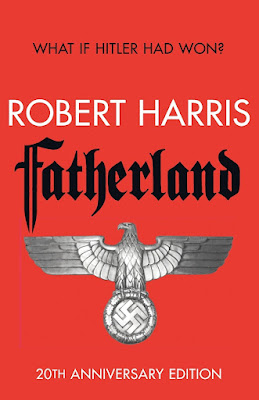
Harris, Robert "Fatherland"

Harris, Robert "Fatherland" - 1992

What an awful thought. Hitler resp. the Nazis had won the war. I always say, the Germans didn't lose the war, that were the Nazis. The Germans effectively won the war. In this book (and in various others, like my favourite "The Children's War") we can all see why.

The story itself concentrates on one particular case. A policemen who is not a fan of the Nazis but still has to wear their uniform for his job, tries to find the secret behind a murder. And with that, he could transform the whole world.

We need people like that everywhere, people who don't just blindly follow some dicatators, even if it is an advantage for them.

I think, right now is the right time to read this book again. Right now, where the Right is on the rise in many, many countries. Too many, if you ask me. How can people forget what it was? Even if you haven't lived during the war, most of us haven't, lets be honest. My parents would have been ninety had they still lived. And they were five when the Nazis were elected, so anyone responsible for the regime must be about a hundred. Not many of them alive anymore. But we have to remember what our parents or grandparents told us and see where we are heading if we elect those idiots that tell us the foreigners are our enemies. Nope, those who want to abolish our hard-earned democracy are.

We should all be happy that the war ended the way it did, this book shows us what could have been had it been different.

From the back cover:

"April 1964.

The naked body of an old man floats in a lake on the outskirts of Berlin. In one week it will be Adolf Hitler’s 75th birthday. A terrible conspiracy is starting to unravel…

What if Hitler had won?
"