Showing posts with label Germany. Show all posts

Monday, 11 May 2026

McEwan, Ian "Lessons"

McEwan, Ian "Lessons" - 2022

This is the second book by Ian McEwan that I've started. I finished the first one, but I didn't like it at all. I stopped reading this one after a third of the way (150 pages); it was simply too boring, bloated, rambling, and tedious. I just can't find the right word to express how much this book bored me.

It could have been a good book in principle. But the author simply fails to engage the reader. The writing style is incredibly stiff, the whole approach utterly bland and outdated. The protagonist's life isn't just boring; you want to shake him. The eternal victim—what have others always done to me…

And this is supposed to be his masterpiece?

This will definitely be my last book by Ian McEwan. No matter what anyone else tells me, I won't touch another one. There are so many good books and outstanding writers out there.

Book Description:

"When the world is still counting the cost of the Second World War and the Iron Curtain has closed, eleven-year-old Roland Baines's life is turned upside down. 2,000 miles from his mother's protective love, stranded at an unusual boarding school, his vulnerability attracts piano teacher Miss Miriam Cornell, leaving scars as well as a memory of love that will never fade.

Now, when his wife vanishes, leaving him alone with his tiny son, Roland is forced to confront the reality of his restless existence. As the radiation from Chernobyl spreads across Europe, he begins a search for answers that looks deep into his family history and will last for the rest of his life.

From the Suez Crisis to the Cuban Missile Crisis, the fall of the Berlin Wall to the current pandemic and climate change, Roland sometimes rides with the tide of history, but more often struggles against it. Haunted by lost opportunities, he seeks solace through every possible means - music, literature, friends, sex, politics and, finally, love cut tragically short, then love ultimately redeemed. His journey raises important questions for us all. Can we take full charge of the course of our lives without damage to others? How do global events beyond our control shape our lives and our memories? And what can we really learn from the traumas of the past?

Epic, mesmerising and deeply humane, Lessons is a chronicle for our times - a powerful meditation on history and humanity through the prism of one man's lifetime."

Monday, 16 February 2026

Bjørnson, Bjørnstjerne "Absalom's Hair"

Bjørnson, Bjørnstjerne "Absalom's Hair" (Norwegian: Absalons Haar) - 1894

I enjoy reading books by Nobel laureates from time to time. So when I came across this novel, I had to check it out. It's a novella, so not very long. A bit more plot certainly wouldn't have hurt the story. I wasn't particularly impressed. The narrative jumped around, and the protagonists lacked any compelling qualities. It's simply a very old book that hasn't aged well.

And if it was meant as a satire, I would have expected some humor.

Bjørnson also wrote the Norwegian national anthem, "Ja, vi elsker dette landet" (Yes, we love this country).

Book Description:

"Harald Kaas was sixty. He had given up his free, uncriticised bachelor life; his yacht was no longer seen off the coast in summer; his tours to England and the south had ceased; nay, he was rarely to be found even at his club in Christiania. His gigantic figure was never seen in the doorways; he was failing. Bandy-legged he had always been, but this defect had increased; his herculean back was rounded, and he stooped a little. His forehead, always of the broadest-no one else's hat would fit him-was now one of the highest, that is to say, he had lost all his hair, except a ragged lock over each ear and a thin fringe behind. He was beginning also to lose his teeth, which were strong though small, and blackened by tobacco; and now, instead of 'deuce take it' he said 'deush take it.'"

Bjørnstjerne Bjørnson received the Nobel Prize for Literature in 1903 "as a tribute to his noble, magnificent and versatile poetry, which has always been distinguished by both the freshness of its inspiration and the rare purity of its spirit".

I contribute to this page: Read the Nobels and you can find all my blogs about Nobel Prize winning authors and their books here.

Tuesday, 13 January 2026

Mann, Thomas "Confessions of Felix Krull, Confidence Man"

Mann, Thomas "Confessions of Felix Krull, Confidence Man" (German: Bekenntnisse des Hochstaplers Felix Krull) - 1954

Thomas Mann, one of my favorite authors, turned 150, and since I didn't want to end the year without reading at least one of his novels new to me, I went on a search. I had this book on my TBR pile, so the decision was easy.

I must confess, I had no idea that this book was unfinished. I now know that Mann worked on it for a long time and certainly made numerous notes about the plot, but only completed the first part and then died before writing the second.

What a shame, the beginning is already good. The second part would certainly have been just as excellent as anything by Thomas Mann.

In any case, the book has a lot of tongue-in-cheek humor. And even though Felix Krull manages to outwit many people, one can only admire his cunning.

The book is a very good read; I really enjoyed it.

I am not very happy with the translation of the word "Hochstapler" into "Confidence Man". Maybe that's my German thinking but the word "confidence" sounds far too nice to call someone who tricks other people. Impostor, cheater, trickster, swindler sound much more accurate to me.

Book Description:

"'The most astonishing work that Mann ever wrote and also one of the most perfect. . . with Felix Krull the world receives from Thomas Mann the gift which German literature has almost proverbially withheld from it: the great comic novel' - Edwin Muir

Waiter by day man about Paris by night, the young and good looking Felix Krull has created for himself a personality to charm and deceive the world of wealth. Then the Marquis de Venosta makes a proposal that he can't refuse."

Thomas Mann received the Nobel Prize for Literature in 1929 "principally for his great novel, 'Buddenbrooks', which has won steadily increased recognition as one of the classic works of contemporary literature".

I contribute to this page: Read the Nobels and you can find all my blogs about Nobel Prize winning authors and their books here.

Monday, 15 December 2025

Mann, Heinrich "The Blue Angel"

Mann, Heinrich "The Blue Angel" (German: Professor Unrat oder das Ende eines Tyrannen) - 1904

Since reading Heinrich Mann's "Man of Straw" (Der Untertan) two years ago, I only really knew this author as the brother of one of my favorite authors, Thomas Mann. But I enjoyed the novel so much that I absolutely wanted to read more of his work.

And I wasn't disappointed. The talent for writing clearly runs in the family, and I'm looking forward to reading more books by this author.

I've never seen the film "The Blue Angel" and didn't even know it was based on this book. The double standards of the Wilhelmine era are depicted in great detail, as is what happened when you rebelled against them. Of course, things are different today. Or have they really changed that much? Yes, some things have improved, but if you were to imagine the milieu of that time in today's LGBTQ+ scene, you could story the novel being set in a similar way. People don't change that quickly, after all.

But, as I said, a fabulous novel.

Book Description:

"Professor Unrat, which translates as 'Professor Garbage', is one of the most important works of Heinrich Mann and has achieved notoriety through film adaptations, most notably 'Der blaue Engel' (The Blue Angel) with Marlene Dietrich.

The book caricatures the middle and upper class educational system of Wilhelmine Germany and the double standards of the title character. "

Monday, 8 December 2025

Goethe, Johann Wolfgang von "Faust"

Goethe, Johann Wolfgang von "Urfaust. Faust: Erster und zweiter Teil" (German: Faust I + II) - 1772-1808

After reading "The Sound and the Fury" for our classics spin challenge, I thought I will never get through Faust in time if that gets chosen, so I started it right away.

The story is said to be the greatest work of German literature and I can well believe that. 250 years have passed in the meantime but I don't believe that there has been a single book that is as well-known around the world than this.

Even though my edition had more than a thousand pages, I got through it faster than I thought. I mentioned it a lot of times, I am no fan of reading plays, it's not so easy to follow through. However, I didn't find this too bad. Maybe because, growing up in Germany, I've come across descriptions and fragments of the story before. And I found a lot of aphorisms, metaphors, symbols and sayings that we use in German often, quite often. Goethe is our Shakespeare, he has moulded the language more than anyone.

The story itself, well, what can I say? It shows the view of women at the time, of the religion and beliefs of people. The morale of the time is depicted just as well as the internal struggles of the protagonist. And even for non-Germans, the play shows so much of people that would be valid anywhere.

My edition didn't just have the Faust that we know today but also the Urfaust, his early work. It shows all versions in parallel which helps in seeing what he changed and what he added. Totally interesting.

I can well believe that Goethe needed about sixty years to write the whole tale, starting with the Gretchen story and then passing on to Helena. Part I was first published as "Faust. A Tragedy".

All in all, I am really happy I finally read this.

Book Description:

"Goethe's Faust is a classic of European literature. Based on the fable of the man who traded his soul for superhuman powers and knowledge, it became the life's work of Germany's greatest poet. Beginning with an intriguing wager between God and Satan, it charts the life of a deeply flawed individual, his struggle against the nihilism of his diabolical companion Mephistopheles.

Part One presents Faust's pact with the Devil and the harrowing tragedy of his love affair with the young Gretchen. Part Two shows Faust's experience in the world of public affairs, including his encounter with Helen of Troy, the emblem of classical beauty and culture. The whole is a symbolic and panoramic commentary on the human condition and on modern European history and civilisation.

This new translation of both parts of Faust preserves the poetic character of the original, its tragic pathos and hilarious comedy. In addition, John Williams has translated the Urfaust, a fascinating glimpse into the young Goethe's imagination, and a selection from the draft scenarios for the Walpurgis Night witches' sabbath - material so ribald and blasphemous that Goethe did not dare publish it."

Wednesday, 6 November 2024

Herrndorf, Wolfgang "Why We Took the Car"

Herrndorf, Wolfgang "Why We Took the Car" (German: tschick) - 2010

My book club recommended this book to me; they had read it some time ago.

Two boys from different backgrounds but with a similar fate. And both outsiders.

I found the novel very entertaining, but also very compassionate. You could both laugh and cry at the experiences of the two.

What can I say, it was really a great reading experience.

From the back cover:

"A beautifully written, darkly funny coming-of-age story from an award-winning, bestselling German author

Mike Klingenberg isn’t exactly one of the cool kids at his school. For one, he doesn’t have many friends. (Okay, zero friends.) And everyone laughs when he has to read his essays out loud in class. And he’s never, ever invited to parties — especially not the party of the year, thrown by the gorgeous Tatiana.

Andrej Tschichatschow, aka Tschick (not even the teachers can pronounce his name), is new in school, and unpopular as well, but in a completely different way. He always looks like he’s just been in a fight, he sleeps through nearly every class, and his clothes are tragic.

But one day, out of the blue, Tschick shows up at Mike’s house. It turns out he wasn’t invited to Tatiana’s party either, and he’s ready to do something about it. Forget the popular kids — together, Mike and Tschick are heading out on a road trip across Germany. No parents, no map, no destination. Will they get hopelessly lost in the middle of nowhere? Probably. Will they make bad decisions, meet some crazy people, and get into trouble? Definitely. But will anyone ever call them boring again?

Not a chance."

Wednesday, 3 July 2024

Erpenbeck, Jenny "Kairos"

Erpenbeck, Jenny "Kairos" (German: Kairos.) - 2021

This was the starter book for this month's Six Degrees of Separation. I haven't read the starter book very often but this was a new acclaimed book by an author I'd read and liked before, so I gave it a go.

I quite liked "The End of Days" (Aller Tage Abend) and hope this one would be just as good.

Jenny Erpenbeck was the first German author to receive the 2024 International Booker Prize.

This was an okay read but I was a little disappointed. The writing was not as fluent as expected. I think the love story should reflect the relationship between the two countries. And that was not a bad attempt. But, I didn't care for either of the protagonists, I couldn't feel sorry for them.

For those who don't know much about the former GDR or how the fall of the fall came about it probably isn't a bad book, though there are better ones that will tell you about this (The Tower/Der Turm, for instance)

All in all, I found the book, boring, tedious and tiresome. Yet another Booker prize award that I didn't like.

The title comes from an ancient Greek term for the right time.

From the back cover:

"Jenny Erpenbeck’s much anticipated new novel Kairos is a complicated love story set amidst swirling, cataclysmic events as the GDR collapses and an old world evaporates Jenny Erpenbeck (the author of Go, Went, Gone and Visitation ) is an epic storyteller and arguably the most powerful voice in contemporary German literature. Erpenbeck’s new novel Kairos - an unforgettably compelling masterpiece - tells the story of the romance begun in East Berlin at the end of the 1980s when nineteen-year-old Katharina meets by chance a married writer in his fifties named Hans. Their passionate yet difficult long-running affair takes place against the background of the declining GDR, through the upheavals wrought by its dissolution in 1989 and then what comes after. In her unmistakable style and with enormous sweep, Erpenbeck describes the path of two lovers, as Katharina grows up and tries to come to terms with a not always ideal romance, even as a whole world with its own ideology disappears."

Monday, 17 June 2024

Paretti, Sandra "The Wishing Tree"

Paretti, Sandra "The Wishing Tree" (German: Der Wunschbaum) - 1975

Actually nothing more than a love story that I read many years ago. Could also have been a threepenny novel.

The English subtitle actually says it all: "The Saga of a Woman and her Family and a Dream That Wouldn't Die". The cover photo on the English edition does the rest.

But I know that there are readers who like this type of literature. Because, otherwise, it was well written.

From the back cover:

"In 1900 Camilla Hofmann is seventeen. The home of her parents is in Berlin's Steglitz. It's a big house with a park around it. Her father goes bankrupt, the family business is lifted, the main house is sold and the family falls apart. Camilla, the youngest, is nothing else but the memory ... and the desire ever to get back in that house in Steglitz and be able to sit under the big lime tree which is told that he wishes come true can let go."

Wednesday, 5 June 2024

Krall, Hanna "Chasing the King of Hearts"

Krall, Hanna "Chasing the King of Hearts" (Polish: Król kier znów na wylocie) - 2006

This was our international online book club book for May 2024.

The life story of a Jewish woman who loses all her family in the Holocaust. Except for her husband. She is sure he is still alive and she looks for him everywhere.

In the description it says this is a beautiful love story. And it is. In a way. Just not what you would usually expect from a love story. And the style is completely different. It reads like diary. But it's more than that. Quite interesting.

It's amazing what a human being can do in order to save their loved ones.

A good book about a strong woman.

Comments from members:

For me the topic of the WWII in books is very unwelcome as I have a great imagination and empathy, but in this book I really liked how the author scaled back on the emotions in the writing, not wallowing in the horrors, yet still showing very skillfully the realities of the war.

The story was interesting historically and serendipitously.

Smart choices and having a clear purpose helped make hard things easier for the lead character, while others turned the difficulties and how to survive mentally into blaming others.

From the back cover:

"An extraordinary love story, spanning 60 years, from 1939 to 2000, from the Warsaw Ghetto to Israel.

'This is the last leg of my journey. It would be silly to lose my mind now.' After the deportation of her husband to Auschwitz, Izolda Regenberg, alias Maria Pawlicka, has only one aim: to free her husband. Her race to beat fate might appear absurd to others, but not to her. In times of war and destruction she learns to trust herself.

Why Peirene chose to publish this book:


'This is a beautiful love story. A story which makes one weep for mankind. While Hanna Krall's terse prose is designed to convey the utter desperation of war, her deft touch evokes hope and a sense of homecoming.' Meike Ziervogel"

Monday, 18 March 2024

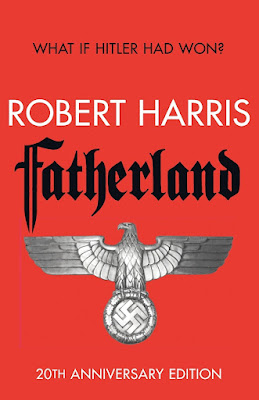
Harris, Robert "Fatherland"

Harris, Robert "Fatherland" - 1992

What an awful thought. Hitler resp. the Nazis had won the war. I always say, the Germans didn't lose the war, that were the Nazis. The Germans effectively won the war. In this book (and in various others, like my favourite "The Children's War") we can all see why.

The story itself concentrates on one particular case. A policemen who is not a fan of the Nazis but still has to wear their uniform for his job, tries to find the secret behind a murder. And with that, he could transform the whole world.

We need people like that everywhere, people who don't just blindly follow some dicatators, even if it is an advantage for them.

I think, right now is the right time to read this book again. Right now, where the Right is on the rise in many, many countries. Too many, if you ask me. How can people forget what it was? Even if you haven't lived during the war, most of us haven't, lets be honest. My parents would have been ninety had they still lived. And they were five when the Nazis were elected, so anyone responsible for the regime must be about a hundred. Not many of them alive anymore. But we have to remember what our parents or grandparents told us and see where we are heading if we elect those idiots that tell us the foreigners are our enemies. Nope, those who want to abolish our hard-earned democracy are.

We should all be happy that the war ended the way it did, this book shows us what could have been had it been different.

From the back cover:

"April 1964.

The naked body of an old man floats in a lake on the outskirts of Berlin. In one week it will be Adolf Hitler’s 75th birthday. A terrible conspiracy is starting to unravel…

What if Hitler had won?
"

Wednesday, 17 January 2024

Wells, Benedict "The End of Loneliness"

Wells, Benedict "The End of Loneliness" (German: Vom Ende der Einsamkeit) - 2016


A quiet book about a family that suddenly isn't a family anymore. How do children cope with the death of their parents, how do they get on?

In this story we can see what happens next.
Or not. How this loss accompanies a child throughout their entire life, how it shapes their life.

After the death of their parents, the children grow up in a boarding school, which is also described very impressively.
Here the author probably drew on his own experiences, as he too was at boarding school at the age of six.

This is a fabulous book that captures all facets of an entire life (or several).
Wonderfully written, a fascinating family story that is so comprehensive despite only being just over 350 pages long. Terrific. 

I think I will read more from this young author.

From the back cover:

"Jules Moreau’s childhood is shattered after the sudden death of his parents. Enrolled in boarding school where he and his siblings, Marty and Liz, are forced to live apart, the once vivacious and fearless Jules retreats inward, preferring to live within his memories - until he meets Alva, a kindred soul caught in her own grief. Fifteen years pass and the siblings remain strangers to one another, bound by tragedy and struggling to recover the family they once were. Jules, still adrift, is anchored only by his desires to be a writer and to reunite with Alva, who turned her back on their friendship on the precipice of it becoming more, but just as it seems they can make amends for time wasted, invisible forces - whether fate or chance - intervene.

A kaleidoscopic family saga told through the fractured lives of the three Moreau siblings alongside a faltering, recovering love story, The End of Loneliness is a stunning meditation on the power of our memories, of what can be lost and what can never be let go. With inimitable compassion and luminous, affecting prose, Benedict Wells contends with what it means to find a way through life, while never giving up hope you will find someone to go with you
."

"The End of Loneliness" has been chosen favourite book of the year 2016 by the German Indepent Book Shops and received the European Union Prize for Literature.

Monday, 30 October 2023

Voltaire "Candide"

Voltaire "Candide, or Optimism" (French: Candide, ou l'Optimisme) - 1759

For the Classics Spin #35, we received #2 and this was my novel.

An interesting take on the Age of Enlightenment.

Candide is a young guy who lives in Germany. He falls in love with a girl but is prevented from marrying her because of her parents. He learns the philosophy "All is for the Best" and travels around the world with this belief.

He probably encounters as many troubles as Homer's Odysseus in the "Odyssey" and solves them almost with the same vigour.

The novel promises to be funny and indeed it is. I have laughed quite a few times during the reading. How can a book be funny and philosophical at the same time? I'm not surprised Voltaire is still such a renowned author even more than two centuries later. I am really happy #2 was pulled for this challenge because I really enjoyed the story.

This novel reminded me a little of Eichendorff's "Life of a Good For Nothing", although it should be the other way around since this one was written earlier. Other than the German novel, I could see more philosophy in this book.

From the back cover:

"Candide tells of the hilarious adventures of the naïve Candide, who doggedly believes that 'all is for the best' even when faced with injustice, suffering, and despair. Controversial and entertaining, Candide is a book that is vitally relevant today in our world pervaded by - as Candide would say - 'the mania for insisting that all is well when all is by no means well.'"

Monday, 19 June 2023

Dumbach, Annette E. "Sophie Scholl and the White Rose"

Dumbach, Annette E.; Newborn, Jud; Gierlichs, Annerose "Sophie Scholl and the White Rose" (German: Die Geschichte der weißen Rose) - 2002

As I already wrote in my description of "The White Rose" by Inge Aicher-Scholl: If there are any books that everyone should read, the story of the White Rose is definitely one of them.

This is another book on the subject.
While Inge Aicher-Scholl was the sister of siblings Hans and Sophie, the authors of this book were journalists who researched the life of the group.
Another point of view that brings us even more information about the life and work of these young people. You just have to admire them and ask yourself: What would I have done in their place?

A few quotes from Sophie Scholl that we should all take to heart:


Stand up for what you believe in even if it means you stand alone.

Offer passive resistance – resistance – wherever you may be, forestall the spread of this atheistic war machine before it is too late ... (from the first leaflet; 1942)

I still believe I did the best I could for my people right now.
Therefore, I do not regret my actions and I want to accept the consequences that arise from my actions.

I am, now as before, of the opinion that I did the best that I could do for my nation. I therefore do not regret my conduct and will bear the consequences that result from my conduct.


And from Hans:
Long live freedom!

From the back cover:

"In the spring and summer of 1942, five young German students and one professor at the University of Munich crossed the threshold of toleration to enter the realms of resistance, danger and death. Protesting in the name of principles Hitler thought he had killed forever, Sophie Scholl and other members of the White Rose realized that the 'Germanization' Hitler sought to enforce was cruel and inhuman, and that they could not be content to remain silent in its midst."

In addition to the Scholl siblings, we should not forget the other members who were also executed:
Alexander Schmorell, Christoph Probst, Willi Graf and the university professor Kurt Huber.

Wednesday, 7 June 2023

Mann, Heinrich "Man of Straw"

Mann, Heinrich "Man of Straw", or "The Patrioteer", or The Loyal Subject (German: Der Untertan) - 1914

Thomas Mann is one of my favorite writers, but I had never read anything by his brother, and when a friend recommended "Der Untertan", I finally gave it a go.

Now, I don't want to compare the two brothers, I don't think that's possible.
Because of his political views and his criticism of fascism, he had to flee Germany after the Nazis took power.

You immediately notice in the story what the author thinks of his protagonist Dietrich Hessling, he doesn't like the submissive behaviour at all. Ultimately, it did lead to the most dreadful part of German history. The description "nazi prefiguration" fits exactly. This is how you imagine the supporters, whether party members or followers. I also saw him compared to Trump somewhere. Bingo!

If you're a bit interested in history, this tongue-in-cheek book is both exhilarating and terrifying, mostly because we know what comes after.
I really liked the novel, I think I'll read more by Heinrich Mann.

"Man of Straw" is the first book in the "Das Kaiserreich" [The Empire] trilogy, the other parts are called "Die Armen" [The Poor] and "Der Kopf" [The Head] (both probably not translated into English as I couldn't find any titles on the usual sites.


From the back cover:

"First published in 1918, Man of Straw is a sharp indictment of the Wilhelmine regime and a chilling warning against the joint elevation of militarism and commercial values. The Man of Straw is Diederich Hessling, embodiment of the corrupt society in which he moves; his brutish progression through life forms the central theme of the book.

Man of Straw is a satirical novel that connects the tradition of nineteenth-century German literature with the larger problems faced on the eve of the Nazi era."

Wednesday, 31 May 2023

Taha, Karosh "In the Belly of the Queen"


Taha, Karosh "In the Belly of the Queen" (German: Im Bauch der Königin) - 2020

An interesting book, not easy to digest, but worth reading. The author is a German-born Kurd and she tells us about life as a foreigner in Germany but also as a Kurd in the international community.

The unique thing about this book is that you can read it from two sides, no, you have to read it from two sides.
Somewhere it is described as a "Wenderoman" which should be translated as a "changing/turning novel" but is really the German description for novels
dealing with the political turning point after the fall of the Berlin Wall.

I decided to start at the top as the bookseller hands me the volumes and so I started with the part of Raffiq. We don't find out what part of Kurdistan he is from or if he is from Kurdistan at all but I
assumed so. First and foremost, he talks about his friends Younes and Amal, teenagers like him who are about to graduate from school and are thinking about what they want to do afterwards. Raffiq also tells about their childhood and their everyday life, where Youne's mother Shahira plays a big role. She does not follow the general rules of the Kurds, and the young people's parents are not exactly enthusiastic about her.


The other half of the book is narrated by Amal. Her family comes from Iraq, her father left his wife many years ago and started a new family in his home country. Amal takes Shahira as an example and does not put up with everything that is not easy in her environment. Everyone finds it very shocking that she cuts her hair short.

You can see the book entirely as a story about growing up, the problems with parents who are larger because the parents grew up in a completely different culture.
I hope my sons don't feel that way, our culture was more similar to that of our host countries.


A lot of the problems that the young people have are certainly exactly the same as those of other German and Western Europeans, and so some may learn from this that people are the same everywhere.

The way the story is told gives us two perspectives that make it seem like two totally different novels.
That's what I found most fascinating.


From the back cover:

"Amal shocks the whole neighbourhood by beating up her classmate Younes. Her father defends her behaviour and encourages her to assert herself. From then on everyone avoids Amal - and then her father leaves. Searching in vain for an explanation, Amal finds unexpected refuge with Younes and his mother Shahira, both outsiders like her. Years later, when the situation comes to a head and the conflict with Raffiq’s gang escalates, Amal flees to Kurdistan to look for her father."

I found this through Karen @ kaggsysbookishramblings who in turn found it on Ali's page @ HEAVENALI.

Monday, 27 March 2023

Kampfner, John "Why the Germans Do it Better"

Kampfner, John "Why the Germans Do it Better. Notes from a Grown-Up Country" - 2020

Another Christmas gift by one of my sons. They know what I'm interested in.

This book gives us an overview of the Germany's post-war politics, economics, and social history. The title might be a little misleading, John Kampfner does not only praise Germany for everything. He compares it mainly with the United Kingdom and their recent politics with which he doesn't seem to agree - well, neither do I. We should all strive for more unity and not drift apart. In that, I seem to be more German than I ever thought I might be.

All in all, the author sees Germany with the eyes of a foreigner who lived here long enough to judge. Many of my compatriots complain about our social security system, our health insurances, anything, really. But they don't know how it is elsewhere. Especially healthcare is still a top priority and every German has a right to medical care. Unfortunately, it's not like that everywhere. But also our politics is exemplary, according to the author. In the book description, we are even described as an eternally fascinating country. I think many Germans would be surprised to hear that. Unfortunately, not all foreigners would agree with John Kampfner. Many still live in the 1940s and see us as the eternal enemy.

A big part of the book is how Germany was rebuilt after the Second World War, how it helped building a united Europe, how it faced the challenges after reunification and how it welcomed many more refugees from Syria than most other countries. He mentions, that "in Germany there had long been a consensus around the principles of generous contributions directly from the pay packet in return for high-quality service. There is similiarly broad support for the principles underlying higher taxation and the role of the state - that you are paying not just for your own benefit, and that of your family, but for the needs of society at large. That way of thinking has been in place for decades."

And about the challenges the reunification posed, he asks: "Could any other nation have dealt with a situation such as that with so little upheaval?"

Mind you, the book is not just written with rose-tinted glasses. The author doesn't just mention the good parts, he also describes what could be better and what could lead to problems in the future. However, he has been asked by many Germans to change the title and include more about what we get wrong.

Still, an interesting book that is probably even more interesting for Germans than it might be for outsiders.

From the back cover:

"Emerging from a collection of city states 150 years ago, no other country has had as turbulent a history as Germany or enjoyed so much prosperity in such a short time frame. Today, as much of the world succumbs to authoritarianism and democracy is undermined from its heart, Germany stands as a bulwark for decency and stability.

Mixing personal journey and anecdote with compelling empirical evidence, this is a critical and entertaining exploration of the country many in the West still love to hate. Raising important questions for our post-Brexit landscape, Kampfner asks why, despite its faults, Germany has become a model for others to emulate, while Britain fails to tackle contemporary challenges. Part memoir, part history, part travelogue,
Why the Germans Do It Better is a rich and witty portrait of an eternally fascinating country."

Wednesday, 8 February 2023

Petrowskaja, Katja "Maybe Esther"

Petrowskaja, Katja "Maybe Esther" (German: Vielleicht Esther) - 2014

A great tale of a Jewish family's history. One critic wrote that Katja Petrowskaja could have written a great novel, but only reproduced fragments. I think it is precisely these fragments that show more of what this family - representative of all other Jewish families - went through, all the little details that you don't often hear about.

A wonderful book.

From the back cover:

"An inventive, unique, and extraordinarily moving literary debut that pieces together the fascinating story of one woman’s family across twentieth-century Russia, Ukraine, Poland, and Germany.

Katja Petrowskaja wanted to create a kind of family tree, charting relatives who had scattered across multiple countries and continents. Her idea blossomed into this striking and highly original work of narrative nonfiction, an account of her search for meaning within the stories of her ancestors.

In a series of short meditations, Petrowskaja delves into family legends, introducing a remarkable cast of characters: Judas Stern, her great-uncle, who shot a German diplomatic attaché in 1932 and was sentenced to death; her grandfather Semyon, who went underground with a new name during the Bolshevik Revolution in Russia, forever splitting their branch of the family from the rest; her grandmother Rosa, who ran an orphanage in the Urals for deaf-mute Jewish children; her Ukrainian grandfather Vasily, who disappeared during World War II and reappeared without explanation forty-one years later - and settled back into the family as if he’d never been gone; and her great-grandmother, whose name may have been Esther, who alone remained in Kiev and was killed by the Nazis.

How do you talk about what you can’t know, how do you bring the past to life? To answer this complex question, Petrowskaja visits the scenes of these events, reflecting on a fragmented and traumatized century and bringing to light family figures who threaten to drift into obscurity. A true search for the past reminiscent of Jonathan Safran Foer’s
Everything Is Illuminated, Daniel Mendelsohn’s The Lost, and Michael Chabon’s Moonglow, Maybe Esther is a poignant, haunting investigation of the effects of history on one family."

In 2013, Katja Petrowskaja received the Ingeborg Bachmann Prize, one of the most important awards for literature in the German language.