Thursday, 31 January 2019

Vargas, Jose Antonio "Dear America"


Vargas, Jose Antonio "Dear America: Notes of an Undocumented Citizen" - 2018

This is such an interesting book that puts a face to all those "illegal immigrants". Even though the author is not your average undocumented citizen, he can express his problems and with that the problem of all the other immigrants who would love to be legal but just have no chance.

But it is also a story about all those who oppose immigration and it teaches us that the country could gain so much from making it easier to attain a citizenship. Many people live somewhere in countries where they weren't born and whose passport they don't carry. If you make it easier for those who really contribute to your country, or need your help, you might end up with an easier life for everyone.

The story is so honest and so well written, you realize that every single of those numbers is talking about a human being.

I think this should be read by many many people though I am sure those who need it most will not even look at it.

From the back cover:

"My name is Jose Antonio Vargas. I was born in the Philippines. When I was twelve, my mother sent me to the United States to live with her parents. While applying for a driver’s permit, I found out my papers were fake. More than two decades later, I am still here illegally, with no clear path to American citizenship. To some people, I am the ''most famous illegal' in America. In my mind, I am only one of an estimated 11 million human beings whose uncertain fate is under threat in a country I call my home.

This is not a book about the politics of immigration. This book - at its core - is not about immigration at all. This book is about homelessness, not in a traditional sense, but about the unsettled, unmoored psychological state in which undocumented immigrants like me find ourselves. This book is about lying and being forced to lie to get by; about passing as an American and as a contributing citizen; about families, keeping them together, and having to make new ones when you can’t. This book is about what it means to not have a home."

Vargas authored or contributed to three Washington Post articles about the Virginia Tech shootings that were awarded the 2008 Pulitzer Prize for Breaking News Reporting.

Wednesday, 30 January 2019

Ackroyd, Peter "Civil War"

Ackroyd, Peter "The History of England, Vol. 3 Civil War" - 2014

After "The History of England, Vol. 1 Foundation" and "The History of England, Vol. 2 Tudors", this is Peter Ackroyd's third voyage into the history of England, their kings and queens, their troubles and wars, their marriages and children, everything you always wanted to know that is behind those numbers like 1642–1651 when the English civil war took place.

He talks to us about the Stuart Kings, starting with James I all through to his grandson James II. I must admit, I did not know half as much about this part of the English history as I did about the Tudors, they are just not as flamboyant. But I learned a little about both the Stuarts as well as the interregnum and why the British all think Prince Charles might take on another name when he accedes to the throne.

I'm looking forward to the next book in this series:
Revolution: The History of England from the Battle of the Boyne to the Battle of Waterloo (The History of England #4)

There is only one thing I really missed and that was a list at the back about who became king when and who was the son of whom etc., you know, those nice little family trees you often find in these kinds of books. I am one of those readers who always wants more information and wants to check this and that. So, I had to always look up my list elsewhere. Maybe a little hint for the future.

Other than that, if you are only remotely interested in history, Peter Ackroyd is an author to read. He always includes so much information, it's such a pleasure to go through his books.

From the back cover:

"In Civil War, Peter Ackroyd continues his dazzling retelling of England's history, painting a vivid portrait of the Stuart kings, from the accession of James I to the ignominious exile of his grandson James II. In it, Ackroyd lays before us the turbulent seventeenth century, most especially the civil war which led to the killing of the hapless Charles I and the despotic reign of England's only dictator, Oliver Cromwell.

But here, too, is the cultural and social life of the period, notable for its extraordinarily rich literature, including Shakespeare's late masterpieces, Jacobean tragedy, the poetry of John Donne and Milton and Thomas Hobbes' great philosophical treatise, Leviathan. Above all, Ackroyd gives us a very real sense of ordinary English men and women, living their lives against a backdrop of constant disruption and uncertainty."

Tuesday, 29 January 2019

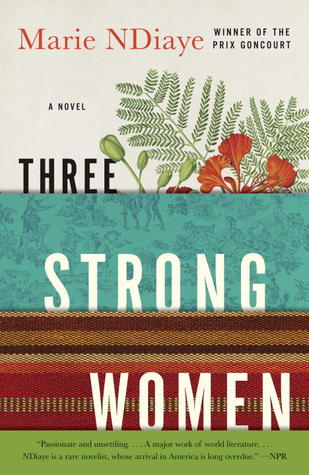
NDiaye, Marie "Three strong women"

NDiaye, Marie "Three strong women" (French: Trois femmes puissantes) - 2009

As I already mentioned in my review about the author's book "Rosie Carpe", I like reading a French book from time to time in order to use and improve my French. Unfortunately, I rarely enjoy them because they are always so weird. Not any different with this one.

I liked the description of the novel, or what I thought was the novel about three women who knew each other. But while reading it, I had to find out that these are three different stories with no relation to each other (other than one of them is a distant cousin of the other but the stories don't overlap). As I'm not a huge fan of short stories, I was quite disappointed when the first story ended in the middle of the book, and also in the middle of the story. None of the stories really has an end, well, the last one, sort of. None of the characters was really likeable, they all had some weird traits that I couldn't agree with.

The stories were unpleasant and ended abruptly. The characters didn't seem to even want to do anything to change their lives for the better. That is always the worst part of these kind of stories.

Nope, not my kind of book. I will have to remember not to fall into that trap again and read another book by this author.

From the back cover:

"In this new novel, the first by a black woman ever to win the coveted Prix Goncourt, Marie NDiaye creates a luminous narrative triptych as harrowing as it is beautiful.

This is the story of three women who say no: Norah, a French-born lawyer who finds herself in Senegal, summoned by her estranged, tyrannical father to save another victim of his paternity; Fanta, who leaves a modest but contented life as a teacher in Dakar to follow her white boyfriend back to France, where his delusional depression and sense of failure poison everything; and Khady, a penniless widow put out by her husband’s family with nothing but the name of a distant cousin (the aforementioned Fanta) who lives in France, a place Khady can scarcely conceive of but toward which she must now take desperate flight.

With lyrical intensity, Marie NDiaye masterfully evokes the relentless denial of dignity, to say nothing of happiness, in these lives caught between Africa and Europe. We see with stunning emotional exactitude how ordinary women discover unimagined reserves of strength, even as their humanity is chipped away. Three Strong Women admits us to an immigrant experience rarely if ever examined in fiction, but even more into the depths of the suffering heart."

Monday, 28 January 2019

Nietzsche, Friedrich "Beyond Good and Evil"

Nietzsche, Friedrich "Beyond Good and Evil: Prelude to a Philosophy of the Future/On the Genealogy of Morality" (German: Jenseits von Gut und Böse. Vorspiel einer Philosophie der Zukunft/Zur Geneologie der Moral) - 1886

A tough book by a great mind, it's hard to follow him all the time, you definitely can't read it in one go and digest it that way, you have to take it in small chunks. And even if you don't always agree with his thoughts, they certainly get you thinking.

From the back cover:

"Beyond Good and Evil confirmed Nietzsche's position as the towering European philosopher of his age. The work dramatically rejects the tradition of Western thought with its notions of truth and God, good and evil. Nietzsche demonstrates that the Christian world is steeped in a false piety and infected with a 'slave morality'. With wit and energy, he turns from this critique to a philosophy that celebrates the present and demands that the individual imposes their own 'will to power' upon the world."

Friday, 25 January 2019

Coetzee, J.M. "The Childhood of Jesus"


Coetzee, J.M. "The Childhood of Jesus" - 2013

I don't really know what to say about this book. It is so strange. A man and a boy arrive in a new country. We are supposed to believe, I think, that they are refugees abut we have no idea from where they come and where they went, only that they had to cross an ocean. They could have gone from Africa to South America, Asia to Australia, North America to Europe or any combination thereof. The only continent I wouldn't suspect is Antarctica though it could be after climate change has taken place and they start settling people there.

That doesn't really matter. I'm not even sure whether this is supposed to be a dystopian novel or not, though I will call it that. Everyone in this country starts with a clean slate, they are given a new name, their past is forgotten. Sounds more like a utopian tale at the beginning, however, it's not. Life couldn't be made more difficult for new arrivals.

I have come to really dislike the boy and that is something I don't really like. I remember a member of our book club mention that she hated books where the children are so awful that one can only dislike them. I doubt she would have liked this book.

As to the title, I have no idea what the title has to do with the novel. There are biblical allusions but without the name "Jesus", it might as well have been coincidences.

Somewhere on the internet I read someone recommending "Disgrace" and "Life of Times of Michael K." and avoid this one. I wish I had read that before starting this novel. I did enjoy "Disgrace" a lot more than this one.

From the back cover:

"After crossing oceans, a man and a boy arrive in a new land. Here they are each assigned a name and an age, and held in a camp in the desert while they learn Spanish, the language of their new country. As Simón and David they make their way to the relocation centre in the city of Novilla, where officialdom treats them politely but not necessarily helpfully.

Simón finds a job in a grain wharf. The work is unfamiliar and backbreaking, but he soon warms to his stevedore comrades, who during breaks conduct philosophical dialogues on the dignity of labour, and generally take him to their hearts.

Now he must set about his task of locating the boy’s mother. Though like everyone else who arrives in this new country he seems to be washed clean of all traces of memory, he is convinced he will know her when he sees her. And indeed, while walking with the boy in the countryside Simón catches sight of a woman he is certain is the mother, and persuades her to assume the role.

David's new mother comes to realise that he is an exceptional child, a bright, dreamy boy with highly unusual ideas about the world. But the school authorities detect a rebellious streak in him and insist he be sent to a special school far away. His mother refuses to yield him up, and it is Simón who must drive the car as the trio flees across the mountains.

THE CHILDHOOD OF JESUS is a profound, beautiful and continually surprising novel from a very great writer."

J.M. Coetzee "who in innumerable guises portrays the surprising involvement of the outsider" received the Nobel Prize in 2003.

I contribute to this page: Read the Nobels and you can find all my blogs about Nobel Prize winning authors and their books here.

Wednesday, 23 January 2019

Harari, Yuval Noah "Sapiens"

Harari, Yuval Noah "Sapiens. A Brief History of Mankind" (Hebrew: קיצור תולדות האנושות/Ḳizur Toldot Ha-Enoshut) - 2014

This book is one of the most interesting ones I have read lately. A book that tries to explain how we became the beings we are today, what happened between the time the first humanoid forms appeared on this earth and today. It answers many questions you might have never asked yourself but always should have.

Why did the Homo Sapiens survive and not the Neanderthal? Why did we go from being hunters and gatherers to being settlers, farmers? Did it do us any good? Have people in the middle ages been unhappier than we are today? What is the advantage of global communities? And where does all this go? How much does biology influence history? What exactly are cultural differences?

If you have any questions along those lines, the answer is probably in this book. Or - it can't be answered.

A brilliant book by a great mind, a history professor who has studied his fellow human beings intensely.

From the back cover:

"100,000 years ago, at least six human species inhabited the earth. Today there is just one. Us. Homo sapiens.

How did our species succeed in the battle for dominance? Why did our foraging ancestors come together to create cities and kingdoms? How did we come to believe in gods, nations and human rights; to trust money, books and laws; and to be enslaved by bureaucracy, timetables and consumerism? And what will our world be like in the millennia to come?

In Sapiens, Dr Yuval Noah Harari spans the whole of human history, from the very first humans to walk the earth to the radical – and sometimes devastating – breakthroughs of the Cognitive, Agricultural and Scientific Revolutions. Drawing on insights from biology, anthropology, paleontology and economics, he explores how the currents of history have shaped our human societies, the animals and plants around us, and even our personalities. Have we become happier as history has unfolded? Can we ever free our behaviour from the heritage of our ancestors? And what, if anything, can we do to influence the course of the centuries to come?

Bold, wide-ranging and provocative, Sapiens challenges everything we thought we knew about being human: our thoughts, our actions, our power ... and our future."
 
I also read "Homo Deus" in the meantime. Just as great.

Tuesday, 22 January 2019

Mary Scott Novels in English


I have read Mary Scott's novels since I was a teenager. She has been my favourite author for quite a while and I still care a lot for her books. They are natural, you can tell she lived through them.

Unfortunately, I only know her books in the German translation. I have always wanted to read them in the original but by the time the internet came up and it was easier to order books in different languages, they were out of print and I was unable to find them.

A while ago, I found a used copy. Hurray! Finally I could read at least one of her novels in English.

I was not disappointed. However, I noticed that not everything found its way into the translation. Not that the book story was changed but a lot of the minor characters and their stories were left out. So, now I wonder what was left out in the other books and would love to read more of them. I will carry on looking through the internet and hopefully find some of her other writings.

I will keep a list here of all the books I read in English now and put up a link in my post "Mary Scott writes about New Zealand".

Scott, Mary "Yours to oblige" (Na endlich, Liebling) - 1954
Scott, Mary "Breakfast at Six" (Frühstück um Sechs. Ich und Paul und Tausend Schafe) - 1953 - the first book in my favourite series about Susan who marries a sheep farmer
Scott, Mary "What Does It Matter" (Macht nichts, Darling) - 1966