Leky, Mariana "What You Can See From Here" (German: Was man von hier aus sehen kann) - 2017
In 2017, this novel was awarded The Favourite Book of the Independents and that is the only reason I was made aware of it. I liked the first one I read from that list and every other one that I read subsequently. Because the one that received the prize last year still isn't available in paperback, I went to one of the older ones, this one.
And I am glad I did. This was such a lovely book, a story of a small village where everyone sticks together, no matter how hard it is sometimes, where everyone looks after everybody else, whether they like them or not. A great description of a functioning small community. The novel has been described as "warm". Yes, it is that but it is so much more. It's a love story as well as a philosophical quest, a coming of age story as well one about old age.
This book is described as "magic realism" and I have tagged it accordingly, though it really is more a touch of superstition in my eyes.
It is hard to describe the book without giving too much away, only this, there is a lot to be said about loss and how to deal with it and this book does it beautifully.
Mariana Leky is certainly an author to be watching out for, I will read more of her novels, so far she has written nine. Where do I begin?
From the back cover:
"In this international bestseller by the award-winning novelist Mariana Leky, What You Can See from Here, a heartwarming story unfolds about a small town, a grandmother whose dreams foretell a coming death, and the young woman forever changed by these losses and her loving, endearingly oddball community
On a beautiful spring day, a small village wakes up to an omen: Selma has dreamed of an okapi. Someone is about to die.
Luisa, Selma’s ten-year-old granddaughter, looks on as the predictable characters of her small world begin acting strangely. Though they claim not to be superstitious, each of her neighbors newly grapples with buried secrets and deferred decisions that have become urgent in the face of death.
Luisa’s mother struggles to decide whether to end her marriage. An old family friend, known only as the optician, tries to find the courage to tell Selma he loves her. Only sad Marlies remains unchanged, still moping around her house and cooking terrible food. But when the prophesied death finally comes, the circumstances fall outside anyone’s expectations. The loss forever changes Luisa and shapes her for years to come, as she encounters life’s great questions alongside her devoted friends, young and old.
A story about the absurdity of life and death, a bittersweet portrait of small towns and the wider world that beckons beyond, this charmer of a novel is also a thoughtful meditation on the way loss and love shape not just a person but a community. Mariana Leky’s What You Can See from Here is a moving tale of grief, first love, reluctant love, late love, and finding one’s place in the world, even if that place is right where you started."
Monday, 14 March 2022
Leky, Mariana "What You Can See From Here"
Friday, 11 March 2022
Book Quotes of the Week
"This
is the only perfection there is. The perfection of helping others. This
is the only thing we can do that has any lasting value or meaning. This
is why we’re here, to make each other feel safe." Andre Agassi, Open
I always think it's amazing when people like Andre Agassi have so much compassion. So, there is no excuse for rich people not to think about others.
"Healing
isn’t about recovery, it’s about discovery. Discovering hope in
hopelessness, discovering an answer when there doesn’t seem to be one,
discovering that it’s not what happens that matters - it’s what you do
with it." Dr. Edith Eva Eger, The Choice: Embrace the Possible
Wise words, not always easy to follow but certainly true.
"In your dark night, I urge you to hold to your faith, to embrace hope, and to bear your love before you like a burning candle, for I promise it will light your way." William Kent Krueger, Ordinary Grace
I found all these quotes two weeks or so ago and thought, they are very pandemic appropriate. Then Ukraine happened and I think it is even more appropriate to war. Let's think about our neighbours, our friends, but also about anyone in danger, we are all brothers and sisters.
Find more book quotes here.
Thursday, 10 March 2022
#ThrowbackThursday. The Shadow of the Wind
Ruiz Zafón, Carlos "The Shadow of the Wind" (Spanish: La Sombra del Viento) - 2001
(El cementerio de los libros olvidados #1)
This was the first novel I read by this wonderful author, Carlos Ruiz Zafón. There were many more to follow, however, there are never enough books if you like someone's writing and we were all very sad about his early passing at the age of 55 in 2020.
This novel and its sequels certainly deserve to be on my list of favourite books ever.
This book is intriguing, exciting,
has all the parts a good book should have, an interesting story, a
historical background, a description of a great city. And, it's a book about a book, that's always exciting for avid readers.
But I couldn't just remind everyone of this first book in the tetralogy, I really have to mention the other three, as well. The great thing here is, you can read them in any sequence you want.
- "The Prisoner of Heaven" (E: El prisionero del cielo - El cementerio de los libros olvidados #3) - 2011
- "The Labyrinth of the Spirits" (E: El laberinto de los espíritus - El cementerio de los libros olvidados #4) - 2016
Find more books by this great author here.
Read more on my original post here.
Wednesday, 9 March 2022
Harari, Yuval Noah "21 Lessons for the 21st Century"
A brilliant follow-up to "Sapiens" and "Homo Deus". This is another book that I think everyone should read. The author shows us what the future might have in mind for us and how we should get prepared. And I don't talk about the fear of war or natural disasters due to climate change but about everyday life. What should we study to get a decent job? More importantly, what should our children study in order to get through their lives? My parents and grandparents would leave school at age 14 or 15, do an apprenticeship and many of them worked in the same company for the rest of their lives. Once they finished their apprenticeship, they could do what they learn for decades without having to learn anything new. That is not the case anymore. That wasn't the case for my generation, that isn't the case for tomorrow's generation and it certainly will not be the case for the next generation after that.
So, we need clever people like Yuval Harari to tell us what might happen, what we can do in order not to be afraid of the future. He does exactly that. His recommendations make sense and are well-founded, he explains every single remark he makes. What's even better, he explains it in such a way that even people who don't understand much about science (like myself) can follow his explanations. And also about politics, global economy, anything that concerns us and influences our lives.
I heartily recommend this and his other books. They are just fantastic. I hope he will write more.
From the back cover:
"Sapiens showed us where we came from. Homo Deus looked to the future. 21 Lessons for the 21st Century explores the present.
How can we protect ourselves from nuclear war, ecological cataclysms and technological disruptions? What can we do about the epidemic of fake news or the threat of terrorism? What should we teach our children?
Yuval Noah Harari takes us on a thrilling journey through today’s most urgent issues. The golden thread running through his exhilarating new book is the challenge of maintaining our collective and individual focus in the face of constant and disorienting change. Are we still capable of understanding the world we have created?"
Tuesday, 8 March 2022
Top Ten Tuesday ~ Epistolary Novels
"Top Ten Tuesday" is an original feature/weekly meme created on the blog "The Broke and the Bookish". This feature was created because they are particularly fond of lists at "The Broke and the Bookish".
It is now hosted by Jana from That Artsy Reader Girl.
Since I am just as fond of them as they are, I jump at the chance to share my lists with them! Have a look at their page, there are lots of other bloggers who share their lists here.
This week, our topic is Books With Your Favorite Trope/Theme
Sometimes it would be nice to have a closer explanation of what the suggestion really means, I have done several about a certain theme:
Top Ten Books From My Favourite Genre. I chose historical fiction here.
Top Ten All Time Favourite Books in X Genre. This was one about my favourite classic books.
According to Wikipedia, "a literary trope is the use of figurative language, via word, phrase or an image, for artistic effect such as using a figure of speech."
So, I thought I should check what kind of books fit into a certain category and before even checking my lists, I thought of epistolary novels. I love writing (and receiving) letters (mostly e-mails today but it's about exchanging news via written word rather than social media, so that counts in my opinion) and reading books that are written as letters or diaries is a lot of fun. So, epistolary novels it is.
When I came to choosing which book to put on this list, I found many that were written by people who suffered from a war or other devastating circumstances and that's what I went with. Maybe Mr. Putin should read at least one of those books, it might change his mind.
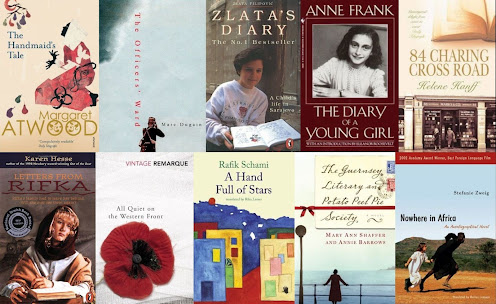
Atwood, Margaret "The Handmaid’s Tale" (Re-Read) - 1985
Dugain, Marc "The Officer's Ward" (F: La Chambre des officiers) - 1999
Filipović, Zlata "Zlata's Diary: A Child's Life in Wartime Sarajevo" (BOS: Zlatin dnevnik: otroštvo v obleganem Sarajevu) - 1993
Frank, Anne "The Diary of a Young Girl" (NL: Het Achterhuis) - 1942-33
Hanff, Helene "84 Charing Cross Road" + "The Duchess of Bloomsbury Street" - 1970 + 1973
Hesse, Karen "Letters From Rifka" - 1992
Remarque, Erich Maria "All Quiet on the Western Front" (GE: Im Westen nichts Neues) - 1928
Schami, Rafik "A Hand Full of Stars" (GE: Eine Hand voller Sterne) - 1987
Shaffer, Mary Ann & Barrows, Annie "The Guernsey Literary & Potato Peel Society" - 2008
Zweig, Stefanie "Nowhere in Africa" und "Somewhere in Germany" - 1995+1996
Monday, 7 March 2022
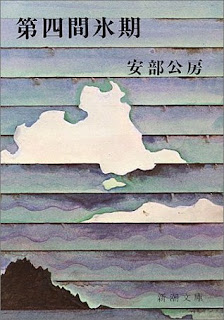
Abe, Kōbō "Inter Ice Age 4"
This was our international online book club book for February 2022.
Before I start talking about the book, I must point out that I never liked science fiction. I don't mind dystopian literature, if it is something that could really happen or that would have happened, had a certain even not taken place or succeeded or whatever.
This is none of that. It really is more a fantasy of someone who would love science to do things that aren't possible. Maybe they will be in future. But a lot of times, we wouldn't even want that to happen.
Sometimes, a science fiction novel has interesting characters or a good plot. This one had neither. I couldn't warm to any of the figures, you hardly got to know them at all. And the plot, well, this was a very predictable novel, you could tell what was going to happen and it happened exactly as I thought it might. Strange and weird might be the most positive remarks I might give it.
I doubt that I will ever read a book by this author again.
Comment by another reader:
"For me the read was not very easy right now. It reminded me of the cold war while watching real war on the news ... so I ended up finishing the reading some days too late. The author was all new to me, but what really opened up the book for me was the afterword where he wrote about his intention to make people think."
From the back cover:
"A Novel of the Future
This is yet another of Mr. Abe's ominous configurations (Woman in the Dunes etc.) this time staking out its uncertain ideological imperatives in a grave new world submerged under water. In the beginning, however, Professor Katsumi who has a computer capable of making predictions, has no idea of the work undertaken in a still more dehumanized laboratory. But a double murder, an analysis of one of the bodies & some anonymous phone calls (this is all quite exciting) alert him to a traffic in human fetuses corroborated by his wife's enforced curettage. Witnessing the works in progress - growing rooms for human submarine colonies which will make human survival possible - he is also threatened with his own extinction betrayed by his own machine & he's made to consider various ethical conjectures & priorities: should one deny one's self - should the present be expendable in the interest of the future? While not everybody's book, Abe's conceptual startler has a chilly precision which makes the unthinkable only too threateningly possible. Kirkus"
Sunday, 6 March 2022
Spell Ukraine
UKRAINE ☮ UKRAINE ☮ UKRAINE
We elect a new mayor in our town today. While emotions have been high between the supports of each of the three candidates, I've been thinking. Aren't we lucky that we have a choice and that we can be sure that at the end of the day the candidate will win who has the most voters behind them? Look at countries where hardly anyone goes anymore because "they are all crooks". And then look at countries that have an election and people go but it is clear who is going to win. And then that guy does whatever he likes. That's a dictatorship, nothing else.
So, I thought to pick up another idea, again not mine, one that I found on Instagram (see here). Spell the name of the Ukraine with book titles. I've been trying to find one-word titled books that could mean something to the instigator of this war. Except for the first one, they all have something to do with war. But even Ulysses certainly would have a lot to say about this subject.
"Kallocain" (SW: Kallocain) - Karin Boye - 1940
"Ragnarok. The End of the Gods" - A.S. Byatt - 2011
"August 1914" ["The Red Wheel" cycle] (RUS: Солженицын, Александр Исаевич/Узел I - «Август Четырнадцатого», Красное колесо) - Alexander Solzhenitsyn - 1971
"In the Memory of the Forest" - Charles T. Powers - 1997
"Night" (F: La Nuit/Yiddish: Un di Velt Hot Geshvign) - Eli Wiesel - 1958
"Echoes of Violence: Letters from a War Reporter" (GE: Von den Kriegen. Briefe an Freund) - Carolin Emcke - 2004