Thursday, 8 June 2023
#ThrowbackThursday. Where the Heart is
One of our first book club reads. A seventeen year old girl ends up pregnant with no support at all and has her baby in a Wal-Mart in Oklahoma.
We discussed this in our international book club in October 2001.
Read my original review here.
Wednesday, 7 June 2023
Mann, Heinrich "Man of Straw"
Thomas Mann is one of my favorite writers, but I had never read anything by his brother, and when a friend recommended "Der Untertan", I finally gave it a go.
Now, I don't want to compare the two brothers, I don't think that's possible. Because of his political views and his criticism of fascism, he had to flee Germany after the Nazis took power.
You immediately notice in the story what the author thinks of his protagonist Dietrich Hessling, he doesn't like the submissive behaviour at all. Ultimately, it did lead to the most dreadful part of German history. The description "nazi prefiguration" fits exactly. This is how you imagine the supporters, whether party members or followers. I also saw him compared to Trump somewhere. Bingo!
If you're a bit interested in history, this tongue-in-cheek book is both exhilarating and terrifying, mostly because we know what comes after. I really liked the novel, I think I'll read more by Heinrich Mann.
"Man of Straw" is the first book in the "Das Kaiserreich" [The Empire] trilogy, the other parts are called "Die Armen" [The Poor] and "Der Kopf" [The Head] (both probably not translated into English as I couldn't find any titles on the usual sites.
From the back cover:
"First published in 1918, Man of Straw is a sharp indictment of the Wilhelmine regime and a chilling warning against the joint elevation of militarism and commercial values. The Man of Straw is Diederich Hessling, embodiment of the corrupt society in which he moves; his brutish progression through life forms the central theme of the book.
Man of Straw is a satirical novel that connects the tradition of nineteenth-century German literature with the larger problems faced on the eve of the Nazi era."
Saturday, 3 June 2023
Six Degrees of Separation ~ From Friendaholic to Kafka on the Shore
Friendaholic
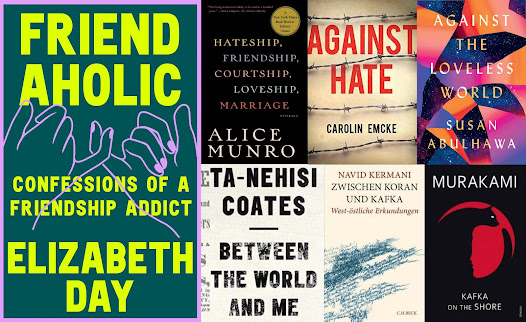
Day, Elizabeth "Friendaholic" - 2023
#6Degrees is a monthly link-up hosted by Kate at Books Are My Favourite and Best. I love the idea. Thank you, Kate. See more about this challenge, its history, further books and how I found this here.
Here is the description of the book:
"As a society, there is a tendency to elevate romantic love. But what about friendships? Aren't they just as - if not more - important? So why is it hard to find the right words to express what these uniquely complex bonds mean to us? In Friendaholic: Confessions of a Friendship Addict, Elizabeth Day embarks on a journey to answer these questions.
Growing up, Elizabeth wanted to make everyone like her. Lacking friends at school, she grew up to believe that quantity equalled quality. Having lots of friends meant you were loved, popular and safe. She was determined to become a Good Friend. And, in many ways, she did. But in adulthood she slowly realised that it was often to the detriment of her own boundaries and mental health.
Then, when a global pandemic hit in 2020, she was one of many who were forced to reassess what friendship really meant to them - with the crisis came a dawning realisation: her truest friends were not always the ones she had been spending most time with. Why was this? Could she rebalance it? Was there such thing as…too many friends? And was she really the friend she thought she was?
Friendaholic unpacks the significance and evolution of friendship. From exploring her own personal friendships and the distinct importance of each of them in her life, to the unique and powerful insights of others across the globe, Elizabeth asks why there isn’t yet a language that can express its crucial influence on our world.
From ghosting and frenemies to social media and seismic life events, Elizabeth leaves no stone unturned. Friendaholic is the book you buy for the people you love but it's also the book you read to become a better friend to yourself."
I don't think I read anything similar, so I went with the words in titles this month.
My first link therefore is Friend
Munro, Alice "Hateship, Friendship, Courtship, Loveship, Marriage" - 2001
Hate
Emcke, Carolin "Against Hate" (GE: Gegen den Hass) - 2016
Against
Abulhawa, Susan "Against the Loveless World" - 2020
World
Coates, Ta-Nehisi "Between the World and Me" - 2015
Between
Kermani, Navid "Between Quran and Kafka: West-Eastern Affinities" (GE: Zwischen Koran und Kafka. West-östliche Erkundungen) - 2014
It's not that easy to find a connection between the first and the last book this time. The title is completely different. The setting as well. "Kafka on the Shore" takes place in Japan, Friendaholic is a non-fiction book that could take place everywhere. However, the protagonist in the last book is trying to find himself, and I think that is the link.
Friday, 2 June 2023
Spell the Month in Books ~ June
I found this on one of the blogs I follow, Books are the New Black who found it at One Book More. It was originally created by Reviews from the Stacks, and the idea is to spell the month using the first letter of book titles.
June: Set someplace you have never lived
This was a lot easier than finding the books with animals for last month. I have lived in four different countries, all of them in Europe, so I still have about 150 more left.
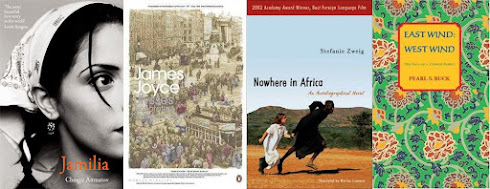
J
Aitmatov, Chinghiz "Jamilya" (RUS: Джамиля) - 1958
I have met a few people who come from Kyrgyzstan but I have never been in any of the former USSR countries.
U
Joyce, James "Ulysses" - 1922
I have visited Ireland several times but never lived there. It is my dream country, therefore, I had to include it.
N
Zweig, Stefanie "Nowhere in Africa" (GE: Nirgendwo in Afrika) - 1995
As the title says, I have lived nowhere in Africa. This semi-autobiographical novel takes place in Kenya and if you haven't read it, I highly recommend it.
E
Buck, Pearl S. "East Wind: West Wind" - 1930
Pearl S. Buck was one of my absolutel favourite authors in my teens and I still love her books. And no, I never lived East of where I grew up, always to the West. But that is quite understandable since there was the Iron Curtain and I wouldn't have gotten very far.
Thursday, 1 June 2023
Happy June!
Happy June to all my friends and readers
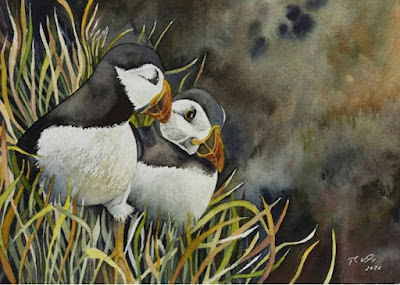
beautiful watercolour painting by Frank Koebsch
"Papageitaucher"
"Puffins"
The June calendar page shows some puffins from our trips to Alaska, Canada, Iceland, Greenland, Norway...
(Das Kalenderblatt vom Juni zeigt ein paar Papageitaucher von unseren Reisen nach Alaska, Kanada, Island, Grönland, Norwegen …)
Read more here.
* * *
I don't think all birds are cute. But puffins certainly are. The German word Papageitaucher means parrot diver. But they are not related to parrots at all, they are also no penguins though they look a little like them. They belong to the group of auks of the family Alcidae. But, in any case, they are totally cute, at least I think so.
* * *
We also could welcome some wonderful visitors in our home.
* * *
Another great watercolour painting by Frank Koebsch. Enjoy!
You can find many more wonderful pictures on their website here.
You can also have a look under my labels Artist: Frank Koebsch and Artist: Hanka Koebsch where you can find all my posts about them.
Wednesday, 31 May 2023
Taha, Karosh "In the Belly of the Queen"
Taha, Karosh "In the Belly of the Queen" (German: Im Bauch der Königin) - 2020
An interesting book, not easy to digest, but worth reading. The author is a German-born Kurd and she tells us about life as a foreigner in Germany but also as a Kurd in the international community.The unique thing about this book is that you can read it from two sides, no, you have to read it from two sides. Somewhere it is described as a "Wenderoman" which should be translated as a "changing/turning novel" but is really the German description for novels dealing with the political turning point after the fall of the Berlin Wall.
I decided to start at the top as the bookseller hands me the volumes and so I started with the part of Raffiq. We don't find out what part of Kurdistan he is from or if he is from Kurdistan at all but I assumed so. First and foremost, he talks about his friends Younes and Amal, teenagers like him who are about to graduate from school and are thinking about what they want to do afterwards. Raffiq also tells about their childhood and their everyday life, where Youne's mother Shahira plays a big role. She does not follow the general rules of the Kurds, and the young people's parents are not exactly enthusiastic about her.
The other half of the book is narrated by Amal. Her family comes from Iraq, her father left his wife many years ago and started a new family in his home country. Amal takes Shahira as an example and does not put up with everything that is not easy in her environment. Everyone finds it very shocking that she cuts her hair short.
You can see the book entirely as a story about growing up, the problems with parents who are larger because the parents grew up in a completely different culture. I hope my sons don't feel that way, our culture was more similar to that of our host countries.
A lot of the problems that the young people have are certainly exactly the same as those of other German and Western Europeans, and so some may learn from this that people are the same everywhere.
The way the story is told gives us two perspectives that make it seem like two totally different novels. That's what I found most fascinating.
From the back cover:
"Amal shocks the whole neighbourhood by beating up her classmate Younes. Her father defends her behaviour and encourages her to assert herself. From then on everyone avoids Amal - and then her father leaves. Searching in vain for an explanation, Amal finds unexpected refuge with Younes and his mother Shahira, both outsiders like her. Years later, when the situation comes to a head and the conflict with Raffiq’s gang escalates, Amal flees to Kurdistan to look for her father."
I found this through Karen @ kaggsysbookishramblings who in turn found it on Ali's page @ HEAVENALI.
Tuesday, 30 May 2023
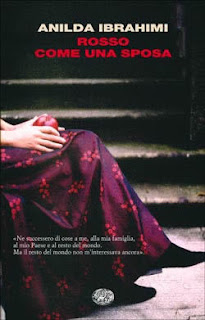
Ibrahimi, Anilda "Red Like a Bride"
Ibrahimi, Anilda "Red Like a Bride" (Italian: Rosso come una sposa) - 2008
This Italian book has not been translated into English but because it is available in other languages (Finnish, French, German, Serbian), some of us read it in our international online book club. I read the German translation: Rot wie eine Braut.
For a long time, we hardly heard anything about
Albania. You knew the country was secluded, no one came in, even fewer
less came out.
In this book we are told about life behind the
curtain. We get to know four generations of women, starting with Saba,
who was married to her sister's widower at the age of 15 and had nine
children by him, five girls and four boys.
The war changes the
position of women, they get an education and become more independent,
also in the countryside. We live through the different generations up to
Dora who is telling the story.
The title alludes to the tradition that in Albania a bride would be dressed all in red.
An interesting story about life in a country we still don't know much about. Well written, easy to read. I liked it very much.
This was discussed in our international online book club in May 2023.
The group had a really good discussion about it, it was very well liked among everyone, both from the interesting perspective of Albanian history and culture, and the different stories moving along the book along the lives of the women the story told about towards modern times, how life goes on and is connected. The group thought it was a high quality read, and warmly would recommend it and gave it 5 out of 5 points.
Book description (translated):
"Four
generations of women, a chest full of memories, the start of a new life
Young Dora left her native Albania to start a better life in Italy. In
the distance, the memories of her family, who have lived a simple life
in the small mountain village of Kaltra for generations, determined by
archaic traditions, suddenly seem like they are from another time. But
whenever she opens the chest that was left to her by Saba, the
grandmother, takes Saba's red wedding veil in her hands and smells the
familiar smell of quince, the past comes to life before her eyes..."