Thursday, 12 November 2020

Non-fiction November - Week 1

Leann from Shelf Aware and Julie from julzreads have given Non-fiction November a new twist.

They encourage us to not only read a non-fiction book this month but also to look at non-fiction books in general.

This week, we are to take a look back at our year of reading and reflect on the following:

1.    What was your favourite non-fiction read of the year?
2.    Do you have a particular topic you’ve been attracted to more this year?
3.    What non-fiction book have you recommended the most?
4.    What are you hoping to get out of participating in Non-fiction November?

1. First, I found not just one favourite non-fiction but three that I all enjoyed tremendously. They are all very different, therefore it is tough to choose a favourite. Here they are:

2. Definitely anti-racism as this was such a big topic this year. I can't believe there are still people out there who think someone with a certain colour is better than others. I published a list because I think everyone should read at least one book about it.

3. That's a tough one but I suppose that must be one of my favourite non-fiction authors, Bill Bryson. My favourites here must be those he wrote about his and my host country (mine only for a while but still, it's the favourite of all the countries I lived in), "Notes from a Small Island" and "The Road to Little Dribbling". 

4. My hopes for this month is that I can tick off another book from my classics club list. LOL. No, I hope that many more people will read classics, whether non-fiction or fiction. They are here to tell us something.

This is part of our Classics Club reading challenge. I found them through Words and Peace. Thank you.

See further years here.

Tuesday, 10 November 2020

Top Ten Tuesday ~ Top Ten Book Titles that Would Make Great Song Titles


"Top Ten Tuesday" is an original feature/weekly meme created on the blog "The Broke and the Bookish". This feature was created because they are particularly fond of lists at "The Broke and the Bookish".

It is now hosted by Jana from That Artsy Reader Girl.

Since I am just as fond of them as they are, I jump at the chance to share my lists with them! Have a look at their page, there are lots of other bloggers who share their lists here.

Book Titles that Would Make Great Song Titles 

I'm a singer-songwriter type of girl. Always have been, always will. Think Carole King, Leonard Cohen, Neil Diamond, James Taylor, Bob Dylan, Billy Joel, etc. But I guess if you know the kind of books I like to read, you're not surprised. I could have found hundreds of books but had to stop after I had ten.

I try to imagine the kind of songs these would make. Maybe one day, someone takes up this idea and writes songs about our favourites books. Wouldn't that be nice?

Don't you feel that some of those pictures would also be great for the record cover?
Possession
Byatt, A.S. "Possession" - 1990

Summerland
Chabon, Michael "Summerland" - 2002

All the Light We Cannot See
Doerr, Anthony "All the Light We Cannot See" - 2014

Edge of Eternity
Follett, Ken "Edge of Eternity" - 2014

Nightwoods
Frazier, Charles "Nightwoods" - 2011
Rose of Sarajevo
Kulin, Ayşe "Rose of Sarajevo"
(Turkish: Sevdalinka) - 1999
 
The Shadow of the Wind
I think La Sombra del Viento also sounds great!
Ruiz Zafón, Carlos "The Shadow of the Wind"
(Spanish: La Sombra del Viento) - 2001

The Dark Side of Love

Schami, Rafik "The Dark Side of Love"
(German: Die dunkle Seite der Liebe) - 2004
 
Red River
Tademy, Lalita "Red River" - 2007

Nowhere in Africa
or also Somewhere in Germany

Which of your favourite books do you think would make great song titles?

Monday, 9 November 2020

Non-fiction November

The Classics Club is an interesting website. It gives us the opportunity not only to read the classics we always wanted to read, no, though their pages we are able to talk to others and also find new classics we didn't think about.

It's non-fiction November and the club reminded us that there are lots of non-fiction classics about, as well. I checked my classic list and found that I don’t have many non-fiction classics on my list, probably because I prefer to read about current affairs there. But there are a few:

Douglass, Frederick "Narrative of the Life of Frederick Douglass, an American Slave" - 1845
Jacobs, Harriet Ann (Linda Brent) "Incidents in the Life of a Slave Girl" - 1861
Rhoides, Emmanuel (Emmanuel Roidis) "The Curious History of Pope Joan" (gr.: Papissa Ioanna) - 1866
Marx, Karl "Das Kapital. Kritik der politischen Ökonomie" (Capital. Critique of Political Economy) - 1867
Elbogen, Ismar; Sterling, Eleonore "Die Geschichte der Juden in Deutschland" [The History of the Jews in Germany] - 1935/66

I have chosen Karl Marx this month. I desperately want to read "The Communist Manifesto" (Das kommunistische Manifest) but bought "Das Kapital" a while ago. So, "The Capital" it is.

Through "Words and Peace" I found "The Classics Club".

Saturday, 7 November 2020

The 100 Best Non-fiction Books of all Time

The 100 best Non-fiction Books of All Time as Chosen by The Guardian

For their non-fiction November month, the Classics Club published a link to Robert McCrum's "The 100 Best Nonfiction Books of All Time" (to be found in The Guardian here). I have read a few of those, there are some on my TBR pile but have never even thought about the majority (though I've heard of most of them which is probably a good sign).

I never considered plays non-fiction unless they are based on a true event but it looks like I'm alone there. Also, a lot of the books here are not real classics but I'm sure they will become one once they're old enough.

I am sure we can all find a few classic non-fiction books to add to this. What would be your suggestion?

1. Kolbert, Elizabeth "The Sixth Extinction" - 2014
2. Didion, Joan "The Year of Magical Thinking" - 2005
3. Klein, Naomi "No Logo by Naomi Klein" - 1999
4. Hughes, Ted "Birthday Letters" - 1998
5. Obama, Barack "Dreams from My Father by Barack Obama" - 1995
6. Hawking, Stephen "A Brief History of Time" - 1988
7. Wolfe, Tom "The Right Stuff by Tom Wolfe" - 1979
8. Said, Edward "Orientalism" - 1978
9. Herr, Michael "Dispatches" - 1977
10. Dawkings, Richard "The Selfish Gene" - 1976
11. Heaney, Seamus "North" - 1975
12. Sacks, Oliver "Awakenings" - 1973
13. Greer, Germaine "The Female Eunuch" - 1970
14. Cohn, Nik "Awopbopaloobop Alopbamboom" - 1969
15. Watson, James D. "The Double Helix" - 1968
16. Sontag, Susan "Against Interpretation" - 1966
17. Plath, Sylvia "Ariel" - 1965
18. Friedan, Betty "The Feminine Mystique" - 1963
19. Thompson, EP "The Making of the English Working Class" - 1963
20. Carson, Rachel "Silent Spring" - 1962
21. Kuhn, Thomas S. "The Structure of Scientific Revolutions" - 1962
22. Lewis, C.S. "A Grief Observed" - 1961
23. Strunk, Willam; White, E.B. "The Elements of Style" - 1959
24. Galbraith, John Kenneth "The Affluent Society" - 1958
25. Hoggart, Richard "The Uses of Literacy: Aspects of Working-Class Life" - 1957
26. Baldwin, James "Notes of a Native Son" - 1955
27. Clark, Kenneth "The Nude: A Study of Ideal Art" - 1956
28. Berlin, Isaiah "The Hedgehog and the Fox" - 1953
29. Beckett, Samuel "Waiting for Godot" - 1952/53
30. David, Elizabeth "A Book of Mediterranean Food" - 1950
31. Leavis, F.R "The Great Tradition" - 1948
32. Trevor-Ro.per, Hugh "The Last Days of Hitler" - 1947
33. Spock, Dr. Benjamin "The Common Sense Book of Baby and Child Care" - 1946
34. Hersey, John "Hiroshima" - 1946
35. Popper, Karl "The Open Society and Its Enemies" - 1945
36. Wright, Richard "Black Boy: A Record of Childhood and Youth" - 1945
37. Fisher, M.F.K. "How to Cook a Wolf" - 1942
38. Connolly, Cyril "Enemies of Promise" - 1938
39. Orwell, George "The Road to Wigan Pier" - 1937
40. Byron, Robert "The Road to Oxiana" - 1937
41. Carnegie, Dale "How to Win Friends and Influence People" - 1936
42. Brittain, Vera "Testament of Youth" - 1933
43. Churchill, Winston "My Early Life: A Roving Commission" - 1930
44. Graves, Robert "Goodbye to All That" - 1929
45. Woolf, Virginia "A Room of One’s Own" - 1929
46. Eliot, T.S. "The Waste Land" - 1922
47. Reed, John "Ten Days That Shook the World" - 1919
48. Keynes, John Maynard "The Economic Consequences of the Peace" - 1919
49. Mencken, H.L. "The American Language" - 1919
50. Strachey, Lytton "Eminent Victorians" - 1918
51. Du Bois, WEB "The Souls of Black Folk" - 1903
52. Wilde, Oscar "De Profundis" - 1905
53. James, William "The Varieties of Religious Experience" - 1902
54. Clark, Andrew, ed. "Brief Lives by John Aubrey" - 1898
55. Grant, Ulysses S. "Personal Memoirs" - 1885
56. Twain, Mark "Life on the Mississippi" - 1883
57. Stevenson, Robert Louis, "Travels with a Donkey in the Cévennes" - 1879
58. Lear, Edward "Nonsense Songs" - 1871
59. Arnold, Matthew "Culture and Anarchy" - 1869
60. Darwin, Charles "On the Origin of Species" - 1859
61. Mill, John Stuart "On Liberty" - 1859
62. Seacole, Mary "The Wonderful Adventures of Mrs Seacole in Many Lands" - 1857
63. Gaskell, Elizabeth "The Life of Charlotte Brontë" - 1857
64. Thoreau, Henry David "Walden" - 1854
65. Roget, Dr. Peter Mark "Thesaurus" - 1852
66. Mayhew, Henry "London Labour and the London Poor" - 1851
67. Martineau, Harriet "Household Education" - 1848
68. Douglass, Frederick "Narrative of the Life of Frederick Douglass, an American Slave" - 1845
69. Emerson, R. W. "Essays" - 1841
70. Trollope, Frances "Domestic Manners of the Americans" - 1832
71. Webster, Noah "An American Dictionary of the English Language" - 1828
72. Quincey, Thomas de "Confessions of an English Opium-Eater" - 1822
73. Lamb, Charles and Mary "Tales from Shakespeare" - 1807
74. Park, Mungo "Travels in the Interior Districts of Africa" - 1799
75. Franklin, Benjamin "The Autobiography of Benjamin Franklin" - 1793
76. Wollstonecraft, Mary "A Vindication of the Rights of Woman" - 1792
77. Boswell, James "The Life of Samuel Johnson LLD" - 1791
78. Burke, Edmund "Reflections on the Revolution in France" - 1790
79. Equiano, Olaudah "The Interesting Narrative of the Life of Olaudah Equiano" - 1789
80. White, Gilbert "The Natural History and Antiquities of Selborne" - 1789
81. 'Publius' (James Madison, Alexander Hamilton, John Jay) "The Federalist Papers"- 1788
82. Burney, Frances "The Diary of Fanny Burney" - 1778
83. Gibbon, Edward "The History of the Decline and Fall of the Roman Empire" - 1776-1788
84. Smith, Adam "The Wealth of Nations" - 1776
85. Paine, Tom "Common Sense" - 1776
86. Johnson, Samuel "A Dictionary of the English Language" - 1755
87. Hume, David "A Treatise of Human Nature" - 1739
88. Swift, Jonathan "A Modest Proposal" - 1729
89. Defoe, Daniel "A Tour Through the Whole Island of Great Britain" - 1727
90. Locke, John "An Essay Concerning Human Understanding" - 1689
91. Cranmer, Thomas "The Book of Common Prayer" - 1662
92. Pepys, Samuel "The Diary of Samuel Pepys" - 1660
93. Browne, Sir Thomas Hydriotaphia, Urn Burial, or A Brief Discourse of the Sepulchral Urns Lately Found in Norfolk" - 1658
94. Hobees, Thomas "Leviathan" - 1651
95. Milton, John "Areopagitica" - 1644
96. Donne, John "Devotions Upon Emergent Occasions" - 1624
97. Shakespeare, William "The First Folio" - 1623
98. Burton, Robert "The Anatomy of Melancholy" - 1621
99. Raleigh, Walter "The History of the World" - 1614
100. King James Bible: The Authorised Version - 1611

See my classics club list here. 

There is also a list of the 100 Greatest Fiction Books as Chosen by The Guardian. See my post here.

Friday, 6 November 2020

Book Quotes of the Week


"Until then I had thought each book spoke of the things, human or divine, that lie outside books. Now I realized that not infrequently books speak of books: it is as if they spoke among themselves. In the light of this reflection, the library seemed all the more disturbing to me. It was then the place of a long, centuries-old murmuring, an imperceptible dialogue between one parchment and another, a living thing, a receptacle of powers not to be ruled by a human mind, a treasure of secrets emanated by many minds, surviving the death of those who had produced them or had been their conveyors." Umberto Eco, The Name of the Rose
Such a nice reflection on libraries and what they do for us.

"Thank God for books and music and things I can think about." Daniel Keyes, Charlie Gordon in Flowers of Algernon
Especially at times like this.

"Books invite all. They constrain none." Susan Orelan, The Library Book
Books have no prejudices. They are there for all of us.

Find more book quotes here.

Thursday, 5 November 2020

Boye, Karin "Kallocain"

Boye, Karin "Kallocain" (Swedish: Kallocain) - 1940

I started reading this book and then had to go back and check when it was written. Yes, it was before "Nineteen Eighty-Four", so George Orwell must have received some of his ideas from Karin Boye.

This was another book our international online book club read. I had never heard of this Swedish author even though she seems to be quite well known for her dystopian literature. Probably not that much outside of Sweden which is a shame. So, I am glad one of our Scandinavian members recommended it.

The book is well-written, the plot runs smoothly and even with an opening paragraph that tells us more or less how the story will end, it is quite gripping to guess how the end will come.

I can never understand highly idealistic people who want to change the world with something they have no clue about. The protagonist of this novel, Leo Kall, is convinced that every person belongs to the state and we are only there to serve the state, are not allowed to have any private wishes or even thoughts. How can that be? How can someone blindly follow a leader like a lamb to the slaughter? If we knew that, we'd have fewer problems in this world.

There is a German song called "Die Gedanken sind frei" (The Thoughts Are Free). I always liked that song because it showed that no matter how much can be controlled, nobody can guess and therefore control my thoughts unless I share them. Not in this story, though. A very thought-provoking idea. What if people would know what we think. I'm pretty sure this world would be a worse place because not everybody likes the truth.
There is an article about the song on Wikipedia with a translation.

This is a great book that shows where our fear can lead us, how we can deal with ideas that want to influence our thinking, how we can try to escape the hatred all around us. I wish more people would read this kind of books. It's also interesting to see, like in "Nineteen-Eight Four" how everyone thinks, their state is the only good one and the others are bad and the others think just the same.

A highly impressive book.

Some comments by other book club members:
  • This was a great discussion book, both about the story itself and all its many sides, but also to mirror it to the real world at the same time and the author's suicide a year after publishing it.
  • Author's suicidal ideas are clearly showing up in this book. Heavy use of splitting and fantasizing about killing or imprisoning the bad side of the split.
  • Our library was not able to get the book for me so I reluctantly read it online. I like to cozy up with a book and empathize with the characters but that didn't happen for me with Kallocain. The book was deliciously creepy as were the characters so I enjoyed it as a chilling warmup to Hallowe'en.

And here is a great quote that sounds so true especially at the moment:
"Here I am, then. As it must be. A question of time. If truth be told. Can you hear the truth? Not everyone is true enough to hear the truth, that is the sad thing."

This was our international online book club read in October 2020.

From the back cover: 

"A pioneering work of dystopian fiction from one of Sweden's most acclaimed writers

Written midway between
Brave New World and Nineteen Eighty-Four, as the terrible events of the Second World War were unfolding, Kallocain depicts a totalitarian 'World State' which seeks to crush the individual entirely. In this desolate, paranoid landscape of 'police eyes' and 'police ears', the obedient citizen and middle-ranking scientist Leo Kall discovers a drug that will force anyone who takes it to tell the truth. But can private thought really be obliterated? Karin Boye's chilling novel of creeping alienation shows the dangers of acquiescence and the power of resistance, no matter how futile."

Tuesday, 3 November 2020

Top Ten Tuesday ~ Top Ten Non-Bookish Hobbies


"Top Ten Tuesday" is an original feature/weekly meme created on the blog "The Broke and the Bookish". This feature was created because they are particularly fond of lists at "The Broke and the Bookish".

It is now hosted by Jana from That Artsy Reader Girl.

Since I am just as fond of them as they are, I jump at the chance to share my lists with them! Have a look at their page, there are lots of other bloggers who share their lists here.

Non-Bookish Hobbies
(let’s get to know each other! What do you do that does not involve books or reading?)

I think for most of us that is a tough question. I am sure none of us reads 24 hours a day and, yet, if we have do define ourselves, the first thing we can come up with is that we love reading. At least that's the fact for me.

Cards
Now, what else do I like? First, I've always liked to create something. And for the last twenty years, my family had to endure my love of cardmaking.

Food
I better carry on in alphabetical order. It's not just the food, it's more the companionship. We have lived among Americans for decades and have adapted their way of Thanksgiving for our German friends and family. That's just as important to us than our holidays. I absolutely love baking bread, cakes and cookies, as well.

Games
I used to play games with my family when I was little and then we carried on playing with our boys. And we still play with our friends and family. We just love it.
Languages
I love languages. I often get asked how many languages I spek. That's a tough question. It depends on how well you need to speak a language before you can put it in the category "I speak the language". Let's start with the easy ones.

German - my mother tongue

English - I started learning it in 5th grade, that's about half a century ago and I still learn more every day. I lived in England for six years and have worked with/lived among English speaking people more than half of my life. So, I guess, that definitely goes into that category.

French - I started that in 7th grade. I lived in Brussels for a while and went back to visit at least once every year since 1980. I wouldn't call myself perfect but I can easily put it with the languages I speak.

Esperanto - Started this in 1977 and used it a lot in international meetings. It is such an easy language that I can also communicate with it without any difficulties.

Dutch - I'm from Northern Germany where we speak Low German which really is more related to Dutch than High German. (Check here on Wikipedia). Then I lived in the Netherlands for twenty years. Again, one of the languages I would say I speak.

That makes five. Those are also the languages where I read the original book if I get a copy of it. Now it gets toughter. While many who leave school probably know less then I do in those languages, I wouldn't say I speak them. I know enough to be able to read an easy text, get the gist of something. I can even talk to a person one to one (not without ease) but I certainly cannot follow a conversation between two natives.

Spanish - 11th grade but my teacher was sick half the time and that was that. I have been following up with books and online courses (Duolingo, for instance).
 
Italian - I really wanted to learn this for so long becaues I love the sound of it. It's not too difficult when you speak some other Roman languages already but I never found the right course, the beginner's courses were too easy but I needed to learn the basics. Now, with Duolingo, I'm on the right track.

Latin - 9th grade - not my most glorious subject at school, I didn't like it at all. I've picked it up again but I doubt I will ever be able to really read a long text.

Swedish - my son moved to Sweden for his masters' degree. We meant to visit us, so I started learning it on Duolingo. I've finished the course there but with Corona, we never managed to go. Still, another language that I can read.

Find me here on Duolingo.

Letters
I've had pen friends from all sorts of countires since I was about thirteen. Still love it. I send more cards nowadays than letters but I communicate with many of my friends via e-mail.
Maps
I just love studying maps and everything that relates to it. Where is Kazakhstan (to quote one of my favourite quizmasters, Richard Osman), what is the capital of Burkina Fazo (Ouagadougou, one of the coolest names there is), what does the flag of Suriname look like (green-white-red-white-green stripes with a yellow star in the middle)??? Fascinating.
Maths
Next to languages and geography, this was one of my favourite subjects in school. Still love it.
Photography
Granted, my husband is the better photographer but I love it, as well. All the pictures on this page are taken with my camera, the one you can see in this photo.
Sudoku
Killer-Sudoku
I have always loved any kind of puzzles, starting with crosswords and not yet ending with Sudoku (here, I especially love the Killer variety).
Travel
I have always loved traveling and I found a husband who does, as well. While we can't go on any trips at the moment, we enjoy looking at our photographs from past years.
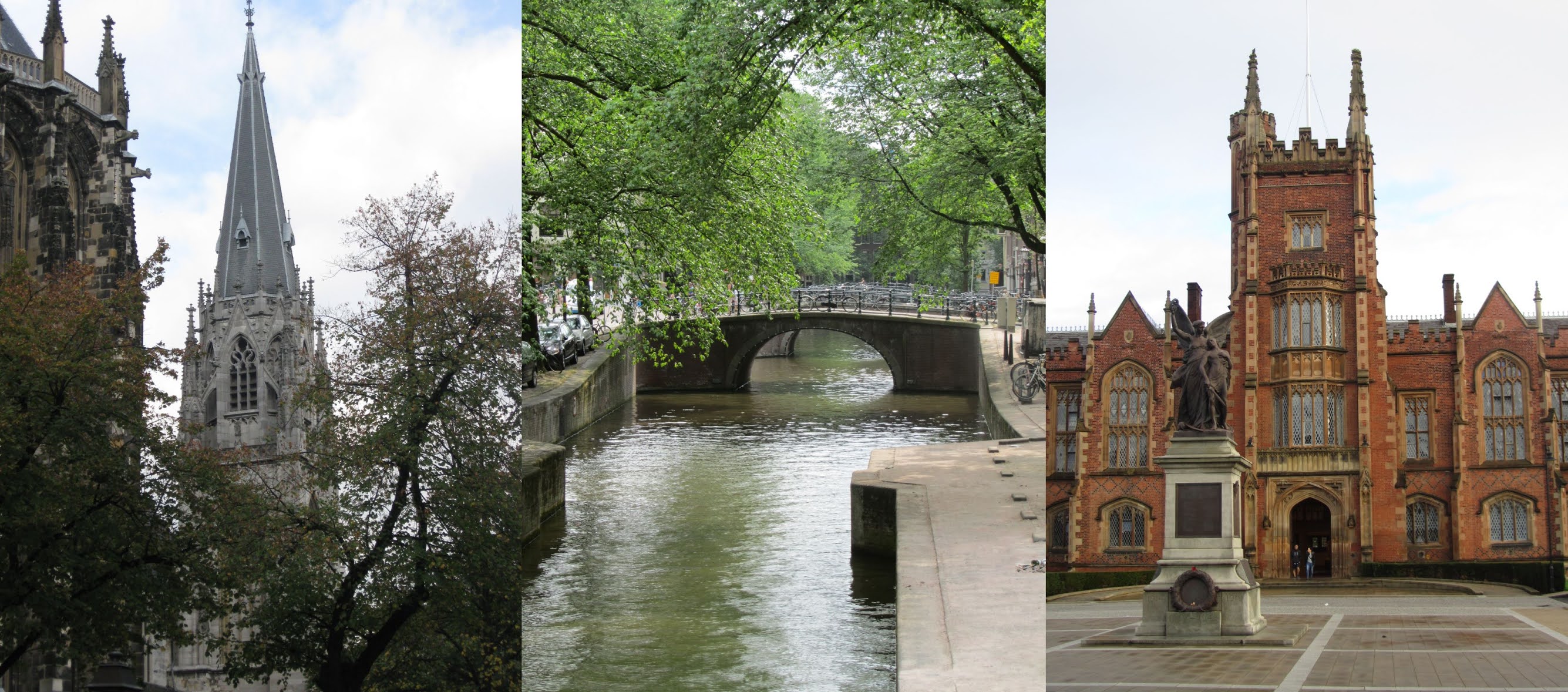
Aachen, Amsterdam, Belfast

Lübeck, Brussels, Strasbourg, Bonn