Saturday, 1 May 2021

Happy May!

Happy May to all my friends and readers

New Calendar picture with this
beautiful watercolour painting by Hanka Koebsch


"Versteckspiel"
"Playing Hide and Seek"


The little seagull chicks are playing Hide and Seek. Let's hope nobody finds them.

* * *

The official name in Low German is "Maimaond" which doesn't need any further explanation, I think.

* * * 
 
 
May starts with a holiday. The night to the 1st is celebrated as Walpurgis Nacht (Walpurgis Night). According to legend, witches meet on the Brocken in the Harz mountain and dance with the devil.

The rest of the country usually dances in the night, we call it "Dance into May". According to tradition, a fire is lit (though not all communities do that anymore) to drive away evil ghosts. In many areas, boys bring a maypole (often cut from birches) to their girlfriend. They get decorated with strings of crepe paper in many colours and put next to the girl's bedroom window (see left picture). Nowadays, it's often the whole group that brings one to each other.

In some areas, boys bring a heart decorated with paper flowers and the initial or name of their beloved. (some examples in my pictures)


The 1st of May is a holiday in Germany, International Worker's Day. Everyone uses it for a day out. You see many people on their bikes or with little toy wagons which we call Bollerwagen. If you have little kids, they can take a rest in there, the others fill it with beer for their "arduous" trip. Of course, things are different this year.

And then there's Pentecost which usually falls into May. And Ascension Day, another holiday in Germany. These are two important days in the church and because it brings extra holidays (Pentecost Monday and Ascension Day Thursday) for those who don't celebrate anything in church.

* * *

Weather lore (or farmers' rule) for May:
"Mairegen bringt Segen." May rain brings blessings.

From May 11th to 13th, we celebrate the days of the Ice Saints St. Pancras, St. Servatius, and St. Boniface. They are followed by St. Sophia on the 14th and we call her
"the Cold Sophie". 
When I say "celebrate", I don't mean that there is a particular feast, it's just that the weather gets quite colder again around those dates on those days and we blame it on the Saints.

Hubby and I have been lucky to have received our first vaccination last month since we are both on the high risk list. I hope that most of you will get yours soon, as well, so that we can all go back to normal one day.

* * *

Have a happy May with this beautiful watercolour painting by Hanka Koebsch.
 
 Stay safe and healthy, everyone!


You can find many more wonderful pictures on their website here.

You can also have a look under my labels Artist: Frank Koebsch and Artist: Hanka Koebsch where you can find all my posts about them.

Friday, 30 April 2021

Adiga, Aravind "The White Tiger"

Adiga, Aravind "The White Tiger" - 2008

While this book has a lot of information about the life of any average Indian who lives in poverty, it wasn't my favourite book about India. By far not my favourite, maybe even the one I liked least.

Was it the style? Maybe. Did I dislike the protagonist? Of course I didn't. Could I warm to any of the others? Certainly not.

Having said that, I am sure it is a picture of the true India, at least part of it. But even in the worst society of all, there is usually someone who is kind-hearted, there are people who are not just selfish and egotistic. I couldn't find anyone like that in the whole story. And I know many really nice Indians. None of them showed up in this book.

All in all, I couldn't really "believe" in the characters, they had no voice, they had no soul.

I have tried to find the reason why this book won the Booker prize. Apparently, "Balram’s journey from darkness of village life to the light of entrepreneurial success is utterly amoral, brilliantly irreverent, deeply endearing and altogether unforgettable."

Maybe it is unforgettable but not because it is such a great book. At least not in my eyes. This is not the first Booker prize winner I disliked. Maybe I should stay away from them in future. Mind you, there are a few I do like but they are more the exception than the rule.

This was our international online book club read in April 2021.

Comments from the discussion:

  • I am really enjoying the way he writes and tells the story. I do, however, agree that it is a horrific, negative story that I hope has no base in the real world. 
  • Maybe I only know people from "Light India"?
  • Either way it is definitely a broadening of my world and reading.
  • I thoroughly enjoyed this book. I especially liked the sense of doing the unthinkable in order to break free of constraints and make sense of one's life. I felt a sense of liberation reading this book.

Btw, the protatonist always talks about the four greatest Persian poets and mentions "Rumi, Iqbal, Mirza Ghalib and another fellow whose name he has forgotten". I keep wondering who the fourth one is supposed to be.

From the back cover:

"No saris. No scents. No spices. No music. No lyricism. No illusions.

This is India now.

Balram Halwai is a complicated man. Servant. Philosopher. Entrepreneur. Murderer. Over the course of seven nights, by the scattered light of a preposterous chandelier, Balram tells us the terrible and transfixing story of how he came to be a success in life - having nothing but his own wits to help him along. Born in a village in the dark heart of India, Balram gets a break when he is hired as a driver for a wealthy man, two Pomeranians (Puddles and Cuddles), and the rich man's (very unlucky) son.

Through Balram's eyes, we see India as we've never seen it before: the cockroaches and the call centers, the prostitutes and the worshippers, the water buffalo and, trapped in so many kinds of cages that escape is (almost) impossible, the white tiger. And with a charisma as undeniable as it is unexpected, he teaches us that religion doesn't create morality and money doesn't solve every problem - but decency can still be found in a corrupt world, and you can get what you want out of life if you eavesdrop on the right conversations.
"

Aravind Adiga won the Booker Prize for "The White Tiger" in 2008.

Tuesday, 27 April 2021

Top Ten Tuesday ~ Turkish Authors


"Top Ten Tuesday" is an original feature/weekly meme created on the blog "The Broke and the Bookish". This feature was created because they are particularly fond of lists at "The Broke and the Bookish".

It is now hosted by Jana from That Artsy Reader Girl.

Since I am just as fond of them as they are, I jump at the chance to share my lists with them! Have a look at their page, there are lots of other bloggers who share their lists here.

This week's topic is: Animals from Books (these could be mythical, real, main characters, sidekicks, companions/pets, shifters, etc.)

I'm not really an animal person and we already had this topic a while ago (in November), well, a similar one: Books with Animals. And since I have only read one other book in the meantime that would fit here (One Man and His Dog), I have decided to twist the top ten a little today. I try not to stray too far away from this, but in a cheeky way.

I was thinking what other books I could have that link to an animal and then it dawned on me. I love Turkish authors and they come from a country that shares its name with an animal (at least in English): Turkey.

In Turkish it's Türkiye for the country and Hindi for the bird, in German Türkei and Truthahn, in French Turquie and Dinde, in Spanish Turquía and pavo, in Dutch Turkije and Kalkoen, in Swedish Turkiet and Kalkoner and in Esperanto Turkio and Meleagro. None of them has the same word for both. Maybe someone knows an example where it is the same word in both languages (other than English) but I don't know of any.

Ali, Sabahattin "Madonna in a Fur Coat" (Turkish: Kürk Mantolu Madonna) - 1943
Kemal, Yaşar "The Drumming-Out" (Turkish: Teneke) - 1987
Kulin, Ayşe "Rose of Sarajevo" (Turkish: Sevdalinka) - 1999
Mağden, Perihan "Two Girls" (Turkish: İki Genç Kızın Romanı) - 2002
Pamuk, Orhan "The Museum of Innocence" (Turkish: Masumiyet Müzesi) - 2008
I try not to always use my favourite of his books (My Name is Red). His books are all great.
Şafak, Elif "The Forty Rules of Love: A Novel of Rumi" - 2001
Sevindim, Asli "Candlelight Döner: Geschichten über meine deutsch-türkische Familie" - 2005 (Goodreads)
(I never reviewed this since it hasn't been translated into English. It's a humours book about a German-Turkish family.)
Tanpınar, Ahmet Hamdi "The Time Regulation Institute" (Turkish: Saatleri Ayarlama Enstitüsü) - 1961
Tekin, Latife "Swords of Ice" (Turkish: Buzdan Kiliçlar) - 1989
Toptaş, Hasan Ali "The Shadowless" (Turkish: Gölgesizler) - 1995

Monday, 26 April 2021

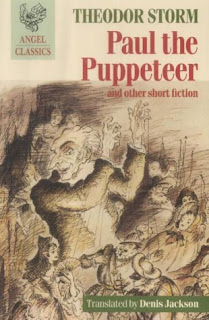
Storm, Theodor "Paul the Puppeteer"

Storm, Theodor "Paul the Puppeteer" (German: Pole Poppenspäler) - 1874

A novella by a famous German author known as one of the most important figures of German realism.

He has been compared to Thomas Hardy. I think the comparison isn't bad. Theodor Storm is certainly worth having a look at.

In this story, he tells us about a guy called Paul (Low German Pole) who is a puppeteer (you guessed it, Poppenspäler in Low German).

Of course, this was a novella we had to read in school. I enjoyed it tremendously and even after all these years, it's still vividly in my mind. Still, when I came upon my old copy when moving, I decided to read it again.

And there is no change. The book is still as good as it was when I first read it. We learn about the changing of the world, how the marionette theatre vanishes from everyday life, like so many other things that disappeared with the coming of the television. But we also hear about the life of those travelling and bringing joy to the people.

The author was born in Husum, a lovely city on the North Sea where you can still visit his house. He called it "The Grey Town by the Sea". But it's not at all grey, it has some lovely (mainly red brick) buildings and being located at the sea makes it even more attractive.

As an English translation, I only found a collection with two other books, "The Village on the Moor" and "Renate" which I haven't read. Maybe some day when I happen to find them.

From the back cover:

"Pole Poppenspäler is the nickname given to the cabinet-maker Paul Paulsen, because of his childhood enthusiasm for Herr Tendler's travelling puppet theatre and his friendship with the latter's daughter, Lisei. In later life Paul comes across Lisei in great distress while he is working as a journeyman in a town in central Germany; her father has been imprisoned on a false accusation of theft. Paul's local influence succeeds in freeing Herr Tendler and shortly afterwards he marries Lisei, taking both her and her father to his north German home, Husum. Herr Tendler is able to help Paul in his workshop for he is a wood-carver of great skill, as demonstrated by his former creation of the puppet 'Kasperle' which plays a leading part throughout the tale. His desire, however, to continue to produce puppet plays is strong, but his first attempt in the town hall is ruined by rowdy local youths. He retires deeply hurt and dies a saddened man shortly thereafter."

Friday, 23 April 2021

Book Quotes of the Week


"The classics are books that exert a peculiar influence, both when they refuse to be eradicated from the mind and when they conceal themselves in the folds of memory, camouflaging themselves as the collective or individual unconscious.
Italo Calvino "Why Read the Classics"

I couldn't have said it any better. Well, I probably couldn' have even said it that well but I agree wholeheartedly. 

"Don't worry, it only takes four chapters!" Mayersche Buchhandlung 

Heehee. Story of my life!
 

"You're in a world full of color and you want to see it in black and white." by Philip Pullman, The Secret Commonwealth

This reminds me of a cartoon where this one guy sits in the bus or tram reading. Everyone else looks into their mobile phones and is black and white. Only he is in colour. So true.

Find more book quotes here.

Thursday, 22 April 2021

Dickens, Charles "The Old Curiosity Shop"


Dickens, Charles "The Old Curiosity Shop" - 1840

When I mentioned to another blogger that I was just reading this book, he said that it "… was not one of my favorite Dickens, but that's a high bar, I still enjoyed it." Now that I just finished it, I can say that he put my thoughts into words. It's definitely not my favourite, that's still David Copperfield, but I have yet to read a book by Charles Dickens I don't enjoy.

The enjoyment of reading wasn't improved by the copy I had, an A4 sized cheap reprint (letter size in the US). Well, it couldn't be helped. It taught me to look for the size of an edition when ordering books online.

Funnily enough, this is supposed to be the most popular of Dickens' books during his lifetime. As it says on the cover, readers in New York even stormed the ship bringing the final instalment. Reminds me of Harry Potter today. Wow! This that not all tales stand the test of time equally well.

However, as with all books by Dickens, he observed his surrounding so well and could describe it so you are transformed to his world that it is definitely worth reading. Especially if you like classics. And chunky books.

I still have a few to go and I'm looking forward to getting my hands on them.

From the back cover:

"The Old Curiosity Shop is a novel by Charles Dickens. The plot follows the life of Nell Trent and her grandfather, both residents of The Old Curiosity Shop in London. The Old Curiosity Shop was one of two novels (the other being Barnaby Rudge) which Dickens published along with short stories in his weekly serial Master Humphrey's Clock, which lasted from 1840 to 1841. It was so popular that New York readers stormed the wharf when the ship bearing the final instalment arrived in 1841. The Old Curiosity Shop was printed in book form in 1841."

Tuesday, 20 April 2021

Top Ten Tuesday ~ Colourful Covers


"Top Ten Tuesday" is an original feature/weekly meme created on the blog "The Broke and the Bookish". This feature was created because they are particularly fond of lists at "The Broke and the Bookish".

It is now hosted by Jana from That Artsy Reader Girl.

Since I am just as fond of them as they are, I jump at the chance to share my lists with them! Have a look at their page, there are lots of other bloggers who share their lists here.

This week's topic is: Colourful Book Covers

We had "Book Titles That Sound Like They Could Be Crayola Crayon Colours" and we carry on with colours this week. 

What is colourful? It can be a cover with many different colours. Or one with two contrasting colours that immediately catch your eye. Or one with just one colour but that one very vibrant. Even though I don't often read books with colourful covers, I think (hope) I found examples for all of them. 


Adichie, Chimamanda Ngozi "Americanah" - 2013
Brown, Rita Mae "Loose Lips" - 1999
Dai, Sijie "Balzac and the Little Chinese Seamstress" (French: Balzac et la Petite Tailleuse Chinoise) - 2002
Fredriksson, Marianne "Hanna’s Daughters" (Swedish: Anna, Hanna og Johanna) - 1994
Gavalda, Anna "Hunting and Gathering" (French: Ensemble c’est tout) - 2006
Kingsolver, Barbara
"The Lacuna" - 2009
Lee, Min Jin "Pachinko" - 2017
MacDonald, Ann-Marie "The Way the Crow Flies" - 2003
Pamuk, Orhan "The Red-Haired Woman" (Turkish: Kırmızı Saçlı Kadın) - 2016
Stewart, Sheila "Ramlin Rose" - 1993